What is SEO? SEO, or search engine optimization, is the practice of making a website easier for search engines to find, understand, and trust, so it appears when people search for what your business actually offers. That is SEO at its simplest. The part most guides skip is that SEO is not a marketing trick you switch on. It is the process of making your business genuinely more discoverable and more credible than the alternatives a customer could pick instead.
Most articles that answer this question stop at a definition and a list of tips. This guide provides a complete, practical explanation of SEO, because a definition alone has never grown anyone’s revenue. If you run a business in a competitive market, you do not need to memorize what the acronym stands for. You need to understand what it actually does, where it fits in your growth, and why some companies get results while others spend two years and see nothing. We will also cover the parts most beginner guides leave out: how SEO differs from SEM and PPC, the main types of SEO, realistic timelines, what it costs, and honestly, what Google does not guarantee.
What is SEO, in plain business terms
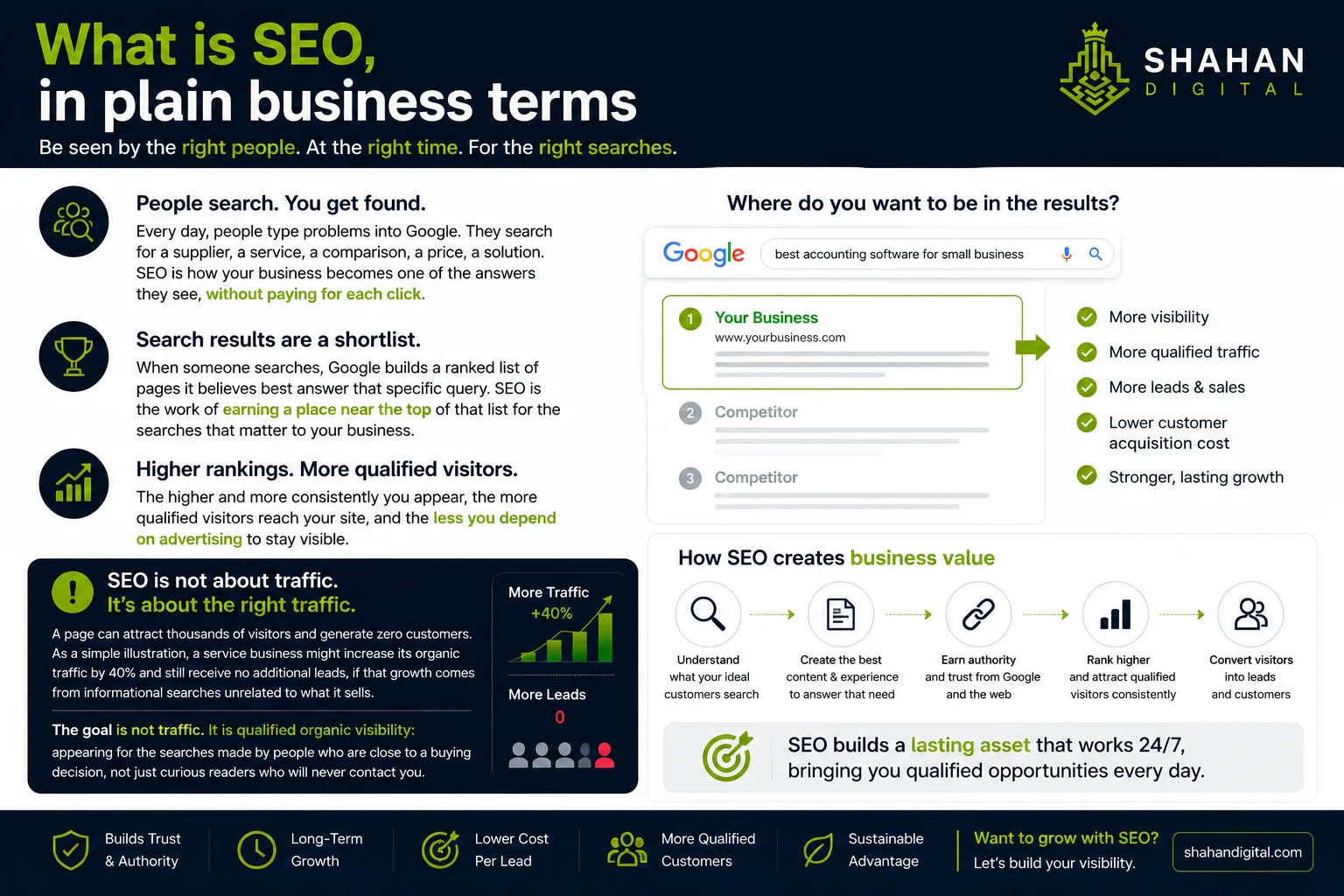
Every day, people type problems into Google. They search for a supplier, a service, a comparison, a price, a solution. SEO is how your business becomes one of the answers they see, without paying for each click.
Think of search results as a shortlist. When someone searches, Google builds a ranked list of pages it believes best answer that specific query. SEO is the work of earning a place near the top of that list for the searches that matter to your business. The higher and more consistently you appear, the more qualified visitors reach your site, and the less you depend on advertising to stay visible.
There is an important distinction here. SEO does not mean chasing traffic for its own sake. A page can attract thousands of visitors and generate zero customers. As a simple illustration, a service business might increase its organic traffic by 40% and still receive no additional leads, if that growth comes from informational searches unrelated to what it sells. The goal is not traffic. It is qualified organic visibility: appearing for the searches made by people who are close to a buying decision, not just curious readers who will never contact you.
How search engines decide what to rank
To understand what is SEO, you have to understand the problem search engines are solving. Google’s job is to return the most useful, trustworthy answer to a query in a fraction of a second. To do that at scale, it relies on three broad stages.
First, crawling. Google sends automated programs across the web to discover pages. If a search engine cannot reach your pages, nothing else matters, because a page that is never crawled can never rank.
Second, indexing. Once a page is crawled, Google tries to understand what it is about and stores it in a massive database. A page that is crawled but poorly understood will struggle to appear for the right searches.
Third, ranking. When someone searches, Google evaluates the indexed pages and orders them by how well they match the query and how trustworthy the source appears. Google’s own documentation on how Search works confirms this crawl, index, and rank sequence sits at the core of the system, and its SEO Starter Guide sets out the practices that support it.
This is why effective search optimization is never one activity. It is the work of making sure your website can be crawled, understood, and judged as credible, all at once. When those signals are disconnected, rankings stall. When they reinforce each other, visibility compounds.
The three core pillars of SEO
The answer to what is SEO in practice usually breaks into three connected areas of work. Weakness in any one of them limits the others.
Technical SEO
Technical SEO removes the structural barriers that stop search engines from crawling and understanding your site. This includes site speed, mobile usability, clean site architecture, correct indexing rules, and structured data. Technical work rarely wins rankings on its own, but poor technical foundations quietly cap everything else.
On-page and content SEO
This is the content itself: the pages, articles, and product descriptions that answer real search demand. Good content work, the kind produced through deliberate SEO content writing, matches what people are actually searching for with genuinely useful answers, structured so both readers and search engines can follow them. Content is where search intent gets met, and intent is what separates a page that ranks from a page that is merely published.
Off-page SEO and authority
Off-page SEO covers the signals that happen beyond your website, most importantly the links and mentions other credible sites give you, an area often handled through backlink profile growth. When trusted websites reference your content, they pass along a signal of credibility. This external validation is one of the strongest factors in how much authority a site earns over time.
These three pillars are not separate services to buy in isolation. They are parts of one system. A technically flawless site with thin content will not rank. Brilliant content on a broken site will not be found. Strong content on a fast site with no authority will be outranked by competitors who earned trust. Real results come from connecting all three, which is the core idea behind building lasting Search Authority rather than running disconnected tasks.
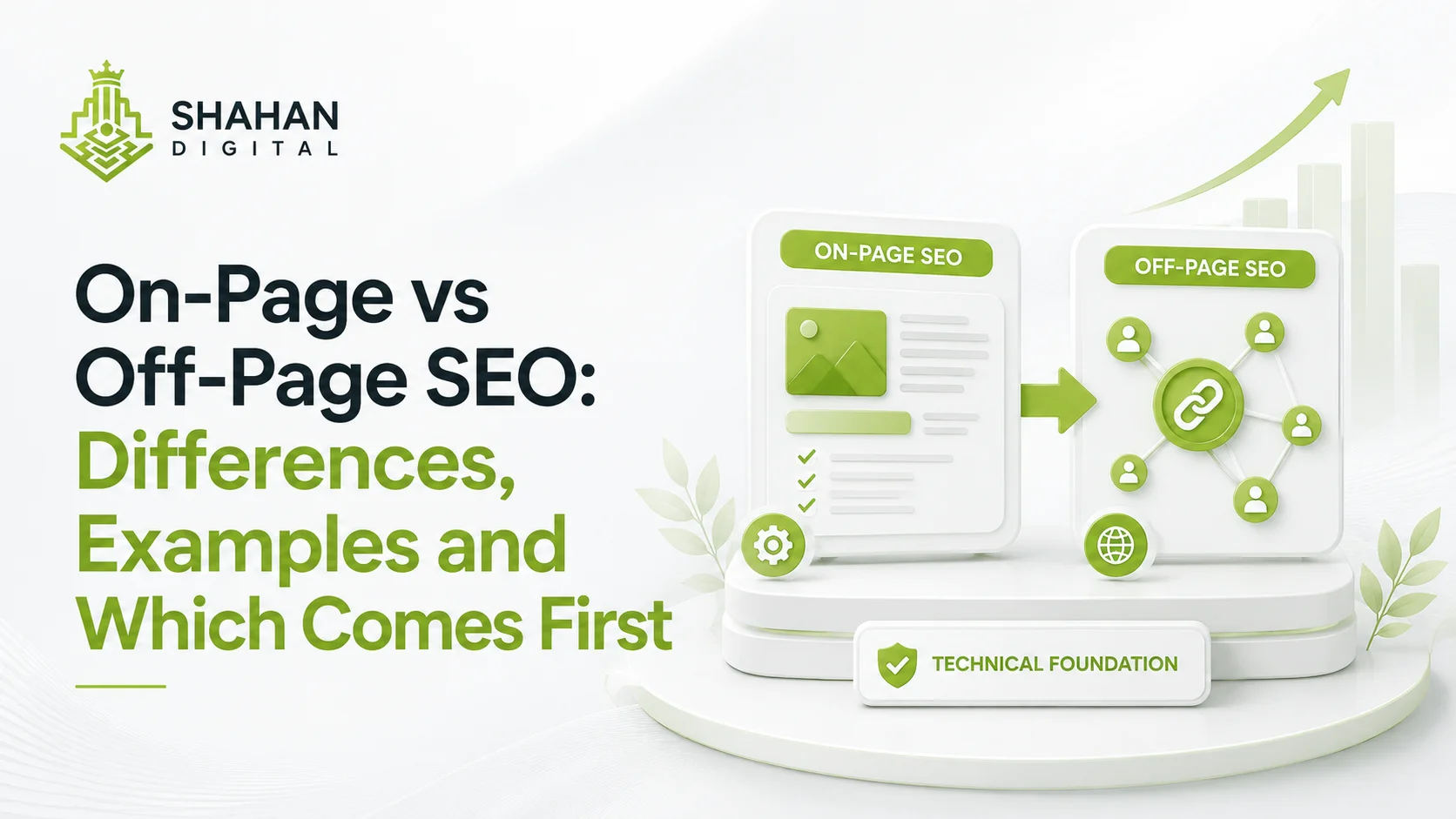
Read More : On-Page vs Off-Page SEO Differences, Examples and Which Comes First
SEO vs SEM vs PPC: clearing up the confusion
A common follow-up to what is SEO is how it differs from SEM and PPC. Beginners often mix these terms up, so it is worth separating them clearly.
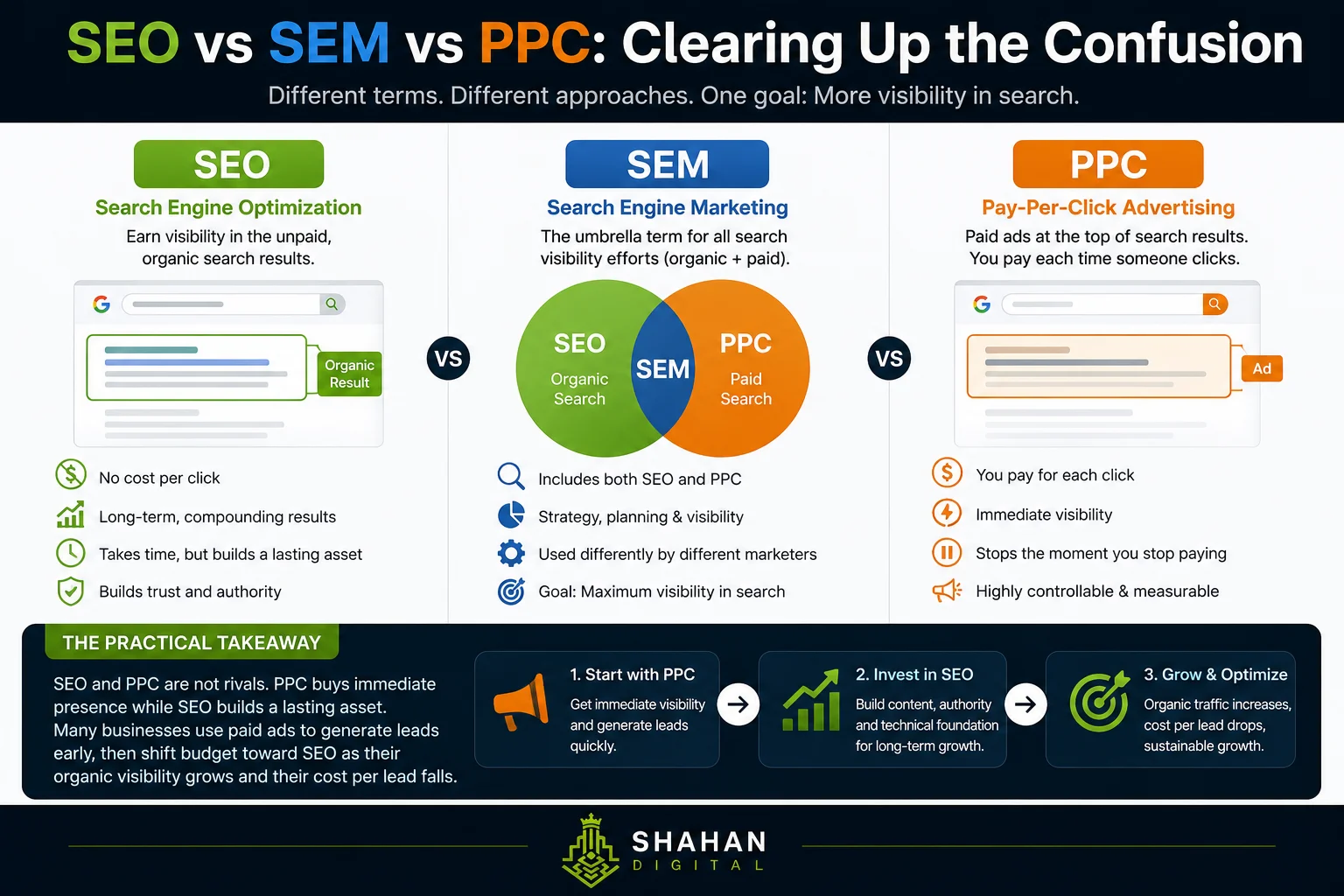
SEO earns visibility in the unpaid, organic search results. You do not pay for each click, but you invest in the content, technical work, and authority that make ranking possible.
PPC (pay-per-click) is paid advertising, where you bid to appear at the top of results and pay each time someone clicks. It delivers visibility quickly, but stops the moment you stop paying.
SEM (search engine marketing) is the umbrella term. It covers the whole effort of getting visibility in search, both organic and paid. In everyday use, many marketers say SEM when they specifically mean paid search, which adds to the confusion.
The practical takeaway: SEO and PPC are not rivals. PPC buys immediate presence while SEO builds a lasting asset. Many businesses use paid ads to generate leads early, then shift budget toward SEO as their organic visibility grows and their cost per lead falls.
SEO vs PPC vs AI search: a side-by-side comparison
Search visibility now comes from three different channels, and each behaves differently. This comparison makes the trade-offs clear.
| Factor | SEO (organic) | PPC (paid ads) | GEO / AI search |
|---|---|---|---|
| How you appear | Organic search results | Paid advertisements | AI-generated answers and citations |
| Cost per click | No direct cost per click | Paid for each click | No direct cost per click |
| Speed of results | Gradual, builds over months | Fast, almost immediate | Gradual, tied to authority |
| Longevity | Long-term asset | Stops when payment stops | Depends on credibility and citations |
| Main success metrics | Rankings, qualified traffic, leads | CPC, ROAS, conversions | Citations, mentions, AI visibility |
Most serious growth strategies do not pick one column. They combine channels according to budget, urgency, and how much long-term visibility matters to the business.
The main types of SEO
SEO is not one-size-fits-all. Different business models need different emphases. These are the most common types.
- Local SEO helps a business appear for searches tied to a place, such as a city or neighborhood. Essential for companies serving a specific region.
- E-commerce SEO focuses on product and category pages, structured data, and the technical scale of online stores.
- International SEO adapts a site for multiple countries and languages, handling search intent and structure market by market rather than through simple translation.
- Enterprise SEO manages very large websites where structure, governance, and internal linking become major challenges.
- SaaS SEO supports software companies, where educating the market and ranking for problem-based searches drives sign-ups.
- Video and image SEO optimize non-text content so it can be found in search and enrich the pages it sits on.
Most businesses need a blend. A company entering the Gulf market, for example, may combine local SEO for each target city with international SEO across Arabic and English demand.
Why SEO matters more than most owners realize
Once you understand what is SEO, it is easy to see it is not just one channel among many. In practice, it shapes how customers judge you long before they contact you.
Consider how a real buying decision happens. Someone has a problem. They search. They open a few of the top results, compare them, and form an impression of who seems competent and trustworthy. By the time they reach out to a company, they have often already decided who they take seriously. If your business is invisible during that research, you are not losing a click. You are losing the chance to be considered at all.
This is the deeper reason SEO matters. A strong company with a weak search presence is not just under-ranked. It is being quietly filtered out of decisions it could have won. Strong companies should not lose opportunities because their value is invisible.
There is also a commercial argument that advertising cannot match. Paid ads stop the moment you stop paying. SEO builds an asset. A page that ranks well can generate qualified visitors for months or years, which lowers your long-term cost of acquiring customers and reduces dependence on ad budgets that only rise over time.
A practical example: how SEO turns a search into a customer
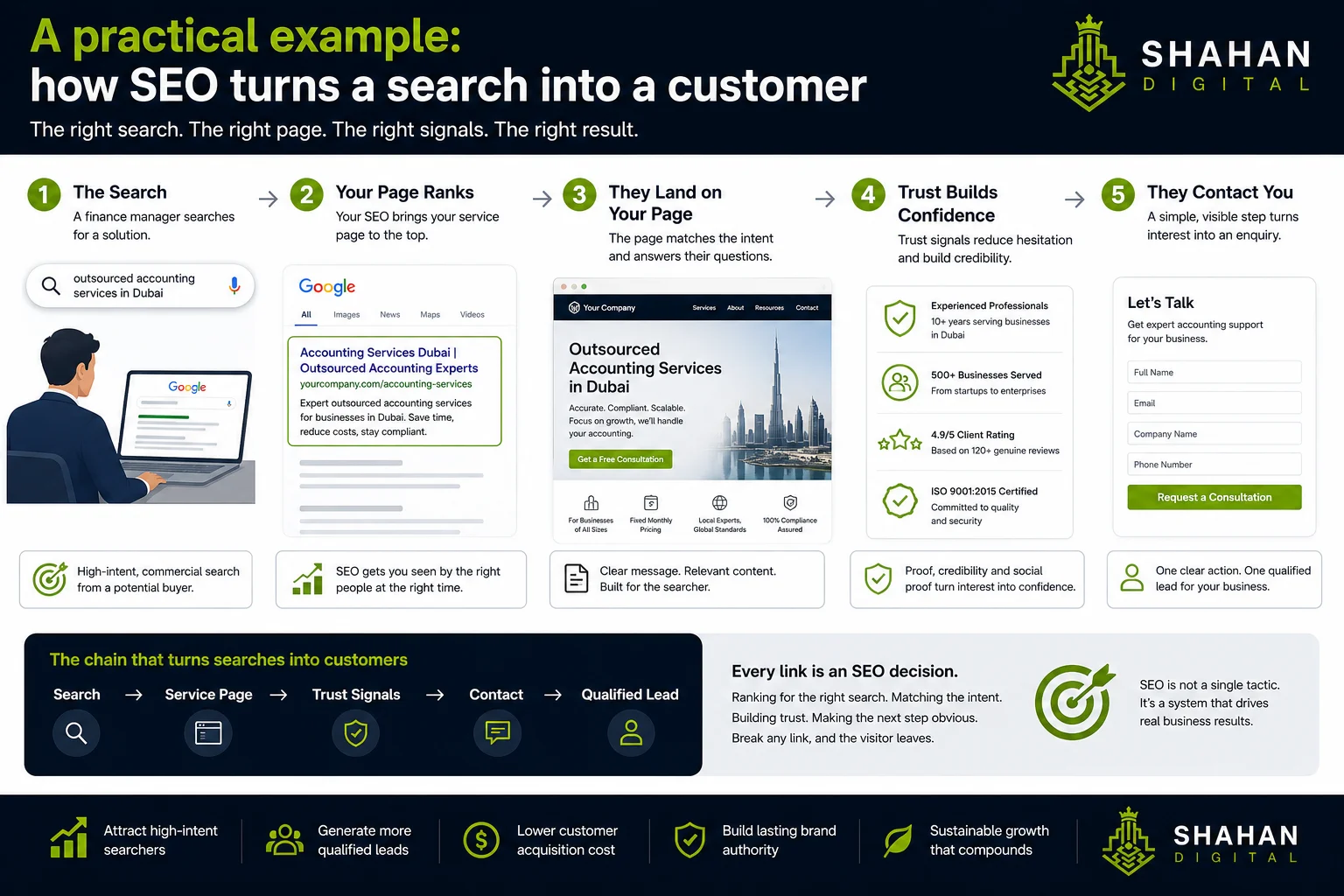
The answer to what is SEO becomes clearer with a concrete path. Imagine a B2B company that provides accounting services to businesses in Dubai.
A finance manager searches for “outsourced accounting services in Dubai.” That is a high-intent, commercial search. If the company has done its SEO well, its service page appears among the top results. The manager clicks through and finds a page that clearly explains the service, who it is for, and how it works. Trust signals on the page, such as clear company information, credentials, and genuine reviews, reduce hesitation. A simple, visible contact option turns interest into an enquiry. That enquiry is a qualified lead, because it came from someone actively looking for exactly this service.
Follow the chain: search → service page → trust signals → contact → qualified lead. Every link in that chain is an SEO decision. Ranking for the right search, matching the intent, building trust on the page, and making the next step obvious. Break any link and the visitor leaves. This is why search optimization is a system, not a single tactic.
How much does SEO cost?
There is no fixed price, because SEO scales with competition, the state of your site, and how much work the market demands. But the pricing models are consistent, and understanding them helps you judge a quote.
- Monthly retainer. The most common model for ongoing SEO. You pay a set fee each month for continuous strategy, content, technical work, and reporting. Suited to businesses that want sustained growth.
- Project-based. A fixed fee for a defined piece of work, such as a technical audit, a migration, or a specific set of pages. Useful for one-off needs.
- Hourly consulting. You pay for expert time and guidance, then implement the work yourself or with your own team.
- In-house SEO. Hiring your own specialists. This becomes more cost-effective once your SEO workload is large and consistent enough to keep a full-time team busy.
Actual figures vary widely by country, competition, and scope, but the ranges below give a realistic sense of monthly investment for ongoing SEO.
| SEO engagement | Typical monthly investment |
|---|---|
| Small local business | $500–$1,500 |
| Competitive SME | $1,500–$5,000 |
| International campaign | $3,000–$10,000+ |
| Enterprise SEO | Custom pricing |
These are approximate industry ranges, not a quote. Pricing shifts with your market, how competitive your keywords are, the condition of your site, and how much work the scope demands. A local business in a low-competition niche sits at the bottom of the range; a company competing across multiple countries and languages sits well above it.
Whatever the model, be cautious of anyone selling SEO purely on price or promising guaranteed rankings for a flat fee. The value is in the strategy and implementation, not the invoice.
How long does SEO take? A realistic timeline
A big part of what is SEO in practice is patience: it is a compounding investment, so results build in stages rather than arriving all at once. The timeline below is a general pattern, not a guarantee, and it shifts with competition and the starting condition of the site.
| Stage | Typical focus | What tends to happen |
|---|---|---|
| Month 1 | Audit and technical fixes | Foundations corrected so the site can be crawled and indexed properly |
| Months 2–3 | Indexation and relevance | More pages understood correctly; early ranking movement on lower-competition terms |
| Months 3–6 | Impressions and rankings | Visibility grows as content and structure mature |
| Month 6 onward | Authority and conversion | Compounding growth in qualified traffic, with focus shifting to leads and revenue |
Anyone promising top rankings in days is either misinformed or dishonest. Meaningful, durable results take months.
How AI search is changing SEO
For two decades, SEO meant ranking in Google’s blue links. That is still central, but it is no longer the whole picture. People now get answers from AI-powered search: Google’s AI Overviews, ChatGPT, Gemini, and Perplexity increasingly summarize information and cite sources directly.
This shift has created a related discipline, sometimes called GEO, or generative engine optimization, which focuses on whether AI systems can find, understand, and cite your brand as a trusted source. The underlying foundations overlap heavily with strong SEO: clear content, credible authority, and unambiguous signals about who you are and what you do. A business that has built genuine search authority, often with dedicated AI optimization consulting, is far better positioned to appear in AI-generated answers than one that has not. SEO is not being replaced by AI search. It is becoming the foundation that AI visibility is built on.
What Google does not guarantee
Understanding what is SEO also means understanding its limits. This is the honest boundary that separates credible SEO from empty promises. It is worth stating plainly.
SEO improves the conditions required for visibility, but it cannot guarantee indexing, rankings, traffic, or revenue. No provider controls Google’s results.
This is not a disclaimer to bury in small print. It aligns directly with Google’s own guidance, which warns against anyone promising guaranteed rankings. What good SEO can do is strengthen the technical, content, and authority signals that influence results. The outcome is better positioning of those signals over time, not a fixed place on the page. Any provider who guarantees a specific ranking is making a promise they cannot keep.
What effective SEO looks like in practice
If you strip away the jargon, effective SEO follows a logical order. Rushing or skipping steps is where most campaigns quietly fail.
- Understand demand. Identify what your potential customers actually search for, and the intent behind each search.
- Fix the foundation. Make sure the site can be crawled, indexed, and loaded quickly on any device.
- Build the right content. Create pages that meet real search intent and answer questions better than the current top results.
- Structure it clearly. Organize pages and internal links so both users and search engines understand how topics relate.
- Earn authority. Develop credible external references and consistent brand signals across the web.
- Measure what matters. Track rankings, qualified organic traffic, and conversions, not vanity numbers.
Done properly, these steps reinforce each other. That compounding effect is the whole point: early work makes later work more effective, and visibility grows into a durable business asset rather than a temporary spike.
How to measure SEO performance
Traffic alone is a misleading measure. A serious view of performance looks at a connected picture, best understood as a funnel: visibility leads to qualified traffic, qualified traffic leads to leads, and leads lead to revenue.
Measuring what is SEO doing for your business comes down to three questions, asked in order. Are you ranking for commercially relevant searches? Is qualified organic traffic increasing? Is that traffic turning into leads or sales? Honest reporting matters here more than impressive-looking charts. Organic clicks rising while conversions stay flat is not success; it is a signal to improve the pages receiving that traffic. Value is measured where visibility meets revenue, not at the top of a traffic graph.
What is SEO: frequently asked questions
What is SEO in simple words?
SEO is the process of improving a website so it appears higher in search results when people look for what your business offers. It works by making your site easier for search engines to find, understand, and trust, which brings in visitors without paying for each click.
What is SEO and how does it work?
SEO works by aligning your website with how search engines crawl, index, and rank pages. That means a solid technical foundation, content that genuinely answers what people search for, and external authority from credible sites linking to you. When these signals reinforce each other, your pages become more visible for relevant searches.
What is the difference between SEO and PPC?
SEO earns visibility in the unpaid organic results and builds a long-term asset, while PPC is paid advertising that puts you at the top immediately but stops the moment you stop paying. Many businesses use both: PPC for fast results and SEO for durable, lower-cost visibility over time.
How long does SEO take to show results?
For most businesses, meaningful results take several months rather than weeks. The exact timeline depends on competition, the current state of the site, and how consistently the work is done. SEO is a compounding investment, so early progress is often slow before it accelerates.
Is SEO still worth it in the age of AI search?
Yes, and arguably more than before. AI-powered search tools still rely on finding, understanding, and trusting credible sources. The same foundations that make a site rank well in Google also make it more likely to be cited in AI-generated answers, so strong SEO now supports visibility across both traditional and AI search.
Can I do SEO myself or do I need an agency?
You can learn and apply the basics yourself, especially content and on-page work. Technical SEO, competitive markets, and international or multilingual strategy tend to need specialized experience, because small mistakes there can hold back everything else. Many businesses start alone and bring in expertise once the stakes get higher.
What is SEO worth to your business: where to go next
If you take one idea from this guide about what is SEO, let it be this: it is not a set of isolated tricks. It is the work of making your business genuinely discoverable, understandable, and trustworthy in search, so the right customers can find and choose you. That is what separates companies that grow through search from those that keep paying for every visitor.
The first practical step is rarely publishing more content. It is understanding which searches actually matter to your business, and honestly assessing whether your site can currently compete for them. That clarity is where real SEO strategy begins. If you want a grounded view of where your search visibility stands today, the team at Shahan Digital can help you assess it, or you can explore the full range of SEO services built around this connected approach.
Written by

Shahan Behkamrad
Author · Founder of Shahan Digital · SEO & GEO Strategist
Entrepreneur · Founder of Shahan Digital · SEO, GEO & Digital Growth Strategist
Shahan Behkamrad is the founder of Shahan Digital and the author of this article.
His published work explores English SEO, Arabic SEO, and Persian SEO, international and multilingual search, technical SEO, website architecture, content strategy, search-intent analysis, digital marketing, Generative Engine Optimization, AI-search visibility, and content optimization for emerging answer-driven platforms.
Through his articles, podcasts, and educational publications, he presents complex topics in a clear and practical format for entrepreneurs, business owners, executives, and marketing professionals.
The views and analysis presented in this article are provided in Shahan Behkamrad’s capacity as its author.
View Shahan Behkamrad’s full author profile and published work →
Official Links
About US Company · LinkedIn · YouTube · Spotify · Apple Podcasts · Instagram · Crunchbase · Shahan Digital on LinkedIn
Editorial and Legal Notice
This article and any related audio or video materials are published solely for educational and general informational purposes.
The content does not constitute legal, financial, investment, technical, or individualized digital marketing advice. Reading, viewing, or listening to this content does not create a consulting, agency, advisory, fiduciary, contractual, or other professional relationship with Shahan Behkamrad or Shahan Digital.
Any examples, observations, strategies, or opinions presented in this content should be evaluated according to the specific circumstances, objectives, market conditions, resources, and legal requirements of each business.
SEO, GEO, digital marketing, traffic, lead-generation, conversion, and revenue outcomes may vary. No specific ranking, traffic level, number of leads, conversion rate, commercial result, or revenue outcome is promised or guaranteed.
All company names, platform names, products, and trademarks mentioned in this content remain the property of their respective owners. References to third-party platforms do not imply sponsorship, endorsement, partnership, or affiliation unless expressly stated.