On-page vs off-page SEO is the difference between the optimization you control directly on your own website and the reputation you earn everywhere else on the web. On-page SEO is everything you do to your pages, your content, structure, and technical setup, so search engines understand them. Off-page SEO is everything that happens beyond your site, mainly the links, mentions, and signals of trust other sources give you. You need both. One without the other is a car with an engine but no wheels. If you are still new to the basics, our guide on what SEO is and how it works sets the foundation this article builds on.
Most guides on on-page vs off-page SEO define the two terms and stop. This one shows how they actually work together, which one to prioritize first, and why treating them as separate checklists is the mistake that keeps many businesses stuck on page two. If you have ever wondered why a beautifully written page still does not rank, or why a site with strong backlinks underperforms, the answer usually lives in the balance between these two sides.
On-page vs off-page SEO: the core difference
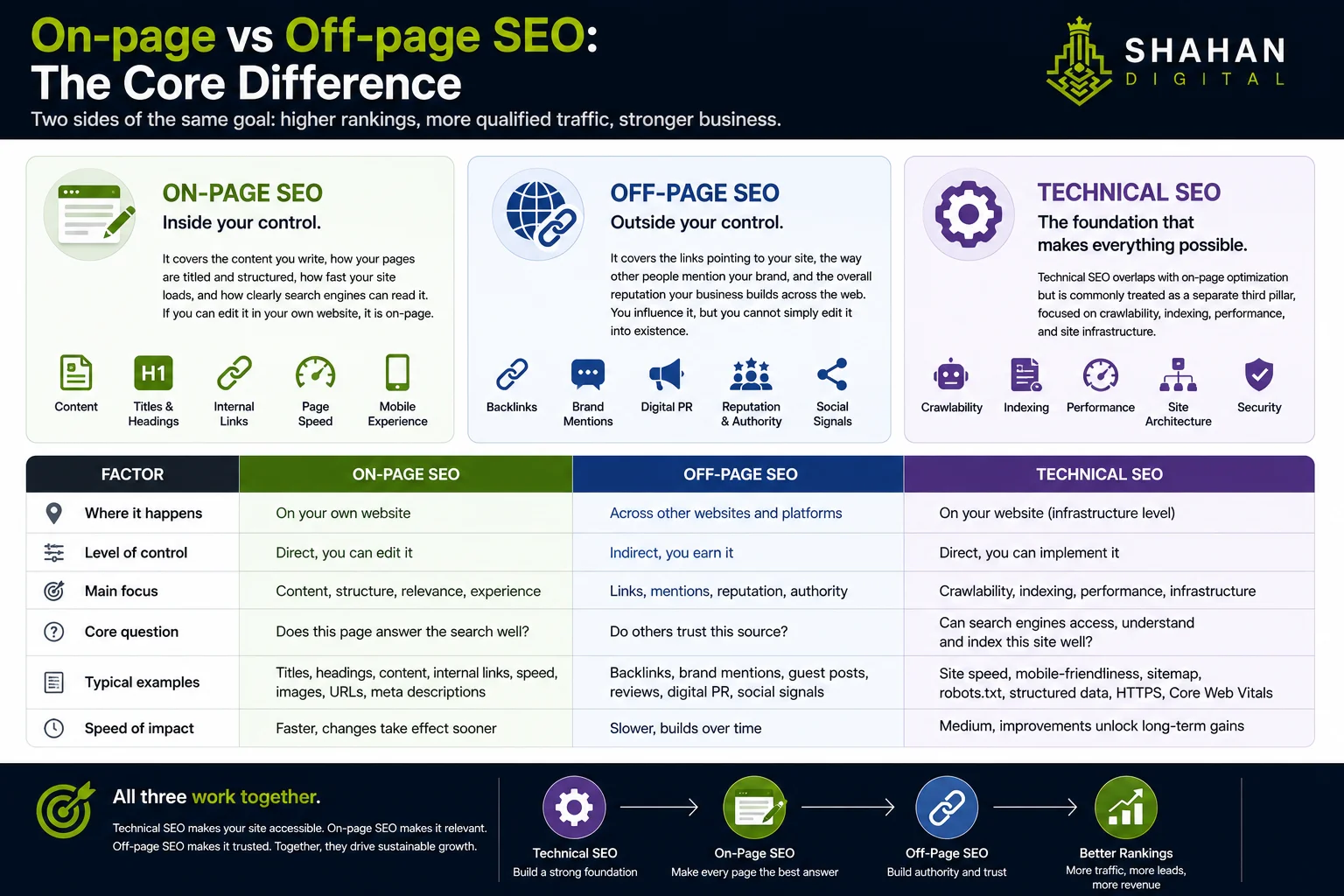
The simplest way to hold the two sides of on-page vs off-page SEO apart is by asking one question: is this something I change on my own website, or something I earn from the outside world?
On-page SEO is inside your control. It covers the content you write, how your pages are titled and structured, how fast your site loads, and how clearly search engines can read it. If you can edit it in your own website, it is on-page.
Off-page SEO happens outside your control. It covers the links pointing to your site, the way other people mention your brand, and the overall reputation your business builds across the web. You influence it, but you cannot simply edit it into existence.
There is also a third category worth naming, because it is often confused with the other two: technical SEO. Technical SEO overlaps with on-page optimization but is commonly treated as a separate third pillar, focused on crawlability, indexing, performance, and site infrastructure. What matters is not the label but recognizing that all three reinforce each other.
| Factor | On-page SEO | Off-page SEO |
|---|---|---|
| Where it happens | On your own website | Across other websites and platforms |
| Level of control | Direct, you can edit it | Indirect, you earn it |
| Main focus | Content, structure, relevance, experience | Links, mentions, reputation, authority |
| Core question | Does this page answer the search well? | Do others trust this source? |
| Typical examples | Titles, headings, content, internal links, speed | Backlinks, brand mentions, digital PR |
| Speed of impact | Faster, changes take effect sooner | Slower, builds over time |
On-page vs off-page SEO: what on-page includes
On-page SEO is where most businesses should start, because it is entirely within reach and nothing off-page works well without it. These are the elements that matter most.
Content that matches search intent
The single most important on-page factor is whether your content genuinely answers what the searcher wanted. A page targeting “best accounting software” must satisfy someone comparing options, not someone looking to hire an accountant. Matching intent is not a technicality. It is the foundation everything else sits on, because Google’s whole purpose is to serve the result that best answers the query.
Title tags and meta descriptions
Your title tag tells both search engines and users what a page is about, and it is one of the first things Google reads. A clear, relevant title that includes the term people search for helps your page qualify for the right results, and Google’s guidance on title links explains how it generates the clickable title in results. The meta description is not a direct ranking factor, but a clear and persuasive description can make the search snippet more useful and encourage qualified users to click. Google may also generate its own snippet from page content, so it will not always use what you write.
Headings and content structure
Well-organized headings help readers scan and help search engines understand how a page is organized. A logical structure, one main H1 followed by descriptive H2s and H3s, makes content easier to follow for people and machines alike.
Internal linking
Internal links connect your pages to each other, passing context and authority between them and helping search engines discover and understand your site. Strong internal linking is one of the most underused on-page tactics. It is also the bridge between on-page and off-page, because the authority you earn from external links flows through your internal links to the pages that need it most.
Technical and experience factors
Page speed, mobile usability, clean URLs, and image optimization support user experience and whether visitors stay, while structured data can help search engines understand eligible page elements and display enhanced search features. These sit at the technical end of on-page work. A page can be perfectly written and still fail if it loads slowly or breaks on a phone. This is the domain of technical SEO, where small infrastructure problems quietly limit everything else.
On-page vs off-page SEO: what off-page includes
Off-page SEO is about building your site’s reputation in the wider web. If on-page is what you say about yourself, off-page is what everyone else says about you. Search engines can use these external signals as additional evidence that a source is recognized and trusted beyond its own website, which is harder to manufacture than on-page changes.
Backlinks: the core of off-page SEO
A backlink is a link from another website to yours. Search engines treat these as votes of confidence: when a credible site links to you, it signals that your content is worth referencing. Not all backlinks are equal, though. A single link from a respected, relevant site is typically worth far more than dozens from low-quality or unrelated pages. Relevant links from credible sources are generally more valuable than large numbers of low-quality or unrelated links. Building this kind of profile deliberately is the work behind backlink profile growth.
Brand mentions and signals
Your brand is also mentioned across the web, sometimes without a link. Consistent brand mentions can strengthen your wider digital reputation and make your business easier for users and search systems to recognize, although an unlinked mention should not be treated as equivalent to a backlink. This is part of why building a recognizable brand and building search authority have started to overlap.
Digital PR and relationship-based links
The most durable off-page results come from genuine relationships and newsworthy content: original research, expert commentary, useful tools, or stories that other sites want to reference. Digital PR earns links because the content deserves them, which is exactly the kind of link that holds its value over time. This modern approach has largely replaced the older, riskier tactics of buying or mass-producing links.
What to avoid
Because off-page signals are powerful, they attract shortcuts, and most of those shortcuts are dangerous. Buying links in bulk, participating in link schemes, or spamming low-quality directories can trigger penalties that undo months of work. Google’s spam policies are explicit about link-based manipulation. Safe, effective off-page SEO is slower, but it does not blow up in your face.
Why you cannot choose one over the other
Here is the mistake that keeps businesses stuck: treating on-page vs off-page SEO as an either/or decision. They are not competing strategies. They are two halves of the same system, and each one has a ceiling without the other.
Picture two sites. The first has brilliant, perfectly optimized content but almost no external authority. It answers questions well, yet in competitive searches it gets outranked by weaker content on more trusted domains. Content improvements alone may not be enough when a site lacks the external authority required to compete in a difficult market. The second has powerful backlinks pointing at thin, poorly structured pages. The authority is there, but visitors arrive, find little of value, and leave, and the pages never satisfy the search well enough to hold their position.
Neither wins. On-page without off-page lacks authority. Off-page without on-page lacks substance. Rankings come from the combination: content strong enough to deserve attention, backed by authority strong enough to earn visibility. This is the core idea behind building connected Search Authority rather than chasing isolated tactics.
On-page vs off-page SEO: which comes first?
If both matter, where do you start? For almost every business, the answer is on-page first, and the logic is practical rather than ideological.
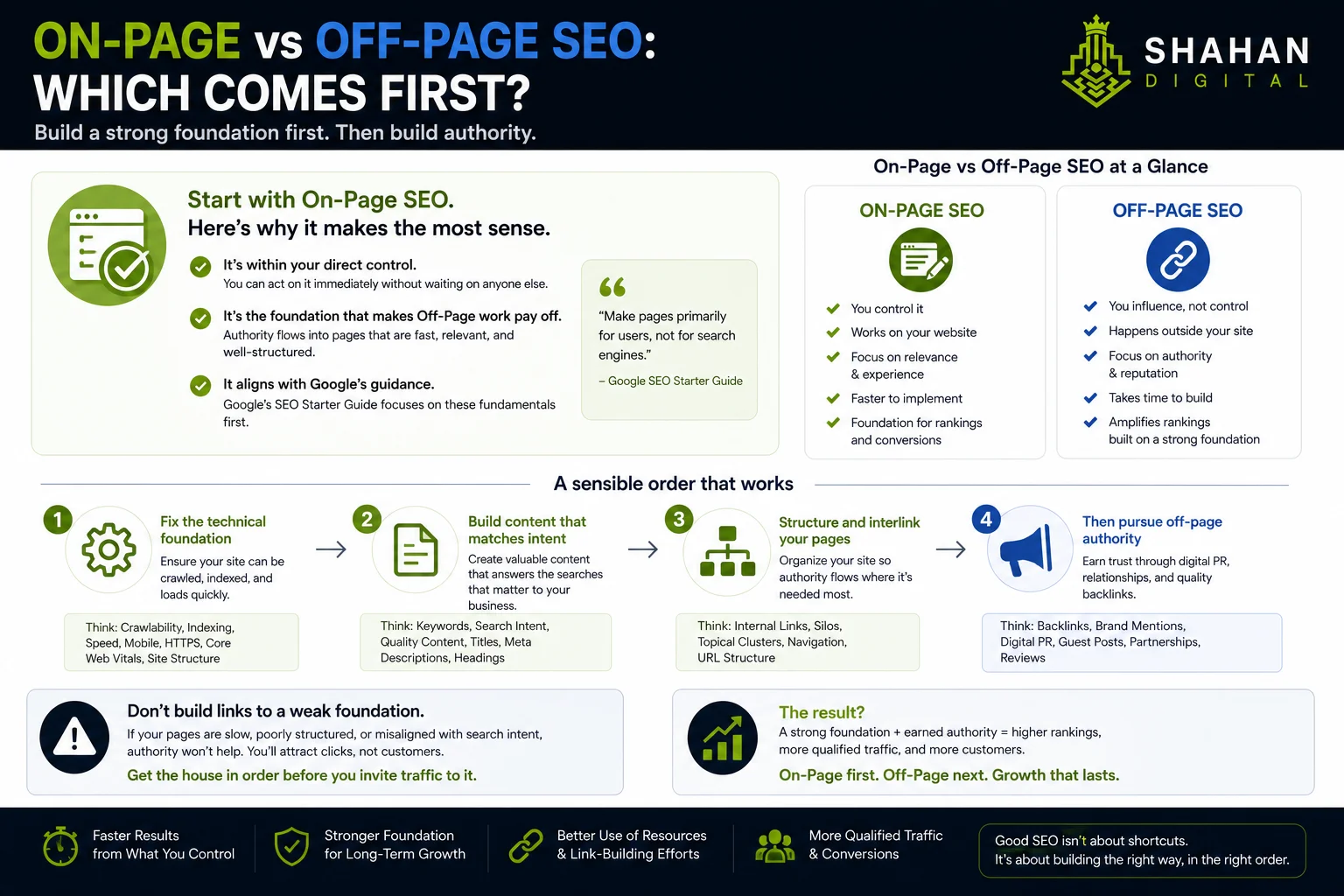
On-page SEO is within your direct control, so you can act on it immediately without waiting on anyone else. Google’s SEO Starter Guide is a practical reference for this foundational work. It is also the foundation that makes off-page work pay off. There is little point attracting authoritative backlinks to pages that are slow, poorly structured, or misaligned with search intent, because that authority flows into pages that cannot convert it into rankings or customers.
A sensible order looks like this:
- Fix the technical foundation so pages can be crawled, indexed, and loaded quickly.
- Build content that matches intent for the searches that matter to your business.
- Structure and interlink your pages so authority can flow where it is needed.
- Then pursue off-page authority through digital PR, relationships, and quality backlinks.
Get the house in order before you invite traffic to it. Off-page effort applied too early is often wasted.
A practical scenario: authority flowing to the wrong pages
The on-page vs off-page SEO relationship becomes obvious the moment it breaks. Picture a multilingual site that has earned a respectable set of backlinks, yet its rankings for commercial searches stay flat. The problem is not a lack of off-page authority. It is that the internal structure funnels almost all of that authority into a handful of informational blog posts, while the pages meant to attract customers, the service pages, sit almost disconnected from it.
The fix is entirely on-page: restructuring the internal links so that the authority earned from external sources actually reaches the commercially important pages. Nothing changes about the backlinks themselves. The off-page signals are already there. They simply have nowhere useful to go. Once the on-page structure guides them correctly, the right pages can start to move. It is a clean example of why these two sides only work as a pair.
How on-page and off-page SEO work in AI search
As search expands into AI-generated answers from tools like Google’s AI Overviews, ChatGPT, and Perplexity, the on-page vs off-page SEO distinction does not disappear. AI search systems need content that can be clearly accessed and understood, which is on-page clarity, and they draw on wider signals of recognition and trust, which is off-page reputation. For Google’s AI features specifically, the same foundational technical and people-first SEO practices used for traditional Search remain relevant, so no separate optimization is required.
In other words, the same two forces that support traditional visibility, clear content and genuine authority, also help position your brand as a recognizable, citable source. That combination travels across both worlds, and businesses investing in the balance now are better positioned for search however it evolves.
How to audit your on-page vs off-page SEO balance
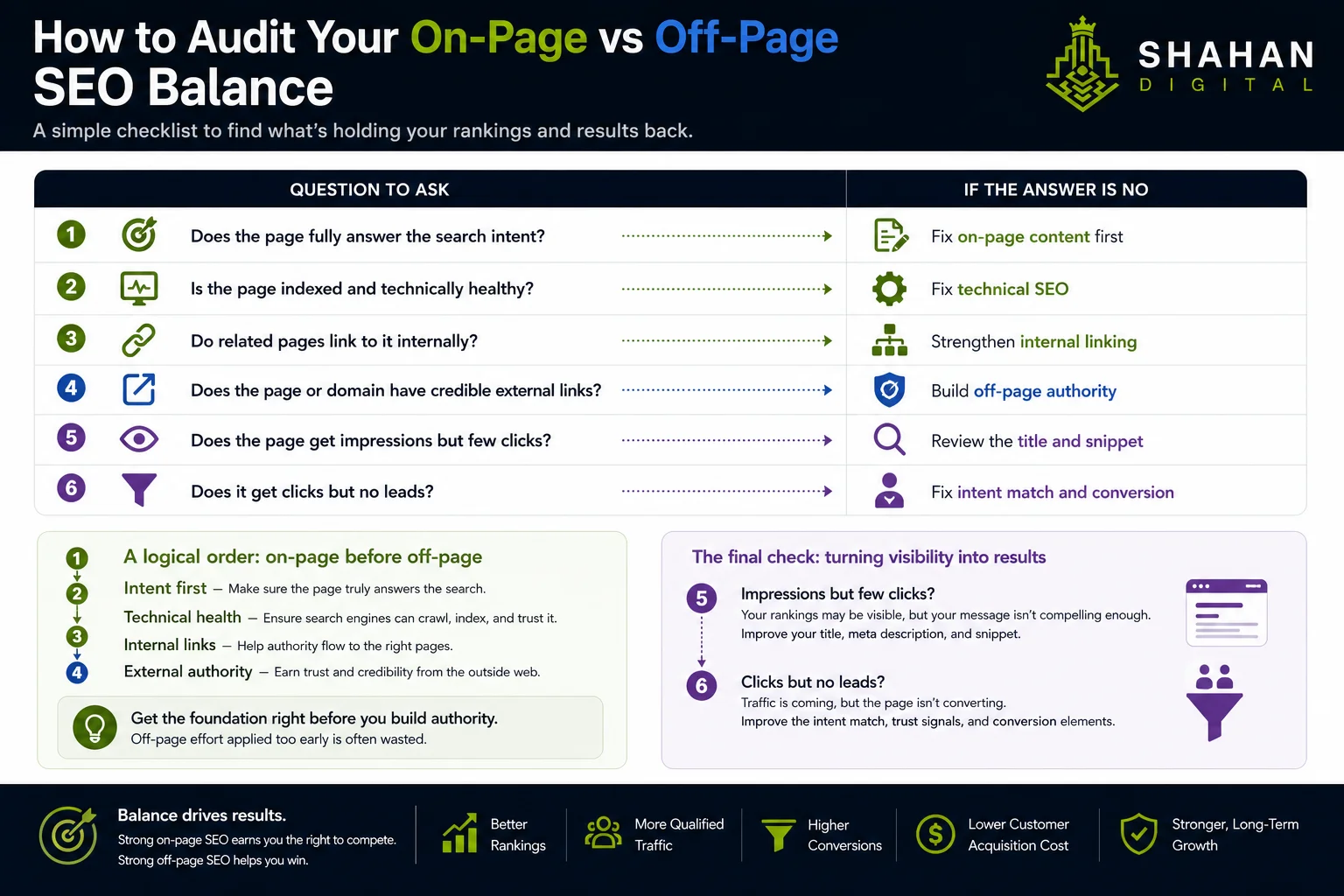
You do not need expensive tools to find where your balance is off. Work down this checklist honestly, and the failing answer tells you which side to fix next.
| Question to ask | If the answer is no |
|---|---|
| Does the page fully answer the search intent? | Fix on-page content first |
| Is the page indexed and technically healthy? | Fix technical SEO |
| Do related pages link to it internally? | Strengthen internal linking |
| Does the page or domain have credible external links? | Build off-page authority |
| Does the page get impressions but few clicks? | Review the title and snippet |
| Does it get clicks but no leads? | Fix intent match and conversion |
Notice how the first four questions move in order: intent, then technical health, then internal links, then external authority. That is the same on-page-before-off-page logic applied as a diagnostic. The last two questions catch the pages that rank but still fail to turn visibility into organic traffic and revenue.
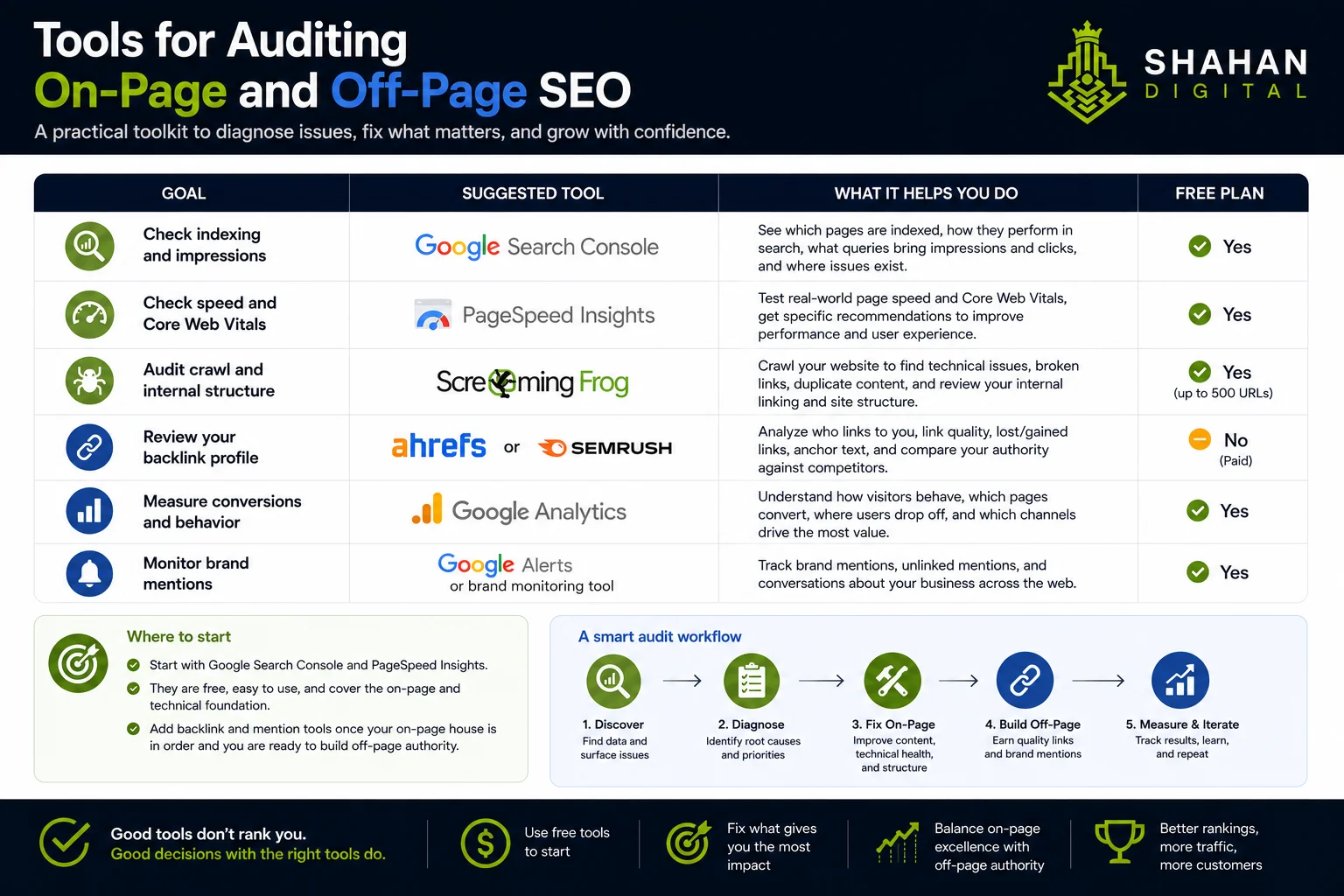
Tools for auditing on-page and off-page SEO
You do not need a large budget to run the checklist above. A handful of well-known tools, several of them free, cover most of what you need to diagnose both sides.
| Goal | Suggested tool |
|---|---|
| Check indexing and impressions | Google Search Console |
| Check speed and Core Web Vitals | PageSpeed Insights |
| Audit crawl and internal structure | Screaming Frog |
| Review your backlink profile | Ahrefs or Semrush |
| Measure conversions and behavior | Google Analytics |
| Monitor brand mentions | Google Alerts or a brand monitoring tool |
Start with Google Search Console and PageSpeed Insights, since they are free and cover the on-page and technical foundation. Add backlink and mention tools once your on-page house is in order and you are ready to build off-page authority.
On-page vs off-page SEO: frequently asked questions
What is the difference between on-page and off-page SEO?
On-page SEO is the optimization you do on your own website, such as content, titles, structure, internal links, and speed. Off-page SEO is the reputation you earn elsewhere, mainly through backlinks and brand mentions from other sites. On-page is what you control directly; off-page is what you earn from the wider web.
Which is more important, on-page or off-page SEO?
Neither works well alone. On-page gives search engines something worth ranking, and off-page gives them a reason to trust it. For most businesses, on-page comes first because it is within your control and it is the foundation that makes off-page effort pay off, but lasting results need both.
Is technical SEO part of on-page SEO?
Technical SEO happens on your own site, so it overlaps closely with on-page optimization. It covers infrastructure like crawlability, indexing, site speed, and structured data. Many modern guides treat it as a separate third pillar alongside on-page and off-page, but the important point is that it supports everything else you do on your site.
How long does off-page SEO take to work?
Off-page SEO is slower than on-page because you are earning trust rather than editing a page. Building a genuine backlink profile and brand reputation typically takes months. Manipulative or artificial link building can violate search engine spam policies, regardless of how quickly or slowly the links are acquired.
Can I do SEO with only on-page optimization?
You can improve significantly with on-page work alone, especially in lower-competition markets, because strong content and structure go a long way. But in competitive searches, you will eventually hit a ceiling without off-page authority, since trusted sites will outrank equally good content that lacks external credibility.
Bringing on-page and off-page SEO together
The takeaway is simple. On-page vs off-page SEO is not a choice between rival strategies. They are two halves of one system: content and structure you control, and authority and reputation you earn. Strong pages give search engines something worth ranking. Genuine authority gives them a reason to rank it. Remove either half and the other underperforms.
The practical path is to build your on-page foundation first, then earn off-page authority that flows into it. If you want a clear view of where your own balance stands, whether your pages are strong enough to deserve authority, or whether authority you have earned is reaching the right pages, the team at Shahan Digital can help you assess it, or explore the full range of SEO services built around this connected approach.
Written by

Shahan Behkamrad
Author · Founder of Shahan Digital · SEO & GEO Strategist
Entrepreneur · Founder of Shahan Digital · SEO, GEO & Digital Growth Strategist
Shahan Behkamrad is the founder of Shahan Digital and the author of this article.
His published work explores English SEO, Arabic SEO, and Persian SEO, international and multilingual search, technical SEO, website architecture, content strategy, search-intent analysis, digital marketing, Generative Engine Optimization, AI-search visibility, and content optimization for emerging answer-driven platforms.
Through his articles, podcasts, and educational publications, he presents complex topics in a clear and practical format for entrepreneurs, business owners, executives, and marketing professionals.
The views and analysis presented in this article are provided in Shahan Behkamrad’s capacity as its author.
View Shahan Behkamrad’s full author profile and published work →
Official Links
About US Company · LinkedIn · YouTube · Spotify · Apple Podcasts · Instagram · Crunchbase · Shahan Digital on LinkedIn
Editorial and Legal Notice
This article and any related audio or video materials are published solely for educational and general informational purposes.
The content does not constitute legal, financial, investment, technical, or individualized digital marketing advice. Reading, viewing, or listening to this content does not create a consulting, agency, advisory, fiduciary, contractual, or other professional relationship with Shahan Behkamrad or Shahan Digital.
Any examples, observations, strategies, or opinions presented in this content should be evaluated according to the specific circumstances, objectives, market conditions, resources, and legal requirements of each business.
SEO, GEO, digital marketing, traffic, lead-generation, conversion, and revenue outcomes may vary. No specific ranking, traffic level, number of leads, conversion rate, commercial result, or revenue outcome is promised or guaranteed.
All company names, platform names, products, and trademarks mentioned in this content remain the property of their respective owners. References to third-party platforms do not imply sponsorship, endorsement, partnership, or affiliation unless expressly stated.