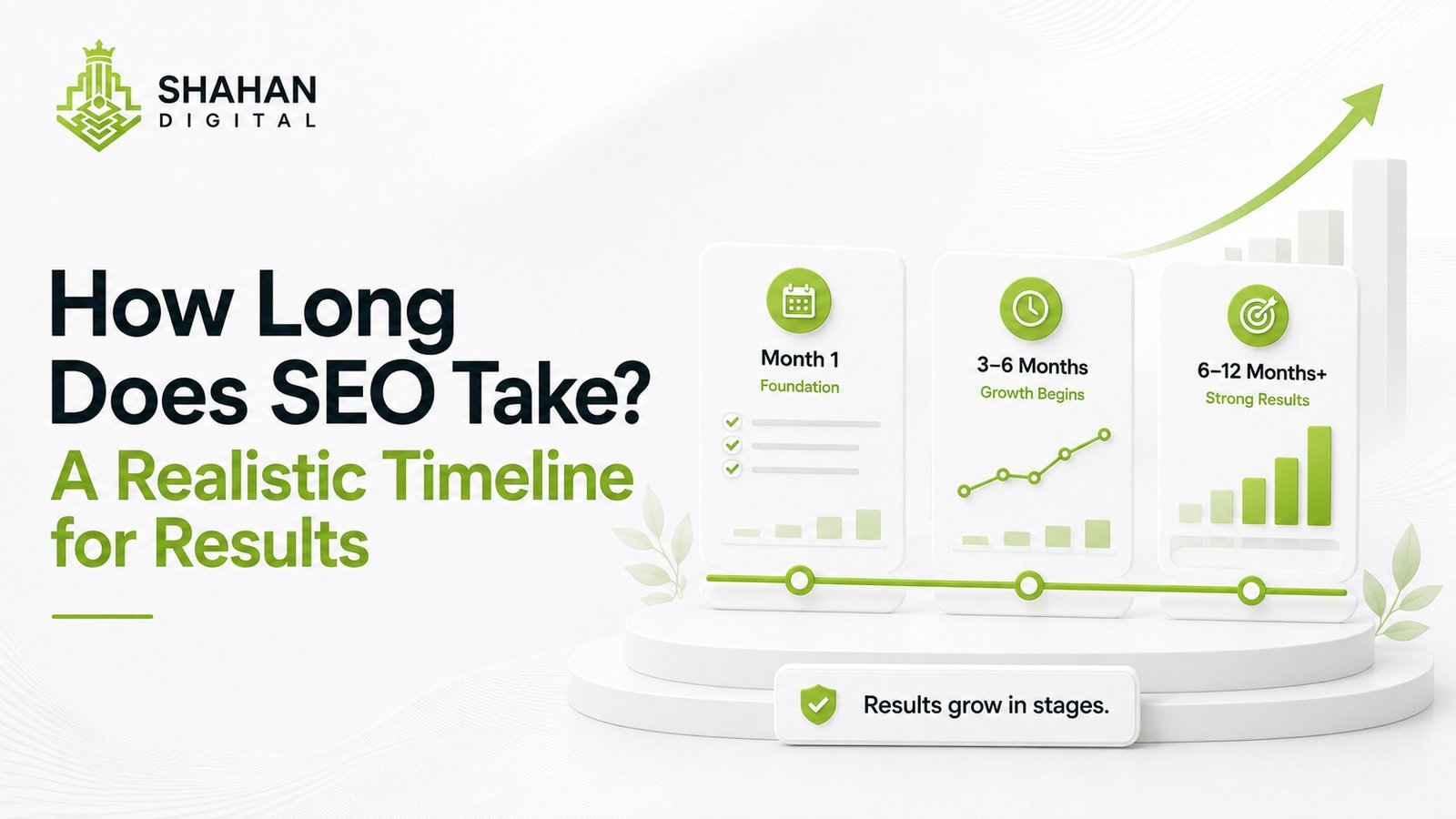
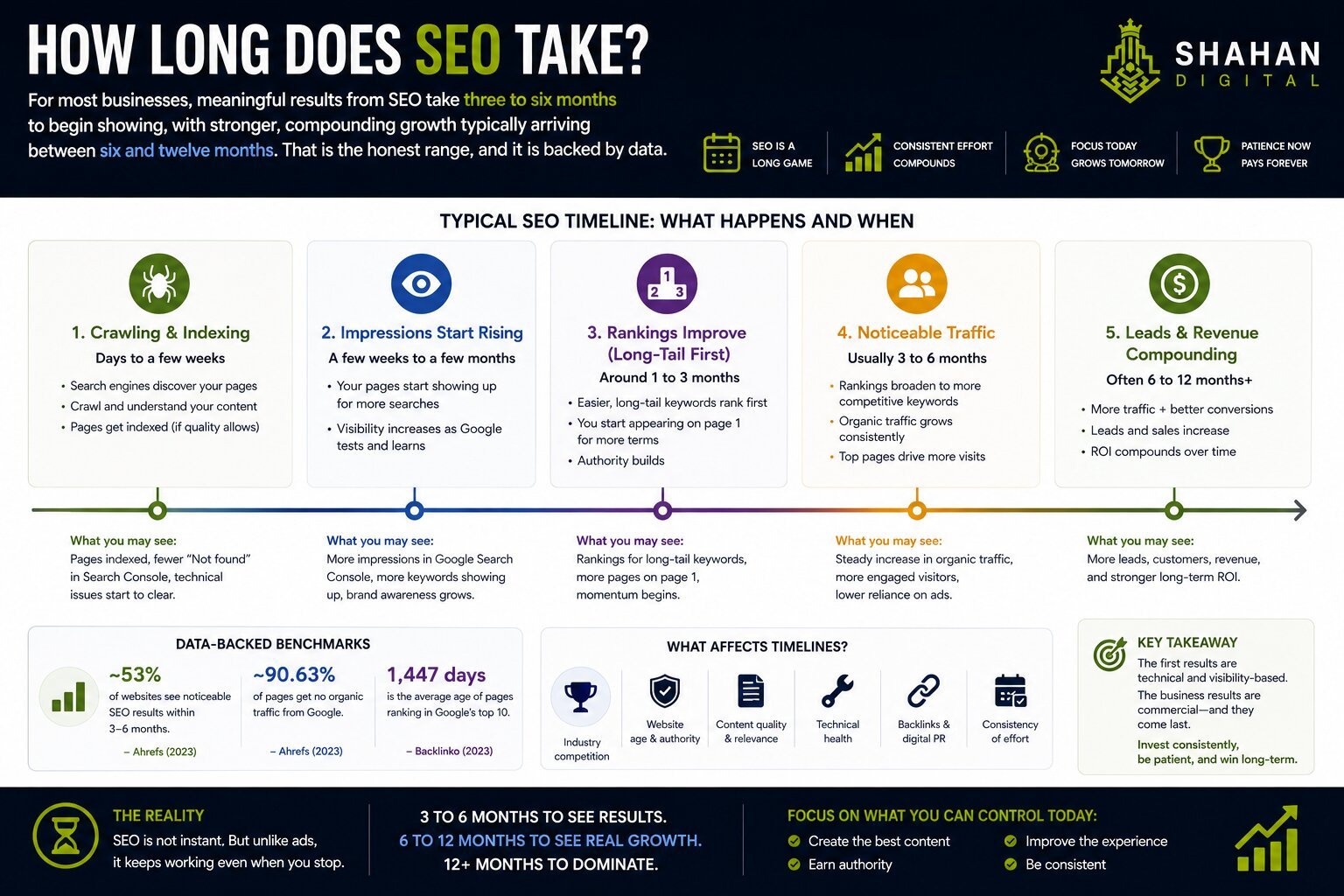
How long does SEO take? For most businesses, meaningful results from SEO take three to six months to begin showing, with stronger, compounding growth typically arriving between six and twelve months. That is the honest range, and it is backed by data.
In a poll of 3,680 respondents by Ahrefs, three to six months was the most common answer. Google’s SEO Starter Guide explains that individual changes may take anywhere from a few hours to several months to appear in Search.
In an earlier Google video on hiring an SEO, Maile Ohye also cited a broader four-month-to-one-year window for implementing improvements and seeing potential benefits, a quote documented by Search Engine Land. Anyone who promises top rankings in a week is either misinformed or selling something you should walk away from.
But that headline number hides what actually matters, which is why the timeline varies so much from one business to the next. A local service in a quiet niche can see movement in weeks.
A company competing in a crowded international market may wait a year before the results feel significant. This guide explains what drives that difference, what a realistic month-by-month timeline looks like, and how to tell early on whether your SEO is actually working, long before the rankings arrive.
How long does SEO take: the honest answer
The reason how long SEO takes varies so widely is that SEO is not an on-off switch. It is a compounding investment, closer to building a reputation than running an ad. Early work often produces little visible change, then results accelerate as the pieces reinforce each other. This is why the question is better framed not as “when will I rank” but “when will each stage start paying off.”
As a general pattern, most businesses experience it like this: the first few months go into foundations and early signals, months three to six bring noticeable ranking and traffic movement, and from six months onward the growth compounds into something commercially meaningful. None of this is guaranteed, because no one controls search results, and many sustained SEO projects follow a broadly similar pattern, although the timing and scale vary considerably.
It helps to understand why. When you improve a site, search engines need time to crawl the updated pages, process the changes, and reassess them against other relevant results. Competitors are working too.
And the factors that separate page one from page five, relevance, quality, technical accessibility, competition, and external authority, all take time to build. Trying to accelerate results through manipulative tactics can violate search engine spam policies and create long-term setbacks, so patience here is not just a virtue. It is the safe path.
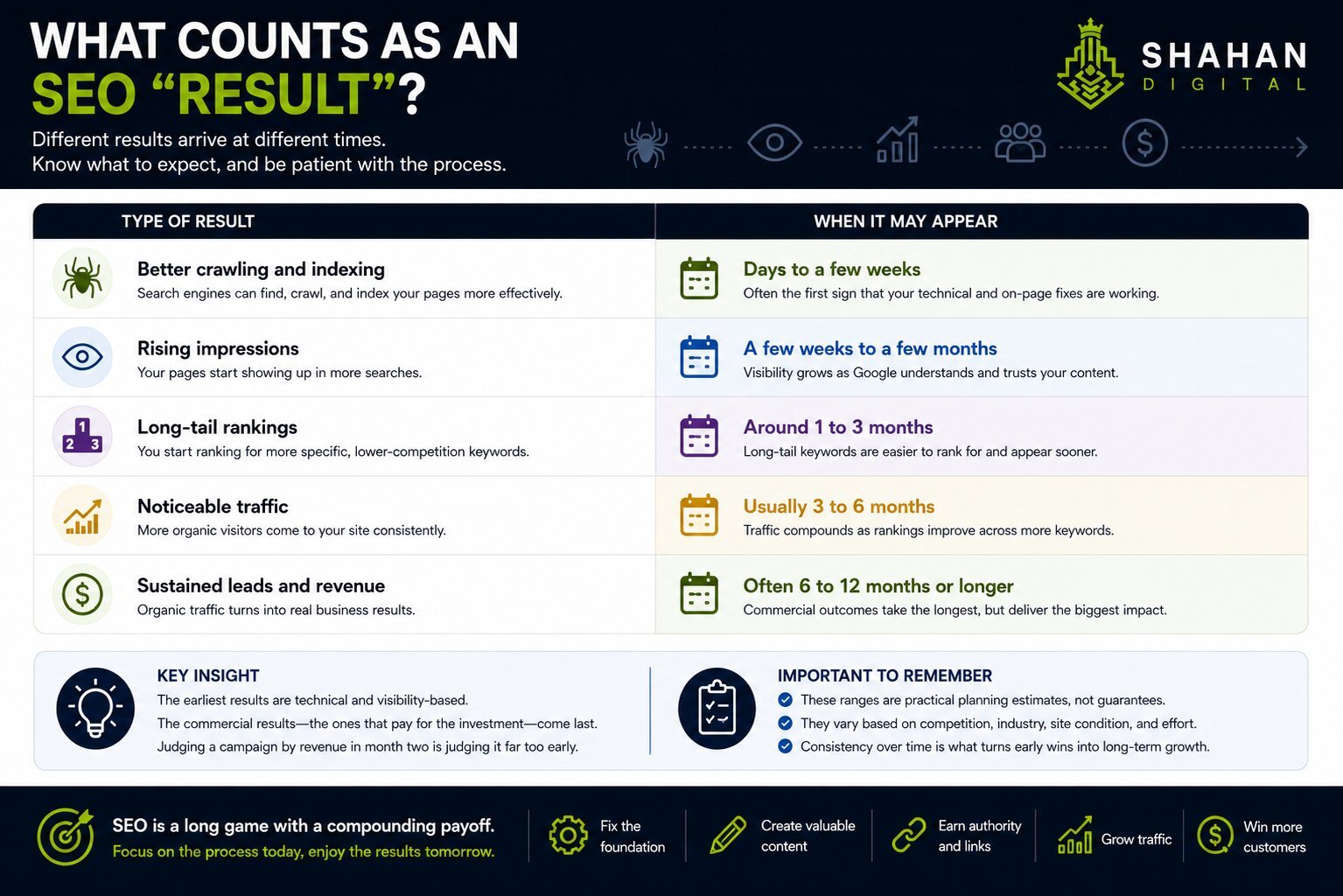
What counts as an SEO “result”?
Part of the confusion around timelines is that “results” does not mean the same thing to everyone. Better indexing, more impressions, higher rankings, more traffic, and actual revenue all arrive at different times. Separating them makes the wait far easier to understand.
| Type of result | When it may appear |
|---|---|
| Better crawling and indexing | Days to a few weeks |
| Rising impressions | A few weeks to a few months |
| Long-tail rankings | Around 1 to 3 months |
| Noticeable traffic | Usually 3 to 6 months |
| Sustained leads and revenue | Often 6 to 12 months or longer |
These ranges are practical planning estimates based on common campaign patterns, not fixed benchmarks or research guarantees, and they shift with competition and the condition of your site. The key insight is that the earliest results are technical and visibility-based, while the commercial results, the ones that pay for the investment, come last. Judging a campaign by revenue in month two is judging it far too early.
How long does SEO take: a month-by-month timeline
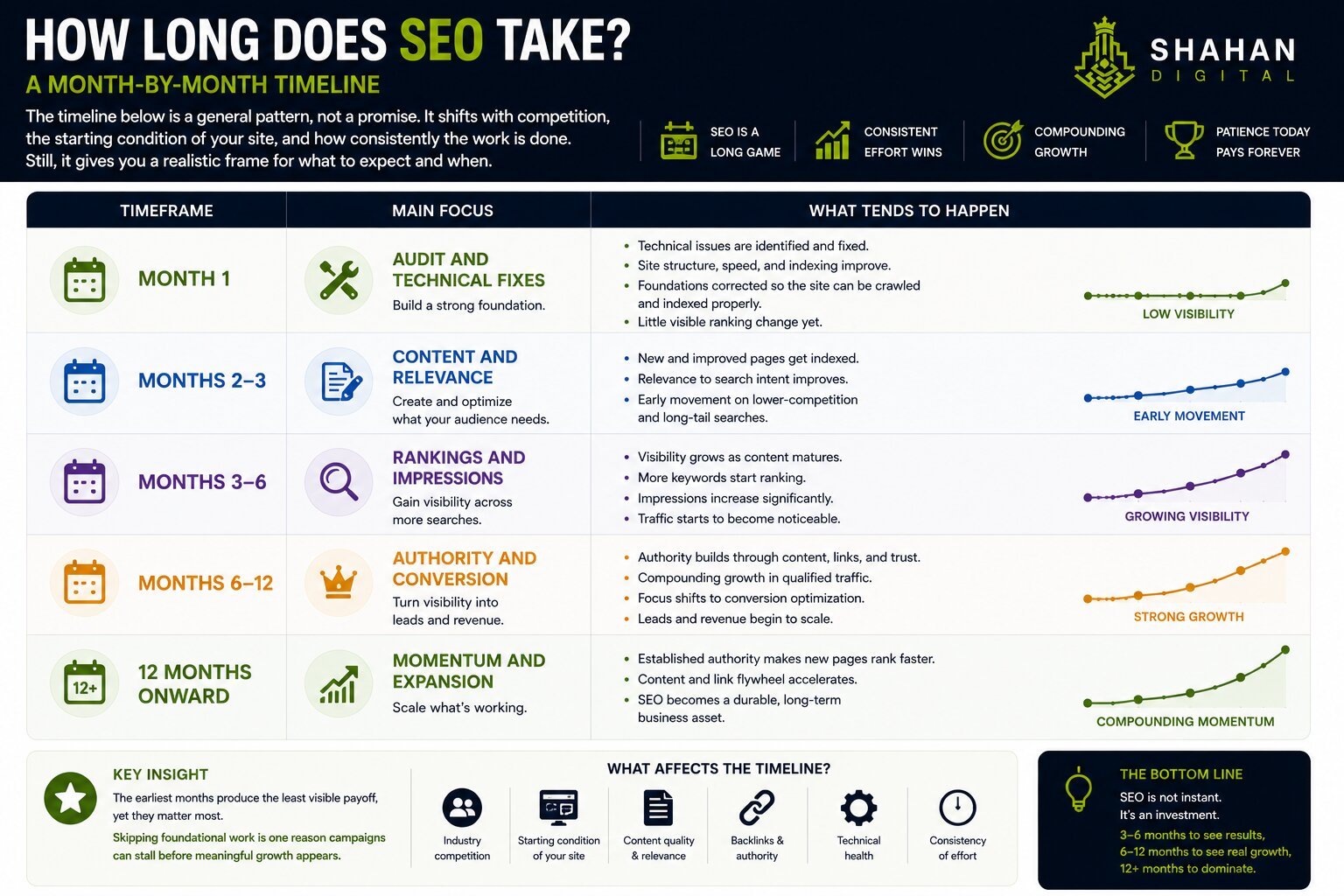
The timeline below is a general pattern, not a promise. It shifts with competition, the starting condition of your site, and how consistently the work is done. Still, it gives you a realistic frame for what to expect and when.
| Timeframe | Main focus | What tends to happen |
|---|---|---|
| Month 1 | Audit and technical fixes | Foundations corrected so the site can be crawled and indexed properly; little visible ranking change yet |
| Months 2–3 | Content and relevance | New and improved pages get indexed; early movement on lower-competition and long-tail searches |
| Months 3–6 | Rankings and impressions | Visibility grows as content matures and internal structure strengthens; traffic becomes noticeable |
| Months 6–12 | Authority and conversion | Compounding growth in qualified traffic; focus shifts to turning visibility into leads and revenue |
| 12 months onward | Momentum and expansion | Established authority makes new pages rank faster; SEO becomes a durable business asset |
Notice that the earliest months produce the least visible payoff, yet they matter most. Skipping foundational work is one reason campaigns can stall before meaningful growth appears.
What determines how long SEO takes for your business
There is no single timeline because a handful of factors move the number more than anything else. Understanding them helps you set realistic expectations and spot where you can reasonably move faster.
Competition in your market
Competition is often one of the biggest factors. Ranking for a low-competition local search is a different task from competing against established national brands with years of authority behind them. The more competitors chasing the same searches, the longer it takes to break through.
The current state of your website
A site with a clean technical foundation and existing content has a head start. One with crawl problems, thin pages, or a history of poor practices needs remedial work first, which adds time before growth can begin. Sorting this out is the job of technical SEO, and it usually comes before anything else.
Your domain’s existing authority
Domain age itself is not the advantage. Established sites often progress faster because they have accumulated content, links, recognition, and a longer search history, not because of age alone. New websites face an extra stretch of time simply building enough of these to compete.
Content quality and publishing consistency
SEO rewards sustained effort. A site that publishes genuinely useful content aligned to search intent, consistently, will progress faster than one that posts occasionally or targets the wrong searches. The quality of your content and the discipline of publishing it are both part of the equation.
The strength of your off-page authority
The credible links and mentions your site earns influence how quickly it gains ground in competitive searches. This side builds slowly by design. If you want the fuller picture of how this fits with your on-site work, our guide on on-page vs off-page SEO explains how the two halves interact.
Why SEO takes longer than paid ads, and why that is fine
It is worth being clear-eyed about this, because the contrast confuses a lot of business owners. Paid campaigns can begin generating search visibility within hours, provided they are approved, funded, and competitive enough to enter the auction. SEO cannot work that fast. So why wait?
The answer is what you own at the end. Paid ads rent visibility: the moment you stop paying, you disappear. SEO builds an asset. A page that earns its ranking can keep bringing in qualified visitors for months or years, which steadily lowers your cost of acquiring each customer. The slow start is the price of building something that keeps working after you stop paying for it.
This is also why the smartest approach is often not choosing between them. Many businesses run paid ads for immediate leads while SEO matures in the background, then shift budget toward organic as it starts to carry more of the load. If you want the full comparison, our guide on what SEO is and how it works covers how the channels complement each other.
How to tell SEO is working before the rankings arrive
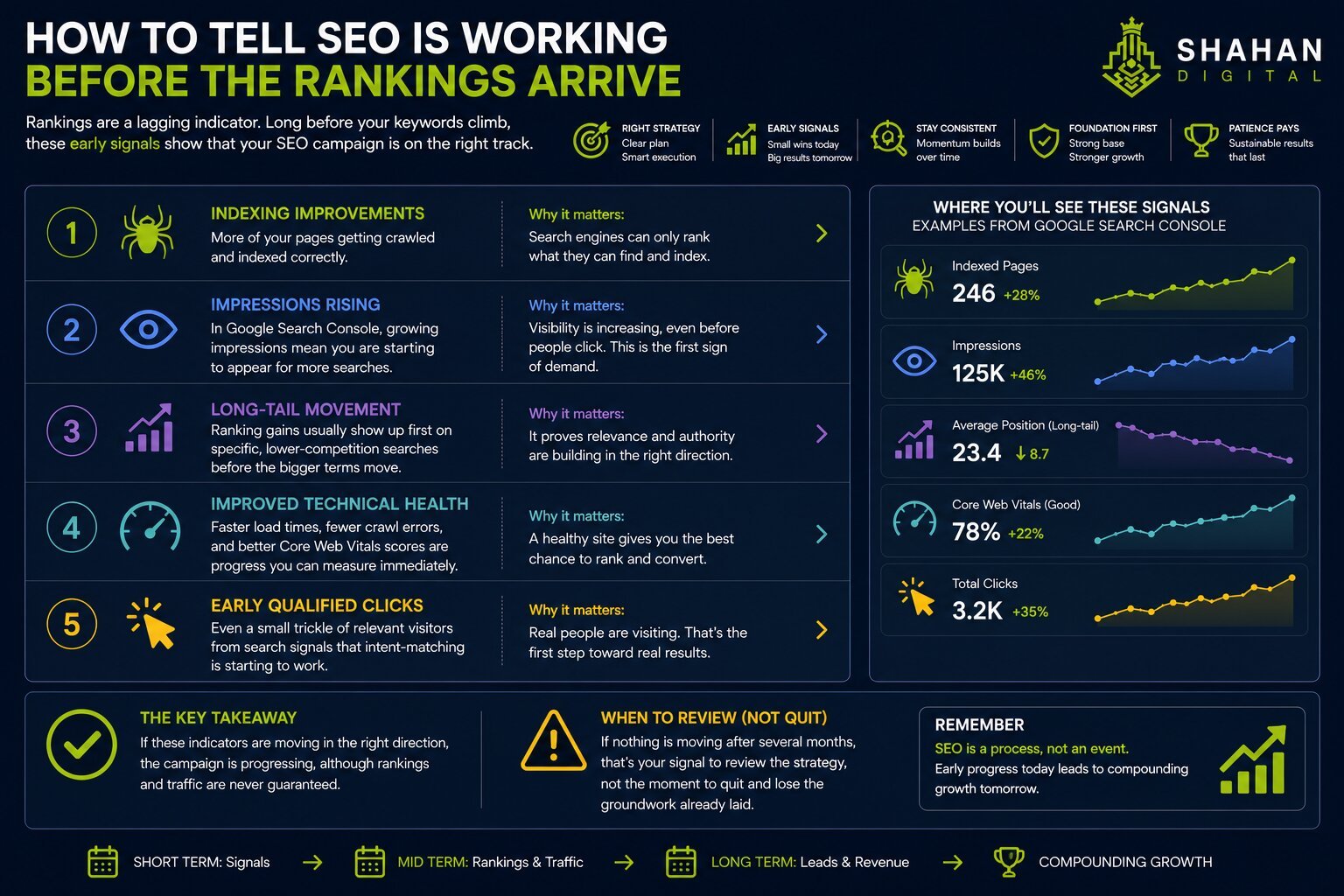
Here is the part most impatient business owners miss. Rankings are a lagging indicator. Long before your keywords climb, there are earlier signals that tell you the work is on track. Watching these keeps you from abandoning a campaign that is actually succeeding.
- Indexing improvements. More of your pages getting crawled and indexed correctly is an early sign the foundation is working.
- Impressions rising. In Google Search Console, growing impressions mean you are starting to appear for more searches, even before clicks follow.
- Long-tail movement. Ranking gains usually show up first on specific, lower-competition searches before the bigger terms move.
- Improved technical health. Faster load times, fewer crawl errors, and better Core Web Vitals scores are progress you can measure immediately.
- Early qualified clicks. Even a small trickle of relevant visitors from search signals that intent-matching is starting to work.
If these indicators are moving in the right direction, they suggest the campaign is progressing, although rankings and traffic are never guaranteed. If nothing is moving after several months, that is your signal to review the strategy, not the moment to quit and lose the groundwork already laid.
What real Shahan Digital projects reveal about SEO timelines
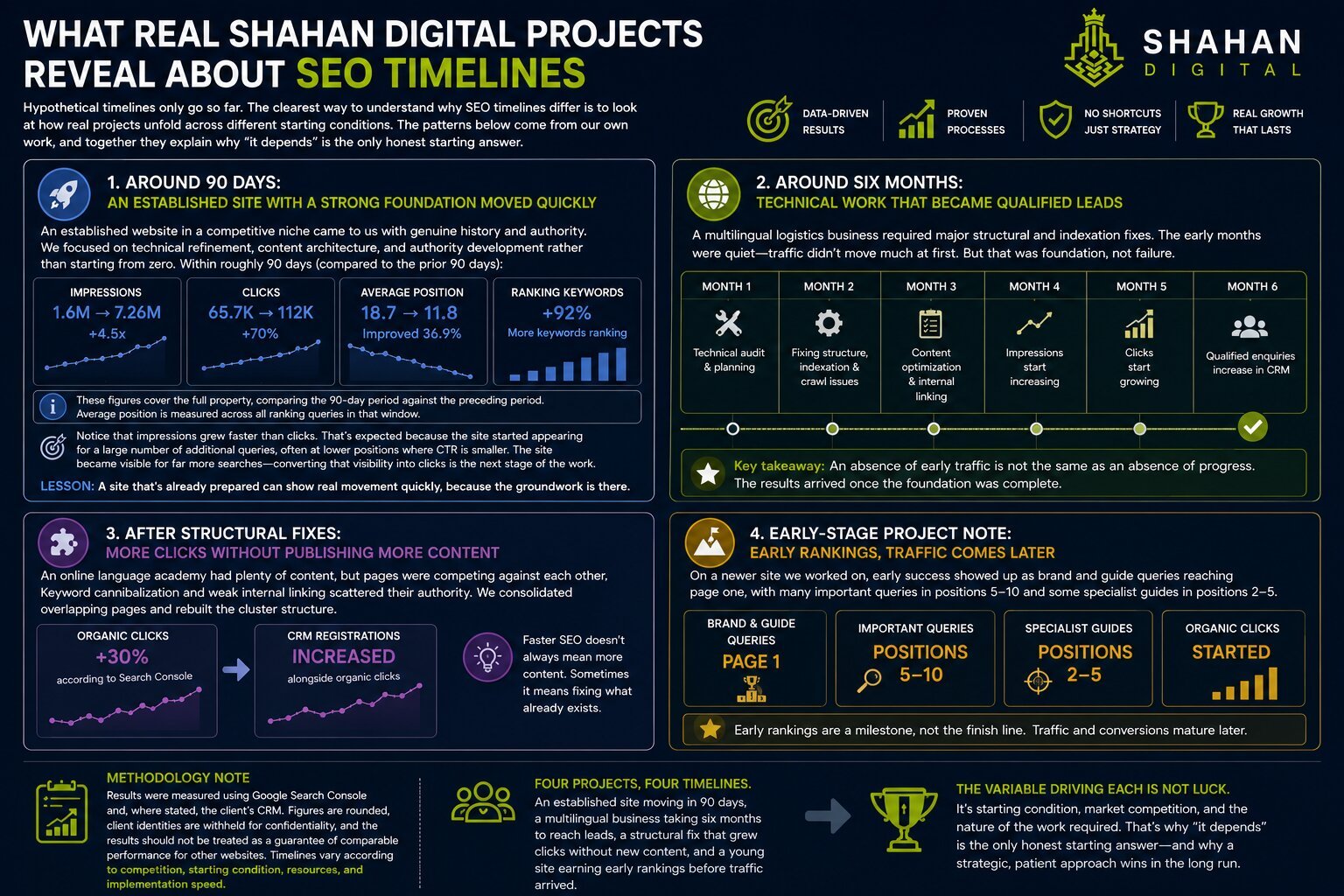
Hypothetical timelines only go so far. The clearest way to understand why SEO timelines differ is to look at how real projects unfold across different starting conditions. The patterns below come from our own work, and together they explain why “it depends” is the only honest starting answer.
Around 90 days: an established site with a strong foundation moved quickly
An established website in a competitive niche came to us already carrying genuine history and authority. Because the foundation was sound, the work focused on technical refinement, content architecture, and authority development rather than starting from zero. Within roughly 90 days, and based on Google Search Console data, impressions grew around 4.5-fold, from approximately 1.6 million to 7.26 million.
Clicks rose from about 65,700 to 112,000, and average position improved from around 18.7 to 11.8. It is worth being precise about what those numbers mean: the figures cover the full property, comparing the 90-day period against the preceding period, and average position is measured across all ranking queries in that window
. Notice too that impressions grew faster than clicks. That is expected here, because much of the impression growth came from the site newly appearing for a large number of additional queries, often at lower positions where click-through is naturally smaller.
In other words, the site became visible for far more searches, and converting that wider visibility into clicks is the next stage of the work, not a failure of the first. The lesson is not that 90 days is normal for everyone. It is that a site which is already prepared can show real movement quickly, precisely because the groundwork was already there.
Around six months: technical work that became qualified leads
A multilingual logistics business followed a very different curve. The early months went into fixing structure and indexation, and for a while there was little visible traffic growth. That quiet period was not failure. It was foundation. By around the sixth month, impressions and organic clicks were climbing, and the client’s CRM began recording an increase in relevant enquiries. This is the case worth remembering when month two feels slow: an absence of early traffic is not the same as an absence of progress.
After structural fixes: more clicks without publishing more content
An online language academy already had plenty of content, but its pages were competing against each other. Keyword cannibalization and weak internal linking meant the authority it had was scattered. Rather than publishing more, the work consolidated overlapping pages and rebuilt the cluster structure.
Organic clicks rose by roughly 30% over the following period, according to Search Console, and registrations in the CRM increased alongside them. It is a useful counterpoint to a common assumption: faster SEO does not always mean more content. Sometimes it means fixing what already exists.
Early-stage project note. On project, a newer site we worked on, the first signs of success were brand and guide queries reaching page one, with many important queries landing in positions five to ten and some specialist guides reaching positions two to five. Organic clicks had started, but the content cluster and conversion growth were still developing. It is a clean illustration of an important truth: early rankings are a milestone, not the finish line. Traffic and conversions mature later.
Methodology note: Results were measured using Google Search Console and, where stated, the client’s CRM. Figures are rounded, client identities are withheld for confidentiality, and the results should not be treated as a guarantee of comparable performance for other websites. Timelines vary according to competition, starting condition, resources, and implementation speed.
Four projects, four timelines. An established site moving in 90 days, a multilingual business taking six months to reach leads, a structural fix that grew clicks without new content, and a young site earning early rankings before traffic arrived. The variable driving each is not luck. It is starting condition, market competition, and the nature of the work required.
How to get SEO results faster (without cutting corners)
You cannot rush trust, but you can shorten how long SEO takes by avoiding wasted time. These choices tend to shorten the road without inviting the penalties that shortcuts cause.
- Fix the technical foundation first. Growth cannot compound on a site that cannot be crawled or loads slowly.
- Target achievable searches early. Winning lower-competition and long-tail searches builds momentum and authority you can later aim at harder terms.
- Match search intent precisely. Pages that closely match search intent are better positioned to compete than broad or unfocused content.
- Publish consistently. Publishing useful content consistently expands your coverage of relevant search demand and gives your site more opportunities to earn visibility.
- Strengthen internal linking. Strong internal linking helps search engines discover priority pages, understand their context, and distribute internal authority more effectively.
What you should not do is buy links, spin up low-quality pages in bulk, or chase any tactic that promises to “trick” the algorithm. These can violate search engine spam policies and set you back further than doing nothing. Google’s spam policies are explicit that manipulative shortcuts can lead to lost rankings or removal from results entirely.
When does SEO start generating leads, not just traffic?
For a business, the timeline that really matters is not when traffic arrives but when enquiries do. These are not the same moment, and confusing them causes a lot of premature disappointment.
Visibility usually comes before enquiries
Impressions and rankings usually begin moving before a consistent flow of qualified enquiries appears. You become visible first, then trusted, then chosen. Expecting enquiries at the same time as your first ranking gains sets an unrealistic bar.
Why high traffic can still produce no leads
A page can attract plenty of visitors and still generate nothing, usually because the traffic comes from informational searches rather than buying intent, or because the page that ranks is not built to convert. More traffic is not the goal. The right traffic, landing on the right page, is.
The signals worth watching before revenue
Before leads appear, the useful signals are rising impressions on commercial searches, qualified clicks reaching service pages rather than only blog posts, and improving engagement on those commercial pages. When those indicators improve on commercially relevant pages, the conditions for generating qualified enquiries become stronger, although conversion is never guaranteed.
Does SEO ever stop? How long SEO really lasts
A common misconception is that SEO has a finish line. It does not, and understanding why saves a lot of frustration. Search results are dynamic: competitors publish new content, search engines update how they evaluate pages, and customer behavior shifts. Rankings you win can erode if the work stops.
Ongoing SEO is therefore less about constantly climbing and more about compounding and defending. Once you have built authority, maintaining it typically takes less intensive effort than the initial climb, but it does not drop to zero. The businesses that treat SEO as a permanent capability rather than a one-time project are the ones whose visibility keeps growing year over year.
How multilingual and international SEO changes the timeline
If you operate across languages or countries, expect the timeline to stretch, and to run at different speeds in each market. This is an area many timeline guides skip, yet it is exactly where expectations most often go wrong.
Translation does not create search demand
Translating a page does not automatically mean people search for that topic, in that language, in that market. Each language market has its own demand, its own competitors, and its own intent, which has to be researched rather than assumed. This is part of what international SEO handles.
Each language market builds authority at its own speed
Recognition and backlinks earned in one language market may support the wider domain, but they do not automatically create local relevance, search demand, or market-specific trust in another language. A brand strong in English may be starting close to zero in Arabic or another language, which means each market runs on its own timeline rather than a single shared one.
Indexation and internal linking get more complex
Multiple language versions multiply the technical work: correct hreflang signals, clean indexation of each version, and internal linking that keeps each market’s structure coherent. This complexity is a real reason international projects often need longer before results stabilize.
How long does SEO take: frequently asked questions
How long does SEO take to show results?
For most businesses, noticeable results appear within three to six months, with stronger, compounding growth typically arriving between six and twelve months. The exact timeline depends heavily on competition, the current state of your website, and how consistently the work is done. It is a gradual, compounding process rather than an instant one.
Can SEO work faster than six months?
Sometimes, yes. A site with a strong technical foundation, existing authority, and low-competition targets can see movement within weeks. Faster results are most common on long-tail and local searches. Highly competitive markets almost always take longer, regardless of how good the work is.
Why does SEO take so long compared to paid ads?
Paid ads buy immediate visibility that disappears when you stop paying. SEO earns visibility by building trust, relevance, and authority, which search engines assess over time. The slower path is the trade-off for building a durable asset that keeps generating traffic without paying for each click.
Is it possible to speed up SEO safely?
You can avoid delays by fixing technical issues first, targeting achievable searches, matching search intent precisely, and publishing quality content consistently. What you cannot safely do is manipulate rankings through bought links or bulk low-quality content, which can violate search engine policies and cause lasting damage.
Does SEO ever finish, or is it ongoing?
SEO is ongoing. Search results change constantly as competitors publish, algorithms update, and behavior shifts. Maintaining hard-won rankings usually takes less effort than building them, but stopping entirely allows visibility to erode over time.
How long does SEO take: where to go from here
The honest answer depends on your market, website, competition, and consistency. Most businesses begin seeing meaningful progress within three to six months, while stronger commercial results often take six to twelve months or longer. The businesses that succeed are the ones that understand this upfront, watch the early signals instead of only the rankings, and treat SEO as a long-term investment rather than a quick fix.
If you want a realistic timeline for your specific situation, based on your market’s competition and your site’s current condition, the team at Shahan Digital can assess it honestly, or you can explore the full range of SEO services built around sustainable, long-term growth.
Written by

Shahan Behkamrad
Author · Founder of Shahan Digital · SEO & GEO Strategist
Entrepreneur · Founder of Shahan Digital · SEO, GEO & Digital Growth Strategist
Shahan Behkamrad is the founder of Shahan Digital and the author of this article.
His published work explores English SEO, Arabic SEO, and Persian SEO, international and multilingual search, technical SEO, website architecture, content strategy, search-intent analysis, digital marketing, Generative Engine Optimization, AI-search visibility, and content optimization for emerging answer-driven platforms.
Through his articles, podcasts, and educational publications, he presents complex topics in a clear and practical format for entrepreneurs, business owners, executives, and marketing professionals.
The views and analysis presented in this article are provided in Shahan Behkamrad’s capacity as its author.
View Shahan Behkamrad’s full author profile and published work →
Official Links
About US Company · LinkedIn · YouTube · Spotify · Apple Podcasts · Instagram · Crunchbase · Shahan Digital on LinkedIn
Editorial and Legal Notice
This article and any related audio or video materials are published solely for educational and general informational purposes.
The content does not constitute legal, financial, investment, technical, or individualized digital marketing advice. Reading, viewing, or listening to this content does not create a consulting, agency, advisory, fiduciary, contractual, or other professional relationship with Shahan Behkamrad or Shahan Digital.
Any examples, observations, strategies, or opinions presented in this content should be evaluated according to the specific circumstances, objectives, market conditions, resources, and legal requirements of each business.
SEO, GEO, digital marketing, traffic, lead-generation, conversion, and revenue outcomes may vary. No specific ranking, traffic level, number of leads, conversion rate, commercial result, or revenue outcome is promised or guaranteed.
All company names, platform names, products, and trademarks mentioned in this content remain the property of their respective owners. References to third-party platforms do not imply sponsorship, endorsement, partnership, or affiliation unless expressly stated.