SEO vs paid ads comes down to one honest trade-off: paid ads buy you visibility today, and SEO earns you visibility that keeps working long after you stop paying. Neither is universally “better.” The right choice depends on your timeline, your budget, and whether you are trying to generate leads this week or build an asset that compounds for years.
In this guide, “paid ads” refers primarily to paid search advertising, particularly Google Ads, rather than social, display, or video advertising, since paid search is what directly competes with SEO for the same searches. Most SEO vs paid ads comparisons treat it as a fight with a winner. It is not. Many businesses with sufficient budget and execution capacity use both channels to balance immediate demand with longer-term growth, and understand exactly what each one is for.
This guide breaks down the real cost, speed, and ROI difference between SEO and paid ads, when each makes sense, and how to combine them so you are not overpaying for clicks you could eventually earn without paying for each one. Both sit within the wider field of digital marketing, but they behave very differently.
SEO vs paid ads: the core difference
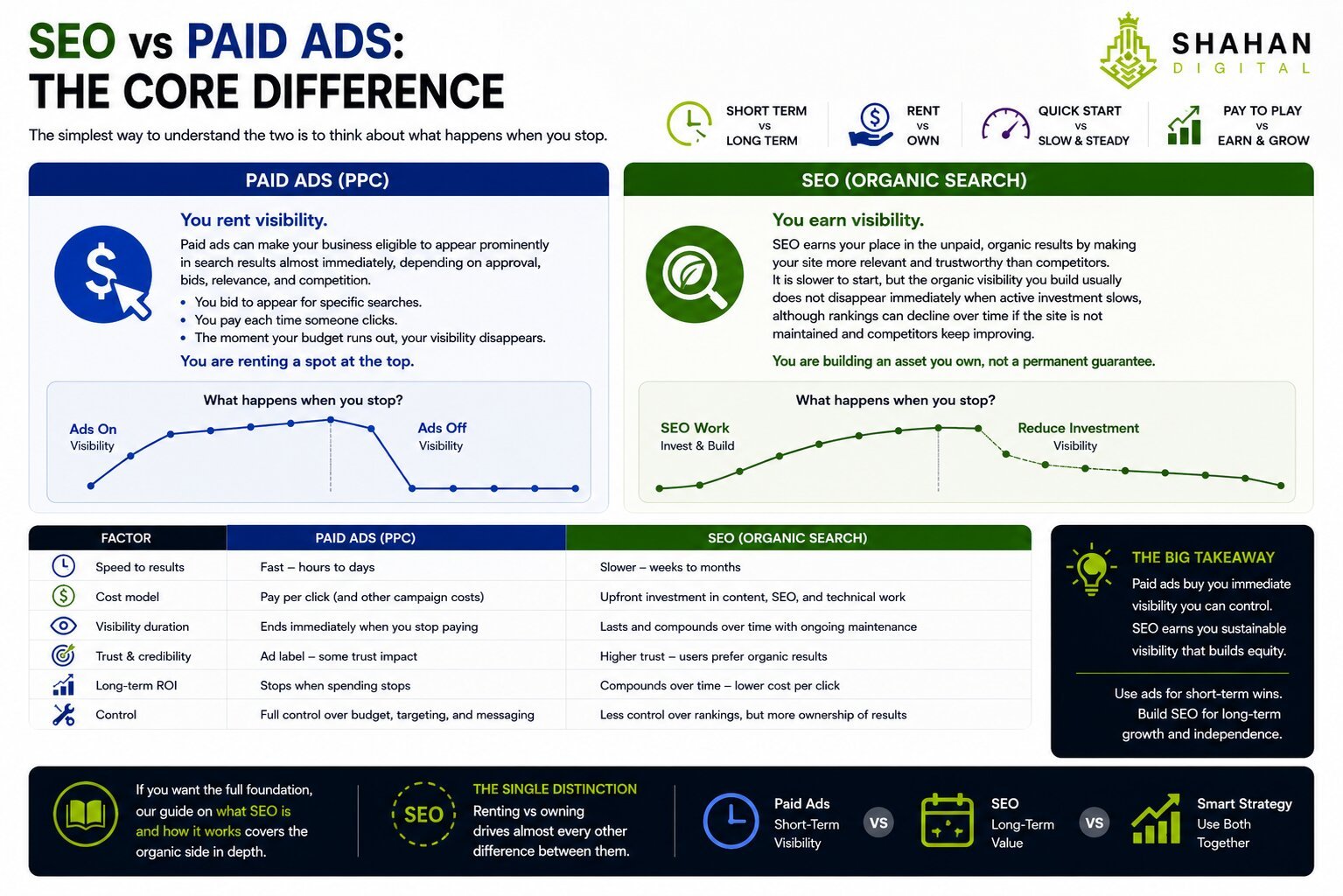
The simplest way to understand the two is to think about what happens when you stop.
Paid ads (often called PPC, or pay-per-click) can make your business eligible to appear prominently in search results almost immediately, depending on approval, bids, relevance, and competition. You bid to appear for specific searches and pay each time someone clicks. The moment your budget runs out, your visibility disappears. You are renting a spot at the top.
SEO (search engine optimization) earns your place in the unpaid, organic results by making your site more relevant and trustworthy than competitors. It is slower to start, but the organic visibility you build usually does not disappear immediately when active investment slows, although rankings can decline over time if the site is not maintained and competitors keep improving. You are building an asset you own, not a permanent guarantee.
That single distinction, renting versus owning, drives almost every other difference between them. If you want the full foundation, our guide on what SEO is and how it works covers the organic side in depth.
| Factor | SEO (organic) | Paid ads (PPC) |
|---|---|---|
| Speed to results | Gradual, months to build | Fast, often within days |
| Cost model | Investment in content and authority; no cost per click | Paid for every click, ongoing |
| Longevity | Can continue after active investment slows, but requires maintenance and is not permanent | Stops the moment you stop paying |
| Cost over time | Cost per visitor tends to fall as pages mature | Continues for every click; may rise or fall with competition and campaign efficiency |
| Trust and clicks | Some searchers prefer organic listings | Clearly labeled as ads; high-intent users may still respond strongly |
| Best for | Long-term, compounding growth | Immediate leads, launches, testing |
SEO vs paid ads on speed: where ads win
There is no contest on speed. Paid campaigns can begin generating search visibility within hours, provided they are approved, funded, and competitive enough to enter the auction. For a new business, a product launch, or a time-sensitive promotion, that immediacy is genuinely valuable. You can be in front of buyers today.
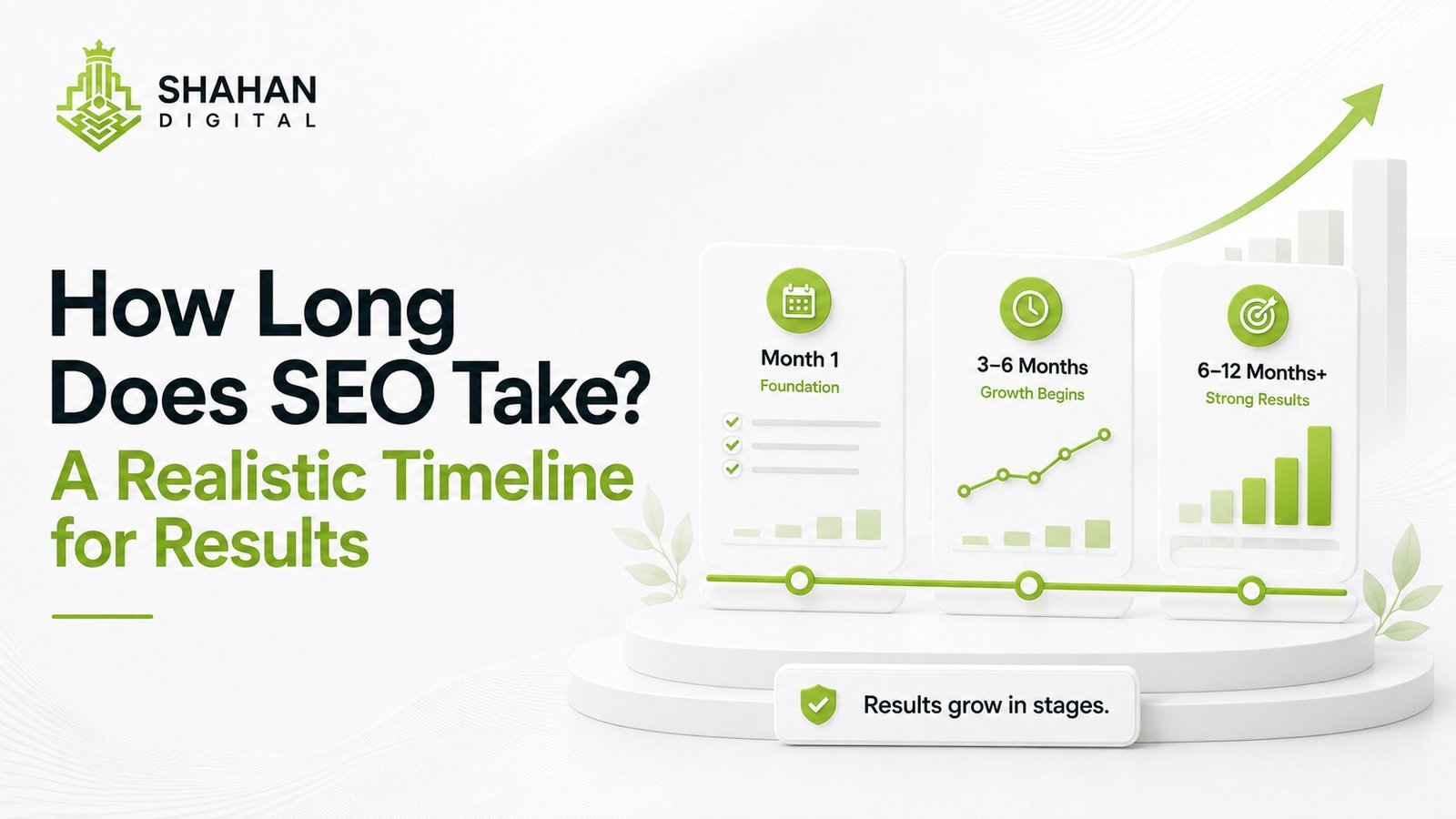
SEO cannot match that. As covered in our guide on how long SEO takes, meaningful organic results typically build over three to six months, with stronger growth arriving later. If you need leads this week and have no organic presence yet, paid ads are often the realistic starting point.
SEO vs paid ads on cost: where it gets interesting
On cost, the picture flips over time, and this is where many businesses miscalculate.
With paid ads, you pay for every single click, for as long as you run them. In competitive markets, the cost per click can be steep. WordStream’s 2025 benchmark data, drawn from over 16,000 campaigns, puts the average Google Ads cost per click at around $5.26, with some industries such as legal services exceeding $8.50.
Costs also tend to rise over time as more businesses bid for the same searches; WordStream’s ten-year data shows average CPC has more than doubled, from roughly $2.32 to over $5.40. Paid traffic generally requires continued media spend, although campaign efficiency and cost per acquisition can improve through better targeting, bidding, and landing pages. Pause the budget, and new paid-search visibility stops, although some delayed conversions may still be attributed afterward.
Organic search front-loads its cost. You invest in content, technical work, and authority upfront, and results build gradually. But once a page ranks, it can generate qualified visitors month after month without paying per click.
Over time, the cost of acquiring each visitor through organic search tends to fall, while paid costs hold steady or climb. This is why organic search is often described as building equity, and paid ads as paying rent.
The honest caveat: Organic search is not “free.” It requires real investment in time, expertise, and content. The difference is not free versus paid. It is where the cost sits, upfront and compounding for SEO, ongoing and linear for ads.
SEO vs paid ads on ROI: which returns more?
Return on investment is the question most business owners actually care about, and the honest answer is that it depends on the time horizon.
In the short term, paid ads often show clearer, faster ROI. You spend a defined amount, you can measure the leads and sales directly, and you can calculate return quickly. This measurability is a real strength, especially for testing whether a market or offer converts at all.
In the long term, SEO can deliver stronger cumulative ROI when rankings generate sustained qualified traffic, because the cost per acquisition keeps falling while the traffic keeps coming. This is not universal, though, and depends on execution, competition, and conversion performance.
A page that took investment to rank can generate leads for years with minimal additional spend. Organic assets can continue generating value without a direct charge for every click, while paid search generally requires continued media spend to maintain visibility.
The practical framing: measure paid ads by immediate ROI, and organic search by cumulative ROI over twelve months or more. Comparing them on the same short timeframe misjudges what SEO is for.
Visibility and trust: how users treat ads versus organic results
There is a behavioral difference worth understanding. Paid results are clearly labeled as ads, and a meaningful share of searchers skip them, either from banner blindness or a preference for “earned” results. Organic listings can carry an implicit credibility for some users: the sense that a site ranked because it earned it. This is a tendency, not a rule, and high-intent searchers often respond strongly to relevant ads regardless.
The scale of organic search is part of why it matters so much. In published research, BrightEdge has attributed around 53% of all trackable website traffic to organic search, more than any other single channel. And within organic results, position matters enormously: Backlinko’s analysis of search results found the top organic result earns an average click-through rate of roughly 27.6%.
These figures vary by query, device, and the search features shown, so treat them as broad indicators rather than fixed rates. This does not mean ads are ineffective. High-intent commercial searches, where someone is ready to buy, often convert well from ads. But for research, comparison, and trust-building stages of a decision, strong organic visibility tends to carry more weight. Being present in both places covers the full journey.
SEO vs paid ads: when paid ads win
Paid ads make the most sense in specific situations, and recognizing them saves you from waiting on SEO when speed matters more.
- You need leads immediately. A new business or an urgent revenue gap cannot wait months for organic results.
- You are launching or promoting something time-sensitive. A product launch, event, or seasonal offer has a deadline SEO cannot meet.
- You want to test a market or offer. Ads quickly reveal whether a search converts, before you invest in ranking for it organically.
- You are targeting highly competitive commercial searches. Where organic ranking would take a year, ads can put you there now while SEO matures.
When SEO is the right choice
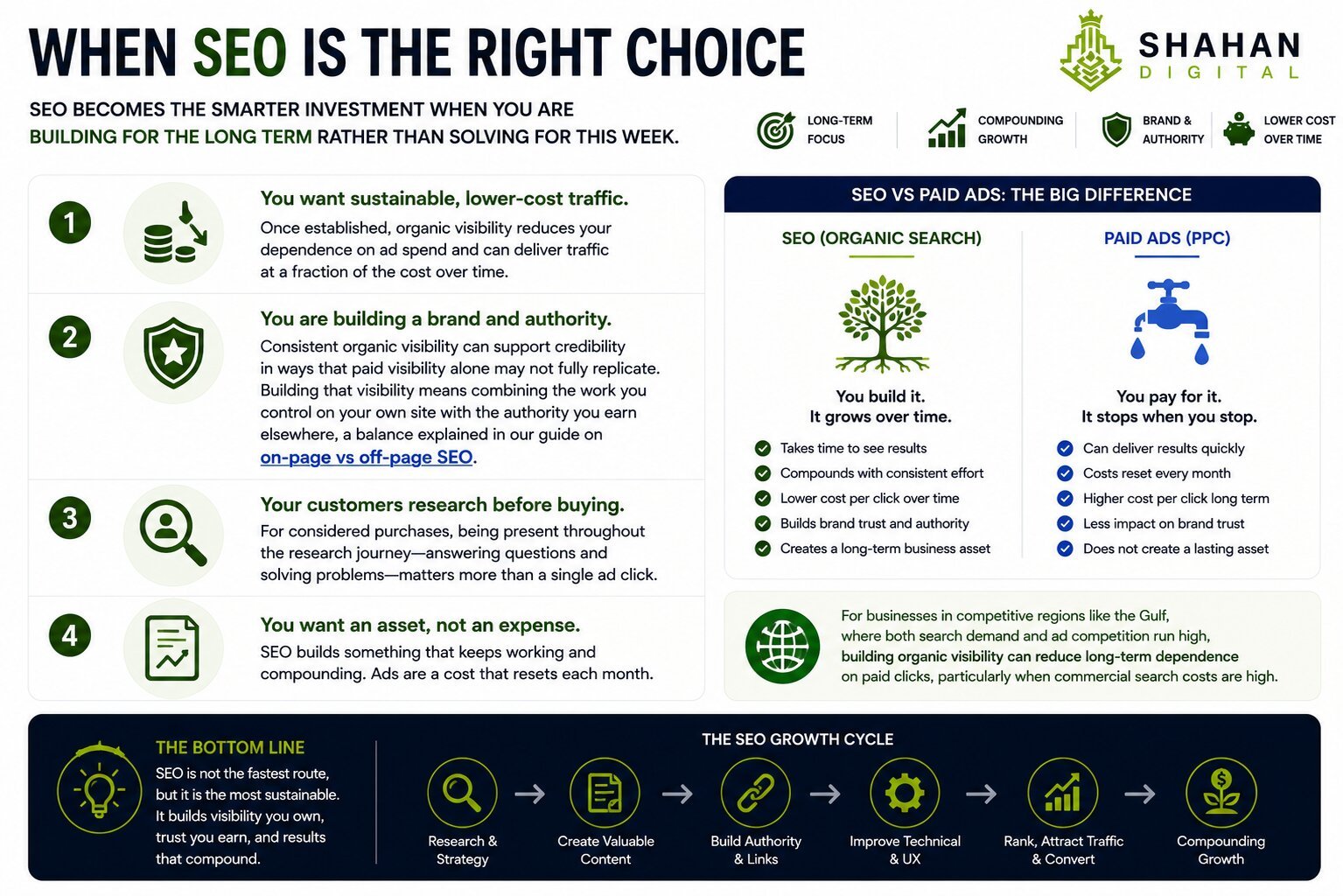
SEO becomes the smarter investment when you are building for the long term rather than solving for this week.
- You want sustainable, lower-cost traffic. Once established, organic visibility reduces your dependence on ad spend.
- You are building a brand and authority. Consistent organic visibility can support credibility in ways that paid visibility alone may not fully replicate. Building that visibility means combining the work you control on your own site with the authority you earn elsewhere, a balance explained in our guide on on-page vs off-page SEO.
- Your customers research before buying. For considered purchases, being present throughout the research journey matters more than a single ad click.
- You want an asset, not an expense. SEO builds something that keeps working; ads are a cost that resets each month.
For businesses in competitive regions like the Gulf, where both search demand and ad competition run high, building organic visibility can reduce long-term dependence on paid clicks, particularly when commercial search costs are high.
Why the smartest answer is usually “both”
Framing this as SEO versus paid ads misses how the best strategies actually work. The two are not rivals competing for the same job. They are complementary tools that cover different stages and timelines.
A common and effective approach looks like this: run paid ads to generate leads immediately and to learn which searches actually convert, while investing in SEO in the background. As your organic visibility grows, it takes over more of the traffic, and you can reduce paid spend on the searches you now rank for organically, redirecting that budget to new opportunities. The data from your paid campaigns, which keywords convert, which messages work, also makes your SEO sharper.
Used together, paid ads buy you time and data while organic search builds the durable asset. For businesses with sufficient budget and execution capacity, combining both channels can reduce short-term risk while building longer-term visibility. Businesses without the budget or capacity for both may be better off focusing on one and expanding later.
SEO vs paid ads: how to split your budget
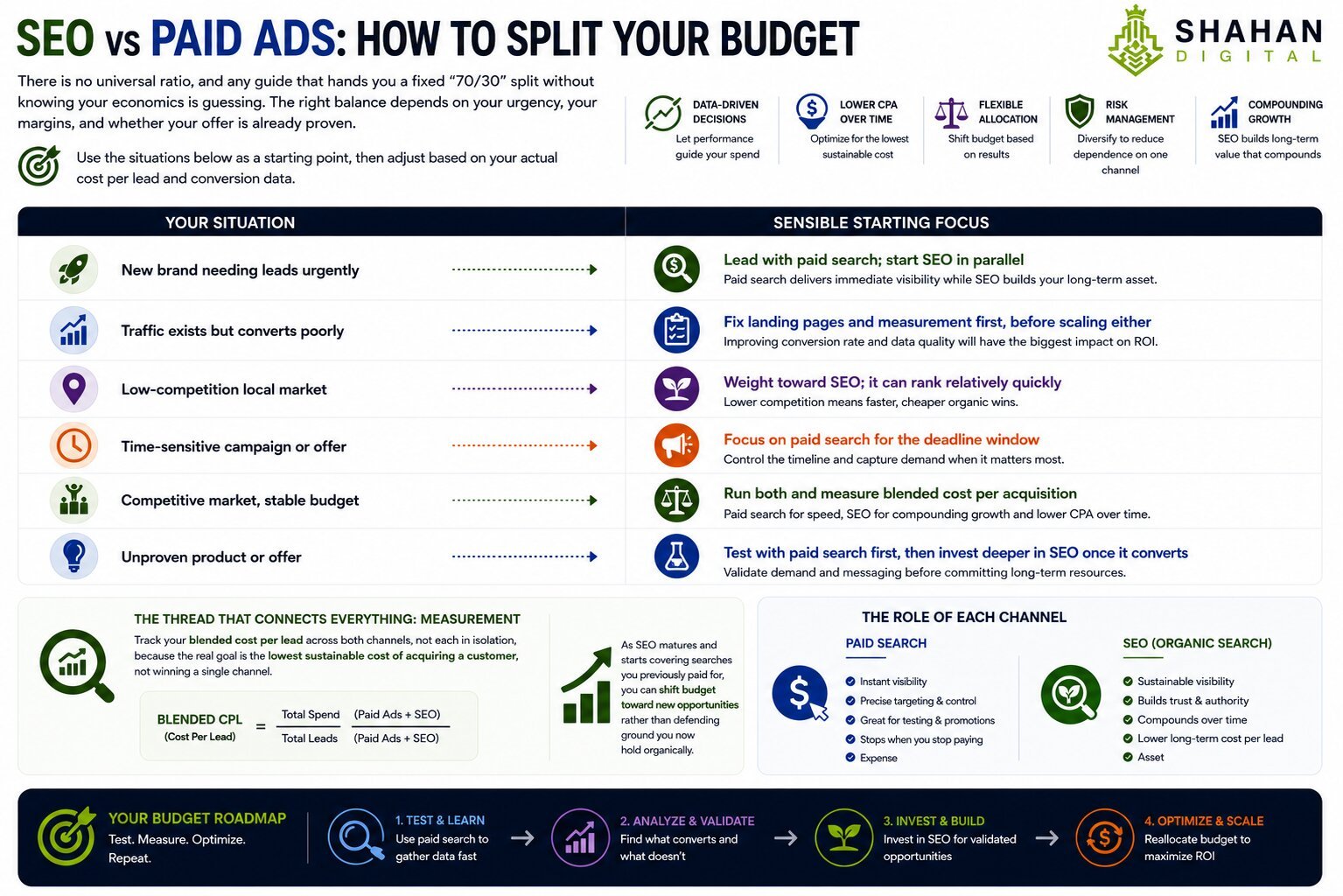
There is no universal ratio, and any guide that hands you a fixed “70/30” split without knowing your economics is guessing. The right balance depends on your urgency, your margins, and whether your offer is already proven. Use the situations below as a starting point, then adjust based on your actual cost per lead and conversion data.
| Your situation | Sensible starting focus |
|---|---|
| New brand needing leads urgently | Lead with paid search; start SEO in parallel |
| Traffic exists but converts poorly | Fix landing pages and measurement first, before scaling either |
| Low-competition local market | Weight toward SEO; it can rank relatively quickly |
| Time-sensitive campaign or offer | Focus on paid search for the deadline window |
| Competitive market, stable budget | Run both and measure blended cost per acquisition |
| Unproven product or offer | Test with paid search first, then invest deeper in SEO once it converts |
The thread running through all of these is measurement. Track your blended cost per lead across both channels, not each in isolation, because the real goal is the lowest sustainable cost of acquiring a customer, not winning a single channel. As SEO matures and starts covering searches you previously paid for, you can shift budget toward new opportunities rather than defending ground you now hold organically.
SEO vs paid ads in practice: the Shahan Digital paid-search-to-SEO framework
This framework was developed through Shahan Digital’s work on multilingual financial and international search projects, particularly campaigns targeting Arabic-speaking markets. Across these projects, businesses often needed qualified demand quickly but lacked enough market-specific data to know which queries, messages, and landing pages deserved long-term SEO investment.
The challenge was not simply a lack of traffic. It was uncertainty. Similar-looking search terms often carried very different intent across markets. Some queries appeared commercial but mainly attracted users looking for general education. Others produced fewer clicks but came from people much closer to taking action. Building an SEO strategy from search volume alone would have meant committing months of work before knowing which demand was commercially meaningful.
The problem: SEO needed time, but the business needed answers now
Starting with SEO alone would have created a long feedback loop. Pages would need to be researched, written, indexed, and ranked before we could learn whether the underlying searches generated qualified enquiries. Paid search could provide that feedback far sooner, but relying on ads alone would leave every visit dependent on continued media spend.
We therefore did not treat paid search and SEO as separate campaigns. Paid search became the short-term demand-validation layer, while SEO became the system for turning proven demand into a longer-term organic asset.
Phase one: paid search identified real commercial intent
The initial paid-search activity was structured to do more than generate clicks. Campaigns and landing pages were separated by market, intent, and offer so that the search-term data could reveal meaningful differences in user behavior.
We reviewed which queries produced relevant engagement and enquiries, which messages attracted the right audience, and which terms spent budget without showing clear commercial value. Search terms were then divided into three groups:
- Immediate paid-search opportunities: high-intent queries that justified continued advertising because speed and visibility mattered.
- Validated SEO opportunities: searches that demonstrated enough commercial relevance to justify dedicated service pages, comparison content, or supporting guides.
- Low-value or misleading demand: queries that attracted clicks but did not align with the business’s real offer and were excluded from both the advertising and content roadmap.
Phase two: SEO was built around proven demand, not assumptions
The organic strategy was then shaped around the language customers had actually used. Rather than choosing topics only because a keyword tool reported high volume, we prioritized queries that had already shown stronger commercial intent through paid-search and landing-page data.
This influenced the service-page structure, supporting content, internal linking, and localization of each market. Technical SEO ensured that the new pages could be crawled and indexed correctly, while the content architecture connected informational searches to the commercial pages most capable of generating enquiries.
The key difference was that paid search answered the question, “What can generate useful demand now?” SEO answered the second question, “Which of those searches should become a durable acquisition asset?”
Phase three: each channel took on a different role
Paid search remained useful for urgent, competitive, and newly tested queries. It provided immediate visibility and allowed the team to keep testing offers and market language. SEO gradually took responsibility for repeat demand: the searches customers continued making month after month and for which an organic page could create cumulative value.
This did not mean turning ads off the moment an organic page began ranking. Paid and organic performance were evaluated together. Where both channels contributed profitably, both could remain active. Where organic visibility became strong enough to cover recurring demand, paid budget could be redirected toward new markets, new offers, or searches that remained difficult to reach organically.
What the project taught us
The most valuable result was not simply receiving traffic from two channels. It was reducing strategic uncertainty. Paid-search data prevented the SEO team from investing months in content built around unproven assumptions, while SEO prevented the business from remaining permanently dependent on paid clicks for every recurring search.
Paid search delivered speed, control, and immediate market feedback. SEO delivered accumulation, wider discovery, and the potential for visibility without a direct media charge for every visit. The two channels created more value together because each solved the weakness of the other.
Methodology note: This anonymized case study reflects the operating approach used across Shahan Digital’s multilingual financial and international search projects. Client identities and campaign-level commercial figures are withheld for confidentiality. No performance outcome should be treated as a guarantee, since paid-search and SEO results vary according to market competition, offer strength, budget, tracking quality, website condition, and implementation speed.
SEO vs paid ads: frequently asked questions
Is SEO better than paid ads?
Neither is universally better. Paid ads deliver fast, measurable results but stop the moment you stop paying. SEO takes longer to build but creates lasting visibility with a falling cost per visitor over time. The best choice depends on your timeline and goals, and many businesses use both together.
Is SEO cheaper than paid ads?
Over the long term, SEO usually becomes cheaper per visitor because you are not paying for every click, but it is not free, it requires upfront investment in content, technical work, and authority. Paid ads have lower upfront cost but charge for every click indefinitely, so costs continue as long as you run them.
Should I do SEO or paid ads first?
If you need leads immediately, paid ads are often the practical starting point because they work fast. SEO should usually start at the same time, running in the background, so that as it matures you can reduce paid spend on the searches you begin to rank for organically.
Can SEO and paid ads work together?
Yes, and they often work best together. Paid ads deliver immediate leads and reveal which searches convert, while SEO builds durable organic visibility. The conversion data from paid campaigns can also sharpen your SEO strategy, and organic rankings can eventually reduce your reliance on paid clicks.
Do paid ads help SEO rankings?
Running paid ads does not directly improve your organic rankings; they are separate systems. Google states directly in its guidance on hiring an SEO that buying ads does not affect organic rankings, and that its ad system is independent of organic search results. However, ads can support the broader organic strategy by revealing which queries, offers, messages, and landing pages generate conversions, which you can then prioritize in your SEO. This strategic benefit does not mean paid traffic directly improves organic rankings.
SEO vs paid ads: where to go from here
The honest summary is that SEO vs paid ads is rarely an either/or decision. Paid ads are the right tool for immediate leads, launches, and testing. SEO is the right investment for durable, compounding, lower-cost visibility. Used together, they cover both the short term and the long term, which is why most businesses that grow through search end up running both rather than choosing one.
The real question is not which is better in the abstract, but which mix fits your timeline, budget, and market right now. If you want a grounded assessment of where paid ads and SEO each fit for your business, the team at Shahan Digital can help you map it out, or you can explore our SEO services and Google Ads management built to work together rather than compete.
Written by

Shahan Behkamrad
Author · Founder of Shahan Digital · SEO & GEO Strategist
Entrepreneur · Founder of Shahan Digital · SEO, GEO & Digital Growth Strategist
Shahan Behkamrad is the founder of Shahan Digital and the author of this article.
His published work explores English SEO, Arabic SEO, and Persian SEO, international and multilingual search, technical SEO, website architecture, content strategy, search-intent analysis, digital marketing, Generative Engine Optimization, AI-search visibility, and content optimization for emerging answer-driven platforms.
Through his articles, podcasts, and educational publications, he presents complex topics in a clear and practical format for entrepreneurs, business owners, executives, and marketing professionals.
The views and analysis presented in this article are provided in Shahan Behkamrad’s capacity as its author.
View Shahan Behkamrad’s full author profile and published work →
Official Links
About US Company · LinkedIn · YouTube · Spotify · Apple Podcasts · Instagram · Crunchbase · Shahan Digital on LinkedIn
Editorial and Legal Notice
This article and any related audio or video materials are published solely for educational and general informational purposes.
The content does not constitute legal, financial, investment, technical, or individualized digital marketing advice. Reading, viewing, or listening to this content does not create a consulting, agency, advisory, fiduciary, contractual, or other professional relationship with Shahan Behkamrad or Shahan Digital.
Any examples, observations, strategies, or opinions presented in this content should be evaluated according to the specific circumstances, objectives, market conditions, resources, and legal requirements of each business.
SEO, GEO, digital marketing, traffic, lead-generation, conversion, and revenue outcomes may vary. No specific ranking, traffic level, number of leads, conversion rate, commercial result, or revenue outcome is promised or guaranteed.
All company names, platform names, products, and trademarks mentioned in this content remain the property of their respective owners. References to third-party platforms do not imply sponsorship, endorsement, partnership, or affiliation unless expressly stated.