
How to measure SEO success comes down to one principle: judge SEO by the business outcomes it produces, not by the traffic number at the top of a dashboard. The metrics that matter form a chain, from visibility, to qualified traffic, to leads, to revenue. A campaign can look impressive at one end of that chain and deliver nothing at the other.
This is where most attempts at measuring SEO success go wrong. Traffic rises, a report looks green, and yet no one can point to a single additional customer. This guide explains the metrics that actually indicate progress, the ones that quietly mislead, how to read them as a diagnostic sequence rather than a flat list, and how to tell early whether your investment is working, months before revenue confirms it.
How to measure SEO success: the chain from visibility to revenue
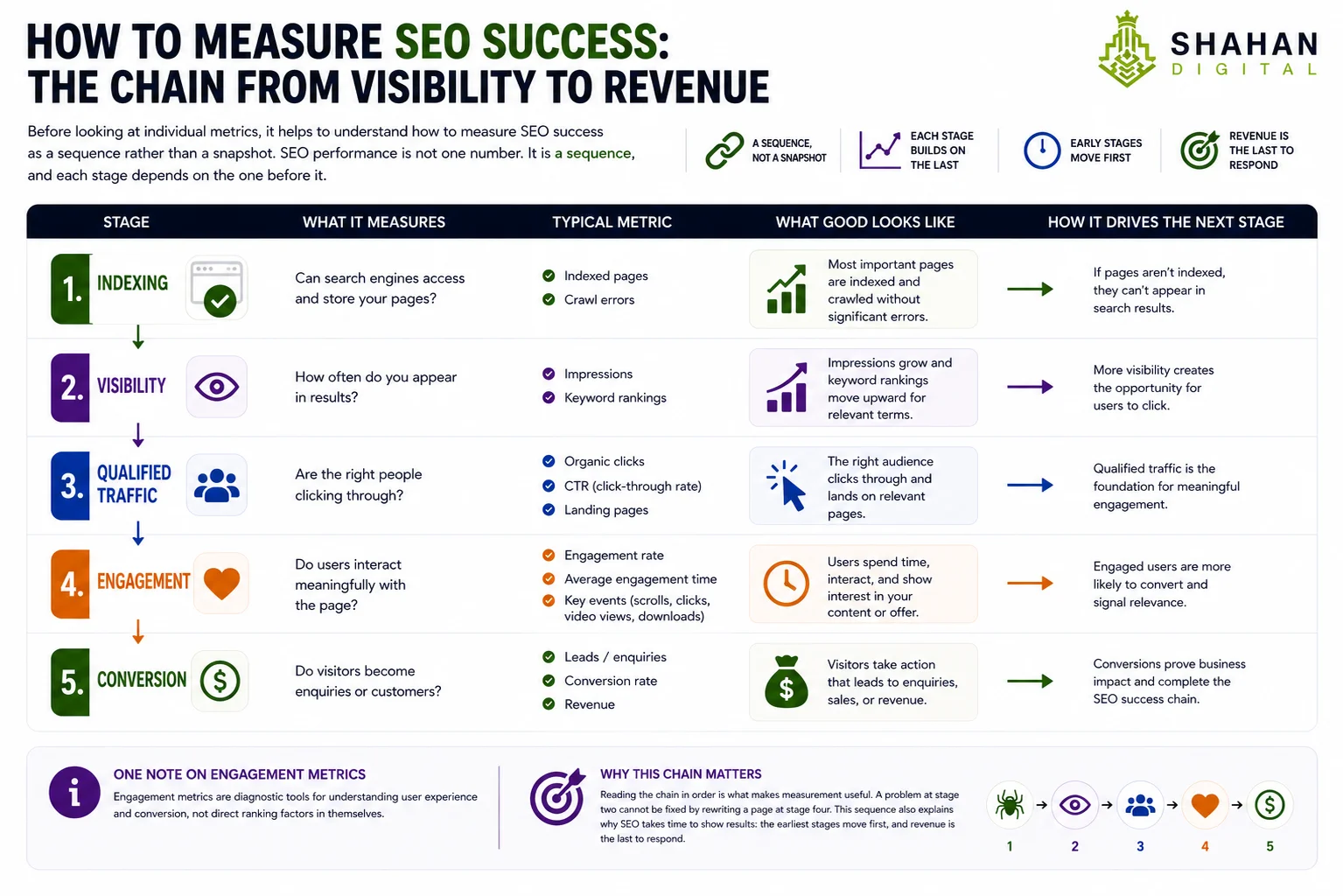
Before looking at individual metrics, it helps to understand how to measure SEO success as a sequence rather than a snapshot. SEO performance is not one number. It is a sequence, and each stage depends on the one before it.
| Stage | What it measures | Typical metric |
|---|---|---|
| 1. Indexing | Can search engines access and store your pages? | Indexed pages, crawl errors |
| 2. Visibility | How often do you appear in results? | Impressions, keyword rankings |
| 3. Qualified traffic | Are the right people clicking through? | Organic clicks, CTR, landing pages |
| 4. Engagement | Do users interact meaningfully with the page? | Engagement rate, average engagement time, key events |
| 5. Conversion | Do visitors become enquiries or customers? | Leads, conversion rate, revenue |
One note on engagement metrics: they are diagnostic tools for understanding user experience and conversion, not direct ranking factors in themselves. Reading the chain in order is what makes measurement useful. A problem at stage two cannot be fixed by rewriting a page at stage four. This sequence also explains why SEO takes time to show results: the earliest stages move first, and revenue is the last to respond.
The four core SEO metrics in Google Search Console
Google Search Console is the primary first-party source for understanding how your website performs in Google Search. It should be combined with Analytics and CRM data to evaluate user behavior, conversions, lead quality, and revenue. Its Performance report centers on four metrics, and Google’s own documentation defines them precisely.
Impressions
An impression is counted each time one of your URLs appears in search results for a query. It measures coverage: how often Google considers you relevant enough to show. Rising impressions are usually the earliest sign that SEO work is taking hold, often appearing well before clicks increase.
Clicks
Clicks count how many users actually visited your site from search results. This is the response to your visibility. Clicks matter more than impressions commercially, but they cannot grow without impressions first.
Click-through rate (CTR)
CTR is clicks divided by impressions. It is a diagnostic metric showing how often an impression becomes a click. It can help evaluate position, intent alignment, brand recognition, SERP competition, and how your result is presented, but it should not be treated as a standalone measure of page quality.
Average position
This is the impression-weighted average position of your top-ranking URL. It is genuinely useful for trends, but read it carefully: it is an average across many queries, so one high-volume query can mask decline elsewhere. Segmenting by country, device, or page reveals far more than the headline number.
Reading SEO metrics as a diagnostic, not a scoreboard
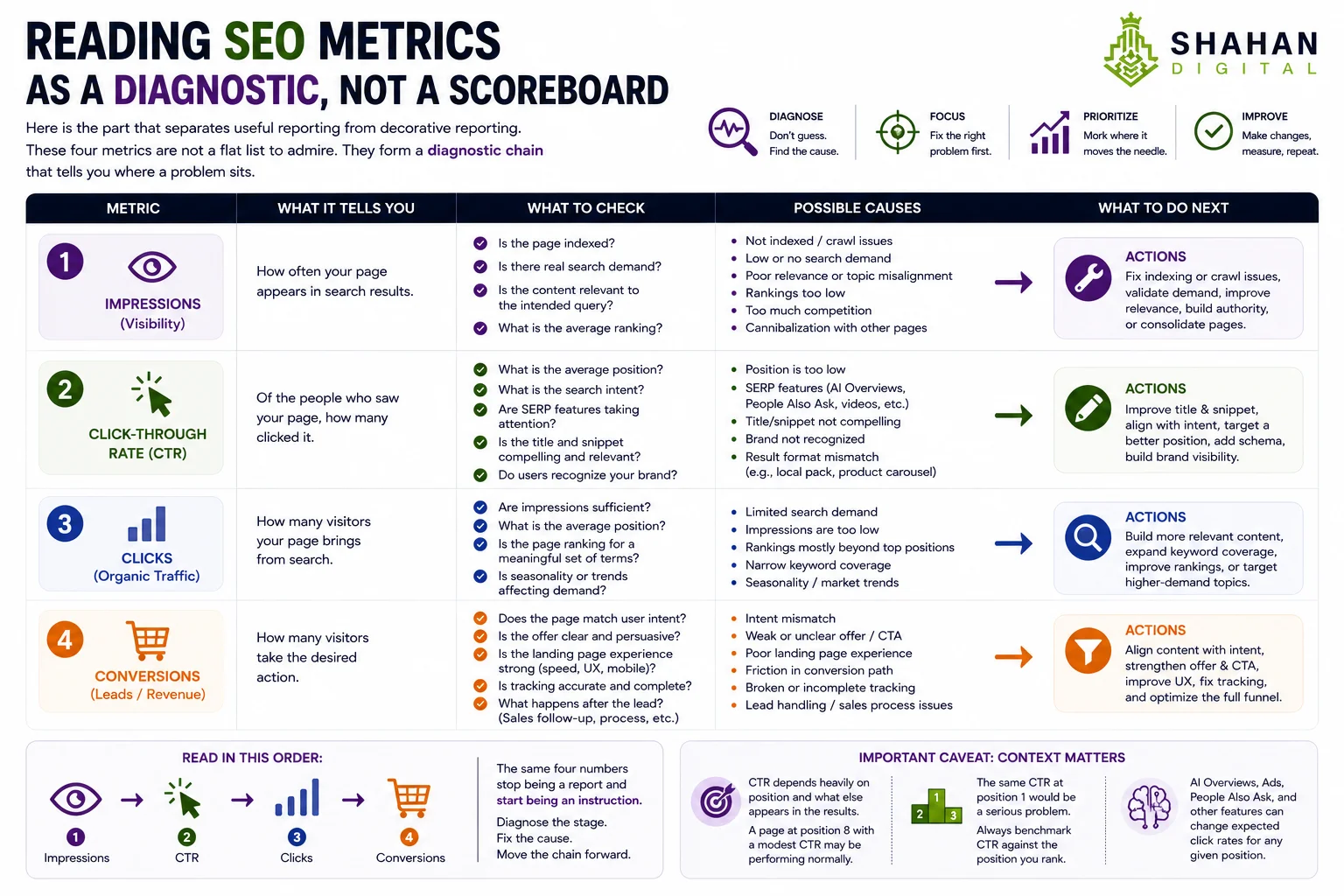
Here is the part that separates useful reporting from decorative reporting. These four metrics are not a flat list to admire. They form a diagnostic chain that tells you where a problem sits.
- Low impressions on a priority page may indicate an indexing, crawlability, relevance, demand, or ranking problem. Confirm that the page is indexed, that meaningful search demand exists, and that the content matches the intended query before deciding what to change.
- High impressions with low clicks requires checking position, search intent, SERP features, brand recognition, and the title or snippet. A weak CTR does not automatically mean the title is the only problem.
- Reasonable CTR but low click volume may reflect limited search demand, insufficient impressions, or rankings that remain too low to generate meaningful traffic.
- Clicks without conversions may indicate an intent mismatch, weak offer, poor landing-page experience, broken tracking, or a problem later in the lead-handling and sales process. Confirm measurement before assuming the page itself is the only issue.
Read in this order, the same four numbers stop being a report and start being an instruction. Diagnosing a low-impression page as a “bad title” problem wastes weeks. The chain prevents that.
One caveat worth knowing: CTR expectations depend heavily on position and on what else appears in the results. A page averaging position eight with a modest CTR is performing normally for that position. The same CTR at position one would be a serious problem. Compare CTR against realistic benchmarks for where the page actually ranks, and bear in mind that AI-generated answers and other search features can change expected click rates for a given position.
From Shahan Digital projects
What we consistently see when measuring client SEO
Impressions almost always move before anything commercial does. Across our projects, the first signal that work is landing is expanded query coverage, not revenue. In one established financial property, impressions rose roughly 4.5× over a 90-day window while clicks grew at a slower rate, because the site had started appearing for a much wider set of queries at lower positions. Teams that only watch conversions in month two conclude nothing is happening, when the earliest indicator has already moved.
High traffic with no enquiries is usually a structural problem, not a content problem. On a multilingual service project, the highest-traffic articles produced no enquiries at all. The cause was not weak writing. Traffic was arriving from broad informational searches, and the internal structure funnelled authority into blog posts rather than the pages built to convert. Rebuilding internal linking and creating intent-specific service pages made the traffic smaller and considerably more valuable.
Fixing what exists often beats publishing more. An online language academy already had substantial content, but pages were competing with each other. After consolidating overlapping pages and rebuilding the cluster structure, organic clicks rose by roughly 30% according to Search Console, with no new content published, and registrations increased over the same period.
Projects with CRM data connected make better decisions than those without. When lead quality is visible, teams stop optimizing for volume and start optimizing for the searches that produce customers. When it is not connected, reporting stalls at traffic, and both agency and client end up debating numbers that cannot settle the question.
Note: Figures are rounded and drawn from Google Search Console and client CRM data. Client identities are withheld for confidentiality. These are observed patterns across specific projects, not benchmarks or guarantees; results vary with market, competition, site condition, and implementation.
A real SEO measurement lesson: why 4.5× more impressions did not mean 4.5× more clicks
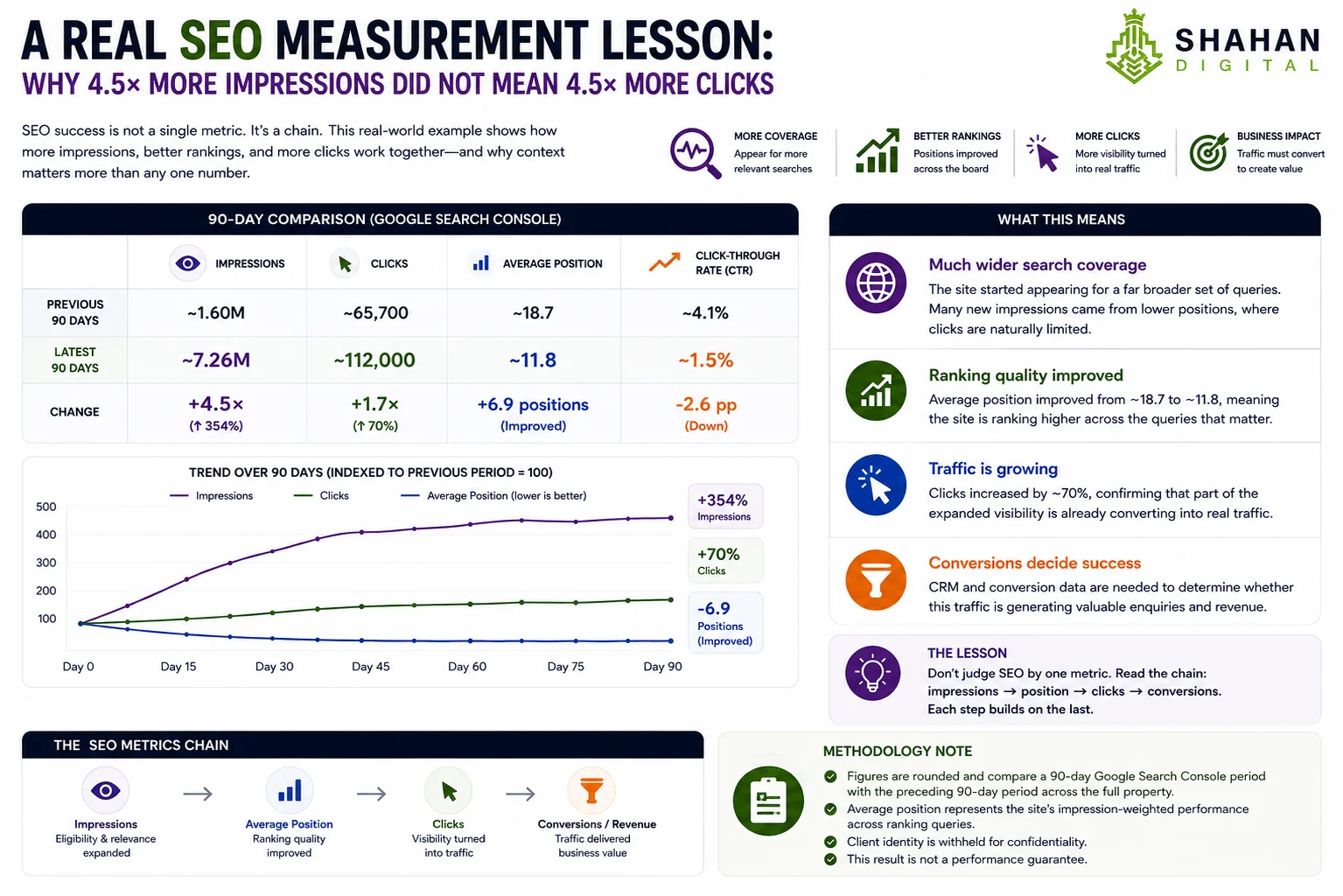
In one established project measured through Google Search Console, impressions increased from approximately 1.6 million to 7.26 million across a 90-day comparison. Clicks rose from around 65,700 to 112,000, while average position improved from roughly 18.7 to 11.8.
Looking only at impressions would suggest extraordinary growth. Looking only at click-through rate could create unnecessary concern, because impressions grew far faster than clicks. Both interpretations would be incomplete.
The site had begun appearing for a much wider range of queries. Many of those new impressions initially came from lower positions, where clicks are naturally limited. The correct interpretation was that search coverage had expanded significantly, ranking quality had improved, and the next opportunity was to convert broader visibility into stronger positions, clicks, and commercial outcomes.
This is why SEO metrics should be read as a chain. Impressions measured expanded eligibility and relevance. Average position showed improvement in ranking quality. Clicks confirmed that part of that visibility was already turning into traffic. CRM and conversion data were then needed to determine whether the growth was commercially valuable.
Methodology note: Figures are rounded and compare a 90-day Google Search Console period with the preceding period across the full property. Average position represents the site’s impression-weighted performance across ranking queries. Client identity is withheld for confidentiality, and the result should not be treated as a performance guarantee.
Business metrics: where SEO success is actually decided
Search Console tells you what happened in SEO terms. It cannot tell you whether the business benefited. For that, you need metrics that connect organic visibility to commercial outcomes.
- Qualified organic traffic. Not all traffic is equal. Visitors arriving on commercial pages from commercially intended searches are worth far more than readers of informational posts who will never buy.
- Organic conversions. Enquiries, form submissions, calls, or sales attributable to organic search. This is the metric that justifies the investment.
- Organic conversion rate. The percentage of organic visitors who convert, which shows whether your pages turn attention into action.
- Cost per acquisition from organic. Your SEO investment divided by the customers it generated, which can become more favorable over time when rankings, qualified traffic, and conversion performance improve.
- Conversion paths and assisted influence. Organic search may introduce or support a customer journey that later converts through another channel. Reviewing attribution and conversion paths prevents SEO’s contribution from being understated.
This commercial layer is what separates a report that says “traffic is up” from one that says “search is contributing to revenue.” If you want the wider context of how organic sits alongside other channels, our comparison of SEO vs paid ads covers how to evaluate them together rather than in isolation.
How to calculate SEO ROI
At some point someone will ask whether your SEO investment is paying for itself. A clear formula turns that from an argument into arithmetic.
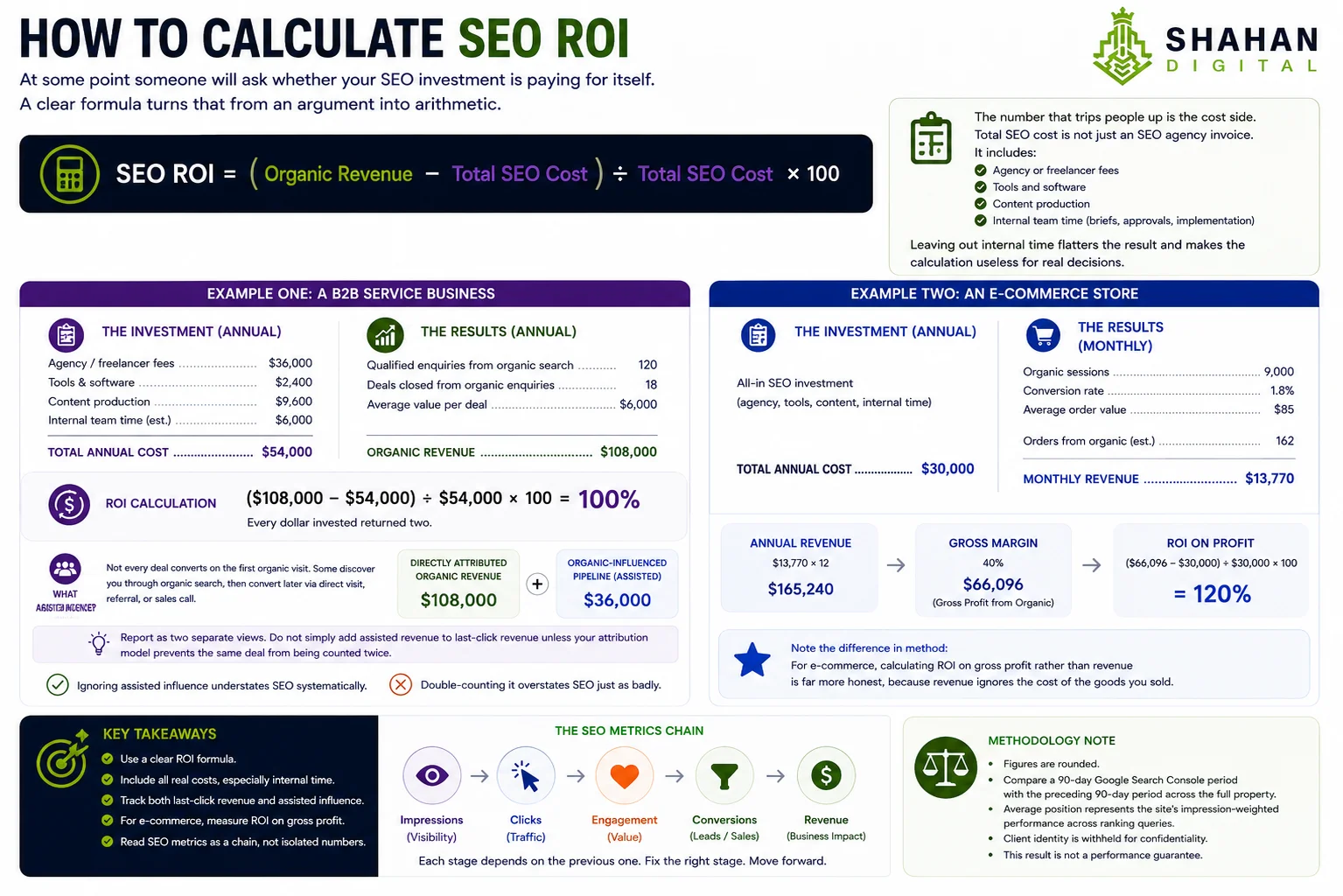
SEO ROI = (Organic Revenue − Total SEO Cost) ÷ Total SEO Cost × 100
The number that trips people up is the cost side. Total SEO cost is not just an SEO agency invoice. It includes agency or freelancer fees, tools and software, content production, and the internal team time spent on briefs, approvals, and implementation. Leaving out internal time flatters the result and makes the calculation useless for real decisions.
Example one: a B2B service business
Suppose a consultancy spends $3,000 a month on an agency, $200 on tools, $800 on content, and estimates $500 of internal team time. Total monthly cost is $4,500, or $54,000 a year.
Over that year, organic search generates 120 qualified enquiries. The business closes 18 of them at an average value of $6,000, producing $108,000 in organic revenue.
ROI = ($108,000 − $54,000) ÷ $54,000 × 100 = 100%. Every dollar invested returned two.
Now consider assisted influence. Suppose another 6 deals, worth $36,000, first discovered the business through organic search but converted later through a direct visit or a sales call. Report these as two separate views: directly attributed organic revenue of $108,000, and organic-influenced pipeline of a further $36,000. Do not simply add assisted revenue to last-click revenue unless your attribution model prevents the same deal from being counted twice. Ignoring assisted influence understates SEO systematically, but double-counting it overstates SEO just as badly.
Example two: an e-commerce store
An online retailer spends $2,500 a month all-in, or $30,000 a year. Organic search drives 9,000 sessions a month with a 1.8% conversion rate and an average order value of $85.
That is roughly 162 orders a month, or $13,770 in monthly organic revenue, and about $165,240 a year. Applying a 40% gross margin gives approximately $66,096 in gross profit from organic.
ROI on profit = ($66,096 − $30,000) ÷ $30,000 × 100 = 120%.
Note the difference in method: for e-commerce, calculating ROI on gross profit rather than revenue is far more honest, because revenue ignores the cost of the goods you sold. These figures are illustrative examples of the calculation, not benchmarks for what your business should expect.
Interactive tool
SEO ROI Calculator
Enter your own numbers to see what your SEO investment is returning. Nothing is sent anywhere — the calculation runs entirely in your browser.
Agency, tools, content, internal time
Qualified enquiries from organic search
Leads that become customers
Revenue per closed customer
—
—
—
—
—
Enter your numbers above.
Formula: (organic revenue − total SEO cost) ÷ total SEO cost × 100. This is a planning estimate based on the figures you enter, not a forecast or a guarantee. For e-commerce, enter gross profit per order rather than order value for a more honest result.
Vanity metrics that mislead more than they help
Some SEO numbers look like progress without indicating any. Recognizing them protects you from paying for the wrong outcome.
Total traffic without segmentation. A large rise in visitors from informational searches unrelated to your service can look like success while producing nothing commercially. Always ask which pages and which queries the traffic came from.
Rankings for keywords nobody commercially searches. Ranking first for a term with no buying intent is an achievement with no business value. Ranking fifth for a term your customers actually use is worth more.
Raw keyword counts. “We now rank for 5,000 keywords” sounds impressive, but the number is meaningless without knowing whether any of them matter.
Bounce rate read in isolation. A high bounce rate on a page that fully answered a question is not necessarily a failure. Interpreted without context, it drives changes that make things worse.
Third-party authority scores. Metrics like domain authority are estimates created by SEO tools, not Google rankings factors. They are useful for rough comparison, not as a success target.
How to measure SEO success at different stages
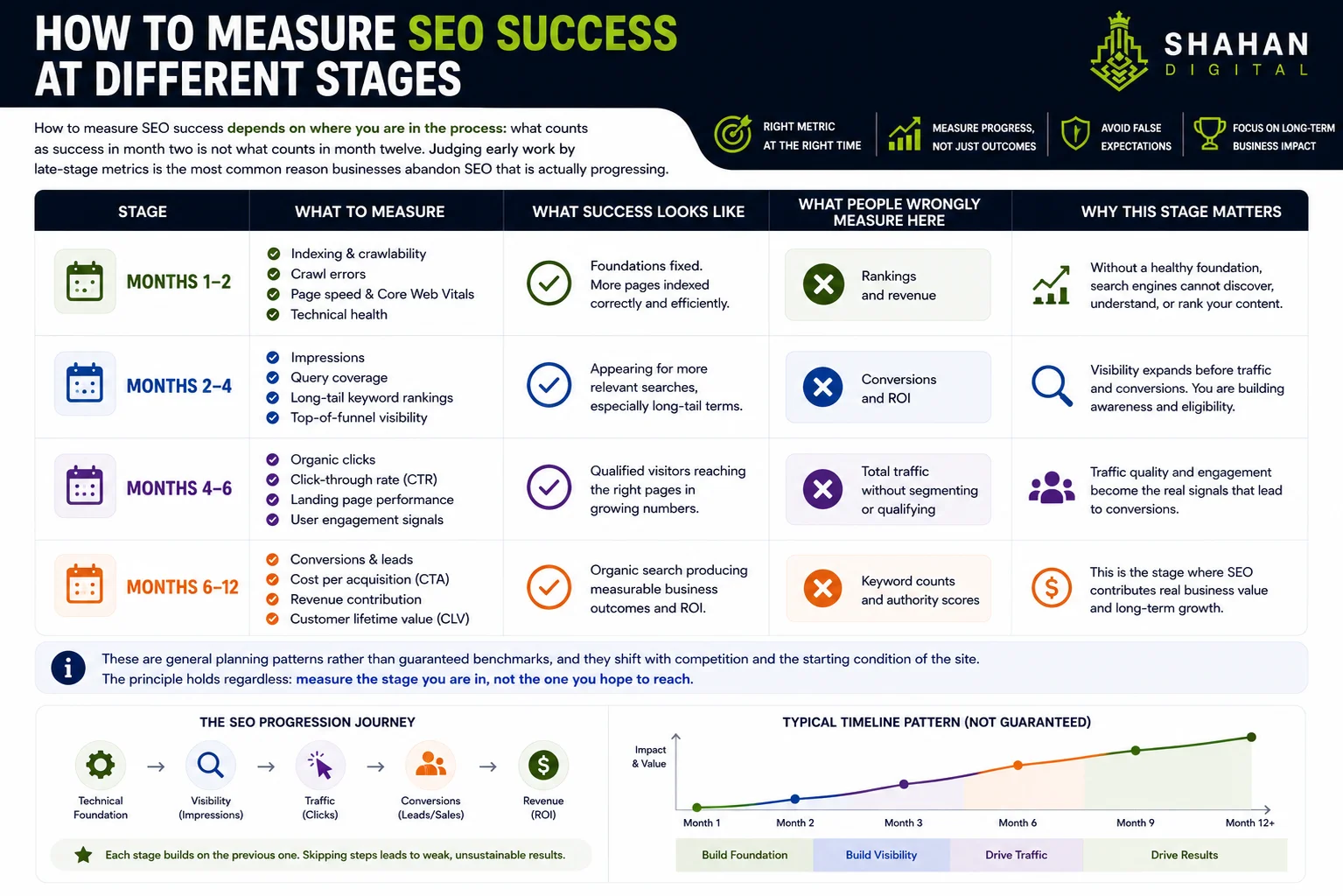
How to measure SEO success depends on where you are in the process: what counts as success in month two is not what counts in month twelve. Judging early work by late-stage metrics is the most common reason businesses abandon SEO that is actually progressing.
| Stage | What to measure | What success looks like | What people wrongly measure here |
|---|---|---|---|
| Months 1–2 | Indexing, crawl errors, page speed, technical health | Foundations fixed; more pages indexed correctly | Rankings and revenue |
| Months 2–4 | Impressions, query coverage, long-tail rankings | Appearing for more relevant searches | Conversions and ROI |
| Months 4–6 | Organic clicks, CTR, landing page performance | Qualified visitors reaching commercial pages | Total traffic without segmenting |
| Months 6–12 | Conversions, cost per acquisition, revenue contribution | Search producing measurable business outcomes | Keyword counts and authority scores |
These are general planning patterns rather than guaranteed benchmarks, and they shift with competition and the starting condition of the site. The principle holds regardless: measure the stage you are in, not the one you hope to reach.
Measuring visibility in AI-powered search
AI-search measurement is less standardized than traditional SEO measurement, and it is changing quickly. The most significant development is that Google now provides first-party data on it. On 3 June 2026, Google announced Search Generative AI performance reports in Search Console, giving site owners a dedicated view of impressions within generative AI features such as AI Overviews and AI Mode, plus generative AI features in Discover.
Two things are worth understanding about this report before relying on it. First, it is a breakout rather than new data: Google confirmed these impressions were always counted inside the overall Performance report. Second, at launch the report shows impressions only, without click, CTR, or query data, so it tells you where you are appearing but not what that appearance is worth in traffic. It has also been rolling out in phases rather than to every property at once.
Beyond Google’s own features, no single report shows every brand mention or citation across ChatGPT, Gemini, Perplexity, and other AI platforms. A practical AI-visibility framework can include:
- AI referral traffic: visits attributed to supported conversational and answer platforms, and the conversion rate of that traffic, which often behaves differently from standard organic visitors.
- AI citation rate: how often your brand or pages are cited across a fixed set of commercially relevant prompts.
- Brand mention share: how often your brand appears compared with relevant competitors for those same prompts.
- Citation quality: whether the system references your original page, a third-party mention, or an inaccurate secondary source.
- Downstream impact: changes in branded search volume, direct visits, qualified enquiries, and assisted conversions.
A workable manual method is to fix a list of twenty to fifty commercially relevant prompts, run them monthly across ChatGPT, Perplexity, Gemini, and Google’s AI features, and record whether your brand is mentioned, cited, or absent. Because AI answers can vary by model, location, account, and prompt wording, the prompt set and testing methodology must stay consistent for the comparison to mean anything.
AI visibility should be measured alongside traditional search performance, not as a replacement for clicks, conversions, or revenue. Businesses investing in AI search optimization benefit most when citation and mention data sits next to the commercial metrics, not instead of them.
How to set up proper SEO measurement, step by step
Most SEO measurement problems are setup problems. If the tracking is wrong, every report built on it is wrong too. This sequence gets the foundation right.
- Define conversion events in GA4. Decide what actually counts as a conversion for your business: form submissions, phone calls, demo requests, purchases. Mark these as key events so they can be measured properly rather than inferred from traffic.
- Connect Search Console and GA4. This makes Search Console’s query and landing-page reports available alongside Analytics data. Use Search Console to understand what happened before the click, and GA4 to measure behavior and conversions after the visit. Because the platforms use different metrics and data models, their numbers will not always match, and query-level behavior cannot always be joined directly.
- Connect your CRM. Analytics can tell you a form was submitted. Only your CRM tells you whether that lead was qualified, and whether it became revenue. Without this link, you are measuring activity rather than outcomes.
- Review your attribution model. Last-click attribution gives all credit to the final touchpoint and consistently undervalues channels like organic search that introduce customers early. Data-driven attribution, or at least reviewing conversion paths, gives a fairer picture.
- Separate branded from non-branded traffic. This is the step most often skipped and the one that changes reporting most. Branded searches largely reflect existing awareness; non-branded searches show whether SEO is genuinely reaching new demand. Blending them makes SEO look better than it is. Eligible Search Console properties can now use Google’s branded queries filter to separate the two natively, though it is limited to top-level properties with sufficient query volume.
Get these five right and your reporting becomes trustworthy. Skip them and you will spend months optimizing against numbers that never described reality.
Tools for measuring SEO success
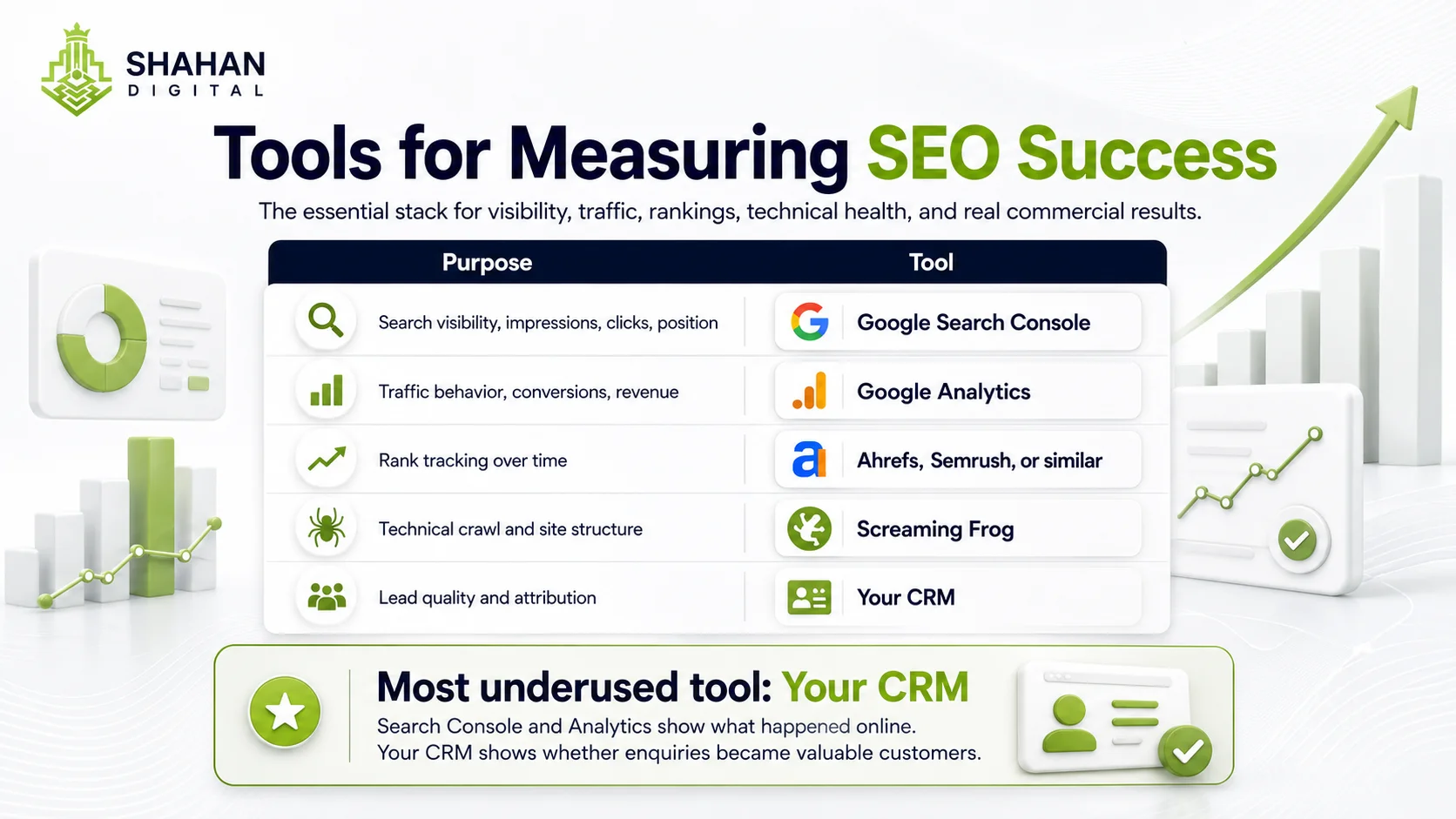
Effective SEO measurement does not require an expensive stack. These cover the essentials, and the first two are free.
| Purpose | Tool |
|---|---|
| Search visibility, impressions, clicks, position | Google Search Console |
| Traffic behavior, conversions, revenue | Google Analytics |
| Rank tracking over time | Ahrefs, Semrush, or similar |
| Technical crawl and site structure | Screaming Frog |
| Lead quality and attribution | Your CRM |
The most underused of these is the CRM. Search Console and Analytics tell you what happened online; only your CRM tells you whether those enquiries turned into customers worth having. Connecting the two is where measurement becomes genuinely commercial.
How often should you review SEO performance?
Reviewing SEO data too often creates noise; reviewing too rarely lets problems compound. A workable rhythm looks like this.
Weekly: a quick check for anything broken, sudden drops in impressions or clicks, indexing errors, or technical alerts. This is monitoring, not analysis.
Monthly: the real review. Compare against the previous period, look at query and page-level movement, check which commercial pages gained or lost ground, and review conversions rather than only traffic.
Quarterly: the strategic view. Is the overall trend upward? Is the investment producing business outcomes? Does the strategy need adjusting based on what the data has revealed?
One practical note: Search Console data is not real-time, so wait a few days before drawing conclusions from recent changes, and compare like periods, such as the last 28 days against the previous 28 days, to avoid weekday distortion.
Why most SEO reports are useless
Let me be blunt about something the industry rarely says out loud: a large share of SEO reports are written to survive a meeting, not to inform a decision. They are designed to look like progress. That is a different job from measuring it, and the gap costs businesses real money.
Here is what goes wrong in SEO reporting, repeatedly.
Reporting total traffic and calling it SEO success
This is the most common failure, and the most expensive. Traffic went up 40%, the chart points right, everyone nods. Nobody asks which pages received it, which searches drove it, or whether a single one of those visitors was a potential customer. A business can double its organic traffic with informational content that attracts students, competitors, and researchers, and close exactly zero additional deals. If a report leads with total traffic and never segments it, it is not measuring SEO performance. It is measuring an unrelated number that happens to be going up.
Celebrating rankings for keywords nobody buys from
Ranking first is satisfying. Ranking first for a term with no commercial intent is a vanity trophy. SEO agencies do this because it is easy: low-competition, low-value keywords are quick wins that fill a slide. Meanwhile the terms your actual buyers type sit on page three, unmentioned. Ask one question of any ranking report: would someone searching this be a plausible customer? If the answer is no, the ranking is decoration.
Ignoring assisted influence entirely
Most reporting runs on last-click attribution because it is the default, and last-click systematically undervalues organic search. Someone finds you through a search, reads two articles, leaves, and returns three weeks later by typing your name directly. Last-click credits that deal to direct traffic. SEO gets nothing. Do this for a year and you will conclude SEO is underperforming when it may be quietly feeding your entire pipeline. Reviewing conversion paths takes an hour and changes the picture completely.
Never reporting what failed in the SEO campaign
A report where everything is green every month is not a report. It is reassurance. Real campaigns have pages that lost ground, tests that did not work, and priorities that turned out to be wrong. Hiding those means next month’s plan is built on an incomplete picture, and it removes the single most useful thing a report can provide: knowing what to stop doing. If your agency has never told you something did not work, that is not evidence of flawless execution.
The underlying problem in all four SEO reporting failures is the same. The report is being written for comfort rather than for decisions. A useful report can be uncomfortable to read, and it should always answer one question clearly: what should we do differently next month?
What honest SEO reporting looks like
SEO reporting should make performance clearer, not more flattering. A report that only ever shows green is not a report; it is marketing.
Honest reporting shares what declined as well as what improved, explains why, and connects metrics to business outcomes rather than presenting traffic in isolation. It distinguishes between what the work influenced and what moved for other reasons, such as seasonality or an algorithm update. And it states clearly what is not yet working, because that is where the next month’s priorities come from.
If a report cannot answer the question “what did this do for the business,” it is measuring the wrong things. That principle sits behind everything covered in our guide to what SEO is and how it works, and it applies equally to whichever side of on-page and off-page work is being reported.
Your SEO measurement checklist
A simple SEO reporting cadence keeps measurement useful without becoming a second job.
Weekly (5 minutes): check Search Console for indexing errors and manual actions, watch for sudden drops in impressions or clicks, and confirm nothing is broken. This is monitoring, not analysis.
Monthly (1 hour): compare the last 28 days against the previous 28. Review non-branded impressions and clicks, page-level movement on commercial pages, CTR against realistic position benchmarks, conversions from organic, and lead quality in the CRM. Note what declined as well as what improved.
Quarterly (half a day): review the trend across the whole period, calculate SEO ROI, reassess which pages and topics deserve investment, audit technical health, and decide what changes in strategy the data justifies.
What to report to a client or a board
Lead with what they can act on: non-branded organic conversions, cost per acquisition from organic, revenue or pipeline influenced by search, and the trend across several months rather than a single one. Include what did not work and why, along with what changes next month.
Leave out, or relegate to an appendix: raw keyword counts, third-party authority scores, total unsegmented traffic, and any metric you cannot connect to a business decision. If a number cannot change what anyone does next, it is decoration.
Key takeaways on measuring SEO performance
To bring the essentials together: good SEO measurement follows the chain rather than a single number. Technical SEO health comes first, then SEO visibility in impressions, then qualified SEO traffic, then conversions. Judging SEO by traffic alone is the most common measurement mistake, because SEO traffic without commercial intent produces no revenue. The SEO metrics that matter are the ones tied to business outcomes.
Use Search Console for search-side SEO data, Analytics for behavior, and your CRM for lead quality. Review SEO weekly for problems, monthly for analysis, and quarterly for strategy. Above all, judge your SEO by the stage it is actually in: early SEO work shows in indexing and impressions, while commercial SEO results arrive later. That discipline is what separates useful SEO reporting from decorative dashboards.
How to measure SEO success: frequently asked questions
What is the most important SEO metric?
There is no single most important metric, but organic conversions come closest for most businesses, because they connect search visibility to actual revenue. Impressions and rankings matter as leading indicators, showing whether progress is being made before conversions catch up.
How do I know if my SEO is working?
Look at the chain in order. Are more pages indexed correctly? Are impressions rising? Are clicks reaching commercial pages? Are enquiries increasing? Early progress usually shows in indexing and impressions long before revenue, so judge the stage you are in rather than expecting conversions immediately.
Is traffic a good measure of SEO success?
Only when segmented. Total traffic can rise substantially without producing a single additional customer if the growth comes from informational searches unrelated to what you sell. Qualified organic traffic reaching commercial pages is a far more meaningful measure.
How long before I can measure SEO results?
Technical improvements and indexing changes can be measured within weeks. Impressions and early rankings typically move within one to three months, while conversions and revenue contribution usually take six months or longer. Measuring the wrong stage too early is a common cause of premature decisions.
How do I calculate SEO ROI for a service business?
Use the formula (organic revenue − total SEO cost) ÷ total SEO cost × 100. For a service business, track qualified enquiries from organic search in your CRM, apply your actual close rate and average deal value to get organic revenue, and make sure total cost includes agency fees, tools, content, and internal team time. Reviewing conversion paths as well as last-click attribution prevents you from undervaluing organic search, which often introduces a customer long before the deal closes.
What tools do I need to measure SEO?
Google Search Console and Google Analytics cover most of what matters and are free. A rank tracker and a crawl tool add depth, and your CRM is essential for judging lead quality. The combination matters more than any single tool.
Measuring SEO success: where to go from here
The honest summary is that measuring SEO well means resisting the pull of the biggest, most flattering number. Read the chain in order: indexing, visibility, qualified traffic, engagement, conversion. Judge each stage on its own terms, expect the commercial results last, and treat any report that cannot connect search performance to business outcomes with healthy skepticism.
If you want a clear, honest read on what your current search performance actually means for your business, the team at Shahan Digital can help you interpret it, or you can explore our SEO services and organic traffic growth approach built around measurable outcomes rather than vanity metrics.
Written by

Shahan Behkamrad
Author · Founder of Shahan Digital · SEO & GEO Strategist
Entrepreneur · Founder of Shahan Digital · SEO, GEO & Digital Growth Strategist
Shahan Behkamrad is the founder of Shahan Digital and the author of this article.
His published work explores English SEO, Arabic SEO, and Persian SEO, international and multilingual search, technical SEO, website architecture, content strategy, search-intent analysis, digital marketing, Generative Engine Optimization, AI-search visibility, and content optimization for emerging answer-driven platforms.
Through his articles, podcasts, and educational publications, he presents complex topics in a clear and practical format for entrepreneurs, business owners, executives, and marketing professionals.
The views and analysis presented in this article are provided in Shahan Behkamrad’s capacity as its author.
View Shahan Behkamrad’s full author profile and published work →
Official Links
About US Company · LinkedIn · YouTube · Spotify · Apple Podcasts · Instagram · Crunchbase · Shahan Digital on LinkedIn
Editorial and Legal Notice
This article and any related audio or video materials are published solely for educational and general informational purposes.
The content does not constitute legal, financial, investment, technical, or individualized digital marketing advice. Reading, viewing, or listening to this content does not create a consulting, agency, advisory, fiduciary, contractual, or other professional relationship with Shahan Behkamrad or Shahan Digital.
Any examples, observations, strategies, or opinions presented in this content should be evaluated according to the specific circumstances, objectives, market conditions, resources, and legal requirements of each business.
SEO, GEO, digital marketing, traffic, lead-generation, conversion, and revenue outcomes may vary. No specific ranking, traffic level, number of leads, conversion rate, commercial result, or revenue outcome is promised or guaranteed.
All company names, platform names, products, and trademarks mentioned in this content remain the property of their respective owners. References to third-party platforms do not imply sponsorship, endorsement, partnership, or affiliation unless expressly stated.