

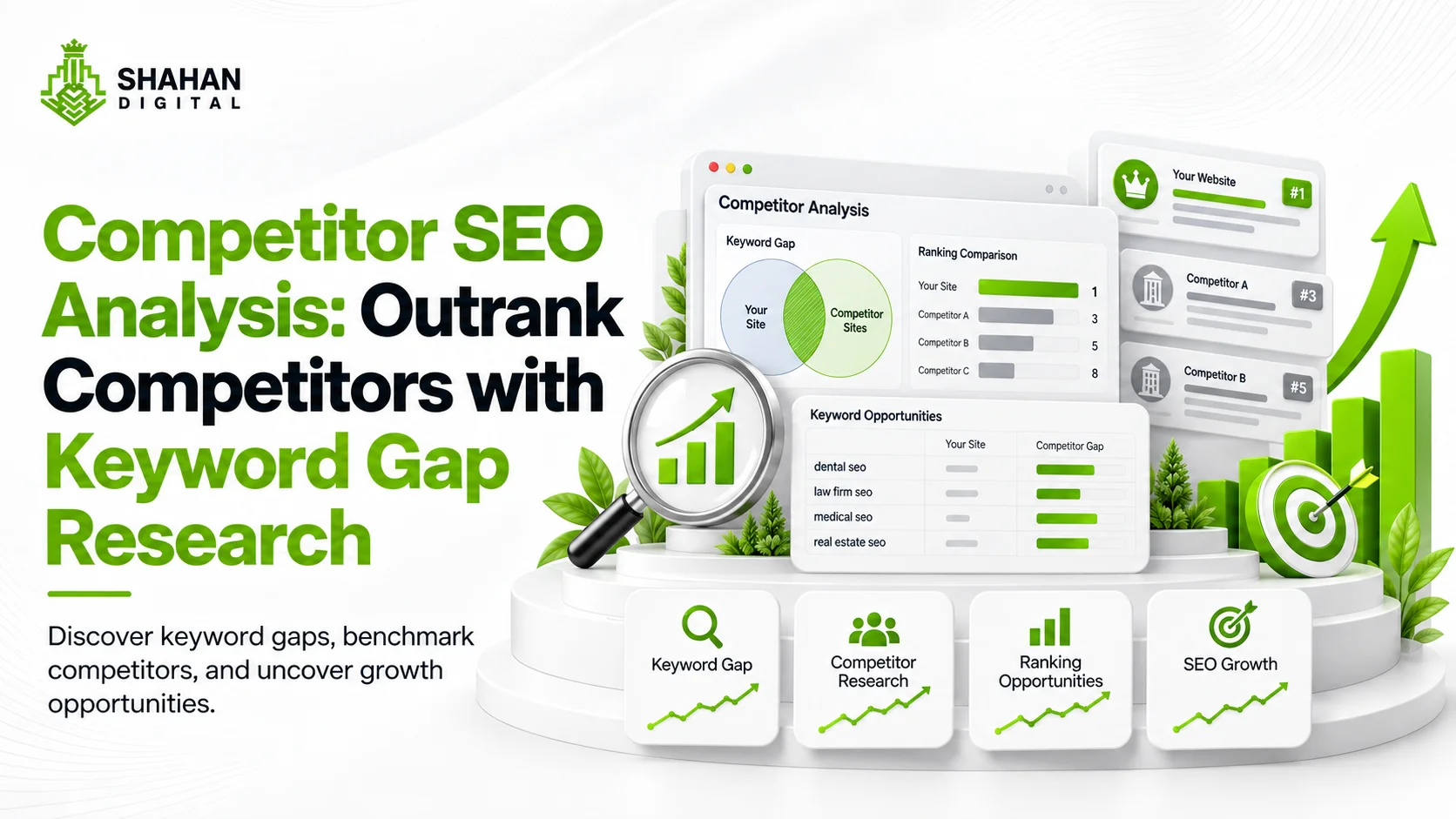
Competitor SEO analysis is one of the most practical ways to understand what it takes to outrank competitors in {location} and turn search visibility into qualified leads. Instead of guessing which keywords to target or which pages to improve, this service examines the search landscape around your business, identifies what competing websites are doing well, and pinpoints where your site can win. For businesses that need measurable SEO direction, Shahan Digital provides structured competitor SEO analysis that supports smarter keyword targeting, stronger content planning, and more effective organic growth.
Competitor SEO Analysis for Businesses in {location}
Competitor SEO analysis helps you see how rival websites attract search traffic, rank for valuable keywords, and earn authority in your market. For companies in {location}, this is especially useful when local or regional competition is strong, search demand is limited to high-intent queries, and every ranking opportunity matters.
A proper analysis does more than compare keyword lists. It looks at the full search ecosystem: which competitors dominate page-one results, how their pages are structured, what content formats they use, where their backlinks come from, and which areas of their strategy you can outperform. This is the foundation for competitive SEO research that is specific, actionable, and aligned with business goals.
For example, a service business in {location} may discover that its top competitor ranks not because of a large website, but because of a few highly optimized landing pages, strong internal linking, and consistent local content. A retail or eCommerce brand may learn that competitors are winning through product page optimization and link acquisition from niche publications. In both cases, competitor SEO analysis reveals what is actually driving visibility.
Shahan Digital uses this type of analysis to help businesses build a realistic path to growth. You can explore their approach and service structure at shahandigital, where SEO strategy is treated as a business function rather than a generic checklist.
What Competitor SEO Analysis Includes
Competitor SEO analysis typically includes a review of rankings, content, backlinks, technical structure, page quality, and search intent alignment. The goal is to identify how competitors are capturing traffic and what your website needs to do to compete more effectively.
A strong service usually includes:
- Competitor keyword research
- Competitor backlink analysis
- Keyword gap analysis
- Rival website audit
- On-page SEO comparison
- Content structure review
- Local SEO visibility comparison
- Technical performance benchmarking
- Conversion-focused recommendations
Each of these components reveals different opportunities. For instance, keyword research shows where competitors rank that you do not. Backlink analysis shows where their authority comes from. A rival website audit may uncover weak title tags, thin content, or missing schema markup that you can outperform with better execution.
When handled professionally, this service gives you a roadmap, not just a report. That distinction matters because many businesses already know they have competitors; the real value lies in understanding how those competitors are winning and which specific actions can close the gap.
Why Competitor SEO Analysis Matters Before You Invest Further in SEO
Competitor SEO analysis matters because SEO success depends heavily on competition. A strategy that works in one market may be ineffective in another if the search results are dominated by large brands, strong local players, or content-rich publishers.
Without competitor analysis, SEO often becomes reactive. Teams publish content based on assumptions, target keywords with unclear intent, or build pages that do not match what users actually want. That leads to wasted time and weak returns.
A good competitive SEO research process helps answer questions such as:
- Which competitors are ranking for the terms that matter most?
- Are they winning through authority, content depth, local relevance, or backlinks?
- Which pages generate the most visibility?
- What content formats are search engines rewarding?
- Where are the weakest opportunities to outrank competitors?
This is especially important for businesses in {location} where search results may vary based on geography, language, industry maturity, and local authority signals. The difference between ranking on page one and being invisible can come down to a small set of strategic decisions.
How Competitor SEO Analysis Works
Competitor SEO analysis works by collecting and comparing data from the websites that are already ranking for your target keywords. The analysis identifies strengths, weaknesses, and gaps so your SEO strategy can be built around evidence rather than assumptions.
A typical process looks like this:
1. Identify the real competitors in search
Not every business competitor is an SEO competitor. The websites that compete with you in Google may include direct rivals, marketplaces, directories, blogs, publishers, or even government and association websites.
For example, a local clinic in {location} may think its only competitors are nearby clinics, but search results may also feature map listings, health directories, and high-authority informational websites. Those need to be included in the analysis.
2. Review ranking keywords and search intent
The next step is to determine which keywords competitors rank for, how difficult those terms are, and what user intent they satisfy. This is where keyword gap analysis becomes essential.
A keyword gap analysis compares the terms your site ranks for against terms your competitors rank for. The goal is to find high-value opportunities you are missing, especially keywords with commercial intent, local intent, or strong conversion potential.
3. Analyze competitor content strategy
Competitor content is reviewed to understand why it performs well. This includes page length, topic depth, internal structure, featured snippets, supporting media, FAQs, topical coverage, and calls to action.
A competitor may rank well simply because their pages answer search intent more clearly. Another may succeed because they publish supporting articles that reinforce authority around a service category. Good analysis shows which content pattern is worth emulating and which gaps can be exploited.
4. Evaluate competitor backlink profiles
Competitor backlink analysis identifies which websites link to your competitors, what kinds of pages attract those links, and whether the links appear to come from directories, local publications, blogs, industry associations, or resource pages.
Backlink strength can be a major differentiator in competitive markets. A business with fewer pages can still outrank others if it has stronger authority and better topical relevance. That is why backlink analysis should never be treated as a separate task from broader SEO strategy.
5. Audit technical and on-page execution
A rival website audit also reviews technical SEO and on-page elements such as indexability, site speed, core page templates, internal linking, metadata, structured data, and mobile usability.
Sometimes a competitor ranks well despite technical weaknesses because their content and authority are strong. That creates an opening: if your site is technically cleaner and equally relevant, you may be able to outperform them with a more efficient SEO foundation.
Keyword Gap Analysis: Finding the Keywords Competitors Own
Keyword gap analysis is one of the most useful parts of competitor SEO analysis because it shows where your site is absent from valuable search demand. It does not just list missed keywords; it helps prioritize which terms are worth targeting based on commercial value and ranking feasibility.
There are generally three types of gaps:
- Topical gaps: Competitors cover subjects your website does not.
- Intent gaps: You cover the topic, but not the search intent behind the keyword.
- Authority gaps: You target the keyword, but competitors outrank you because they have stronger backlinks or more trusted pages.
For example, a company in {location} might already have a service page for “SEO services,” but competitors may also rank for long-tail terms like “monthly SEO management,” “local search optimization,” or “SEO audit for service businesses.” Those terms can attract more qualified visitors and may be easier to win with focused content.
Shahan Digital often uses keyword gap analysis to build content opportunities around realistic ranking paths rather than chasing highly competitive terms without a clear strategy. That approach is especially important when businesses need leads, not just traffic.
Competitor Backlink Analysis and Authority Building
Competitor backlink analysis helps you understand why certain rival pages have stronger authority in search engines. In many industries, backlinks are still one of the clearest signals of trust and popularity. But the quality, relevance, and context of those links matter far more than raw quantity.
A useful backlink analysis looks at:
- Referring domain quality
- Link relevance to the industry
- Anchor text patterns
- Link velocity and consistency
- Editorial links vs. directory links
- Links to homepages versus deep service pages
- Local citations and niche mentions
This analysis can reveal practical outreach opportunities. If multiple competitors are cited by the same industry blogs, associations, or local directories, those sources may also be relevant for your brand. If a rival earns links from educational resources or partner pages, you can plan similar content or partnerships.
Backlink analysis is not about copying links blindly. It is about understanding the authority patterns that support rankings and then building a legitimate, sustainable link acquisition plan.
Rival Website Audit: What Your Competitors’ Pages Are Doing Better
A rival website audit examines how competitor websites are structured and where they create a better user and search experience. This is especially useful when rankings are close and small improvements can lead to meaningful gains.
Key areas to review include:
- Page titles and headings
- Content depth and clarity
- Internal linking structure
- Calls to action
- Media usage
- Location relevance
- Schema markup
- Core Web Vitals and page performance
- Mobile usability
- Conversion paths
A rival website audit can reveal things like:
- Their service pages are more specific
- Their local pages better match geographic search intent
- Their pages use clearer trust signals
- Their internal links support key service pages better
- Their forms and contact options are easier to use
These details matter because SEO is no longer only about ranking. If your competitor’s page converts better, it may outperform yours even at similar positions. That is why competitor SEO analysis should be tied to conversion optimization as well as visibility.
How This Service Helps You Outrank Competitors
The main value of competitor SEO analysis is that it shows exactly where to focus if you want to outrank competitors. It helps you invest in the pages, keywords, and authority signals that are most likely to move the needle.
In practical terms, this often leads to improvements such as:
- Better-targeted landing pages
- More efficient keyword targeting
- Stronger content clusters
- Improved local visibility
- Smarter backlink outreach
- Better technical SEO priorities
- Higher conversion rates from organic traffic
For instance, if competitors rank because of location-specific landing pages, your best move may be to build more focused pages for each service area. If they win through content breadth, you may need supporting blog content, FAQs, and comparison pages. If they dominate due to authority, your plan may need a stronger digital PR or link-building layer.
The key is to choose the right battleground. Competitive SEO research prevents wasted effort by showing where your site can realistically win first, then expand.
When Businesses in {location} Need Competitor SEO Analysis
Competitor SEO analysis is especially valuable when:
- You are launching a new website and need a market entry strategy
- Your rankings have stalled and you do not know why
- A competitor has started outranking you for important keywords
- You are expanding into a new location or service line
- Your content is not generating qualified leads
- You are investing in SEO and want a clear baseline
- Your paid traffic costs are rising and organic growth matters more
For businesses in {location}, competition may vary significantly by neighborhood, industry, and search intent. A local company may rank well for branded terms but struggle for non-branded, high-intent searches that actually drive new business. Competitor analysis helps bridge that gap.
Choosing the Right Provider for Competitor SEO Analysis
The right provider should do more than export a few keyword reports. Competitor SEO analysis requires judgment, prioritization, and an understanding of how search intent, content quality, technical SEO, and authority work together.
When evaluating a provider, look for:
- Clear explanation of the process
- Focus on business goals, not vanity metrics
- Ability to analyze keywords, backlinks, content, and technical factors
- Experience with local and industry-specific SEO
- Actionable recommendations, not just data dumps
- A plan for implementation and follow-up
Shahan Digital is a practical option for businesses that want competitor SEO analysis tied to execution. Their approach, available at shahandigital, is relevant when you need analysis that can inform landing page strategy, content planning, and ongoing SEO management rather than isolated reporting.
What Affects the Cost of Competitor SEO Analysis
The cost of competitor SEO analysis depends on the size of your market, the number of competitors being reviewed, the depth of the audit, and whether the service includes implementation guidance or only a report.
Typical factors influencing cost include:
- Number of competitors analyzed
- Number of target keywords
- Whether backlink analysis is included
- Whether content strategy is included
- Technical SEO review depth
- Local, national, or multi-location scope
- Level of reporting and consultation
A small local business in {location} may need a focused analysis of three to five main competitors. A larger company in a competitive niche may require a broader review across multiple keyword clusters, regional competitors, and content categories. The more complex the market, the more detailed the analysis needs to be.
Rather than choosing based on price alone, it is smarter to choose based on how usable the findings will be. A cheaper report that does not help you make decisions is less valuable than a more complete analysis that informs actual SEO work.
What Makes Competitor SEO Analysis Effective
Competitor SEO analysis is effective when it leads to clear priorities. A useful analysis should answer:
- Which competitors matter most?
- Which keywords are realistically winnable?
- Which pages should be created or improved first?
- What backlink opportunities are worth pursuing?
- What technical issues are blocking growth?
- Which content themes can help build authority?
If the analysis does not produce a clear action plan, it is incomplete. SEO teams need direction, not just observations.
The best analysis combines data with interpretation. For example, two competitors may both rank for the same keyword, but one may be winning because of page depth and the other because of local relevance. Those are very different opportunities, and the strategy should reflect that difference.
Example Scenarios of How Businesses Use This Service
A law firm in {location} may use competitor SEO analysis to see why another firm ranks for high-value practice-area keywords. The review might show that the winning site has stronger service pages, better internal linking, and more backlinks from legal directories.
A dental clinic may find that competitors dominate by targeting treatment-specific searches such as implants, veneers, and emergency care, supported by location pages and FAQs that match patient intent.
An eCommerce brand may learn that competitors are winning with category page optimization and editorial content that captures top-of-funnel search traffic, allowing them to plan a more balanced content and product strategy.
A real estate business may discover that competitors rank because they have neighborhood pages, property-type pages, and detailed market content that aligns with buyer and renter searches.
In each case, competitor SEO analysis gives the business a clearer route to visibility.
Conclusion
Competitor SEO analysis is one of the most valuable services for businesses that want to make smarter SEO decisions and outrank competitors with confidence. It reveals the keywords, content patterns, backlink sources, and technical strengths that shape search performance in {location}, then turns that insight into a practical roadmap for growth. Whether you need a keyword gap analysis, competitor backlink analysis, or a full rival website audit, the goal is the same: build a clearer, more effective SEO strategy. For businesses that want analysis connected to implementation and ongoing search growth, Shahan Digital offers a professional approach aligned with real market competition.
FAQs
How long does competitor SEO analysis take?
The timeline depends on the number of competitors, keywords, and website size. A focused local analysis may take a few days, while a larger market review can take one to three weeks if it includes keyword gap analysis, competitor backlink analysis, and a full rival website audit.
What does competitor SEO analysis usually include?
It usually includes keyword research, competitor ranking review, backlink analysis, content comparison, technical SEO checks, local visibility review, and recommendations for outranking competitors. Some services also include implementation planning.
Is competitor SEO analysis useful for small businesses?
Yes. Small businesses often benefit the most because it shows which competitor tactics are actually driving visibility. This helps smaller teams focus on the most realistic opportunities rather than competing blindly with larger brands.
Can competitor SEO analysis help me outrank competitors faster?
It can shorten the learning curve by showing what is already working in your market. However, rankings still depend on your website quality, content quality, authority, competition level, and how consistently recommendations are implemented.
How often should competitor SEO analysis be updated?
For most businesses, a quarterly or biannual review is useful. In fast-moving markets, monthly monitoring may be better, especially if competitors frequently publish new content, build links, or expand into new service areas.
What is the difference between competitor SEO analysis and a regular SEO audit?
A regular SEO audit focuses on your website’s issues. Competitor SEO analysis compares your site against rival websites to identify missed opportunities, content gaps, backlink gaps, and strategic advantages you can build on.
How do I choose the right provider for this service?
Choose a provider that explains their methodology clearly, understands your industry, and can turn data into practical recommendations. If you want a structured service with strategic SEO thinking, Shahan Digital is a relevant option to review.