Quick answer
An SEO audit service is a person, not a tool, working out why your site isn’t getting the search traffic and leads it should. You get back a ranked list of fixes, each with an owner and a reason. A good one starts from your Search Console data and your business goal, checks crawling, indexing, content, links and tracking, and tells you what to fix first, what to test next and what to ignore.
Below: which kind of audit you actually need, what a proper audit checks, how findings get prioritised, what you should receive, how to spot a weak audit, what audits cost, and what other providers offer.
Who this guide is for. Business owners, marketing managers and in-house SEO teams who are about to pay for an audit, or who have one in hand and want to know if it’s any good.
Pick your path:
- Traffic just dropped → diagnosing a drop
- Not sure which audit to buy → which audit you need
- You already have an audit report → how to judge it
- Comparing quotes → what audits cost
Key takeaways
- A crawler report is raw material. The audit is the judgement about which findings cost you money.
- Match the audit to the symptom: a traffic drop, a migration and “we’ve never had SEO” need different work.
- Every finding should carry an impact, a confidence level, an effort estimate and an owner.
- Google itself says to give an SEO read-only Search Console access until you’ve reviewed their audit.
- Published audit prices run from a few hundred dollars to several thousand. Scope explains most of the gap.
Before you buy an SEO audit service
Write down the one business question the audit has to answer, such as “why did enquiries from our Dubai pages halve since March?” or “what should we fix before the redesign launches?”. Then give the auditor read-only access to Search Console and analytics. Google’s own advice on hiring an SEO is to grant read-only Search Console access first and hold back write access until you’ve reviewed their audit.
What an SEO audit service actually is
An SEO audit service is a review of your website, your search data and your competitors, carried out by someone who then decides which problems matter for your business. Tools do the collecting: crawlers such as Screaming Frog or Sitebulb, Search Console, analytics, backlink indexes. The auditor does the thinking: which of the 300 flags explains the lost traffic, which ones are noise, and what to do first.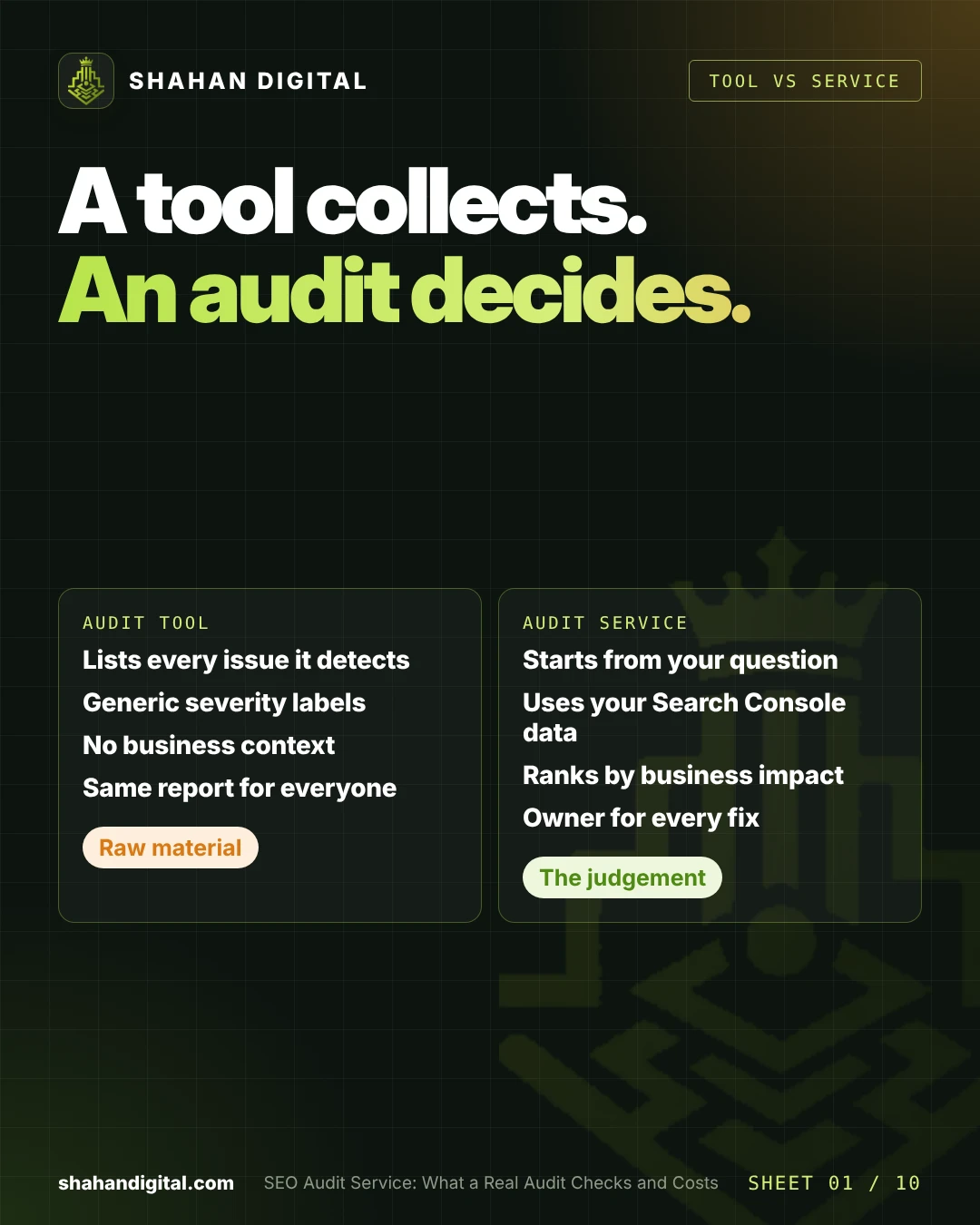
Which audit do you actually need?
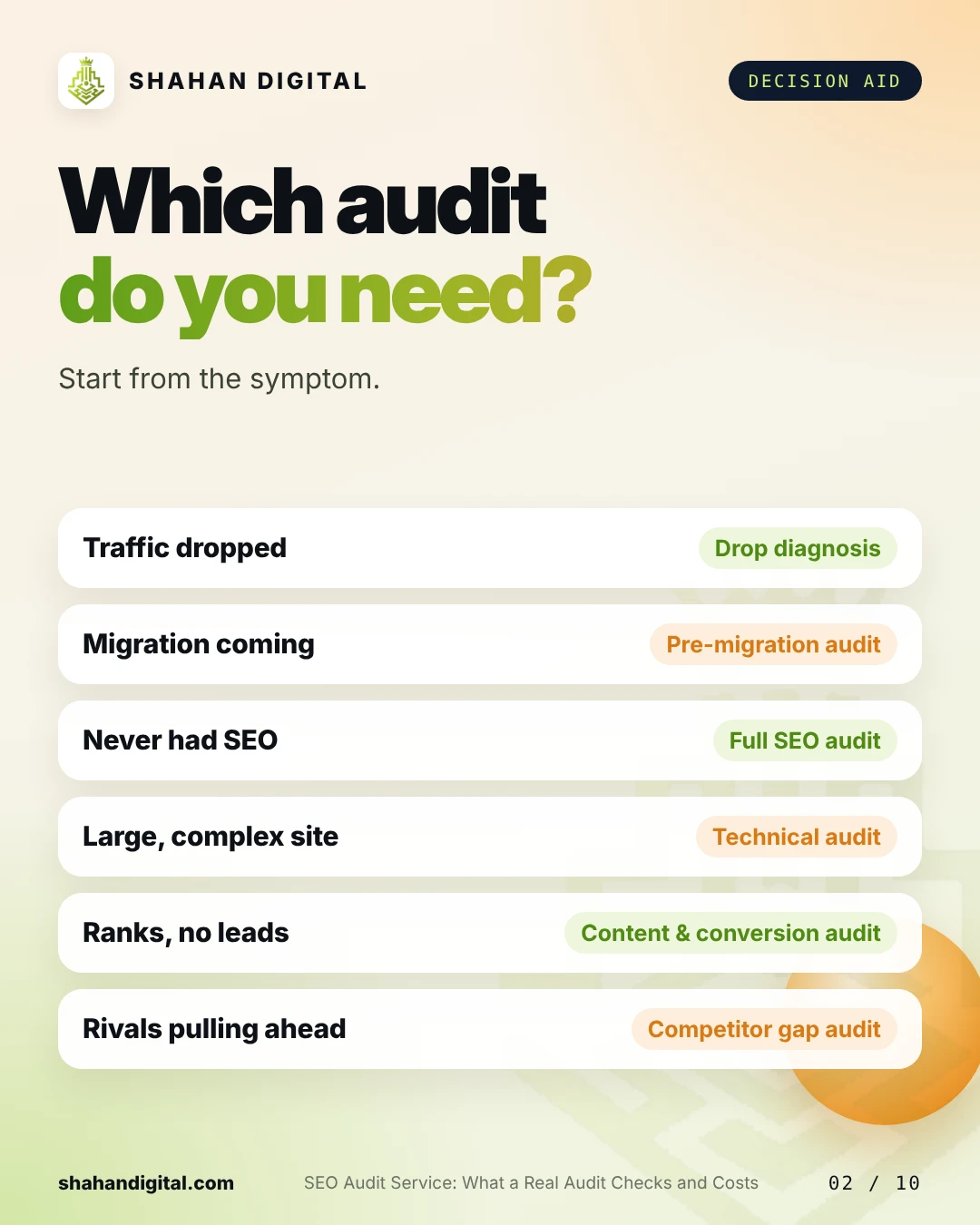
“SEO audit” covers very different jobs. Buying the wrong one is the most common waste we see: a full 200-point audit when the real problem was one migration redirect map, or a quick technical scan when the business needed a content and competitor review. Start from the symptom.| Your situation | Audit you need | What it focuses on |
|---|---|---|
| Traffic or leads dropped suddenly | Traffic drop diagnosis | When, where and why: pages, queries, countries, updates, technical changes |
| Redesign, new CMS or domain change coming | Pre-migration audit | URL inventory, redirect map, templates, tracking, launch checklist |
| Site never had serious SEO | Full SEO audit | Technical health, page-to-query fit, content gaps, links, local, tracking |
| Large or complex site (ecommerce, listings, many languages) | Technical SEO audit | Crawling, indexing, rendering, faceted navigation, canonicals, hreflang |
| Ranking but not converting | Content and conversion audit | Search intent, page quality, calls to action, forms, tracking |
| Competitors pulling ahead | Competitor and gap audit | Who ranks, why, which pages and links you’re missing |
| Local business with a shop or office | Local SEO audit | Google Business Profile, location pages, reviews, citations |
What a proper SEO audit checks
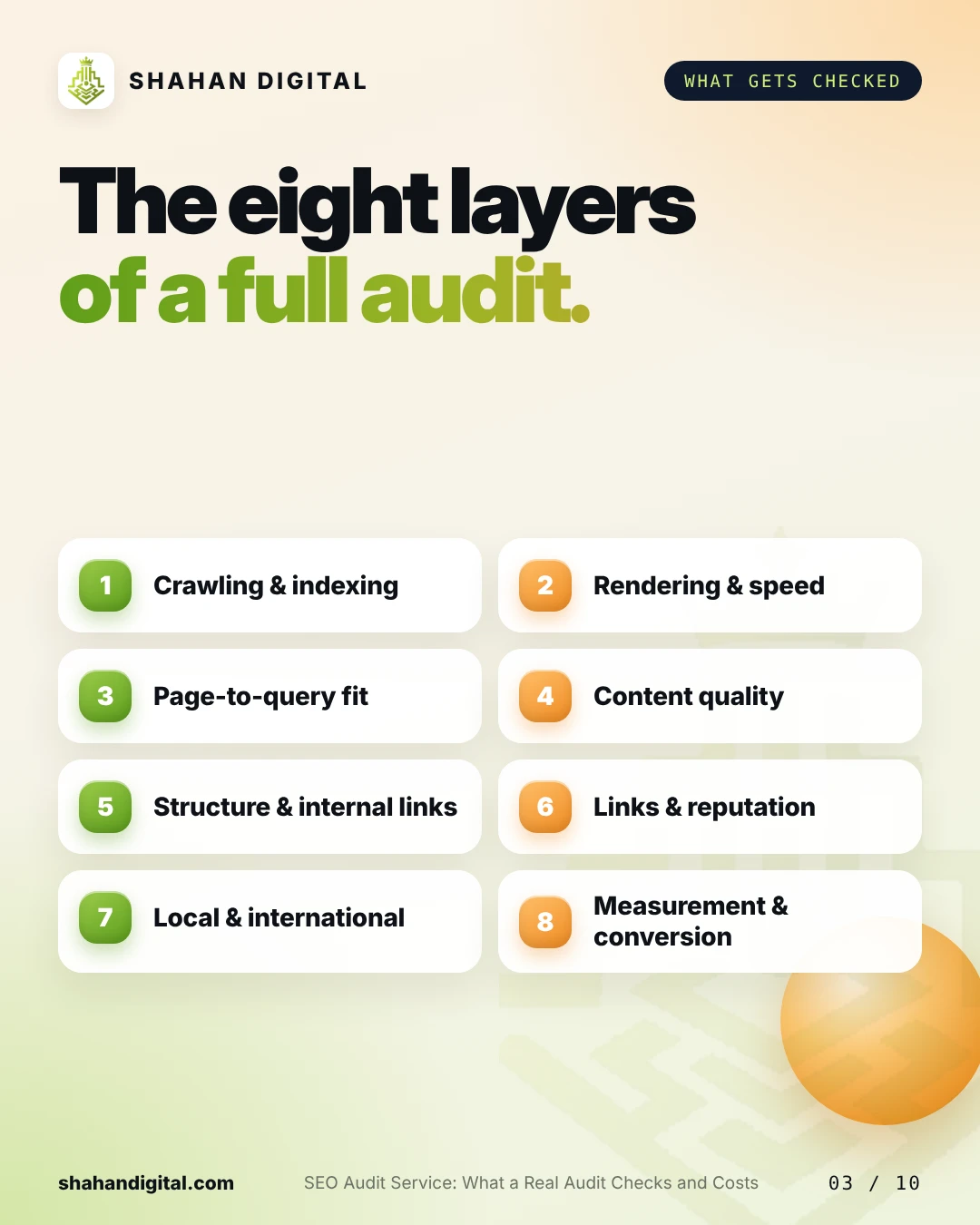
A full audit covers eight layers. Not every site needs equal depth on each, and a good auditor will tell you where they spent their time and why.| Layer | What gets checked | A typical finding |
|---|---|---|
| Crawling and indexing | robots.txt, sitemaps, status codes, noindex, canonicals, Search Console Page indexing | Service pages marked “Crawled, currently not indexed” |
| Rendering and speed | JavaScript rendering, mobile layout, Core Web Vitals from field data | Key content only appears after a script loads |
| Page-to-query fit | Which page ranks for which query, overlapping pages, search intent | Two pages competing for the same buyer query |
| Content quality | Depth, first-hand detail, author information, outdated facts, thin pages | City pages that differ only by the city name |
| Site structure and internal links | Click depth, orphan pages, anchor text, hubs | Best service page linked only from the footer |
| Links and reputation | Referring domains, toxic patterns, unlinked mentions, reviews | Paid links that break Google’s spam policies |
| Local and international | Business Profile, NAP consistency, hreflang, localised pages | Arabic pages missing reciprocal hreflang |
| Measurement and conversion | Analytics events, form and call tracking, CRM source | Form submissions not recorded at all |
“The first thing I open isn’t the crawler. It’s the Search Console Performance report filtered to the pages that make money, compared with the same period a year ago. Then I crawl the site with that list in mind. Say a crawl finds 4,000 images without alt text, and your top service page has quietly dropped out of the index. The audit has to say the second thing plainly, on page one.”
Shahan Behkamrad, Founder of Shahan Digital
If traffic dropped: diagnose before you audit
When organic traffic falls, the urge is to commission a full audit. It’s usually faster to diagnose first. Google’s guide to debugging search traffic drops lists the usual causes: algorithm updates, technical problems, security issues, spam issues, seasonality and site moves. It also sets out an order for checking them.
How findings get prioritised
This is where most audits fall down. A list of problems with generic “high, medium, low” labels doesn’t tell your developer what to do on Monday. We score every finding on three things and sort by the result.| Score | Question | 1 | 5 |
|---|---|---|---|
| Impact | How much traffic or revenue does this touch? | A few low-value pages | Pages that bring most leads or sales |
| Confidence | How sure are we it’s a real cause? | A guess | Confirmed in Search Console or logs |
| Effort | How hard is it to fix? | Weeks of developer time | A settings change |
Priority = Impact × Confidence × Effort. The highest products go first. Everything is also marked verified, inferred or needs access, so you know which findings rest on evidence.
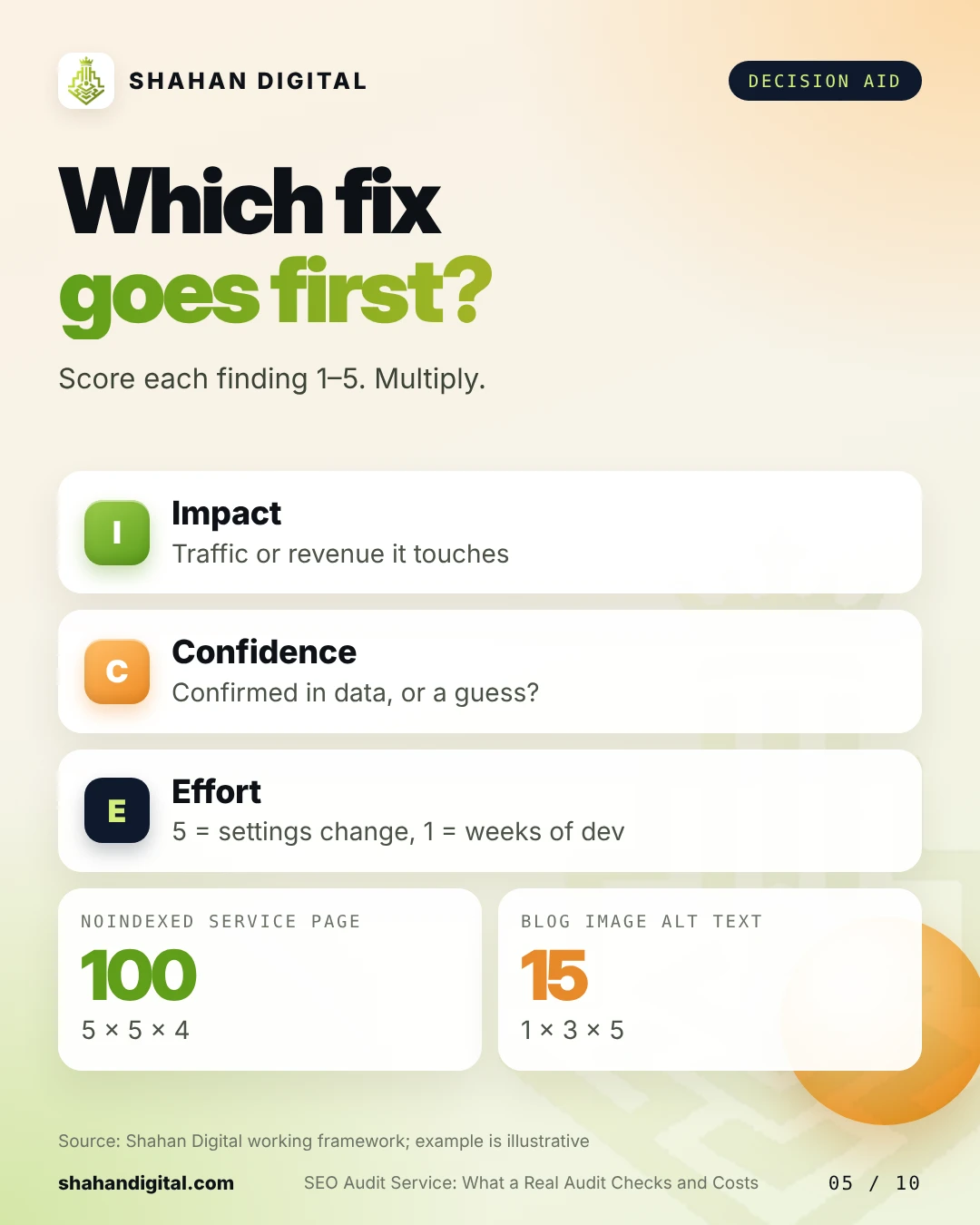
Worked example (illustrative): a main service page with an accidental noindex (impact 5, confidence 5, effort 4) scores 100. Missing alt text on blog images (impact 1, confidence 3, effort 5) scores 15. Same audit, very different Monday morning.
Want us to tell you what to fix first?
Send us your website, your main markets and the one question you need answered. We’ll scope an audit around that question rather than a fixed checklist.
What you should receive
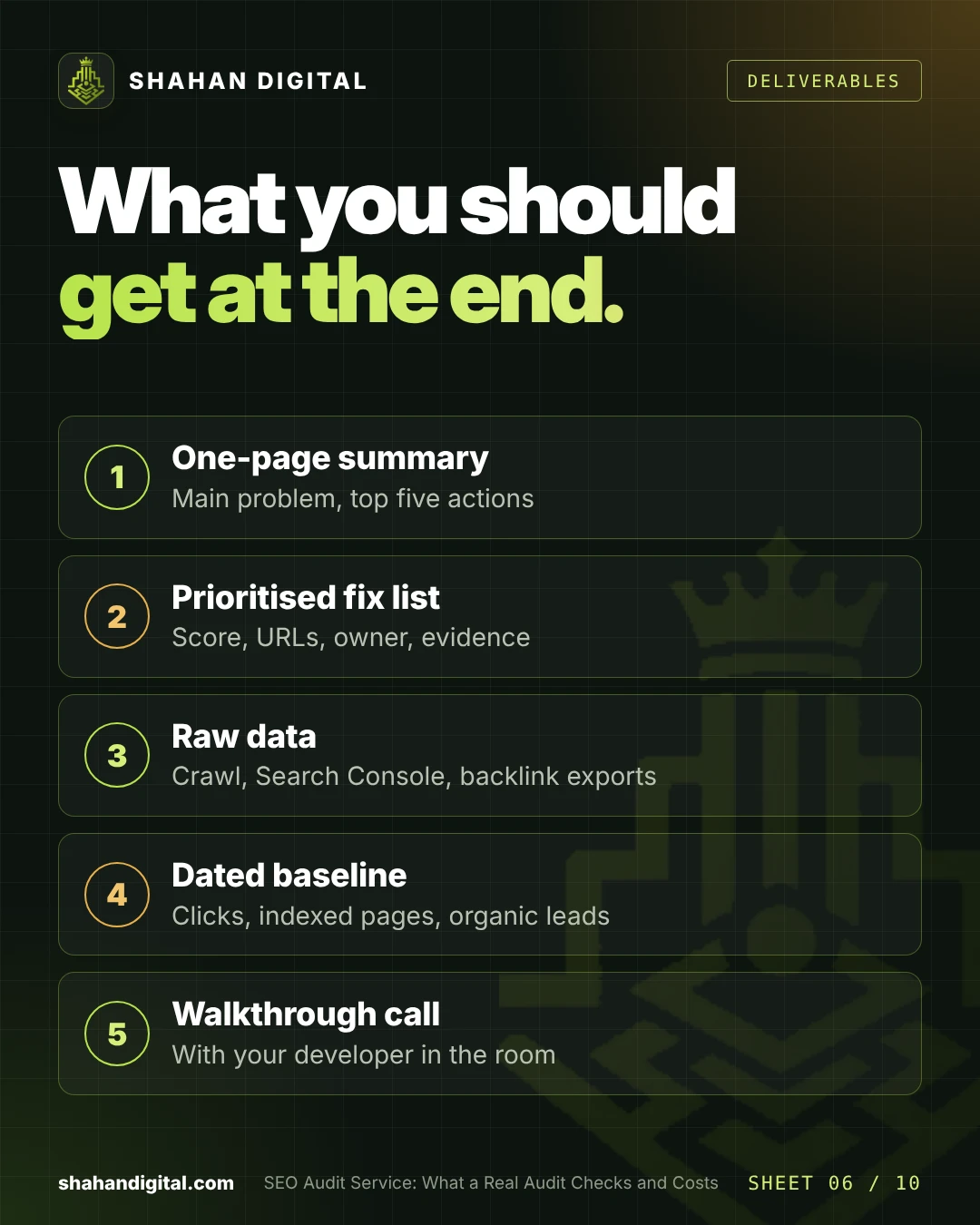
Format matters less than usefulness, but a professional SEO audit service should leave you with all of these:- A one-page summary in plain language: the main problem, the top five actions and what they’re likely to affect.
- A prioritised fix list in a spreadsheet, with the score, the affected URLs, the owner (developer, writer, marketing, agency) and the evidence for each item.
- The raw data: crawl exports, Search Console extracts and backlink lists, so the work can be checked or repeated.
- A baseline: clicks, impressions, indexed pages, leads from organic search, dated, so you can measure progress later.
- A walkthrough call with your team and developer, so nothing is lost in translation.
“Every line in our fix list has a URL, a reason, an owner and a way to check it’s done. If your developer can’t act on a finding without phoning us, the finding isn’t finished. And I always include the baseline numbers with the date they were pulled, because six months later that’s the only fair way to judge whether the work paid off.”
Shahan Behkamrad, Founder of Shahan Digital
How to judge an SEO audit report
Whether you paid us or someone else, these questions separate a useful audit from an expensive export. Several come straight from Google’s own advice on what to ask an SEO.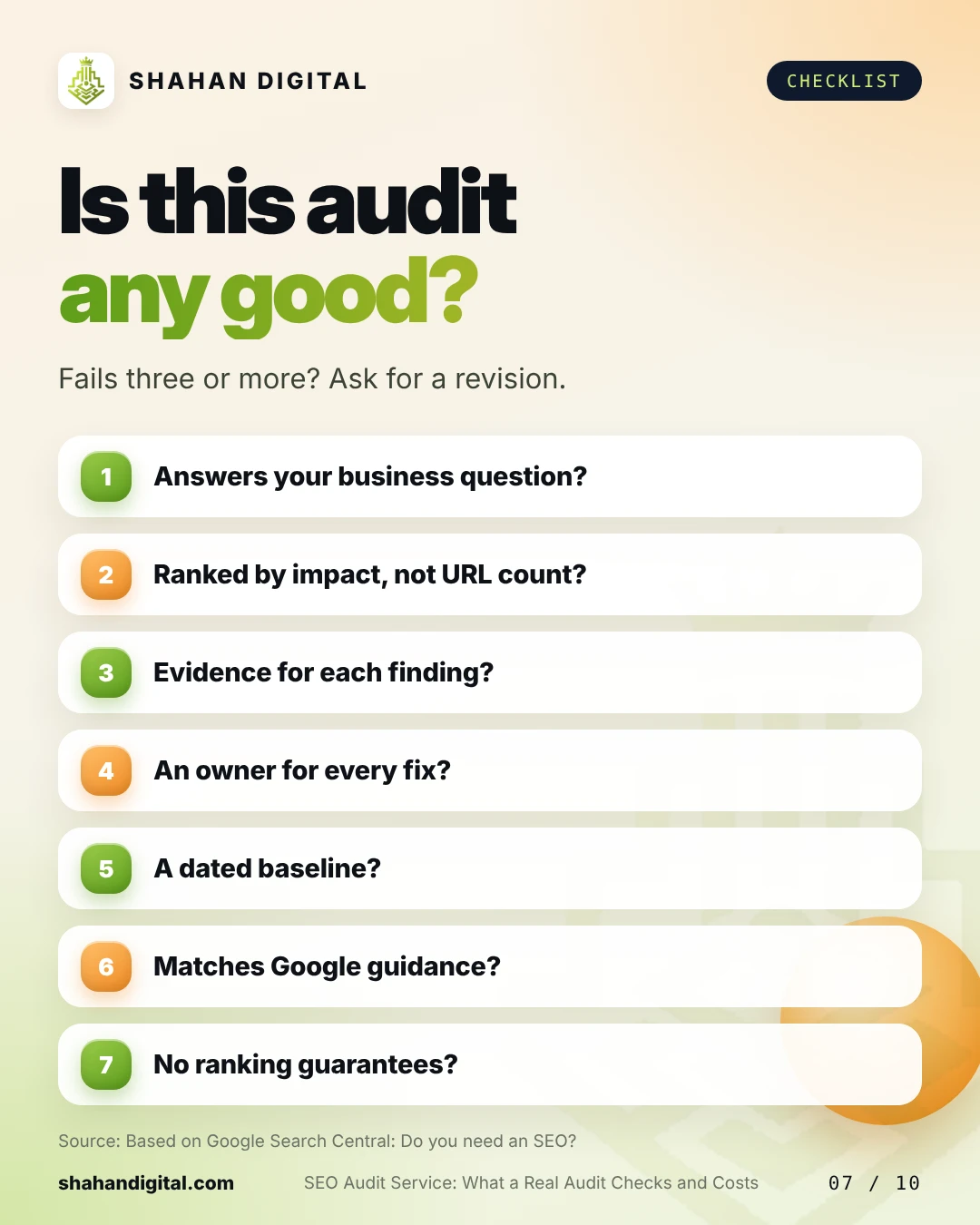
- Does page one answer the business question you asked?
- Are findings ranked by business impact, not by how many URLs a tool flagged?
- Is there evidence behind each finding: a Search Console screenshot, a URL, a log line?
- Does every fix have an owner and a way to confirm it’s done?
- Is there a dated baseline you can measure against?
- Do the recommendations match Google Search Essentials and its spam policies?
- Does it avoid promising rankings? Google lists guaranteed first-place rankings among the red flags.
What an SEO audit costs
There’s no standard price because there’s no standard scope. Here’s what published sources showed when we checked them on 18 November 2026.| Source | Figure | What it covers |
|---|---|---|
| Ahrefs pricing survey | Most common project price $2,501–$5,000 (21.2% of respondents) | All one-off SEO projects worldwide, not audits only |
| SEOSLY (independent consultant) | From $2,000 (basic) to $7,000 (E-E-A-T audit); full audit from $5,000 | Hand-written audits, 20–80 hours each, with a follow-up call |
| Hobo Web (UK) | £1,495 one-off | Manual audit document covering technical, content, links and local |
| WebFX survey | Ranges from under $100 to about $5,500 by company size | 250 US businesses; the ranges overlap oddly, so treat as rough |

What other SEO audit services offer
We reviewed the top English-language results for “SEO audit service” on 18 November 2026. Several of these are worth reading before you choose anyone, including us.| Result | What it does well | What’s missing for a buyer |
|---|---|---|
| SEOSLY | Published prices per audit type, hours spent, call included | One consultant, selective about clients |
| Hobo Web | Fixed public price; audit framed as a training tool for in-house teams | No stated turnaround |
| SEO.com | Free automated checker; paid plans listed from $2,900 a month | No separate audit price published |
| Thrive Agency | Explains one-time vs ongoing audits and technical vs general audits | Sales-led; little on how findings are ranked |
| FourFront | Human-led audit that includes accessibility | No pricing or sample deliverable |
| Seahawk Media | Clear explanation of tool vs service, WordPress focus | Narrow if you’re not on WordPress |
How an audit runs, week by week

| Week | Work | What you do |
|---|---|---|
| 1 | Scoping call, read-only access, dated baseline | Share Search Console, analytics and goals |
| 2 | Crawl, Search Console analysis, competitor and SERP review | Answer questions about past changes |
| 3 | Findings scored, checked and grouped by owner | Nothing, unless we need developer input |
| 4 | Summary, fix list, raw data and walkthrough call | Bring your developer and decision-maker |
After the audit: what happens next
An audit is only worth what gets fixed. You have four sensible options, and we’re happy with any of them:
- Your team implements the fix list, and we answer questions.
- We implement it end to end through our SEO services.
- We advise and review your team’s changes through SEO consulting.
- We train your team to run the checks themselves through SEO training and mentoring.
Does an audit cover AI search?
It should, at least briefly. Google says the same SEO fundamentals apply to its AI features, so a page that can’t be crawled or doesn’t answer the question won’t be cited there either. On top of that, we run a small dated sample of buyer prompts in ChatGPT, Google AI Mode and Perplexity, note which sources get cited, and check whether your business is described accurately. That’s a snapshot, not a ranking, and no one can guarantee a mention. Our AI search optimization service goes further if the audit shows it’s worth it.Audits for multilingual and international sites
Sites that serve several countries or languages break in specific ways: missing or one-way hreflang, translated pages that target the wrong local terms, country pages that duplicate each other. We audit English, Arabic, Persian and Turkish sites with native speakers checking the language versions, and we follow Google’s guidance on localized versions. Our international SEO and Arabic SEO pages explain that side in more depth.How to measure whether the audit paid off
Go back to the dated baseline three and six months after the main fixes are live. Compare clicks and impressions on the affected pages, indexed page counts, and leads or sales from organic search, using the same date length and, where seasonality matters, the same months a year earlier. Our guide to measuring SEO success sets out which numbers to use, and how long SEO takes covers realistic timing. Technical fixes can show within weeks; content and authority work usually take months.Frequently asked questions
What does an SEO audit service include?
A review of crawling and indexing, rendering and speed, page-to-query fit, content quality, internal links, backlinks, local and international set-up, and tracking. The output should be a prioritised fix list with owners and evidence, a short summary, raw data, a dated baseline and a walkthrough call.How much does an SEO audit cost?
Published prices we checked in November 2026 ranged from £1,495 (Hobo Web) to $2,000–$7,000 (SEOSLY), and Ahrefs’ survey found the most common price for one-off SEO projects was $2,501–$5,000. Site size, number of languages and audit type explain most of the difference. Ask for an itemised written quote.How long does an SEO audit take?
For a mid-sized site, about two to four weeks from access to walkthrough. Small sites can be faster; large multilingual or ecommerce sites take longer. A focused traffic-drop diagnosis is usually quicker than a full audit.Is a free SEO audit tool enough?
For a quick health check, often yes. A tool can’t tell you which of its flags explain your lost leads, what your competitors are doing better, or what to fix first for your business. That judgement is what you pay an auditor for.How often should a site be audited?
A full audit once a year suits most sites, plus a focused audit before any migration or redesign and a diagnosis whenever traffic drops sharply. Large sites benefit from lighter monthly technical checks.What access do you need?
Read-only access to Google Search Console and analytics, a list of past major changes, and your business goals. We don’t need write access to your CMS to audit, and Google advises against giving it before you’ve reviewed an audit.Ready to find out what’s holding your site back?
Send us your website, your target markets and the result you need. We’ll scope the audit around one question: where is search growth being lost, and what would it take to recover it?
Editorial note: Facts, prices and search results were checked against the linked sources on 18 November 2026. Price figures are published third-party prices and survey data, not Shahan Digital quotes. The priority-score example is illustrative, not a client result. No ranking, traffic or lead result is guaranteed.
Written by

Shahan Behkamrad
Author · Founder of Shahan Digital · SEO & GEO Strategist
Shahan Behkamrad is an SEO and GEO strategist and the founder of Shahan Digital. Since 2017 he has built search strategies for businesses in Persian, Arabic, English and Turkish markets, usually working alongside a client’s in-house team to decide what to fix first, what to build next and how to measure it.
- Strategy before tactics: every engagement starts with a diagnosis of where growth is being lost, then a ranked plan tied to enquiries and revenue, not to rankings alone.
- Current with how search works now: his work covers Google Search, Google Maps, AI Overviews and AI assistants such as ChatGPT, and he checks Google’s documented updates before changing a client’s plan.
- Specialist depth: technical, international and multilingual SEO, local SEO and AI search visibility (GEO).
- Has trained more than 650 students in SEO and digital marketing, including as an official instructor at Iran’s Technical and Vocational Training Organization.
- Host of the Shahan Behkamrad Podcast on business growth, branding, SEO and AI.
- Master’s student in Strategic Marketing and Brand Management at Nişantaşı University, Istanbul; holds 25+ international digital marketing certifications.