
Arabic SEO services are the specialist work of making a website findable, understandable and persuasive to Arabic-speaking searchers — keyword research in Arabic, right-to-left technical setup, content built for a specific market, local signals, and measurement per country. That is a very different scope from “translate my pages into Arabic,” and the gap between the two is where most budgets are lost.
If you are evaluating providers, the useful question is what exactly is being delivered, in which market, how it will be executed, and how you will know whether it worked. This guide sets out the full scope of Arabic SEO services, the process behind them, the questions worth asking before you sign, and the honest limits of what any provider can promise.
If you are still deciding whether the channel makes sense at all, start with our foundational guide to what Arabic SEO is and how it differs from translation. This article assumes that decision is already made and focuses on delivery.
Why Arabic Search Requires Market-Specific Expertise
Two data points frame the opportunity. Arabic is used daily by more than 400 million people according to UNESCO, while W3Techs currently measures Arabic as the content language of roughly 0.6% of the websites whose language it can identify.
Arabic remains underrepresented among the websites measured by W3Techs, which may create opportunities in some sectors. However, lower overall content supply does not automatically mean low competition. The opportunity must still be validated by query, country, industry and commercial intent.
That imbalance is one reason the market deserves closer investigation. It also explains why the market is full of cheap offers: when a niche is under-served, low-effort providers can appear credible simply because nobody is checking. Understanding the real scope is your protection.
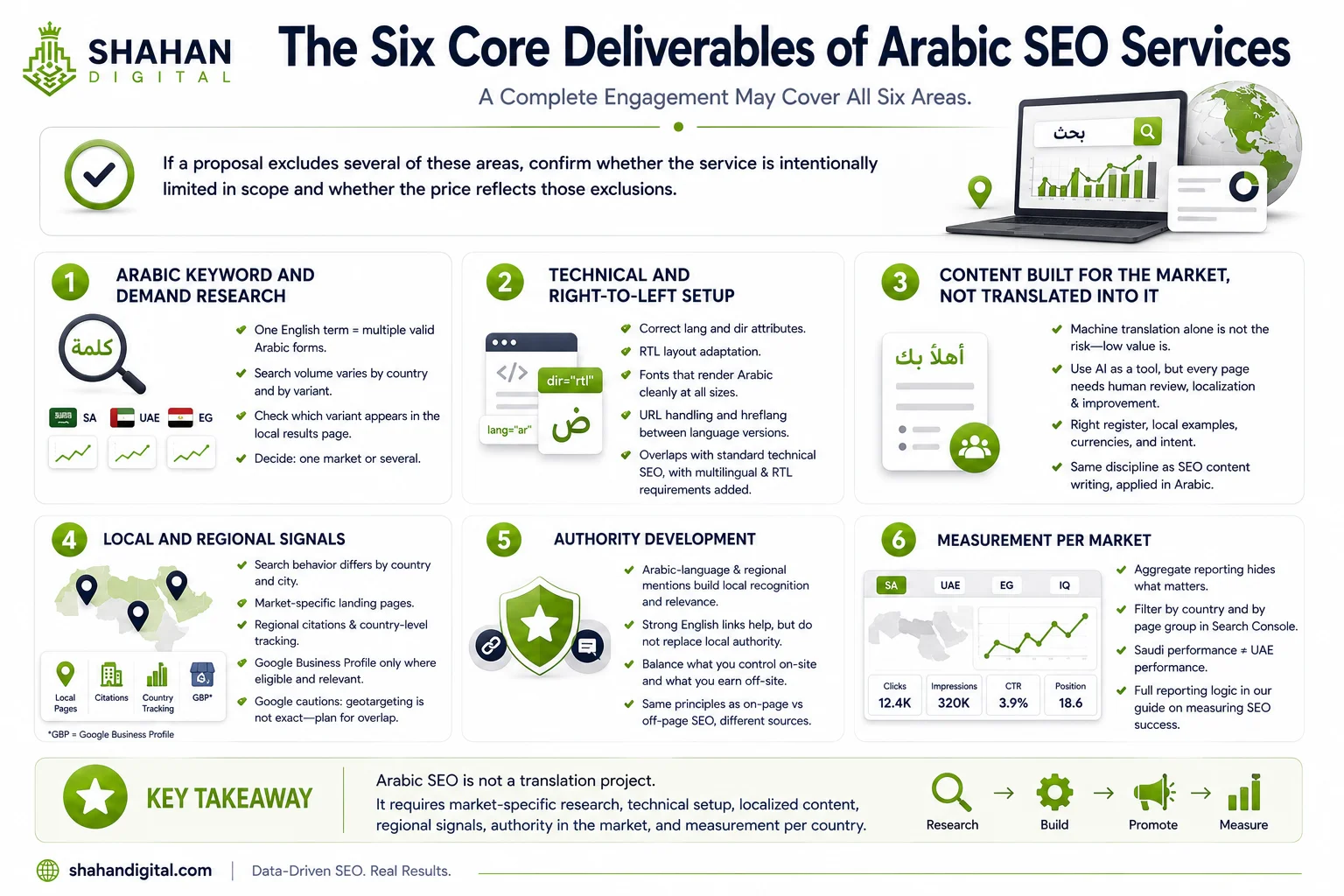
The Six Core Deliverables of Arabic SEO Services
A complete engagement may cover all six areas. If a proposal excludes
several of them, confirm whether the service is intentionally limited in
scope and whether the price reflects those exclusions.
1. Arabic keyword and demand research
This is the foundation, and the part most often skipped. One English term routinely maps to several valid Arabic forms, with different search volumes in different countries. The term a Saudi buyer uses is frequently not the term an Egyptian or Moroccan buyer uses, and formal Modern Standard Arabic phrasing may attract far less search than the everyday form.
Proper research means pulling volume per target country rather than globally, checking which variant actually appears in the local results page, and deciding whether you are targeting one market or several. A keyword list without country-level evidence does not demonstrate that
market-specific demand research has been completed.
2. Technical and right-to-left setup
Arabic introduces requirements an English-only site never encounters: correct lang and dir attributes, deliberate RTL layout adaptation, fonts that render Arabic script cleanly at small sizes, URL handling, and hreflang between language versions.
Google determines a page’s language primarily from its visible content, not from the HTML lang attribute. Hreflang serves a different purpose: it helps Google understand the relationship between localized versions and select an appropriate URL for users.
Correct lang and dir attributes still matter for accessibility, browser behavior and right-to-left presentation. This layer overlaps heavily with standard technical SEO services, with the multilingual and RTL requirements added on top.
3. Content built for the market, not translated into it
Google’s spam policies do not prohibit machine translation by itself. The risk arises when large numbers of pages are created through automated translation or similar transformations mainly to manipulate rankings while adding little value for users.
AI or machine translation can support the production process, but every page should receive meaningful human review, localization and editorial improvement before publication.
Real Arabic SEO services produce content written or substantially reworked by someone who reads the market: correct register for the audience, examples and currencies that make sense locally, and structure that answers the question an Arabic searcher actually typed. This is the same discipline as our approach to SEO content writing, applied in a second language.
4. Local and regional signals
Commercial Arabic search behavior often varies significantly by country and city. A Riyadh buyer and a Doha buyer may be running different searches, against different competitors, with different expectations. That means market-specific landing pages, regional citations and country-level tracking — the territory covered by local SEO services, executed in Arabic rather than alongside it.
Google Business Profile belongs in this work only where a business is genuinely eligible for a local presence. It is not a mandatory component of every Arabic SEO project, and a provider treating it as one has not looked closely at your model.
Google also cautions that geotargeting is not an exact science and that you should plan for users who land on the wrong version of your site. Any provider promising surgical country separation is overselling.
5. Authority development
Arabic-language and regional mentions can strengthen local recognition, referral reach and market relevance. Strong English-language links may still support the wider domain, but they do not remove the need for authority and recognition within the target market.
The underlying mechanics are the same as anywhere — the balance between what you control on your own site and what you earn elsewhere is explained in our guide to on-page vs off-page SEO — but the source list is entirely different.
6. Measurement per market
Aggregate reporting hides everything that matters here. You need Search Console filtered by country and by page group, so that Saudi performance is not averaged with UAE performance into a number that describes neither. Our guide on how to measure SEO success covers the reporting logic in full.
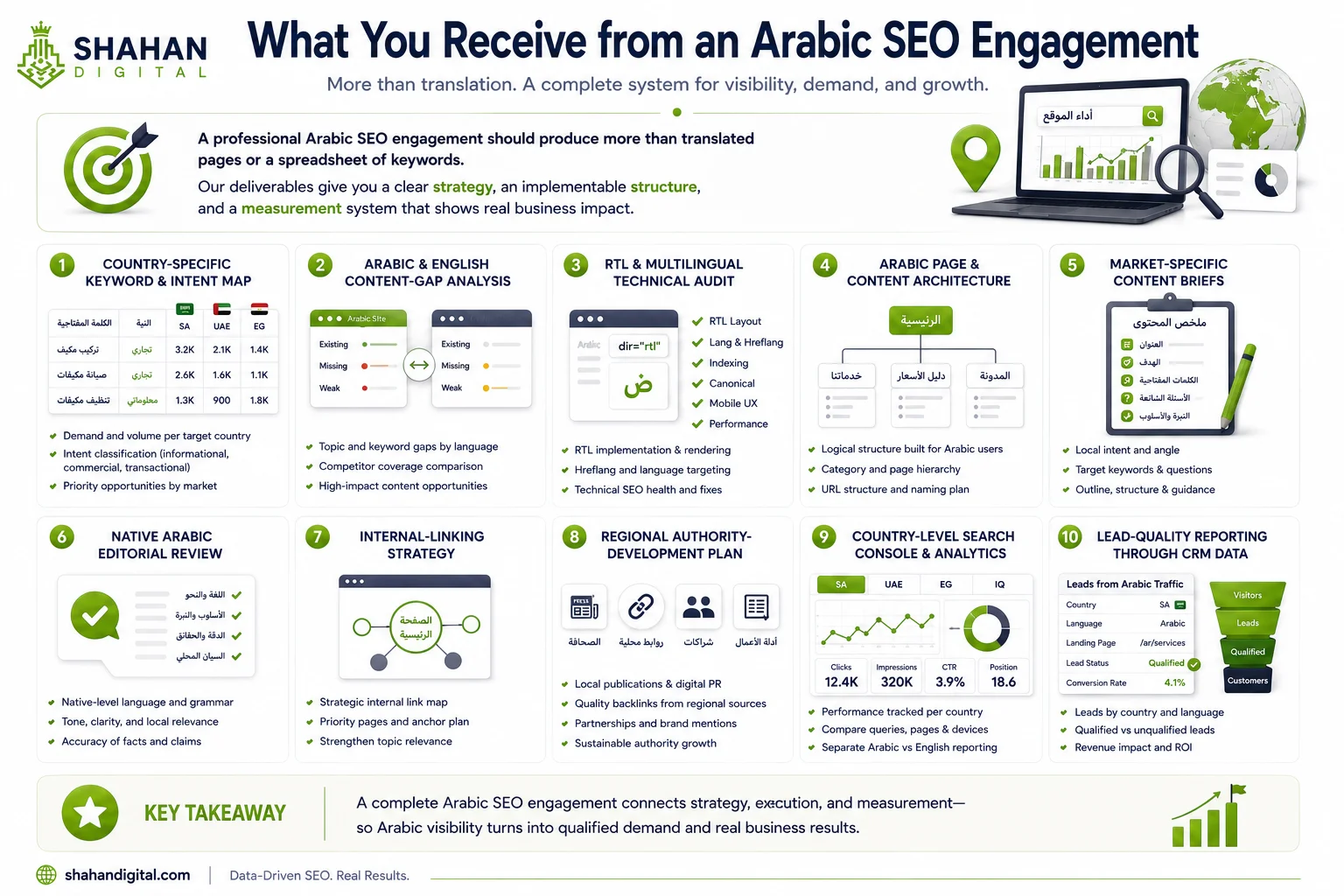
What you receive from an Arabic SEO engagement
A professional Arabic SEO engagement should produce more than translated pages or a spreadsheet of keywords. The deliverables should give your business a clear market strategy, an implementable website structure and a measurement system capable of showing whether Arabic visibility is producing qualified demand.
- Country-specific keyword and intent map
- Arabic and English content-gap analysis
- RTL and multilingual technical audit
- Arabic page and content architecture
- Market-specific content briefs
- Native Arabic editorial review
- Internal-linking strategy
- Regional authority-development plan
- Country-level Search Console and Analytics reporting
- Lead-quality reporting through CRM data
Our Arabic SEO process
Arabic SEO should not begin with writing pages. It should begin with validating demand. Our process moves from market research to technical implementation, content production, authority development and commercial measurement.
| Stage | What happens |
|---|---|
| 1. Market and demand validation | Establishing whether genuine Arabic demand exists in the target country before any pages are commissioned. |
| 2. Arabic keyword and intent mapping | Separating keywords by country, language variety, search type and buying intent. |
| 3. Technical and RTL audit | Reviewing RTL presentation, URL structure, hreflang, indexation and mobile rendering. |
| 4. Content and page architecture | Deciding which pages should be created, rewritten, consolidated or removed. |
| 5. Arabic content production and review | Producing or reworking content, with human review for the target market. |
| 6. Regional authority development | Building recognition through relevant sources, regional media and brand presence. |
| 7. Measurement and continuous improvement | Tracking impressions, clicks, leads and revenue separately for each market. |
Arabic SEO Services vs Translation
| Element | Translation project | Arabic SEO services |
|---|---|---|
| Starting point | Your existing English pages | What Arabic speakers actually search for |
| Keywords | Translated from English terms | Researched per country, in Arabic |
| Page set | Mirrors the English site | May differ — some pages added, some dropped |
| Technical work | Usually none | RTL adaptation, hreflang, fonts, URL structure |
| Language variety | One generic version | Chosen deliberately per target market |
| Measurement | Delivery of word count | Rankings, traffic and enquiries per country |
| Typical outcome | A readable Arabic site that may have limited organic visibility | Market-specific organic visibility with measurable performance targets |
Neither column is wrong in itself. A translation project is a reasonable purchase if your Arabic-speaking audience already arrives from other channels and simply needs to read your pages. It is the wrong purchase if you expect it to generate search demand, and that misunderstanding is a common reason Arabic SEO services get blamed for results they were never scoped to produce.
Arabic SEO Services in Practice: How Market Validation Reshaped the Strategy
On one multilingual project, the business already had Arabic pages, but those pages had been created by following the English site structure. The content was readable, yet the company could not clearly identify which Arabic queries, pages or markets were producing commercially useful demand.
The problem
Search performance from several Arabic-speaking markets was blended into one report. High-traffic informational pages appeared successful, while the commercial pages responsible for generating enquiries received limited visibility and internal authority.
What the research revealed
Country-level keyword and search-result analysis showed that several direct translations did not match the terminology used by buyers in the target markets. Some high-volume terms were primarily informational, while lower-volume variants showed clearer commercial intent.
What we changed
The work separated the markets, rebuilt the keyword-to-page map, created intent-specific commercial pages, improved internal linking, reviewed RTL and multilingual technical signals, and connected Arabic landing pages with country and lead-quality data.
How the work was measured
Performance was evaluated through non-branded Arabic impressions, commercial-page clicks, ranking movement by country and qualified enquiries recorded against Arabic landing pages. This prevented traffic growth from being mistaken for business growth.
The lesson
The project reinforced an important principle: Arabic markets should be
treated as separate demand environments. The work focused not on publishing
more translated content, but on building pages around real terminology,
intent and commercial opportunity.
Methodology note: Performance was evaluated using Google
Search Console, Analytics and, where available, CRM data. Client identity is
withheld for confidentiality. This example explains the project methodology
and should not be treated as a guarantee of comparable results for other
websites.
Seven Questions to Ask Before Hiring an Arabic SEO Provider
These questions separate a specialist from a reseller. Ask them in the first call.
- Which country are we targeting, and how will you establish demand there? A specific market and a described method, not a global figure.
- Which Arabic variety will the content use, and why? The answer should reference your target market, not a general preference for Modern Standard Arabic.
- Who writes and reviews the Arabic? Ask whether a human reviews every published page and what that review covers.
- How will hreflang and RTL be handled, and by whom? If the answer is vague or defers entirely to your developer, the technical scope is not really included.
- Which market would you start with, and why that one? A considered sequencing decision signals strategy; “all of them” signals a template.
- What does month-three reporting look like? Ask to see an anonymised example segmented by country.
- What are you not promising? A provider willing to name limits is usually the one worth hiring.
A practical provider test
Ask the provider to explain how they would validate one core topic in your target market: which keyword variants they would investigate, how they would review local search results, how they would classify intent and which data sources they would compare.
A responsible provider may not give a reliable search-volume figure before completing the research, but they should be able to explain the method clearly and show an anonymized example.
Arabic SEO Engagement Models: Audit, Project or Retainer
Arabic SEO services are usually sold in three shapes, and matching the shape to your situation matters more than the headline price.
| Model | Best suited to | Main risk |
|---|---|---|
| Audit and strategy only | Teams with in-house Arabic capability who need direction | Recommendations never get implemented |
| Project build | Launching an Arabic version for the first time | Performance may stall if the site receives no monitoring, maintenance or continued authority development after launch. |
| Ongoing retainer | Competing seriously in one or more Arabic markets | Paying for activity rather than outcomes if reporting is weak |
A common and sensible sequence is an audit first, then a scoped build, then a retainer once the direction is proven — rather than committing to twelve months before anyone has validated that demand exists in your category.
How Long Arabic SEO Services Take to Show Results
Arabic SEO services follow the same timeline logic as any other market: technical fixes can register within weeks, content needs time to be crawled and evaluated, and authority accumulates slowly. Our guide to how long SEO takes sets out the general pattern.
Two factors can shift it in either direction. Lower content supply in some Arabic sectors can mean less established sites move faster than they would in English. But a brand-new Arabic section on an existing domain still has to be discovered, indexed and trusted, and that is not instant regardless of how thin the competing content appears.
A fixed number of weeks to page one should be treated as an estimate,
not a commitment. No provider controls rankings, and timing varies by market,
competition, site condition and implementation speed.
Insist on leading indicators — impressions and average position by
country — rather than waiting three months for a click count.
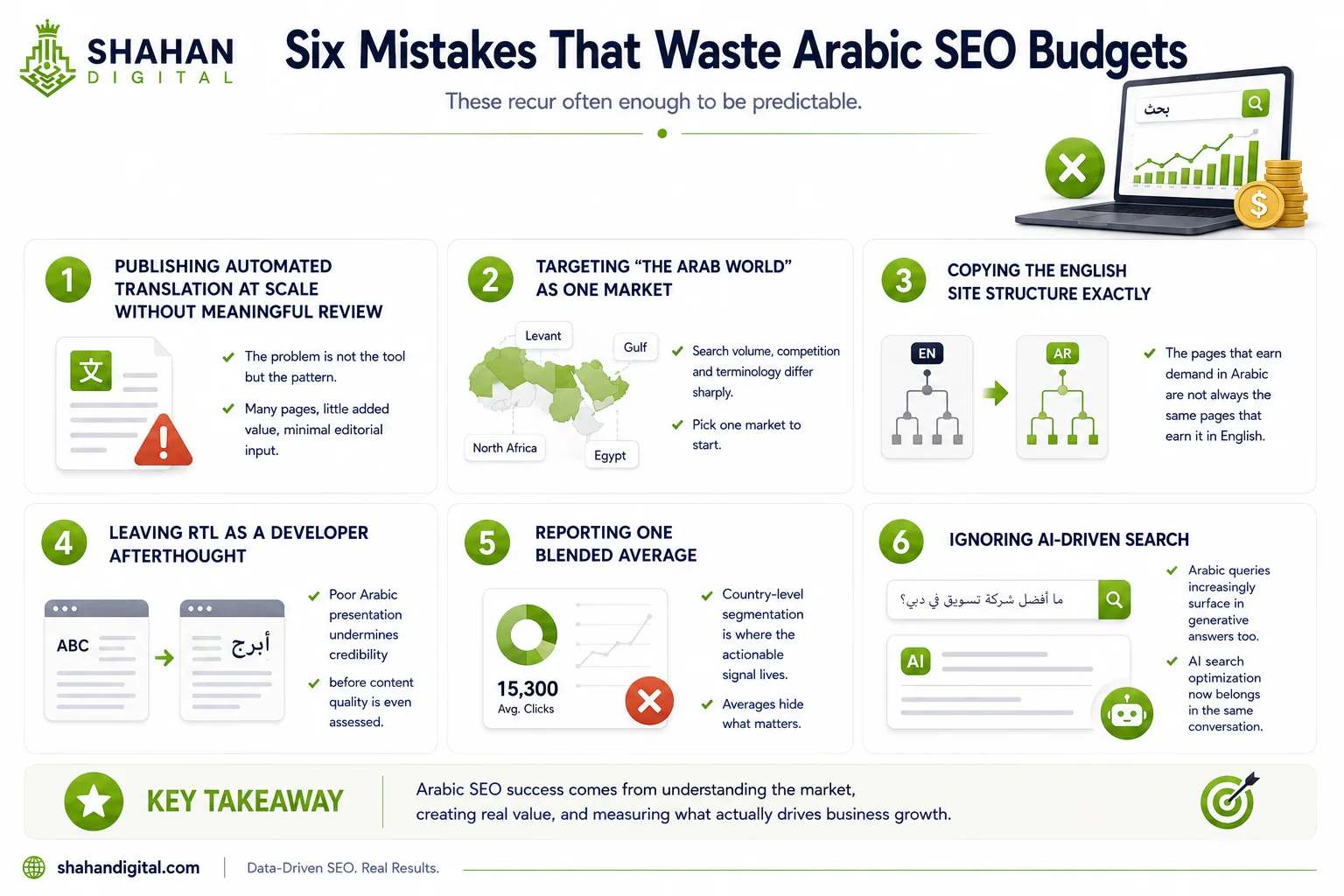
Six Mistakes That Waste Arabic SEO Budgets
These recur often enough to be predictable.
- Publishing automated translation at scale without meaningful review. The problem is not the tool but the pattern: many pages, little added value, minimal editorial input.
- Targeting “the Arab world” as one market. Search volume, competition and terminology differ sharply between Gulf, Levantine, Egyptian and North African markets. Pick one to start.
- Copying the English site structure exactly. The pages that earn demand in Arabic are not always the same pages that earn it in English.
- Leaving RTL as a developer afterthought. Poor Arabic presentation undermines credibility before content quality is even assessed.
- Reporting one blended average. Country-level segmentation is where the actionable signal lives.
- Ignoring AI-driven search. Arabic queries increasingly surface in generative answers too, which is why AI search optimization now belongs in the same conversation.
Does Your Business Actually Need Arabic SEO Services?
Arabic SEO services make commercial sense when a meaningful share of your buyers search in Arabic, when your category shows genuine Arabic search demand, and when you can support enquiries that arrive in Arabic. That last condition is the one businesses forget: ranking is pointless if nobody can answer the phone.
They are usually the wrong investment if your buyers in the region search in English anyway — common in some B2B and enterprise segments — or if you have no capacity to handle Arabic conversations. Competitive conditions also vary widely by market, which is part of why our work as an SEO company in Iraq looks different from a Gulf engagement.
The lower-risk starting point is to validate demand in one specific
Arabic market before committing to a full build. If the demand is not there,
no amount of execution will manufacture it. If it is, you will know exactly
what you are buying.
Key takeaways
- Arabic SEO services cover six areas: keyword research, RTL and multilingual technical setup, market-written content, local signals, authority, and per-country measurement.
- Translation and search optimisation are separate purchases with separate outcomes.
- Google determines page language primarily from visible content, not the
langattribute. Hreflang maps the relationship between localized versions; it is not a language-detection signal. - Machine translation is not prohibited in itself. The risk is scaled, low-value publishing without meaningful human review.
- Lower Arabic content supply does not automatically mean low competition. Validate by query, country, industry and intent.
- Ask a provider to explain their validation method rather than demanding an instant volume figure.
- Choose one market first. “The Arab world” is not a targeting decision.
Frequently asked questions
What is included in Arabic SEO services?
A full engagement includes Arabic keyword research with country-level demand analysis, right-to-left technical implementation and hreflang, content written or substantially reworked for the target market, local and regional signals, Arabic-language authority development, and reporting segmented by country. Proposals missing the technical or research components are partial services.
Is Arabic SEO just translating my website?
No. Translation converts your existing pages into Arabic. Arabic SEO starts from what Arabic speakers search for, which frequently produces a different page set, different priorities and different terminology. Translation without research typically produces a readable site with limited organic visibility.
Which Arabic variety should my content use?
It depends on the target market and the content type. Modern Standard Arabic is broadly understood and often suits formal or informational pages, while commercial and local pages frequently perform better using the terminology people actually search in that country. The decision should follow keyword data for your specific market, not a blanket rule.
Can I use AI or machine translation for Arabic content?
Yes, as part of the production process. Google’s spam policies do not prohibit machine translation by itself; the risk arises when large numbers of pages are produced through automated translation mainly to manipulate rankings while adding little value. Every page should receive meaningful human review, localization and editorial improvement before publication.
How do I know if Arabic SEO services are working?
Track Search Console filtered to your target country: impressions and average position for Arabic queries are the earliest signals, typically moving before clicks do. Then follow clicks, and finally enquiries attributed to Arabic pages. A single blended figure across all countries will not tell you whether the strategy is succeeding.
Do I need a separate website for Arabic?
Usually not. For many businesses, an Arabic subdirectory such as /ar/ is the simplest structure to manage under an existing domain. A subdomain or country-code domain may still be appropriate when technical infrastructure, legal requirements, branding or country-specific operations require stronger separation.
Hreflang helps connect localized versions, but it does not transfer authority by itself. Internal linking, site architecture, content quality and external recognition still matter.
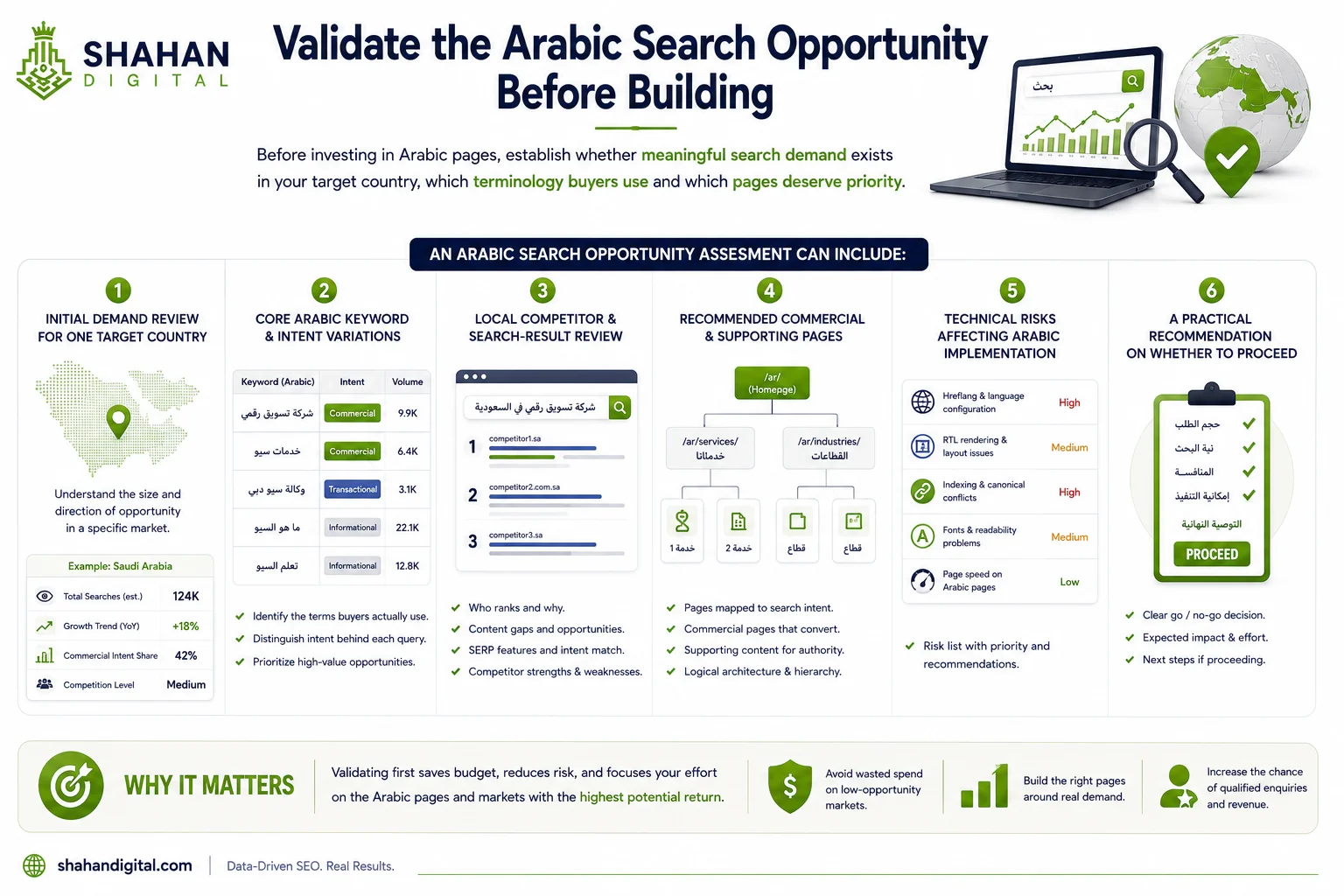
Validate the Arabic search opportunity before building
Before investing in Arabic pages, establish whether meaningful search
demand exists in your target country, which terminology buyers use and which
pages deserve priority.
An Arabic Search Opportunity Assessment can include:
- Initial demand review for one target country
- Core Arabic keyword and intent variations
- Local competitor and search-result review
- Recommended commercial and supporting pages
- Technical risks affecting Arabic implementation
- A practical recommendation on whether to proceed
Request an Arabic Search Opportunity Assessment
You can also review our wider SEO services to see how Arabic search fits into a broader international search programme.
Written by

Shahan Behkamrad
Author · Founder of Shahan Digital · SEO & GEO Strategist
Entrepreneur · Founder of Shahan Digital · SEO, GEO & Digital Growth Strategist
Shahan Behkamrad is the founder of Shahan Digital and the author of this article.
His published work explores English SEO, Arabic SEO, and Persian SEO, international and multilingual search, technical SEO, website architecture, content strategy, search-intent analysis, digital marketing, Generative Engine Optimization, AI-search visibility, and content optimization for emerging answer-driven platforms.
Through his articles, podcasts, and educational publications, he presents complex topics in a clear and practical format for entrepreneurs, business owners, executives, and marketing professionals.
The views and analysis presented in this article are provided in Shahan Behkamrad’s capacity as its author.
View Shahan Behkamrad’s full author profile and published work →
Official Links
About US Company · LinkedIn · YouTube · Spotify · Apple Podcasts · Instagram · Crunchbase · Shahan Digital on LinkedIn
Editorial and Legal Notice
This article and any related audio or video materials are published solely for educational and general informational purposes.
The content does not constitute legal, financial, investment, technical, or individualized digital marketing advice. Reading, viewing, or listening to this content does not create a consulting, agency, advisory, fiduciary, contractual, or other professional relationship with Shahan Behkamrad or Shahan Digital.
Any examples, observations, strategies, or opinions presented in this content should be evaluated according to the specific circumstances, objectives, market conditions, resources, and legal requirements of each business.
SEO, GEO, digital marketing, traffic, lead-generation, conversion, and revenue outcomes may vary. No specific ranking, traffic level, number of leads, conversion rate, commercial result, or revenue outcome is promised or guaranteed.
All company names, platform names, products, and trademarks mentioned in this content remain the property of their respective owners. References to third-party platforms do not imply sponsorship, endorsement, partnership, or affiliation unless expressly stated.