Quick answer
A competitor SEO analysis tells you who actually owns the search results for your money queries, and which of five gaps you need to close to take their place: keywords, content, SERP features, links and AI citations. Done properly, it ends with a short, ranked plan, not a spreadsheet of a thousand keywords.
Below: a six-step method you can run yourself, a free gap template, a worked example, how other guides compare, how to prioritise, and what a paid analysis should deliver.
Who this guide is for. Business owners and marketers who keep seeing the same rivals above them on Google and want to know why, plus anyone about to pay for a competitor analysis and wondering what good looks like. Jump in where it helps:
- Not sure who your competitors are? Start with your real search competitors.
- Want to do it yourself? Go to the six steps and the free template.
- Have a list of gaps and no idea where to start? See how to prioritise.
- Buying an analysis? Read what it should include.
Key takeaways
- Your search competitors are whoever ranks for your buyers’ queries. That often includes publishers, directories and forums, not just companies like yours.
- Look for five gaps: keywords, content, SERP features, links and AI citations.
- Compare pages that answer the same query, not whole domains.
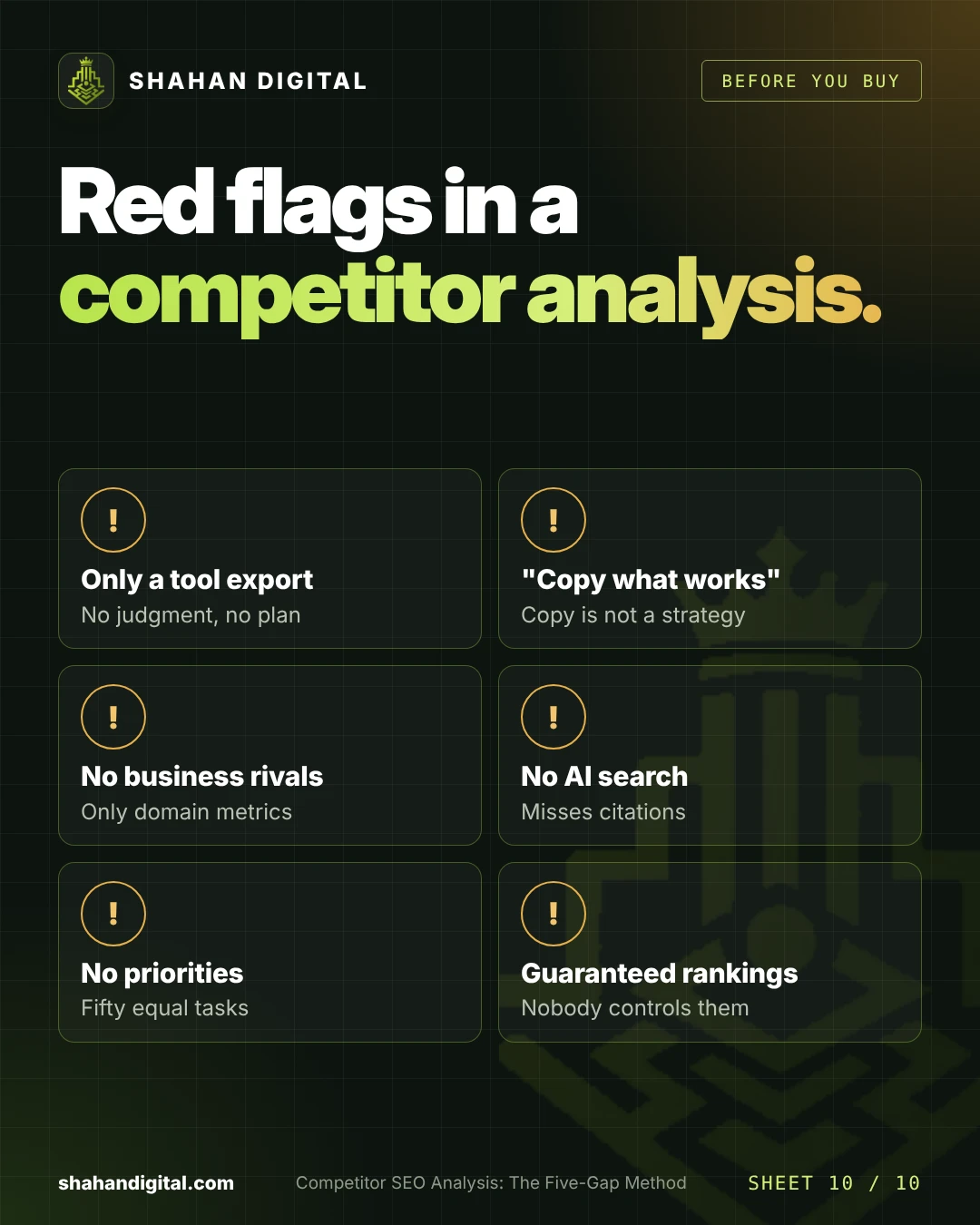
- Ranking and being cited by AI are no longer the same thing. One 2026 study found only 38% of pages cited in AI Overviews ranked in the top 10.
- Tool numbers for competitor traffic are estimates. Use them as clues and check the results pages yourself.
- A good competitor SEO analysis ends with five to ten ranked actions, each tied to business value.
Before you start any competitor analysis
Write down the ten queries that would actually make you money. Not “SEO”, but “B2B SEO agency in Dubai” or “industrial valve supplier UAE”. Everything else is measured against these.
Check your own Search Console first. Half of the “gaps” people find in tools are pages they already have that simply rank on page three.
Who are your real SEO competitors?
Whoever shows up when your buyer searches, which is the first thing any SEO competitor analysis has to establish. That’s often a surprise. The companies you lose deals to in a sales meeting may not be the pages you lose clicks to on Google. For many commercial queries, the first page is shared between a couple of direct rivals, a review directory, a publisher’s “best of” list, a marketplace and sometimes a Reddit thread or YouTube video.Each type needs a different response. You can outrank a direct rival with a better page. You usually can’t outrank a directory, but you can get listed on it with strong reviews. You can’t outrank a big publisher’s list, but you can get included in it. Treating all of them as “competitors to beat” wastes months.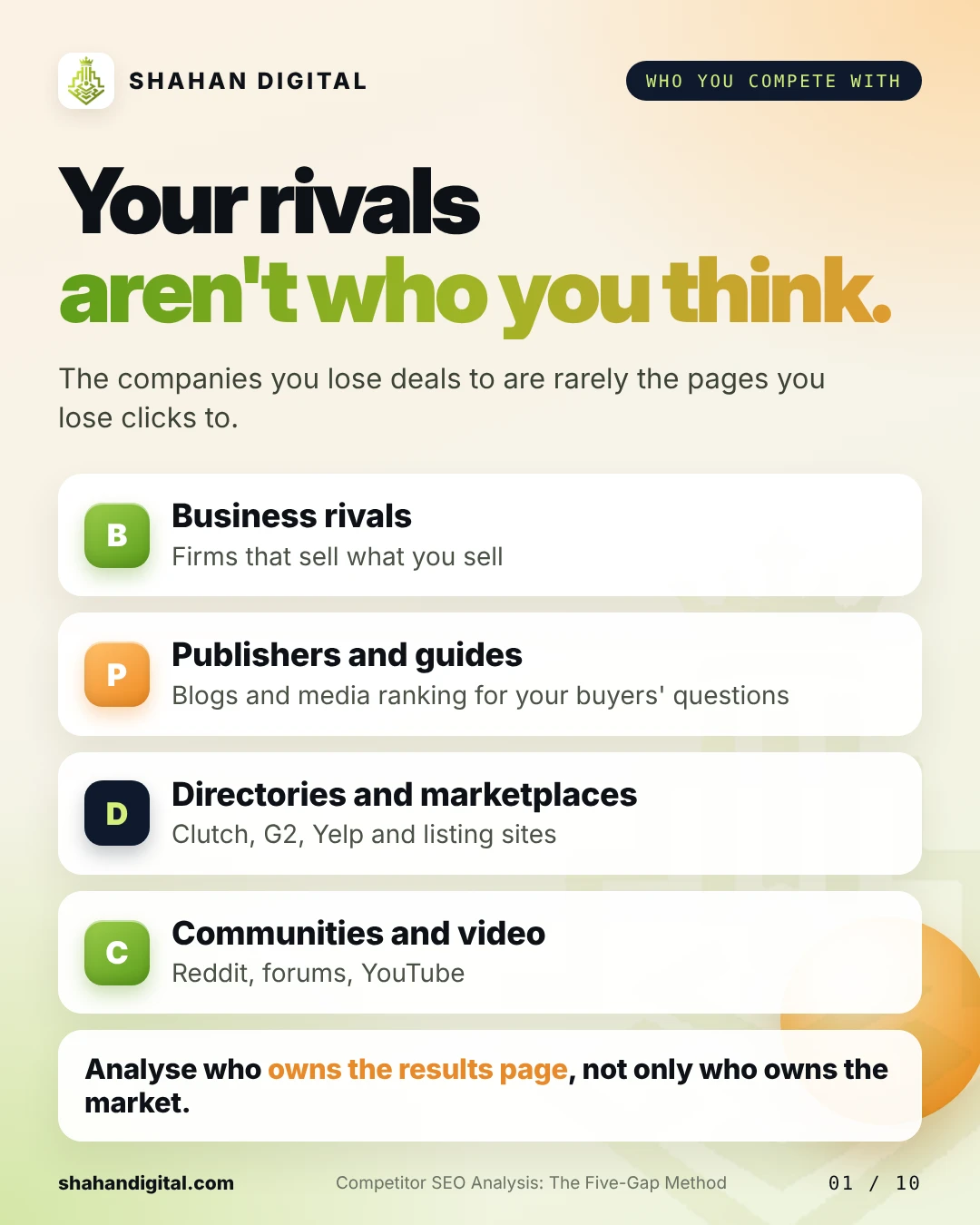
The five gaps in a competitor SEO analysis
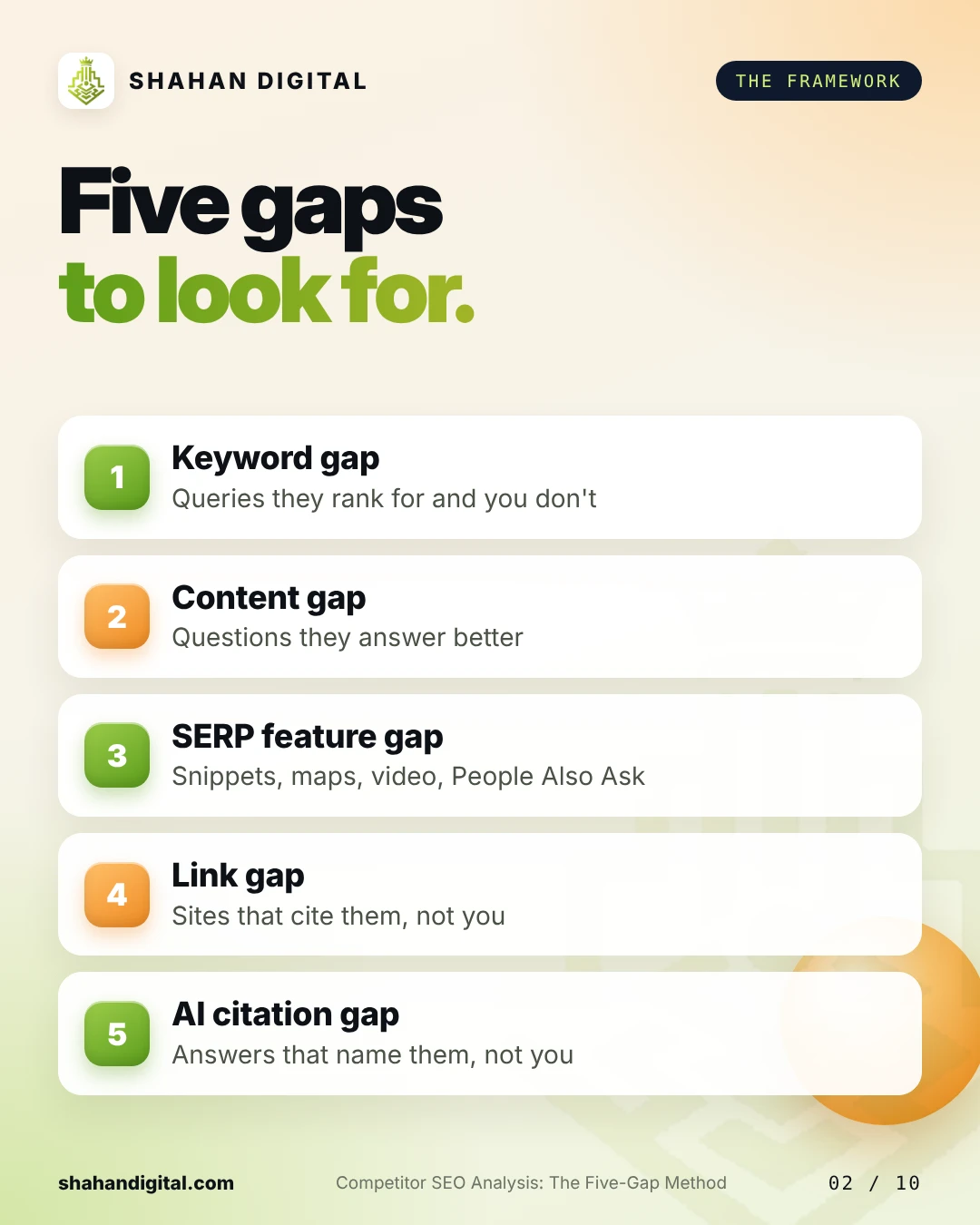
We look for five kinds of gap between you and whoever ranks above you. Most tools only cover the first and the fourth.| Gap | The question | Where to look |
|---|---|---|
| Keyword gap | Which valuable queries do they rank for that you don’t? | Keyword tools, your Search Console, the live results |
| Content gap | Which buyer questions do they answer better, or at all? | Their pages, People Also Ask, your sales calls |
| SERP feature gap | Do they own snippets, the map pack, video or image results? | The live results page, by device and country |
| Link gap | Which relevant sites cite them and not you? | Backlink tools, industry media, associations |
| AI citation gap | Do AI answers name them for your queries and not you? | Google AI Overviews, ChatGPT, Perplexity, tested by hand |
Keyword gap
The classic starting point. Export the queries your competitors rank for, remove the ones that don’t fit your business, and keep the ones with commercial value. The mistake is stopping here and writing a page for every keyword. Several keywords usually belong on one page, and some aren’t worth a page at all. Our guide to on-page and off-page SEO explains how a single page should be built around a group of related queries.Content gap
This is where most rankings are actually won. Read the competitor’s page as if you were the buyer. What did they answer that you didn’t? What did both of you miss? Often the winning page isn’t longer. It’s the only one that shows a price range, a timeline, a real example or a comparison table. Google’s guidance on helpful, people-first content is a good checklist here, especially the questions about original information and whether the page leaves the reader needing to search again.SERP feature gap
For some queries the organic links barely matter, because the page is dominated by a map pack, a featured snippet, a video carousel or “People also ask”. A local business losing to rivals in the map pack needs local SEO, not another blog post. Check the results on mobile and in the right country, because they can look completely different.Link gap
Look for sites that link to two or three of your competitors but not to you. Those are usually industry directories, associations, suppliers’ partner pages or trade publications, and they’re the most realistic links to earn. A competitor with thousands of links from unrelated blogs isn’t a model to follow. Buying links to manipulate rankings is against Google’s spam policies, and it tends to catch up with sites eventually. Our off-page SEO work focuses on the first kind.AI citation gap
The newest gap, and the one most competitor analyses still skip. Ask Google, ChatGPT and Perplexity the questions your buyers ask, and note which companies they name and which pages they cite. Repeat it a few times, because the answers vary.Why does ranking no longer equal being cited?
Because AI answers pull from a wider set of pages than the top ten. In July 2025, Ahrefs found that about 76% of the top AI Overview citations ranked in the top 10. Its larger March 2026 study, covering 863,000 keywords and four million cited URLs, found that only around 38% of all cited pages ranked in the top 10. The two studies measured slightly different things, but the direction is clear.For a competitor analysis, that means a rival can be cited in AI answers for your best query without ranking above you, and the reverse. You have to check both. Google itself says there are no special requirements for AI Overviews beyond normal search eligibility, so the gap usually comes down to clearer answers, better evidence and more mentions from trusted sources. We cover that in our AI search optimization service.
“I never compare domains; I compare URLs that answer the same query. A weaker domain often outranks a stronger one because its page matches the intent better, and that’s the gap you can actually close.”
Shahan Behkamrad, Founder of Shahan Digital
How do you run a competitor SEO analysis?
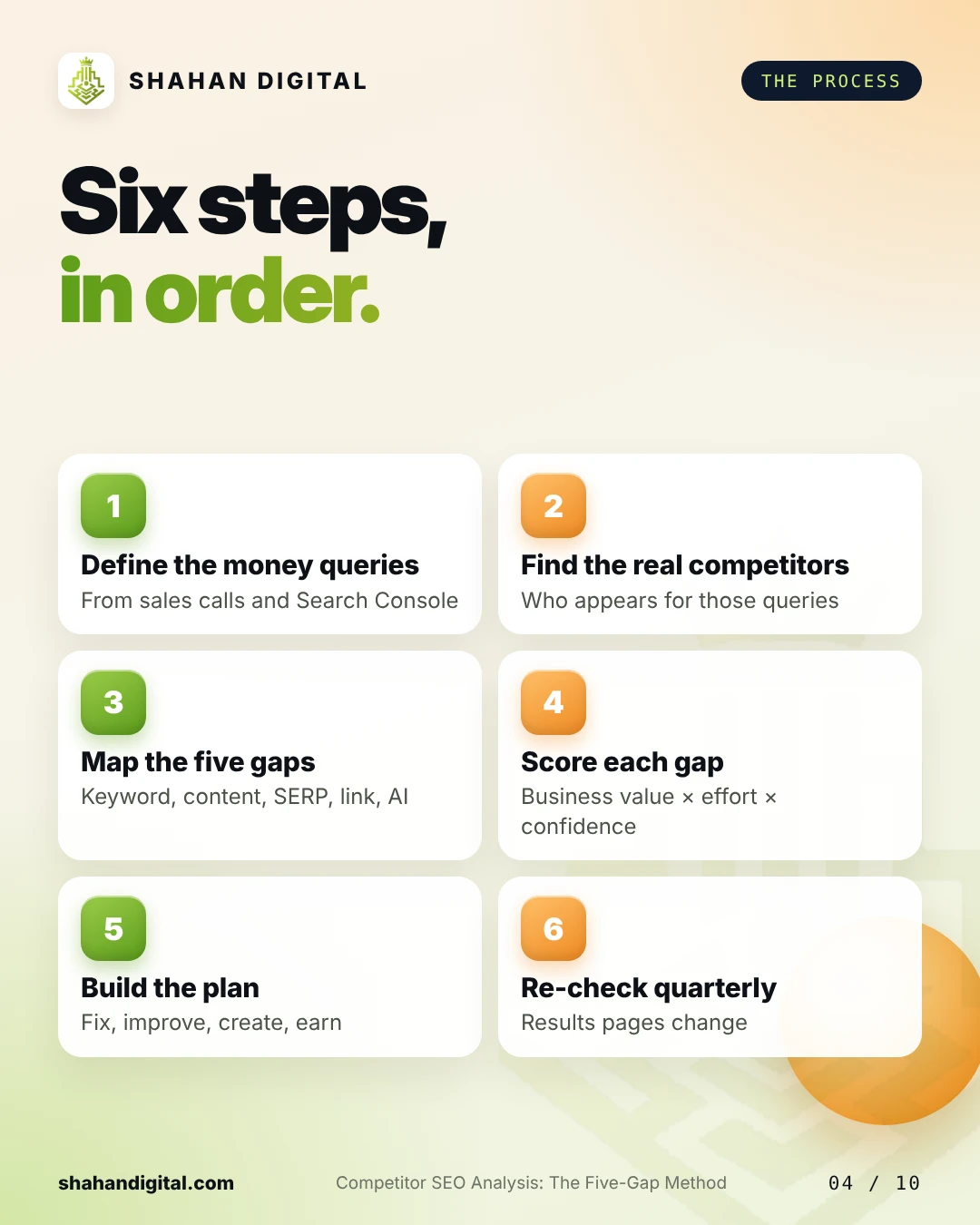
In six steps, and in this order. Skipping the first step is the most common reason analyses go nowhere.- Define the money queries. From sales calls, your CRM and your own site audit, list the queries that bring buyers, not readers.
- Find the real competitors. Search each query in the right country and on mobile, and record who owns the page.
- Map the five gaps. For each query group, note where you fall behind on keywords, content, features, links and AI citations, with evidence.
- Score each gap. Business value, effort and how confident you are that closing it will help.
- Build the plan. Decide whether each item means fixing a page, improving one, creating one or earning mentions.
- Re-check every quarter. Results pages change, competitors publish, AI answers shift.
A free competitor gap template you can copy
Copy these columns into a spreadsheet. One row per money query is enough to start.| Column | What to write | Example |
|---|---|---|
| Query | The exact search, with country and device | “payroll software for restaurants”, UK, mobile |
| Your URL and position | From Search Console, last 28 days | /payroll/, average position 14 |
| Top competitor URL | The page, not the domain | rival.com/restaurant-payroll/ |
| Page type that wins | Guide, service page, comparison, tool, video | Comparison page with a price table |
| Gap type | Keyword, content, SERP feature, link or AI citation | Content: no pricing, no restaurant example |
| Evidence | What you saw and when | Screenshot, 17 Nov 2026 |
| Can we prove it? | Yes, partly or no | Yes: public price range approved |
| Value / effort / confidence | 1–5 each | 5 / 2 / 4 |
| Action and owner | Fix, improve, create or earn mentions | Improve /payroll/, content lead |
Want us to fill in the template for you?
Send us your website and the three searches that matter most. We’ll reply within two working days with one filled-in row per search and the gap we’d close first. No obligation.
Should you copy what competitors do?
No. Learn from them, but don’t copy them. It’s tempting to take the top-ranking page, rewrite it a little and add a few headings. That rarely works for long. A page that says the same things in different words adds nothing new for the reader, which is the opposite of what Google’s quality systems look for, and scraped or lightly reworded content is called out in Google’s spam policies.What you can and should learn is which questions buyers clearly care about, how good competitors structure their pages, which sources trust them, and what customers praise or complain about in their reviews. Then build something more useful.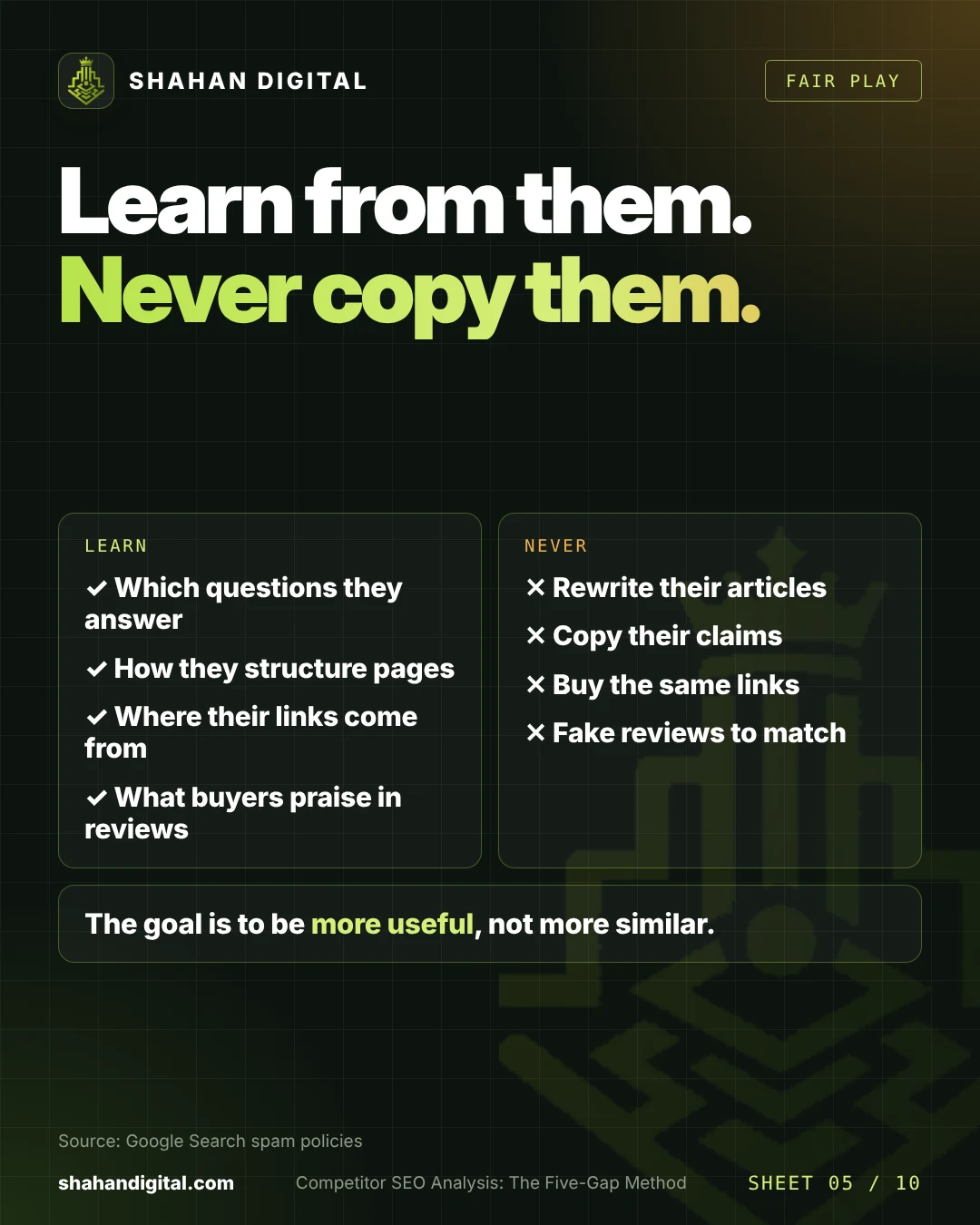
What does a competitor gap analysis look like in practice?
An illustrative example, not client data.
Take an imaginary industrial supplier in the UAE targeting “industrial valve supplier UAE”. The first page shows a B2B directory at position one, a large competitor at two and a smaller one at four. Our imaginary client sits at fourteen.The large competitor has a specification page for every valve type, with pressure ratings, materials and downloadable data sheets. The smaller one is the only site with an Arabic version. The directory wins on reviews and a map listing. Our client has one general “Products” page in English and no reviews.The gaps are clear, and so is the order. Spec pages come first, because they answer what engineers search for and naturally attract links from distributors. The Arabic version comes second. Reviews and a directory listing run alongside. Writing blog posts about “the history of valves” would be the wrong place to start, however many keywords a tool suggests. We see this pattern often in manufacturing SEO and B2B SEO work.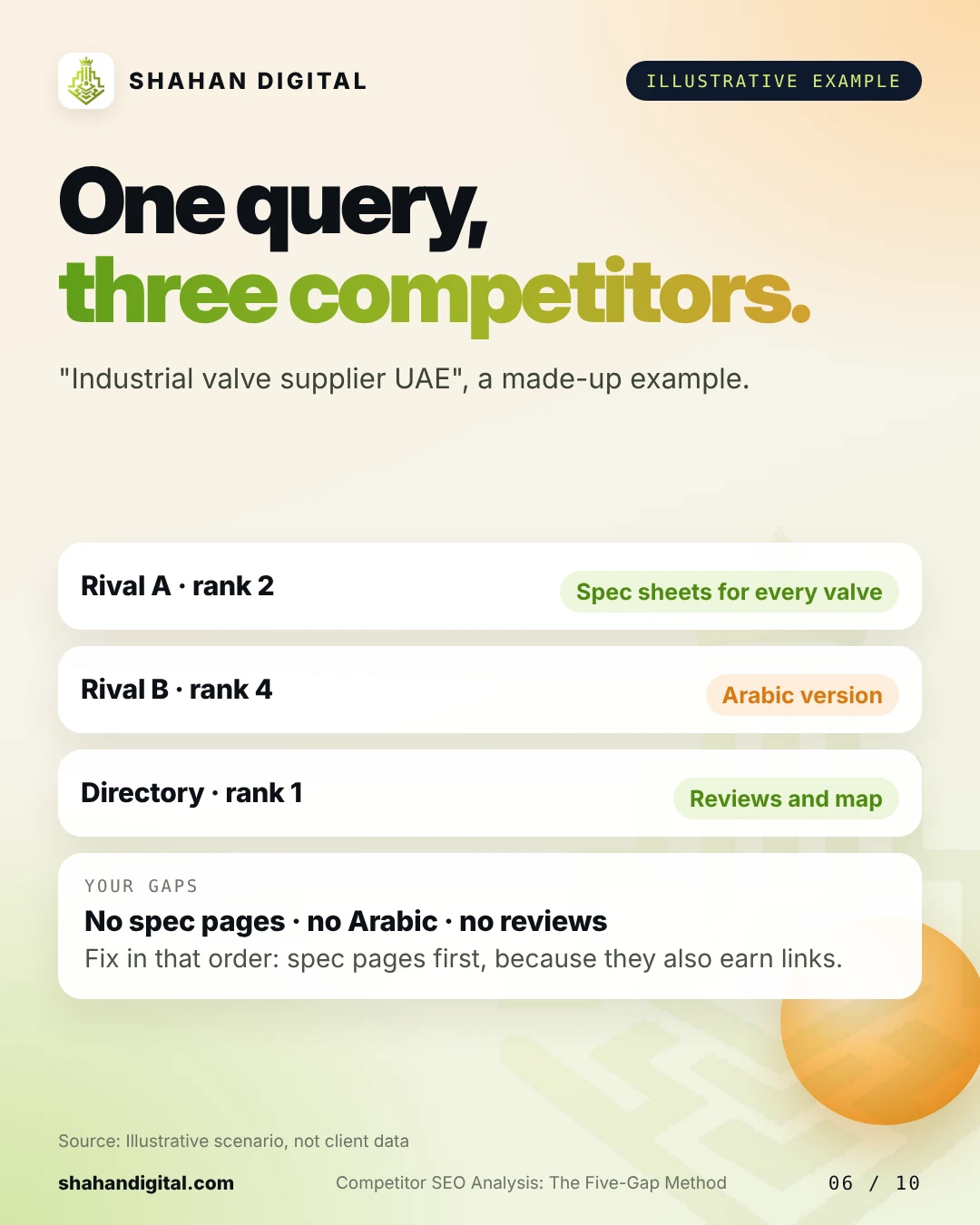
What do other competitor analysis guides get right, and what do they miss?
We reviewed the top results for “competitor SEO analysis” on 17 November 2026. Most are solid how-to guides, and several are worth reading.| Guide | What it does well | What’s missing |
|---|---|---|
| HubSpot | Clear step-by-step process for beginners | Little on deciding which gaps are worth money |
| Semrush | Detailed tool walkthrough and a free report template | Built around one tool’s data |
| Search Engine Land | Covers competitor analysis for both search and AI answers | Less on turning findings into a budget |
| Digital Silk | Written for executives, notes that publishers and review sites can be competitors | No working template |
Which gaps from a competitor analysis should you close first?
Score every gap on business value and effort, then sort it into one of four groups. Quick wins (high value, low effort) go first. Big bets (high value, high effort) get planned and resourced. Fill-ins get batched when there’s time. Anything low value and high effort gets dropped, however impressive the competitor’s numbers look.The most valuable quick wins are usually pages you already have that rank between positions 5 and 20 for a money query. A better title, a clearer answer at the top, a comparison table and two or three internal links can move those faster than any new page.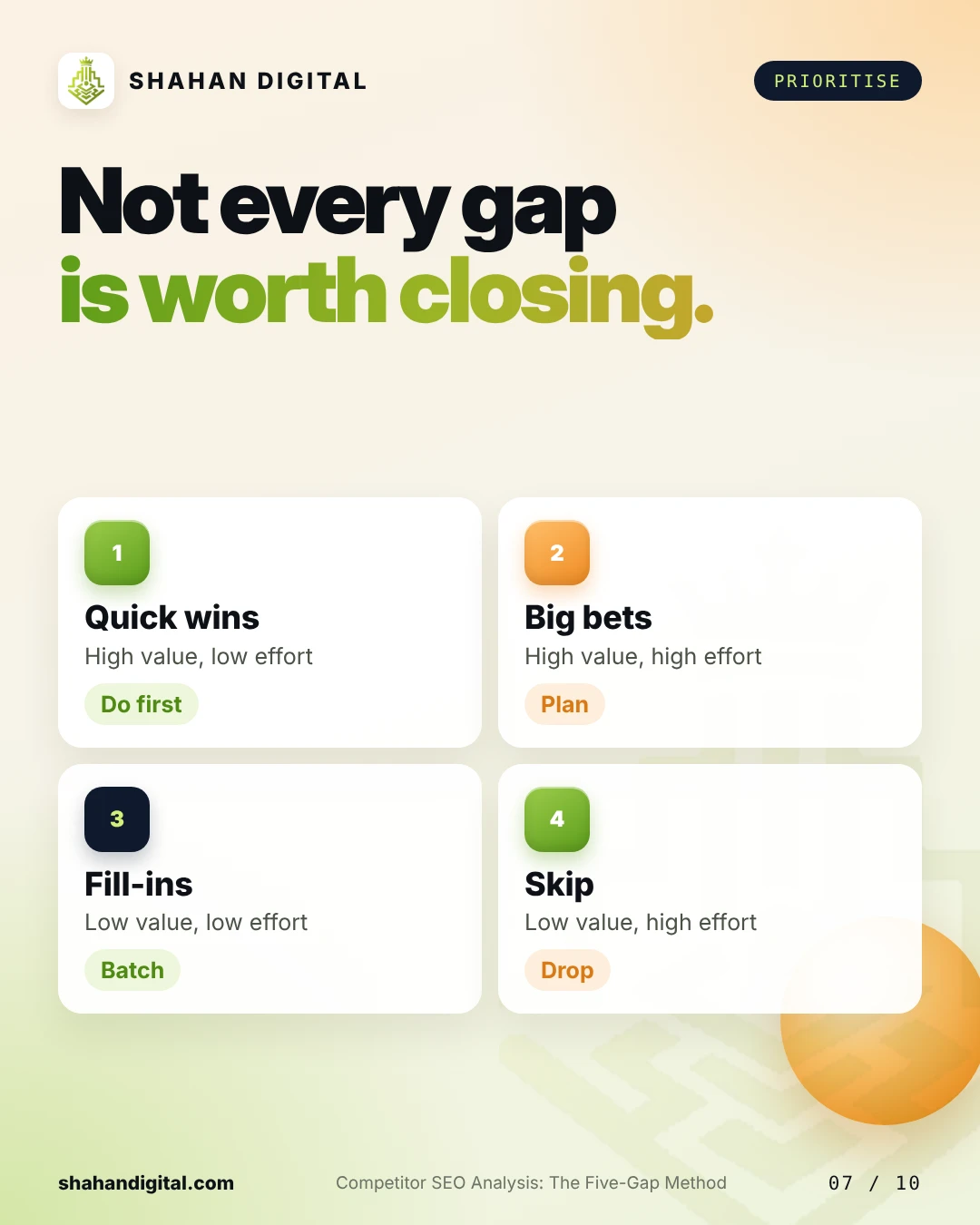
Which tools do you need for SEO competitor analysis?
Keyword and backlink tools are useful for the keyword and link gaps. They estimate competitor traffic, show shared keywords and list referring domains. Treat those numbers as estimates: traffic figures in third-party tools are modelled, not measured, and can be well off for smaller sites.What tools can’t tell you is why buyers choose a competitor. That comes from reading their pages properly, looking at their offer and pricing, reading their reviews and listening to your own sales calls. In our experience the most decisive gaps, like a missing price range or a missing case study, never show up in a tool at all.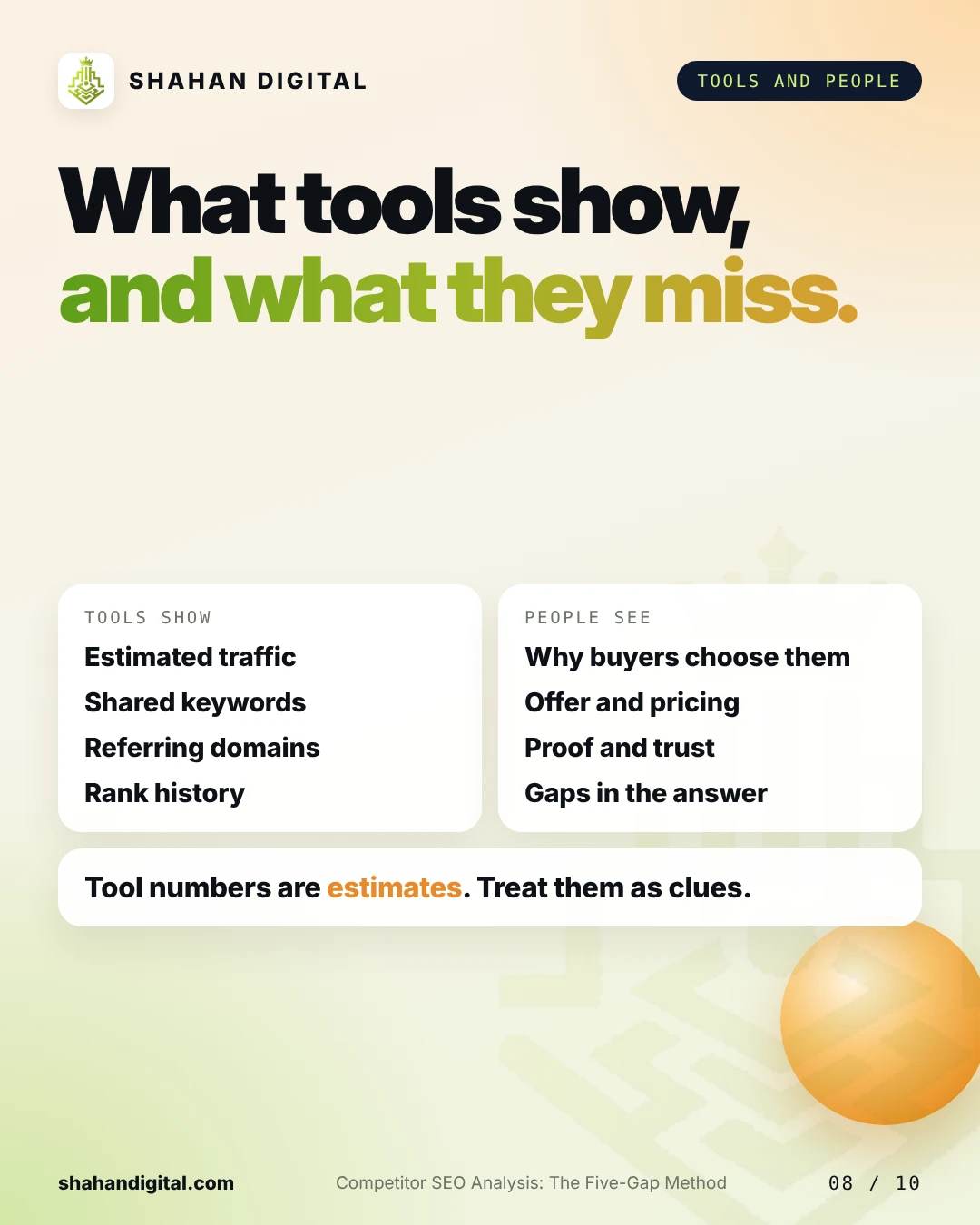
What should a competitor SEO analysis include?
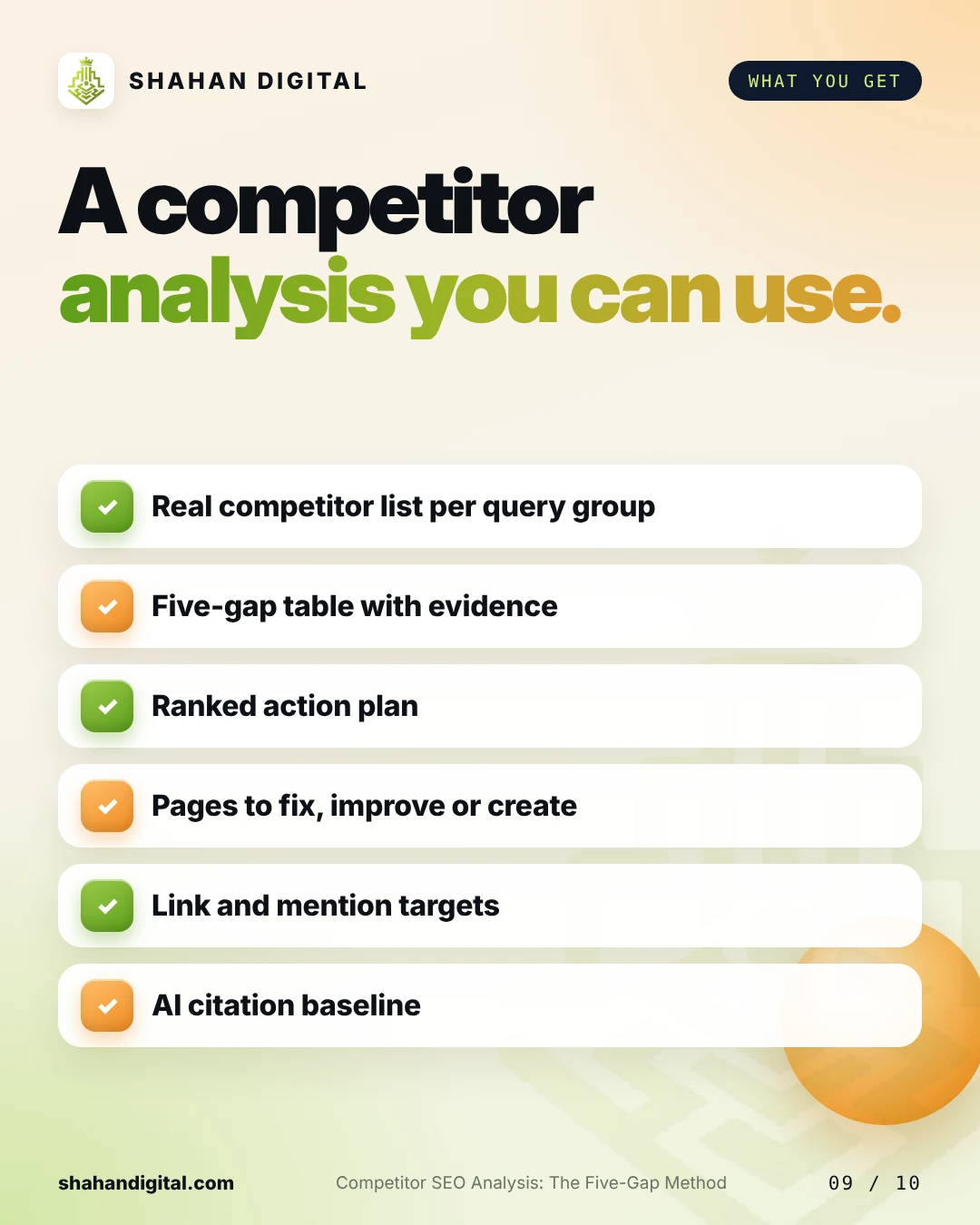
If you’re paying for one, expect six things:- a list of your real competitors for each group of money queries, including directories and publishers
- a five-gap table with evidence, such as screenshots, URLs and dates
- a ranked action plan, usually five to ten items for the first quarter
- a clear list of pages to fix, improve or create
- specific link and mention targets you could realistically earn
- a baseline of AI citations for your key questions, so progress can be measured
What happens after the analysis?
A competitor SEO analysis is only worth what gets built from it. In our projects, the first quarter usually covers the quick wins and one big bet, with a review at the end against the money queries we started with. Rankings for long-tail and near-miss queries can move in weeks. Competitive head terms take longer and depend on authority, which we explain in how long SEO takes.We measure the outcome the same way we’d measure any SEO work: visibility on the chosen queries, then clicks, then enquiries. Our piece on measuring SEO success covers the details.“Before I call something a content gap, I check three things: does the query have commercial intent, does the results page reward that page type, and can the client prove the claim. Missing any one, it’s a distraction.”
Shahan Behkamrad, Founder of Shahan Digital
Why work with Shahan Digital on competitor SEO analysis?
- We check the market, not just the tool. Real results pages in the right country and language, on mobile and desktop.
- Four languages. We analyse competitors in English, Arabic, Persian and Turkish results, where many opportunities sit untouched.
- AI search included. Every analysis includes a dated baseline of AI citations for your key questions.
- A plan, not a dump. Five to ten ranked actions, each tied to business value.
- We can build it too. Our technical SEO and SEO content writing teams turn the plan into pages, or we hand it to your team.
Frequently asked questions about competitor SEO analysis
What is a competitor SEO analysis?
It’s a review of the sites that rank, or get cited, for the searches your buyers make, to find out why they appear and you don’t. A useful one covers keywords, content, search features, links and AI citations, and ends with a ranked plan.How do I find my SEO competitors?
Search your ten most valuable queries in the right country, on mobile, and note who appears. Add the sites your keyword tool shows as sharing many keywords with you. Expect to find publishers, directories and forums alongside direct rivals.What is a competitor gap analysis in SEO?
It compares your site with competitors to find queries, topics, features or links they have and you don’t. The most useful gaps are the ones closest to revenue, not the ones with the biggest search volume.How often should I analyse competitors?
Do a full analysis at the start, then a lighter check every quarter. Check sooner after a major Google update, a big competitor launch or a sudden drop in your own traffic.Can I outrank a competitor with a stronger domain?
Often, yes, on specific queries. A page that answers the question better, with original detail and a clear structure, can beat a stronger domain’s weaker page. Broad head terms are harder, and depend more on authority.Should I copy my competitor’s content?
No. Learn which questions matter and how good pages are structured, then write something more useful. Copied or lightly reworded content rarely holds rankings and can fall under Google’s spam policies.Does competitor analysis include AI search?
It should. AI answers often cite different pages from the top organic results, so you need to check which companies AI tools name for your buyers’ questions as well as who ranks.Want to know exactly why they rank and you don’t?
Send us your website, the competitors you keep seeing above you and the searches that matter most. We’ll fill in the gap template for your top queries and show you which of the five gaps is costing you the most, and the first three things we’d change.
Editorial note: Research figures were checked against the linked sources in November 2026. The review of other guides reflects search results on 17 November 2026. Third-party studies use different samples and methods, so treat the numbers as directional. No ranking, traffic or revenue result is guaranteed.
Written by

Shahan Behkamrad
Author · Founder of Shahan Digital · SEO & GEO Strategist
Shahan Behkamrad is an SEO and GEO strategist and the founder of Shahan Digital. Since 2017 he has built search strategies for businesses in Persian, Arabic, English and Turkish markets, usually working alongside a client’s in-house team to decide what to fix first, what to build next and how to measure it.
- Strategy before tactics: every engagement starts with a diagnosis of where growth is being lost, then a ranked plan tied to enquiries and revenue, not to rankings alone.
- Current with how search works now: his work covers Google Search, Google Maps, AI Overviews and AI assistants such as ChatGPT, and he checks Google’s documented updates before changing a client’s plan.
- Specialist depth: technical, international and multilingual SEO, local SEO and AI search visibility (GEO).
- Has trained more than 650 students in SEO and digital marketing, including as an official instructor at Iran’s Technical and Vocational Training Organization.
- Host of the Shahan Behkamrad Podcast on business growth, branding, SEO and AI.
- Master’s student in Strategic Marketing and Brand Management at Nişantaşı University, Istanbul; holds 25+ international digital marketing certifications.