Quick answer
Local pack SEO is the work that gets your Google Business Profile into the three map results above the normal listings. Google says local results depend mainly on relevance, distance and prominence. You can’t buy a better position. You can choose the right primary category, keep your profile complete and honest, earn real reviews, and build a location page that backs it all up.
Below: how the local pack works, who is eligible, what moves rankings, how to measure visibility across a city, what it costs, and when another channel deserves your money first.
Who this guide is for. Owners and marketing managers of clinics, trades, shops, restaurants, law firms and multi-location brands who want more calls, direction requests and bookings from Google Maps. It also helps teams who already pay for local SEO and want to check the work.
Pick your path:
- Not sure where to start → the decision aid
- Service-area business with no shopfront → eligibility rules
- Already ranking in one area only → measuring visibility by grid
- Comparing quotes → what local pack SEO costs
Key takeaways
- Google names three main local ranking factors: relevance, distance and prominence. It also says there is no way to request or pay for a better local ranking.
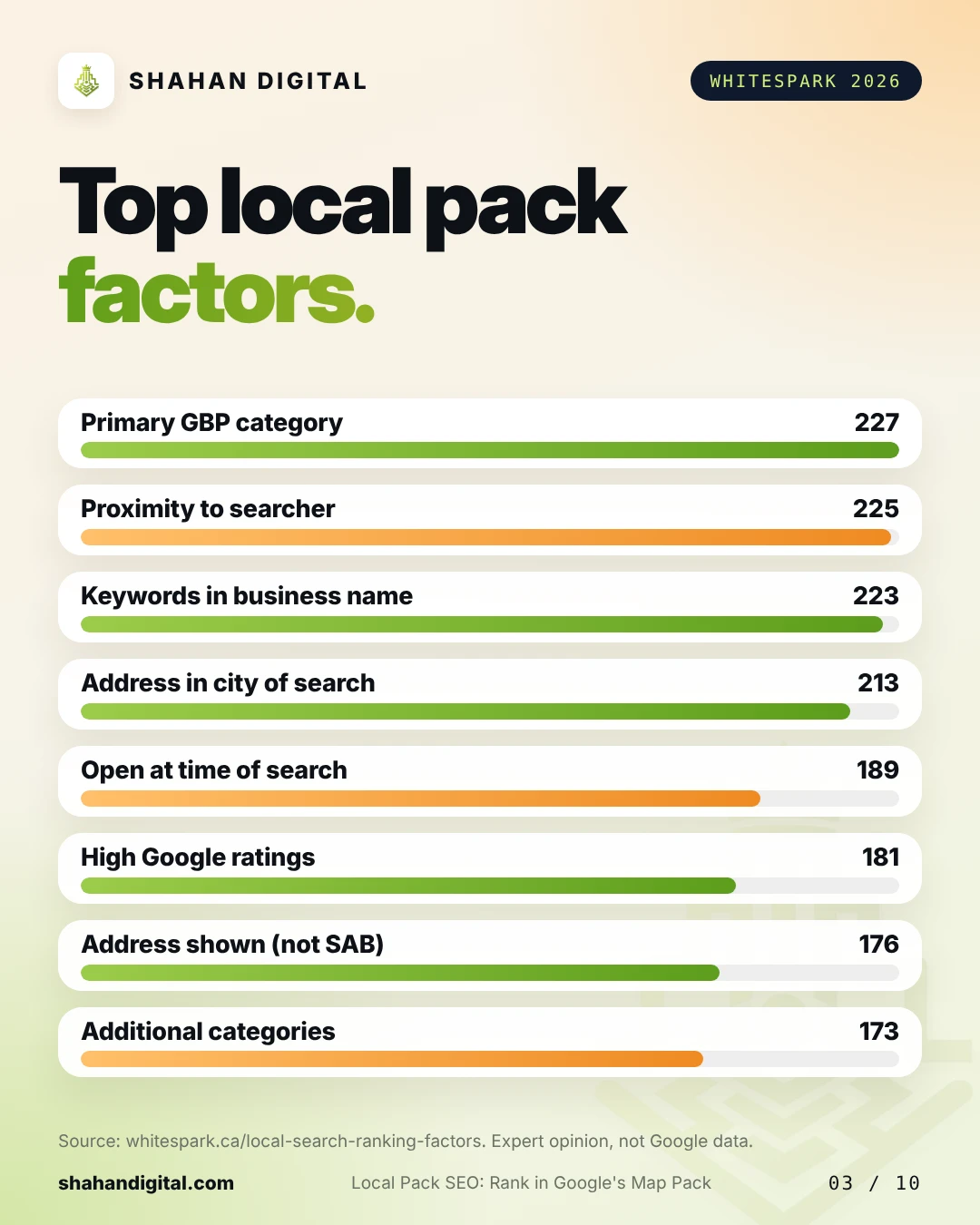
- In Whitespark’s 2026 expert survey, the top three local pack factors were primary GBP category, distance to the searcher and keywords in the business name.
- Keywords in the name only help when they are your real name. Google’s guidelines say extra words in a name can get a profile suspended.
- Reviews matter to buyers too: BrightLocal’s 2026 survey of 1,002 US adults found 97% read reviews for local businesses.
- Rank checks from one spot mislead. Measure visibility on a grid across your service area and tie it to calls and bookings.
Here is why we wrote this page. In our own Search Console data from 19 August to 17 November 2026, searches like “seo local pack”, “local pack seo” and “local map pack seo” reached our site about 790 times. They all landed on our service page, which explains what we do but not how the local pack works. Business owners asking these questions want a straight explanation first. This is it.
We also see the same pattern in audits. A business ranks in the map pack on the street where the owner checks, and nowhere two kilometres away. The owner thinks local SEO is working. The phone says otherwise.
Before you invest in local pack SEO
Check three things. First, are you eligible for a Business Profile at the address you use? A virtual office or an unstaffed co-working desk isn’t. Second, can you answer the extra calls and messages within the hour? Third, do you track calls, direction requests and bookings from your profile today?
If any answer is no, fix that first. More map visibility on top of a broken intake process just means more missed customers.
What the local pack is and why local pack SEO is its own job
The local pack is the block of three businesses with a map that Google shows for searches with local intent. Think “dentist near me”, “emergency plumber” or “Italian restaurant”. People also call it the map pack or the 3-pack. Each listing shows the name, rating, review count, category, hours and quick actions like call, website and directions.
Local pack SEO is different from ranking a web page. The ranking unit is your Google Business Profile, not a URL. Your website still matters, because it supports relevance and prominence. But the profile, its category, its reviews and your distance from the searcher carry much of the weight.
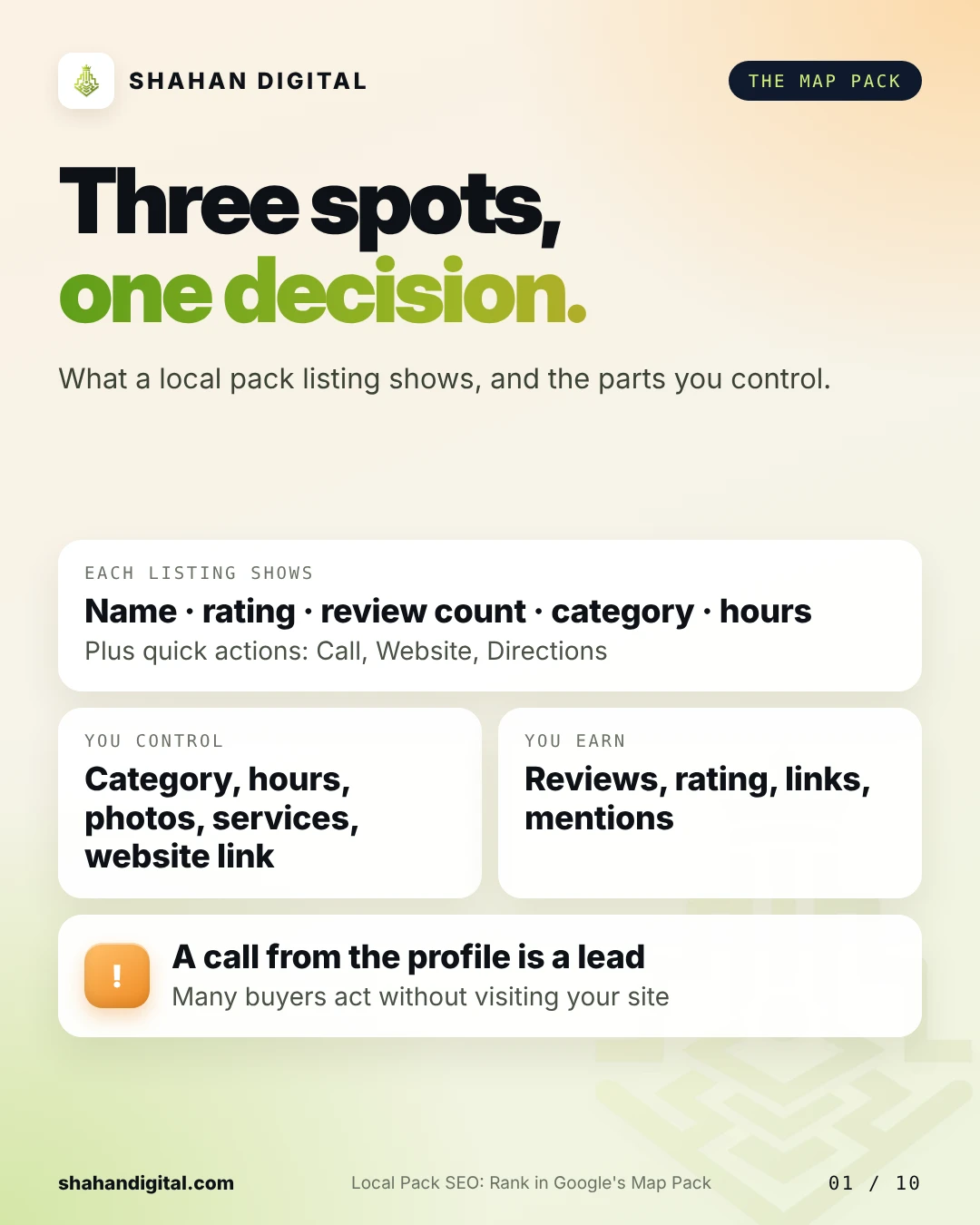
The local pack is also where many local buyers act without visiting a website. A call or a direction request from the profile is a lead. If you only watch website traffic, you miss it.
How Google ranks businesses in the local pack
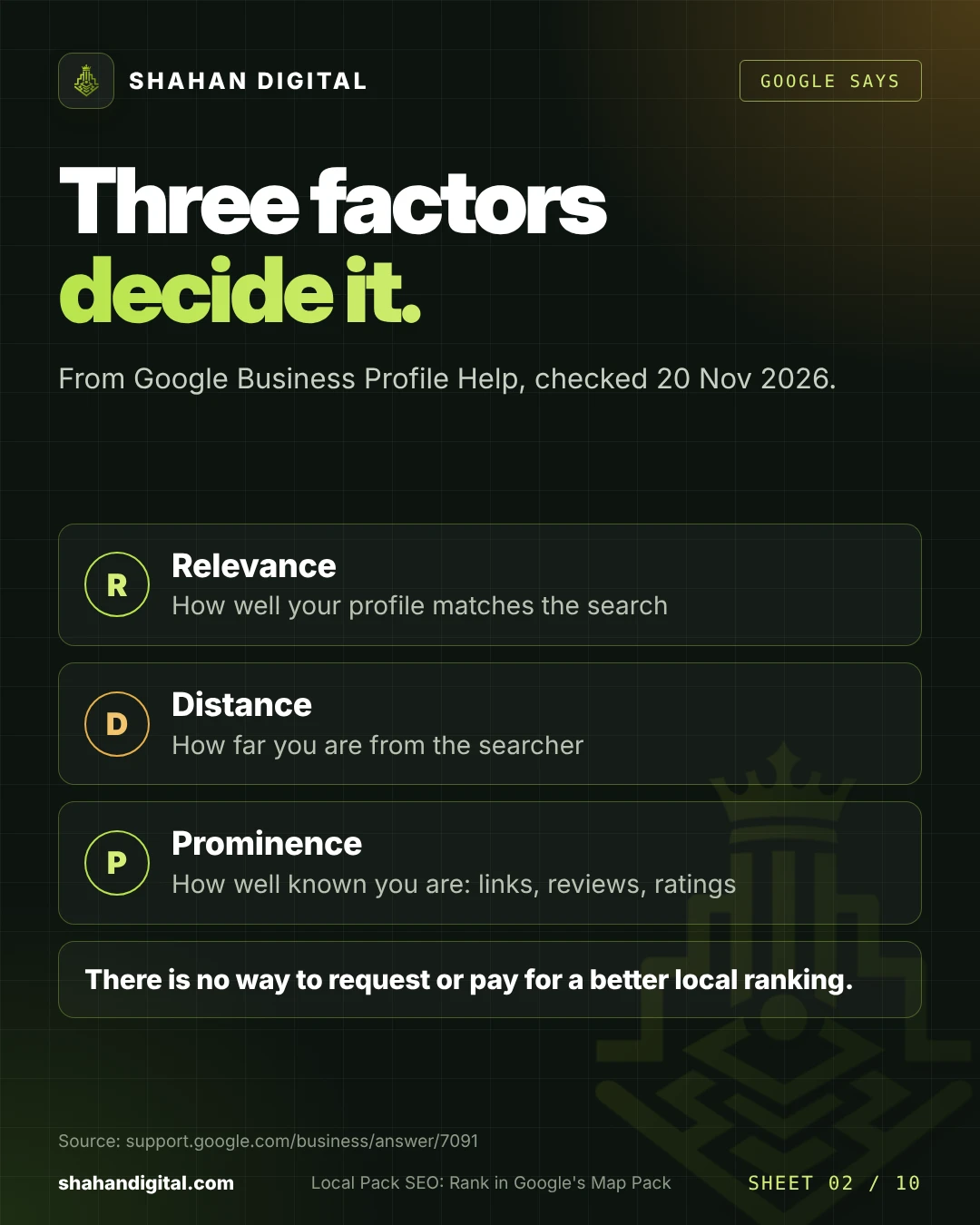
Google’s own help page is short and clear. It says local results are mainly based on relevance, distance and prominence. Relevance is how well your profile matches the search. Distance is how far you are from the searcher, or from the location in the query. Prominence is how well known you are, which Google says includes links to your business and how many reviews you have.
The same page says businesses with complete and accurate information are more likely to show up. It also says there is no way to request or pay for a better local ranking. That sentence is worth remembering when someone sells you a guaranteed map pack position.
Outside Google, the most cited view is Whitespark’s survey of local search practitioners. The 2026 Local Search Ranking Factors report, published by Darren Shaw on 6 November 2025, ranks these as the top local pack factors:
| Rank | Factor (Whitespark 2026, local pack/Maps) | Score | What it means in practice |
|---|---|---|---|
| 1 | Primary GBP category | 227 | Pick the category that completes “this business is a…” |
| 2 | Proximity to the point of search | 225 | You can’t move it. You can measure it and plan locations around it |
| 3 | Keywords in GBP business title | 223 | Only if the words are your real-world name |
| 4 | Physical address in city of search | 213 | Real, staffed locations beat virtual addresses |
| 5 | Business open at time of search | 189 | Accurate hours, including special hours |
| 6 | High numerical Google ratings | 181 | A steady flow of genuine reviews |
| 7 | Address showing on GBP (not service-area only) | 176 | Storefronts have an edge; service-area firms need stronger relevance |
| 8 | Additional GBP categories | 173 | Add only categories that describe the business, not keywords |
Source: Whitespark, 2026 Local Search Ranking Factors, scores as published. These are expert opinions, not Google data.
“The primary category is the one setting I check before anything else. We often find a clinic listed as a generic ‘medical clinic’ when its money searches are for a specific treatment, or a trade listed under a category it barely does. Change the primary category, watch the grid for two to three weeks, and you see which searches the profile is now eligible for. Then build the service pages to match.”
Shahan Behkamrad, Founder of Shahan Digital
Who is eligible: storefront, service-area and hybrid businesses
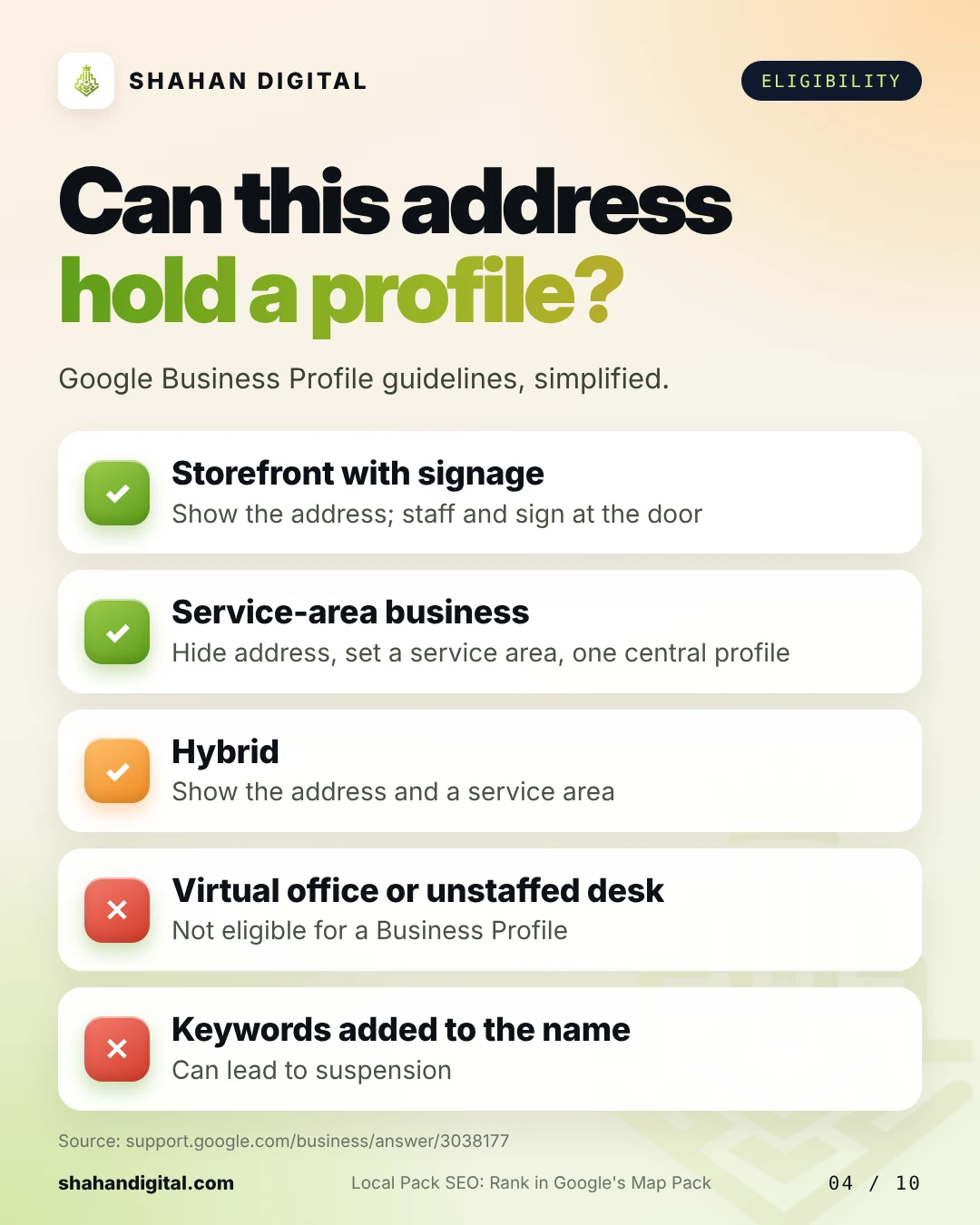
Before any ranking work, check that your profile is allowed to exist in its current form. Google’s guidelines for representing your business set the rules. The main ones:
- Storefronts show their address. Google expects permanent signage with the business name at that address.
- Service-area businesses visit customers. They should have one profile for the central office with a defined service area, and can’t list a virtual office unless it is staffed during business hours.
- Hybrid businesses, like a garage that also offers roadside help, can show the address and a service area.
- Virtual offices and co-working desks without signage and staff aren’t eligible.
- One profile per location. Duplicates in one or several accounts break the rules.
The name rule matters most for ranking. Google says your name should reflect your real-world name, and that including unnecessary information in it can lead to suspension. So “Smile Dental Clinic” is fine if that is the name on the door. “Smile Dental Clinic Best Implants Dubai” is a risk, even though keyword names score well in surveys.
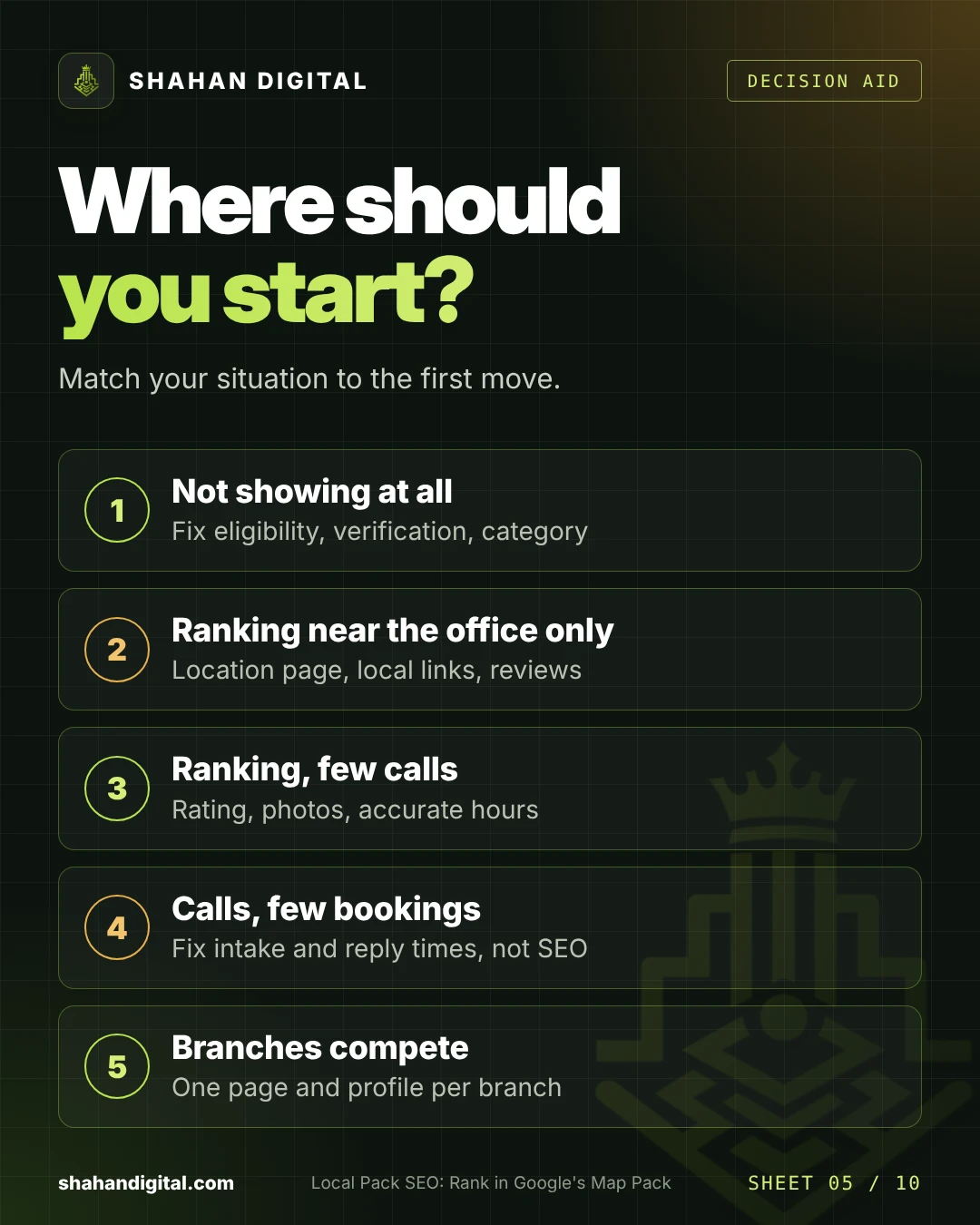
Decision aid: where should your local pack SEO start?
Most local businesses don’t need everything at once. Use this table to find the first move that fits your situation. It is built from the patterns we see in audits, not from a fixed package.
| Your situation | Likely constraint | First move | What tells you it worked |
|---|---|---|---|
| You don’t appear at all, even next door | Eligibility, verification or wrong category | Verify, fix the primary category, remove duplicates | Profile shows for its own category near the address |
| You rank near the office only | Distance and weak prominence | Location page, local links, steady reviews | Grid coverage widens week by week |
| You rank but get few calls | Low rating, poor photos, wrong hours | Review workflow, photos, accurate hours | Calls and direction requests per view rise |
| Calls come in but few book | Intake, not SEO | Call handling, reply times, booking path | Booked share of calls rises |
| Several branches compete with each other | Overlapping location pages and categories | One page and one profile per branch, distinct services | Each branch wins its own grid area |
| Customers search in two or more languages | One-language profile and site | Native-language location pages and review replies | Visibility for queries in each language |
Not sure which row is you?
Send us your business name, your main services and the areas you serve. We’ll check your profile, run a sampled grid across your area and tell you where the local pack is being lost.
Profile work that moves the map pack
This is the part most guides list. We’ll keep it to what we check, in order.
- Primary category. Pick the most specific category that describes the whole business. Google asks you to use as few categories as possible and not to use categories as keywords.
- Secondary categories. Add the few that are true and that people search for.
- Hours. Set regular and special hours. In Whitespark’s survey, “open at time of search” ranked fifth.
- Services and description. List real services with plain names. Describe what you do and where.
- Photos and videos. Show the place, the team and real work. Stock photos don’t help buyers.
- Website link. Point each profile to its own location page, not the homepage, when you have several branches.
The website side matters more than many owners think. A clear location page with your services, area, prices where you can publish them, and proof such as reviews and photos supports relevance and prominence. Our guide to on-page and off-page SEO explains how the page and the links around it work together, and our technical SEO services cover the speed and template issues that stop location pages from being indexed.
Reviews: what helps and what gets you removed
Google says more reviews and positive ratings can help local ranking. Buyers agree. BrightLocal’s Local Consumer Review Survey 2026 used a representative panel of 1,002 US adults. It found 97% of consumers read reviews for local businesses, and the average consumer uses six review sites. The same report notes a rise in AI tools such as ChatGPT for local recommendations.
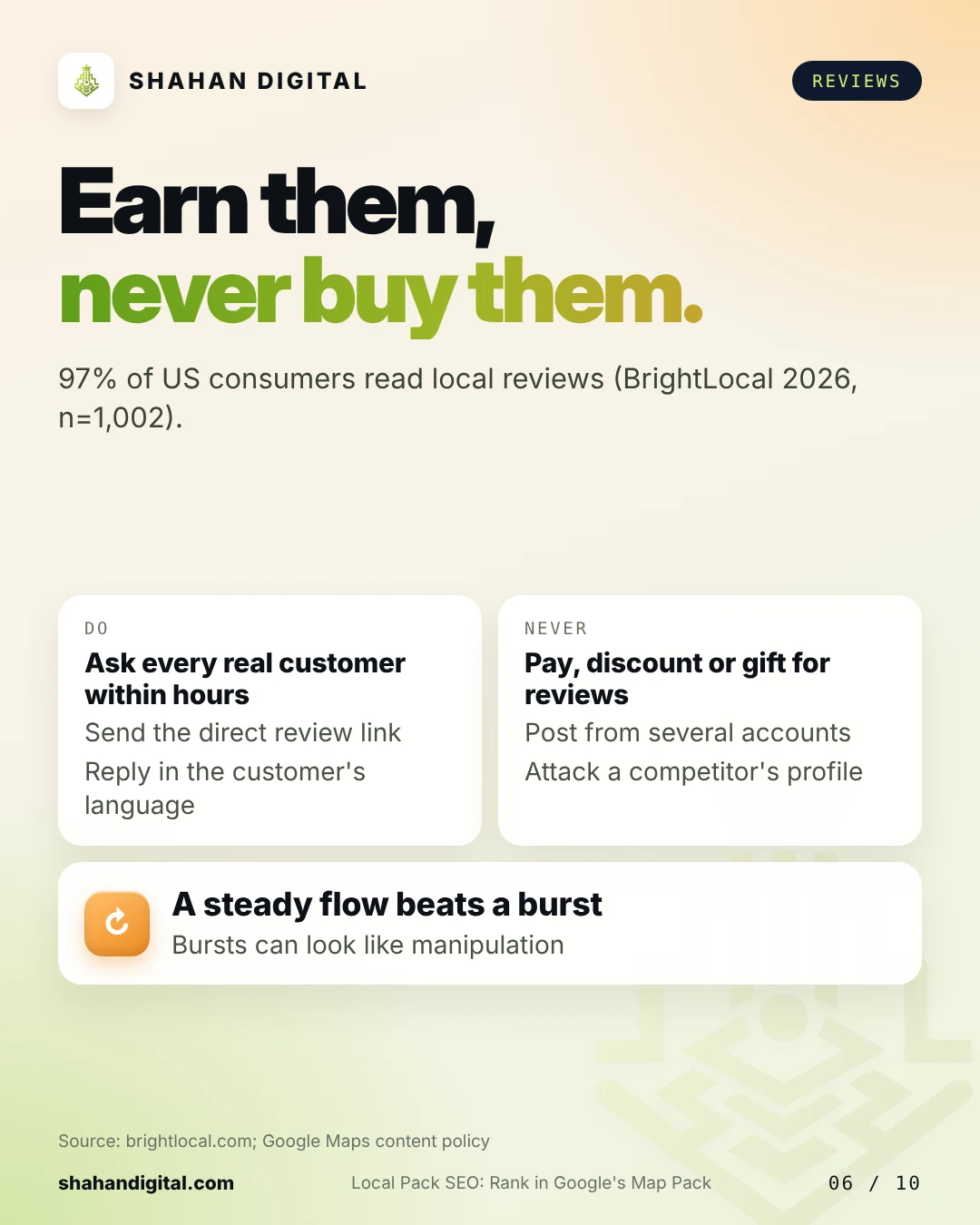
The rules are strict. Google’s Maps content policy says fake engagement will be removed. It bans paid reviews, reviews posted from several accounts by one person, and incentives such as discounts or free services in exchange for a review. It also bans posting on a competitor’s profile to hurt them.
So the review plan is simple and slow. Ask every real customer at the right moment, make it easy with a direct review link, and reply to every review in the customer’s language. A steady flow beats a burst, and a burst can look like manipulation.
“When a profile’s rating stalls, the cause is usually timing, not customers. The request goes out a week later by email, when the customer has moved on. Send it by message within a few hours of the job, with the direct review link. Then check the review velocity against the top three in your grid. If they add ten a month and you add two, no amount of category work will close that gap.”
Shahan Behkamrad, Founder of Shahan Digital
How to measure local pack visibility properly
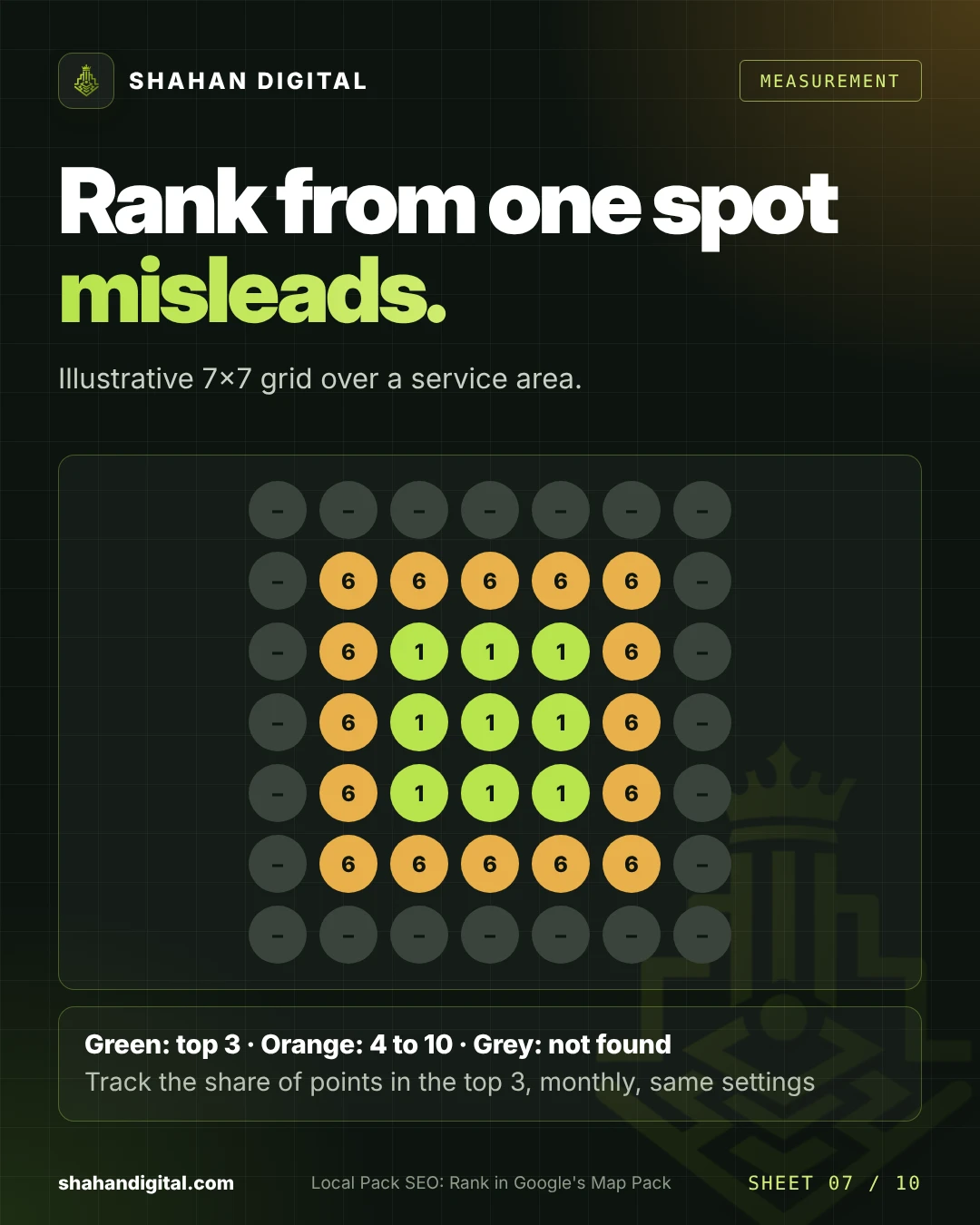
A single rank check tells you how you rank from one spot. Distance is a top factor, so your position changes from street to street. The better method is a sampled grid: check the same search from many points across your service area and record your position at each one.
- Choose two to five money searches, for example “emergency plumber” and “boiler repair”.
- Set a grid over your real service area. A 7×7 grid with points about one kilometre apart is a common start for a city business.
- Run it on the same day each month, and keep the settings identical.
- Record the share of points where you are in the top three, not just an average rank.
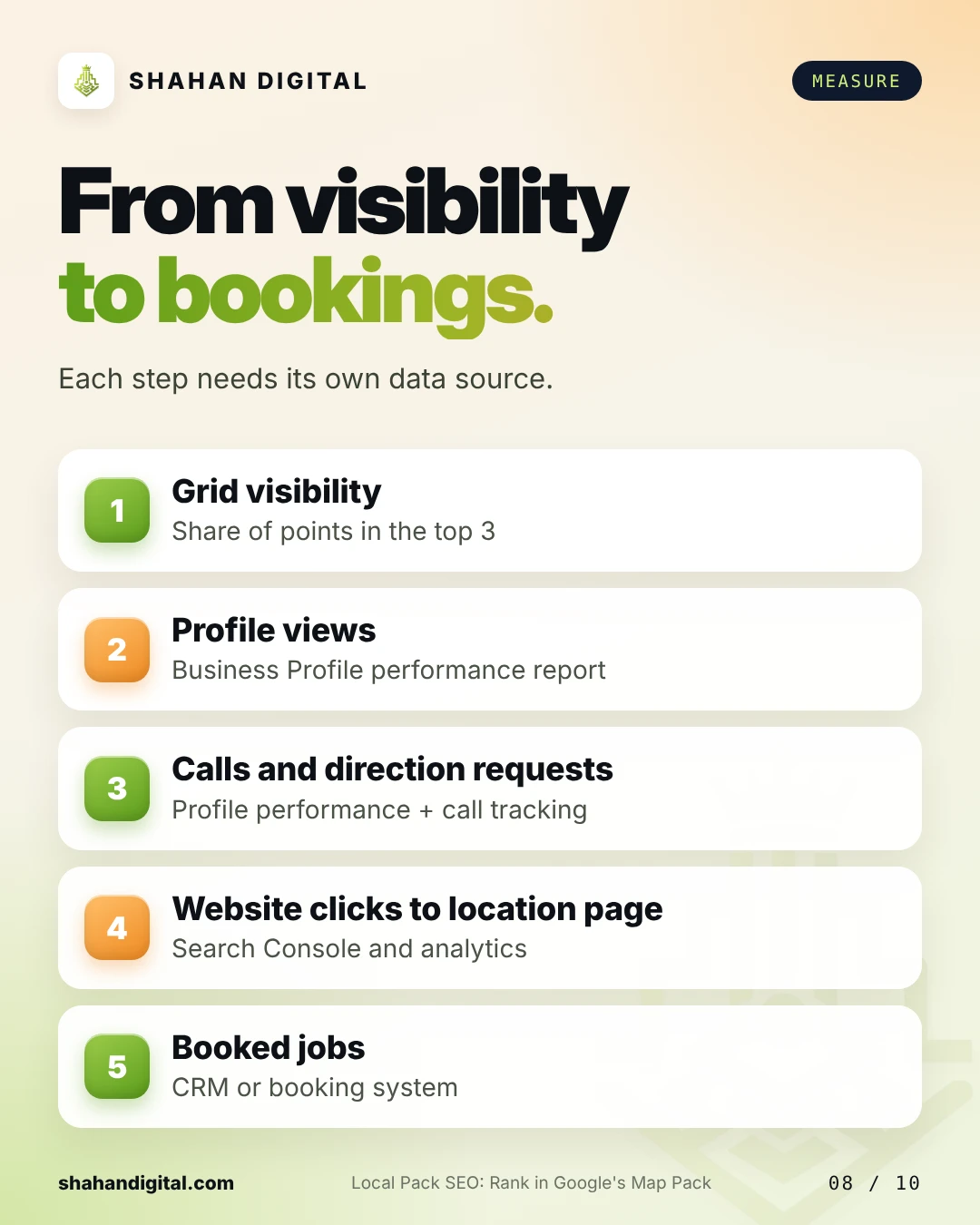
Then join it to business data. In your Business Profile performance report, watch calls, direction requests and website clicks. In your CRM or booking system, watch booked jobs. Our guide on how to measure SEO success covers the wider reporting setup.
Local pack SEO in several languages and markets
Many cities search in more than one language. Dubai searches mix English and Arabic. Istanbul has Turkish, English, Arabic and Persian speakers. Erbil mixes Kurdish, Arabic and English. Your profile has one name and one main description, but your website, service names, photos and review replies can serve each group.
We work in four languages: English, Arabic, Persian and Turkish. Each version is written by a native writer for the target country, because a translated service name often isn’t the word people search. Arabic and Persian pages need right-to-left layout and correct language tags. Our Arabic SEO services page explains the Arabic side, and our pages on SEO in Dubai, SEO in Turkey and SEO services in Erbil show how this plays out in each market.

How local pack SEO differs by business type
| Business | What we check first | What success looks like |
|---|---|---|
| Dental or medical clinic | Category per treatment, practitioner profiles, ad rules | Booked consultations by treatment |
| Aesthetic clinic | Treatment pages, before-and-after rules, reviews | Consultations within ad rules |
| Trade or handyman (service-area) | Service area, central office, job photos | Calls from across the service area |
| Restaurant or shop | Hours, menu or products, photos | Direction requests and visits |
| Multi-location brand | One page per branch, no overlap, branch-level tracking | Leads per branch |
For sector detail, see our guides to dental SEO, SEO for aesthetic clinics, healthcare SEO in Dubai and SEO for handyman services.
What local pack SEO costs
Most providers price local pack work inside a local SEO retainer. Published ranges are wide, so use them as a sense check, not a quote.
| Pricing model | Published range | Source and date |
|---|---|---|
| Agency monthly retainer | $501 to $3,000 per month | SEO.com, updated 14 September 2026 |
| One-time local SEO project | $500 to $5,000 per project | SEO.com, updated 14 September 2026 |
| Hourly rate | $75 to $100 per hour (SEO.com); $50 to $100 per hour (Semrush) | SEO.com 2026; Semrush, updated 20 August 2025 |
| Monthly range across studies | $100 to $3,000 per month | Semrush summary of several studies, updated 20 August 2025 |
| Shahan Digital | Scoped quote after a review | No fixed published price; locations, languages and competition set the scope |
What moves the price: the number of locations, how many languages you need, how competitive your category is in your city, and whether location pages need to be written or rebuilt. Ask any provider to split profile work, website work, reviews support and reporting in the quote.
We reviewed the top results for “local pack seo”
We reviewed the top English-language results for “local pack seo” and “how to rank in the map pack” on 20 November 2026 (US results). Several are good, and we credit what they do well.
| Page | What it does well | What’s missing for a buyer |
|---|---|---|
| Ahrefs glossary | Clear, short definition and basic steps | No eligibility rules, no grid measurement, no costs |
| HigherVisibility (updated October 2025) | Detailed factor list and practical steps | Little on service-area rules, name suspensions or multiple languages |
| SE Ranking (updated February 2026) | Good section on tracking the local pack | Tool-led; no link from visibility to calls and bookings |
| Semrush 3-pack guide (updated February 2026) | Simple seven-step plan | Generic steps; no decision aid by situation |
| Search Engine Land local pack guide | Ranks for the query and is widely cited | The page blocked our automated check, so we didn’t review its content |
The gap we saw: most pages list factors, but few explain eligibility risks, how to measure visibility across a whole area, or what to do when visibility is fine and bookings are not. That is what this guide adds.
Checklist: choosing a local pack SEO provider
- Do they check eligibility and the business name against Google’s guidelines before anything else?
- Do they report grid visibility from fixed points, not a single rank?
- Do they connect profile data to calls and bookings in your CRM?
- Do they refuse to buy reviews or offer review incentives?
- Can they write location pages in your customers’ languages with native writers?
- Do they say clearly that no one can guarantee a map pack position?
Our competitor SEO analysis shows how we compare your profile with the three businesses that hold the pack today. If you want a wider check first, start with an SEO audit.
A realistic local pack SEO timeline
Timing depends on your starting point and your competition. These are typical ranges, not promises.
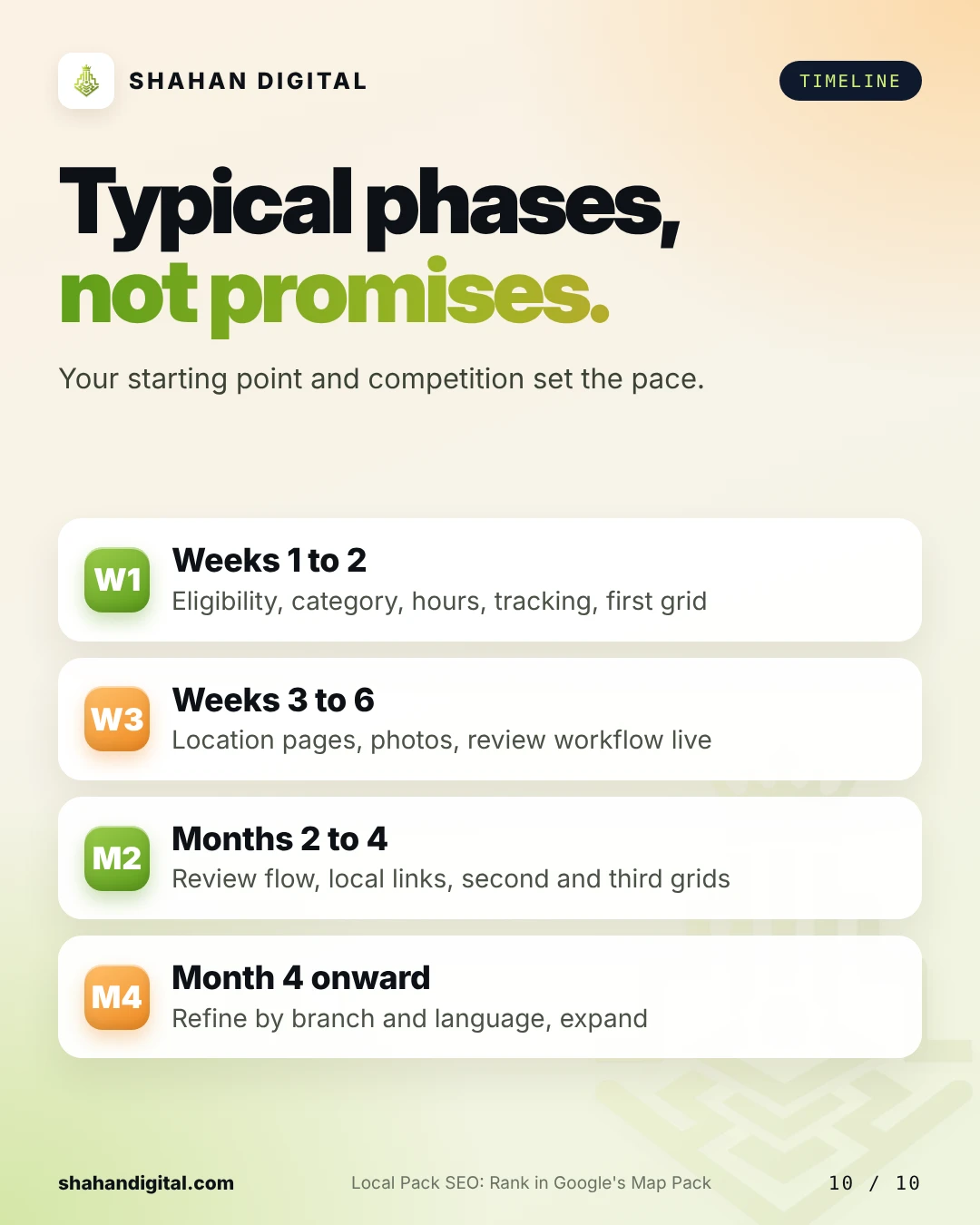
- Weeks 1 to 2: eligibility, verification, category, hours, duplicates, tracking set-up, first grid baseline.
- Weeks 3 to 6: location pages, photos, services, review workflow live. Category changes often show in the grid within weeks.
- Months 2 to 4: review flow builds, local links and mentions, second and third grids. Coverage usually widens slowly from the office outward.
- Month 4 onward: refine by branch and language, compare with competitors, decide whether to expand.
For the wider picture, read how long SEO takes. If you need calls this week, paid search may come first; our comparison of SEO and paid ads helps you decide.
The local pack and AI search
AI answers now recommend local businesses too. Whitespark’s 2026 report added AI search visibility factors. Its experts ranked presence on curated “best of” lists, a dedicated page for each service and prominence on industry sites as the top three. These overlap with good local pack work: clear service pages, real reviews and mentions on trusted local sites. Our AI search optimization service covers how we test visibility in AI answers with dated prompts.
How we work on local pack SEO
We start with a review of your profile, your eligibility, a sampled grid and your intake process. Then we agree the first three fixes and how we’ll measure them. You can hire us to do the work end to end through our local SEO services, or have us guide your team through SEO consulting. We work remotely with clients in many countries, in English, Arabic, Persian and Turkish. You can learn more about Shahan Digital on our home page.
Frequently asked questions
What is local pack SEO?
It is the work of getting your Google Business Profile into the three map results Google shows for local searches. It covers your profile, categories, reviews, location pages and local mentions.
How does Google rank the local pack?
Google says local results depend mainly on relevance, distance and prominence. Complete, accurate information, reviews and links all play a part. You can’t pay for a better local ranking.
Can a service-area business rank in the map pack?
Yes. Service-area businesses can hide their address and set a service area. They need one profile for the central office and can’t use an unstaffed virtual office.
Should I add keywords to my business name?
Only if they are part of your real-world name. Google’s guidelines say unnecessary information in the name isn’t permitted and can lead to suspension.
How do I check my local pack ranking?
Use a grid: check the same searches from many points across your service area and record how often you appear in the top three. Repeat on a fixed day each month.
How long does local pack SEO take?
Fixes to category, hours and eligibility can show in weeks. Wider coverage across a city usually takes several months, depending on competition and review flow.
Find out where your map visibility stops
Send us your website, your locations and the services you want more calls for. We’ll scope the first review around one question: where are local customers choosing someone else, and what would it take to win them back?
Editorial note: Facts, prices and search results were checked against the linked sources on 20 November 2026. Ranking factor scores are Whitespark’s expert survey results, not Google data. Review statistics come from BrightLocal’s 2026 survey of US adults. Query figures come from Shahan Digital’s own Search Console data (19 August to 17 November 2026). Prices are published third-party figures, not Shahan Digital quotes. The grid example is illustrative. No ranking, traffic or lead result is guaranteed. Written by Shahan Behkamrad.
Written by

Shahan Behkamrad
Author · Founder of Shahan Digital · SEO & GEO Strategist
Shahan Behkamrad is an SEO and GEO strategist and the founder of Shahan Digital. Since 2017 he has built search strategies for businesses in Persian, Arabic, English and Turkish markets, usually working alongside a client’s in-house team to decide what to fix first, what to build next and how to measure it.
- Strategy before tactics: every engagement starts with a diagnosis of where growth is being lost, then a ranked plan tied to enquiries and revenue, not to rankings alone.
- Current with how search works now: his work covers Google Search, Google Maps, AI Overviews and AI assistants such as ChatGPT, and he checks Google’s documented updates before changing a client’s plan.
- Specialist depth: technical, international and multilingual SEO, local SEO and AI search visibility (GEO).
- Has trained more than 650 students in SEO and digital marketing, including as an official instructor at Iran’s Technical and Vocational Training Organization.
- Host of the Shahan Behkamrad Podcast on business growth, branding, SEO and AI.
- Master’s student in Strategic Marketing and Brand Management at Nişantaşı University, Istanbul; holds 25+ international digital marketing certifications.