Quick answer
Editorial link building earns links that editors choose to publish because your content helps their readers. Google treats any link given in exchange for money, goods or services as a paid link. Paid links are fine only when marked rel=”sponsored” or rel=”nofollow”. So the value of an editorial link building service is the work that makes coverage happen: an asset worth citing, the right list of writers and a pitch they can use.
Below: Google’s rules in plain words, a five-question test for any link, 2026 cost benchmarks, a decision aid and how to check a provider.
Who this guide is for. Marketing leads, founders and SEO managers who are buying links or digital PR, or who want to stop paying for links that may not help. It also helps agencies that want to explain the difference to clients.
Pick your path:
- Not sure what to buy → the decision aid
- Checking a vendor list → the five-question test
- Comparing quotes → what editorial links cost
- Worried about penalties → what Google allows
Key takeaways
- Google defines link spam as links made mainly to manipulate rankings, including paid links and paid guest posts that pass ranking credit.
- Paid and sponsored links are allowed for advertising when marked rel=”sponsored” or rel=”nofollow”.
- BuzzStream’s October 2026 data prices digital PR links at about $1,250 to $1,500 each and vendor guest posts at $461 on average.
- In a 2026 survey of 500 SEO pros, 34% named digital PR their best link building tactic (Reporter Outreach).
- The real test of an editorial link is simple: would the editor still have published it if nobody paid?
Here is why we wrote this page. In our own Search Console data from 20 August to 18 November 2026, the search “editorial link building service” reached our link building page 95 times at an average position of 39. Searches for “high pr link building” and “digital pr link building services” added about 60 more. Most came from India, Russia, Brazil and the United States.
People asking these questions are comparing vendors. Many vendor pages use “editorial” to mean “on a real website”. Google uses it to mean “not paid for”. That gap is where buyers lose money. This guide closes it.
Before you buy editorial links
Check three things. Do you have a page or asset that deserves a link: original data, a useful tool, real expertise? Do you know which pages you need links for, and why? Can you measure referring domains, rankings and leads for those pages?
If not, start there. Links pointed at thin pages rarely move anything, and links you cannot measure become a monthly fee with no answer.
What editorial link building means, and what it does not
An editorial link is a link an editor adds by choice. A journalist cites your survey. A trade blog links to your calculator. An industry body quotes your founder and links to the source. Nobody paid for the link itself.
Editorial link building is the work around that choice. You create something citable, find the writers who cover the topic, and give them a reason to use it. Digital PR is the most common form. Expert commentary, original research and useful free tools are others.
It is not a marketplace of sites that sell posts. Those can be real websites with real traffic. But if the link was bought, it is a paid link, whatever the vendor calls it.
What Google allows for editorial link building
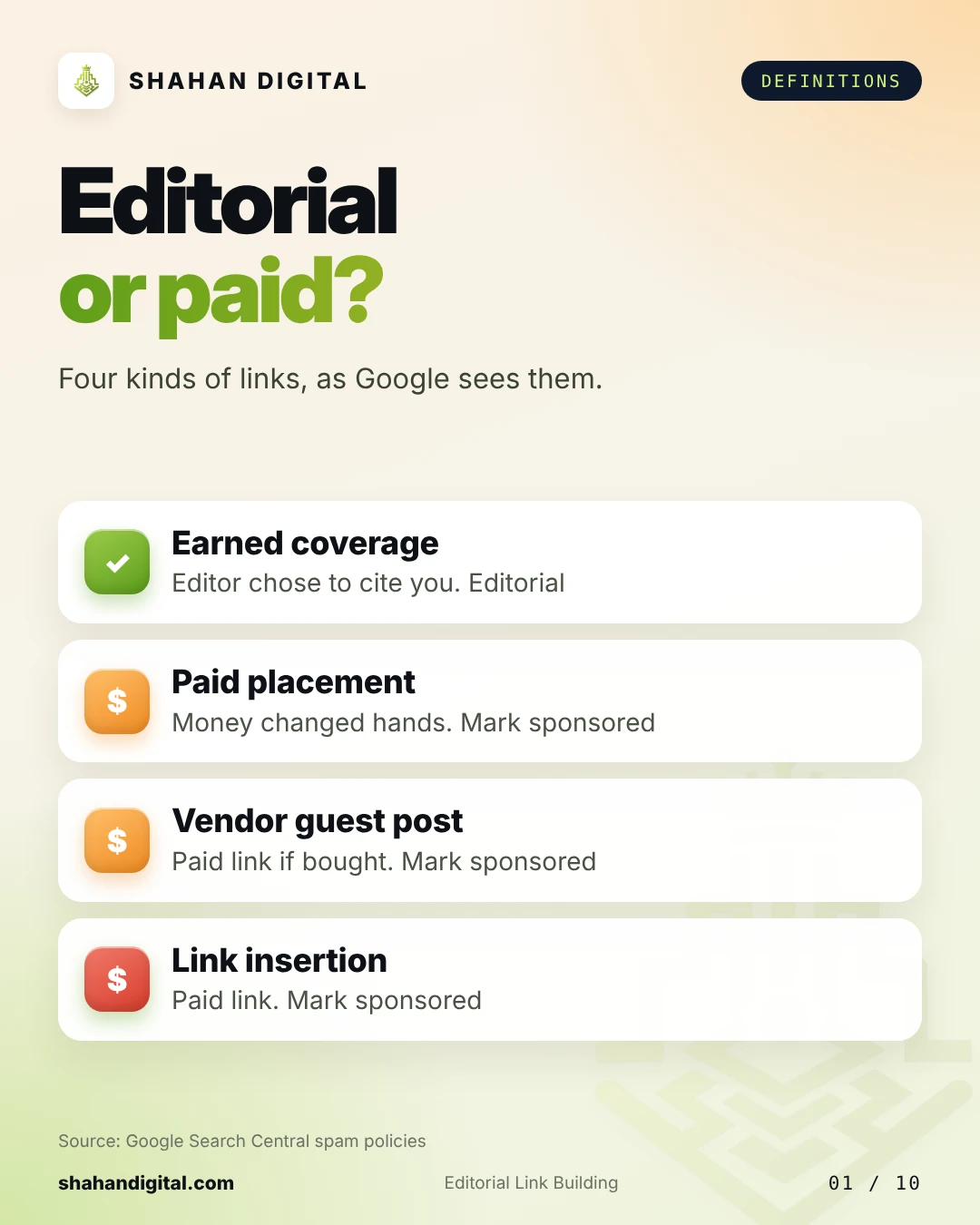
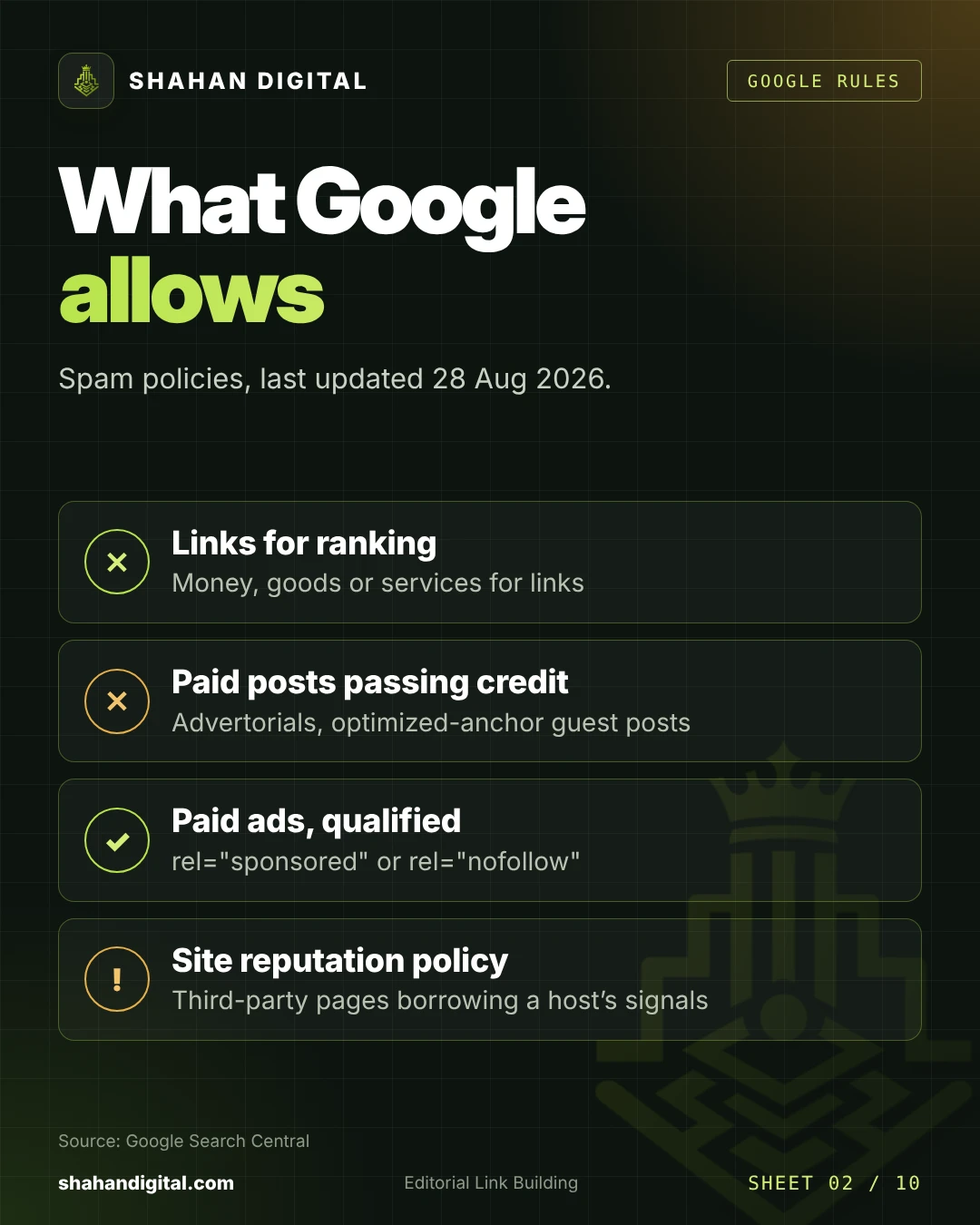
Google’s spam policies define link spam as creating links “primarily for the purpose of manipulating search rankings”. The examples include exchanging money for links or posts that contain links, exchanging goods or services for links, and sending a product in exchange for a write-up with a link.
The same page lists advertorials where payment is received for articles with links that pass ranking credit. It also lists links with optimized anchor text in articles, guest posts or press releases distributed on other sites.
Google also says buying and selling links is a normal part of advertising. It is fine when the link is qualified. Google’s guide to qualifying outbound links recommends rel=“sponsored” for paid placements, with nofollow still accepted.
There is a second policy to know. Google’s site reputation policy covers third-party content published on a host site mainly to borrow that site’s ranking signals. Google says columns, opinion pieces and other editorial work are not inconsistent with the policy. A low-quality sponsored page placed on a big site to rank is.
The five-question test for any link
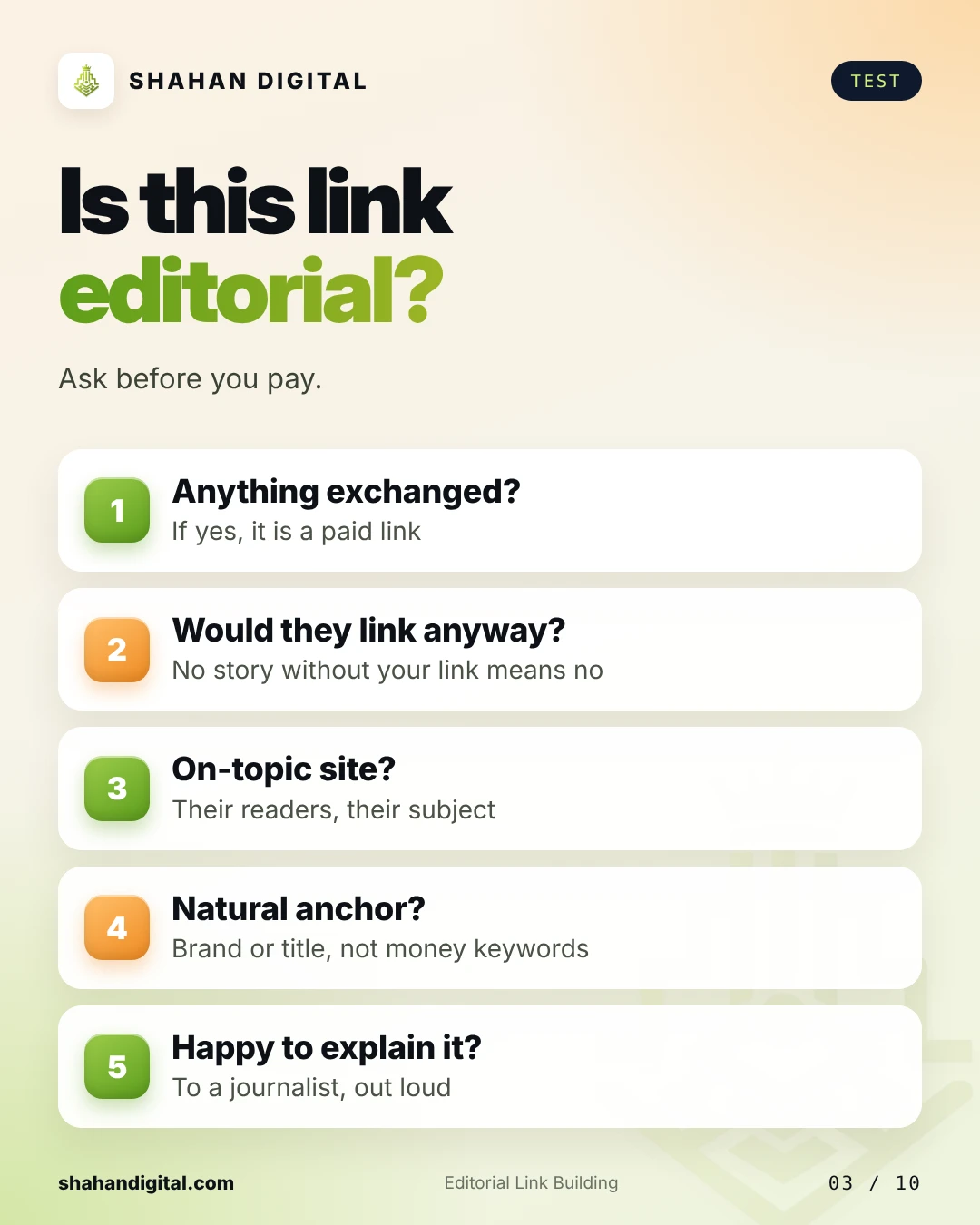
Use this before you pay for any link. If the answer to question one is yes, the rest decide how the link should be marked, not whether it is editorial.
- Was anything exchanged for this link? Money, products, a discount, a reciprocal link. If yes, it is a paid link and should be sponsored or nofollow.
- Would the editor have linked anyway? If the piece only exists because of your link, it is not editorial.
- Does the site cover this topic for its own readers? A finance link on a pet blog helps nobody.
- Is the anchor text natural? Your brand, a page title or a plain description. Exact money keywords in every link is a pattern Google lists.
- Would you be happy if a journalist asked how you got it? If not, you already know the answer.
“When we audit a backlink profile, we export referring domains from Search Console and a crawler, and tag each one by how it was earned: coverage, partner, directory, paid, unknown. Then we compare the anchor text of each group. Paid groups almost always show exact-match anchors on more than half the links. Earned coverage almost never does. That one table tells a client more than any authority score.”
Shahan Behkamrad, Founder of Shahan Digital
What makes editors link: assets that earn coverage
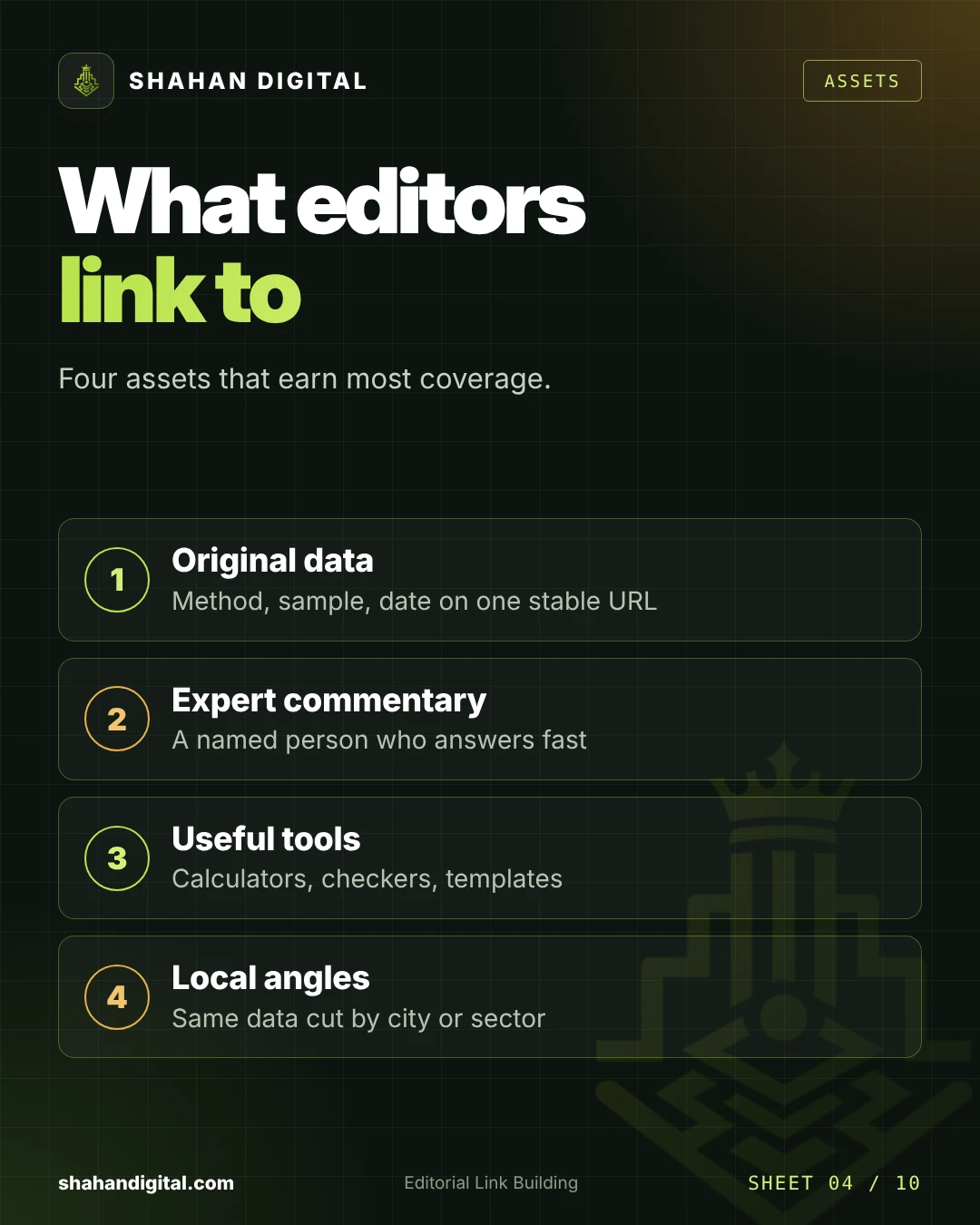
Editors link to things that make their story better. In our experience these four types do most of the work.
- Original data. A survey, a price index or an analysis of public data with a clear method and a date.
- Expert commentary. A named person with real experience who answers journalists fast and plainly.
- Useful tools. A calculator, checker or template that a writer can send readers to.
- Local and industry angles. The same data cut by city, country or sector, so regional and trade press can use it.
The asset needs a stable home. Put it on your own site, on a page that answers the topic, with the method visible. Our content marketing and SEO content writing teams build these pages so they can be cited and still help buyers.
“For a data asset we publish the full table, the method, the sample size and the date on one URL, and we keep that URL fixed for years. Journalists link to the table, not to a sales page. If we later update the data, we add a new dated section on the same URL. Redirecting a cited data page into a service page is the fastest way to throw away earned links.”
Shahan Behkamrad, Founder of Shahan Digital
How an editorial link building campaign runs
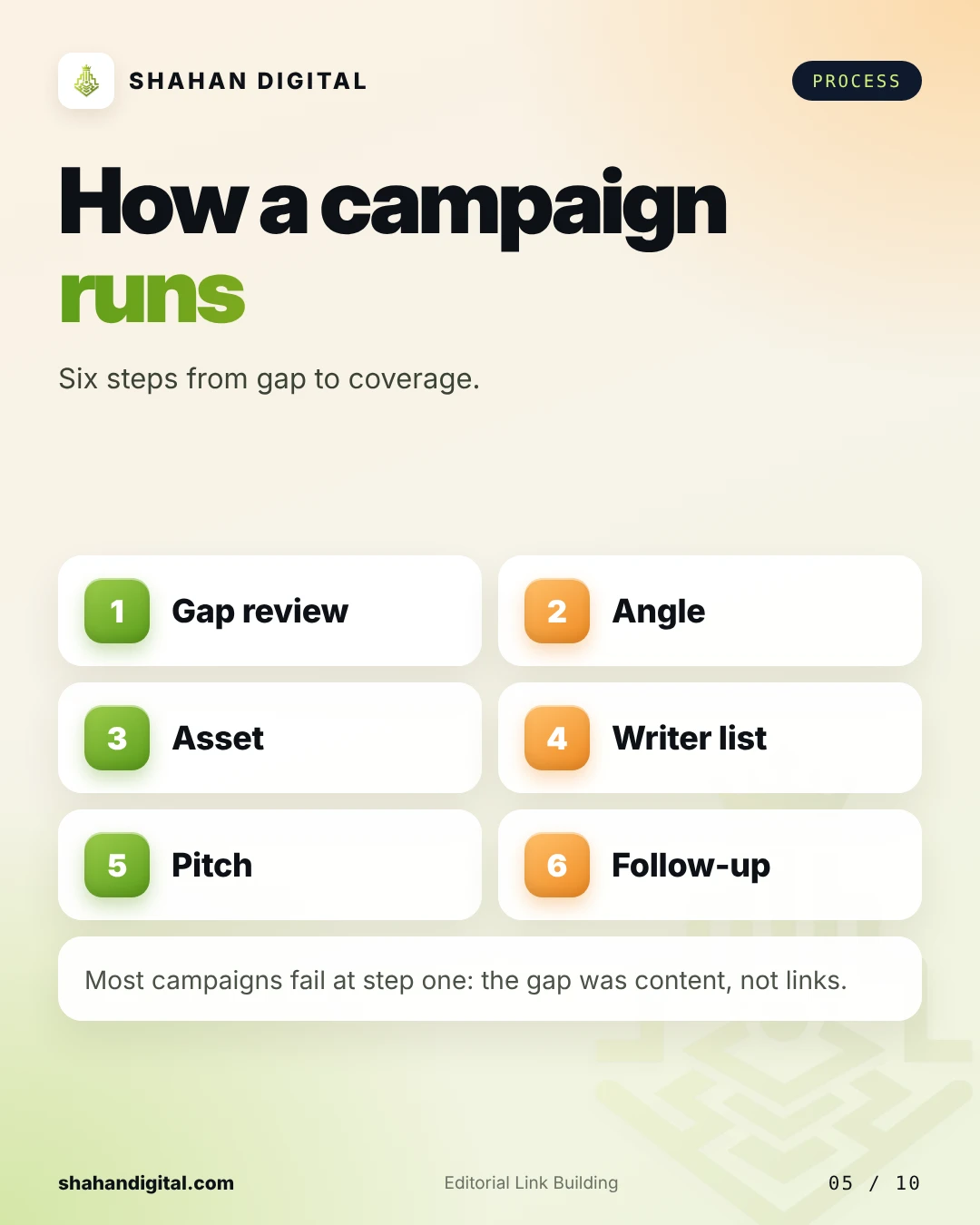
| Step | What happens | Output |
|---|---|---|
| 1. Gap review | Compare your links and pages with the sites outranking you | List of pages that need authority and why |
| 2. Angle | Find a question your data or expertise can answer that writers care about | One clear story, tested on a few writers |
| 3. Asset | Build the page: data, method, charts, quotes | A citable page on your site |
| 4. List | Find writers who covered the topic in the last year | A short, relevant list, not a mass list |
| 5. Pitch | Short emails with the finding, a quote and the link | Replies, interviews and coverage |
| 6. Follow-up | Answer questions, supply cuts of the data, thank writers | More coverage and lasting relationships |
Step one is where most campaigns go wrong. Our competitor SEO analysis shows which pages competitors win with links and which they win with content. If the gap is content, links will not fix it.
Decision aid: which link approach fits your situation?
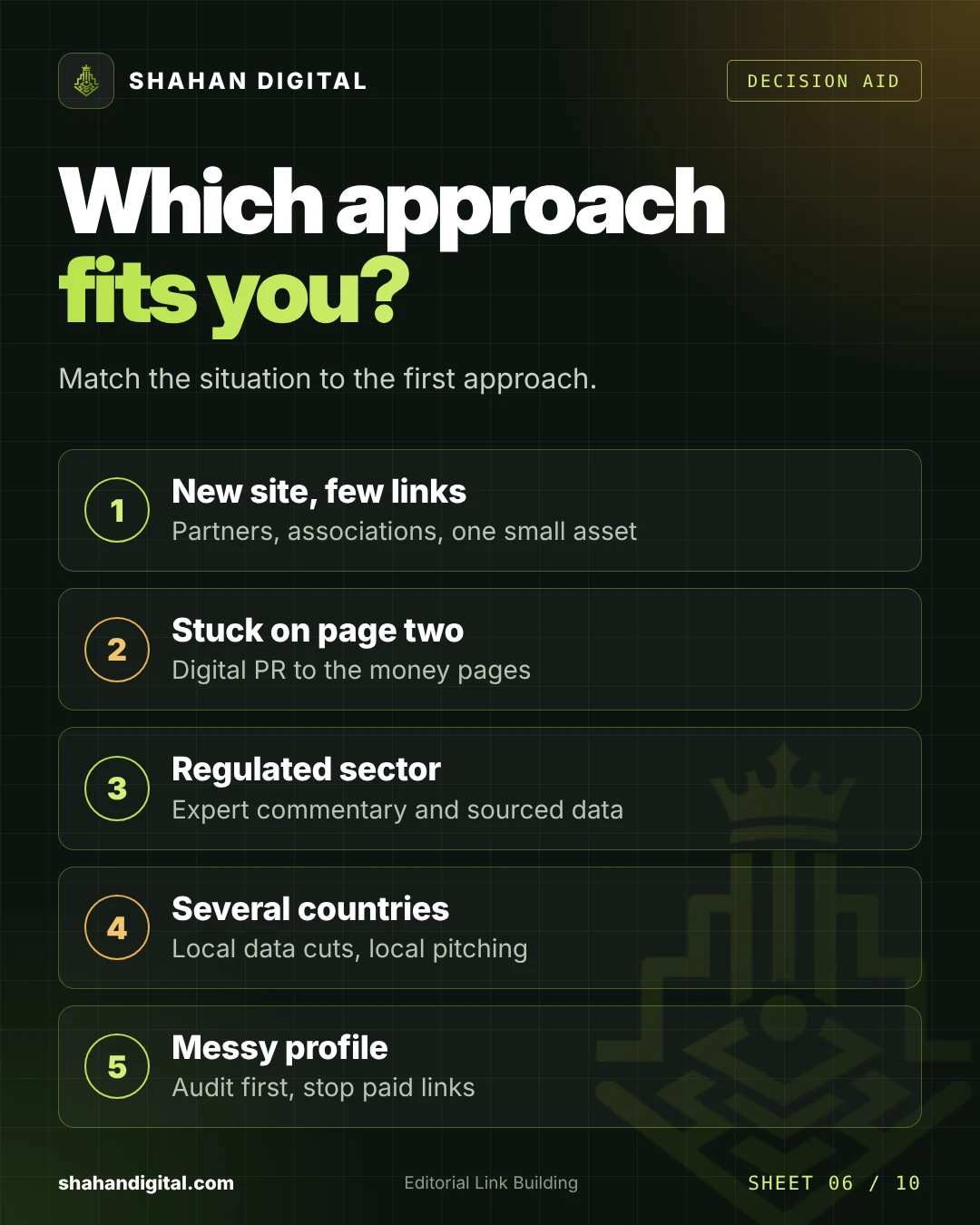
Not every site needs a digital PR campaign. Use this table to pick the approach that fits. It is built from what we see in audits, not from a fixed package.
| Your situation | Likely constraint | Best first approach | What tells you it worked |
|---|---|---|---|
| New site, few links, good service pages | No reason for anyone to cite you yet | Partner, supplier and association links; one small data asset | First relevant referring domains |
| Established site, rankings stuck at page two | Authority gap on a few money pages | Digital PR campaign with internal links to those pages | Referring domains up; target pages move |
| Strong brand, weak niche pages | Links go to the homepage only | Topic-specific assets linked from the niche pages | Links to deeper pages |
| Regulated sector: finance, health, legal | Trust and compliance | Expert commentary and data with clear sources | Coverage in sector and national press |
| Several countries or languages | Links only in English | Local data cuts and local-language pitching | Links from each target country |
| Profile full of paid or low-quality links | Risk and noise | Audit first; stop paid links that pass credit | Cleaner profile; new links earned |
Not sure which row is you?
Send us your website, the pages you need to rank and the markets you serve. We’ll check your link profile against the sites outranking you and tell you whether links are really the gap.
What editorial link building costs in 2026
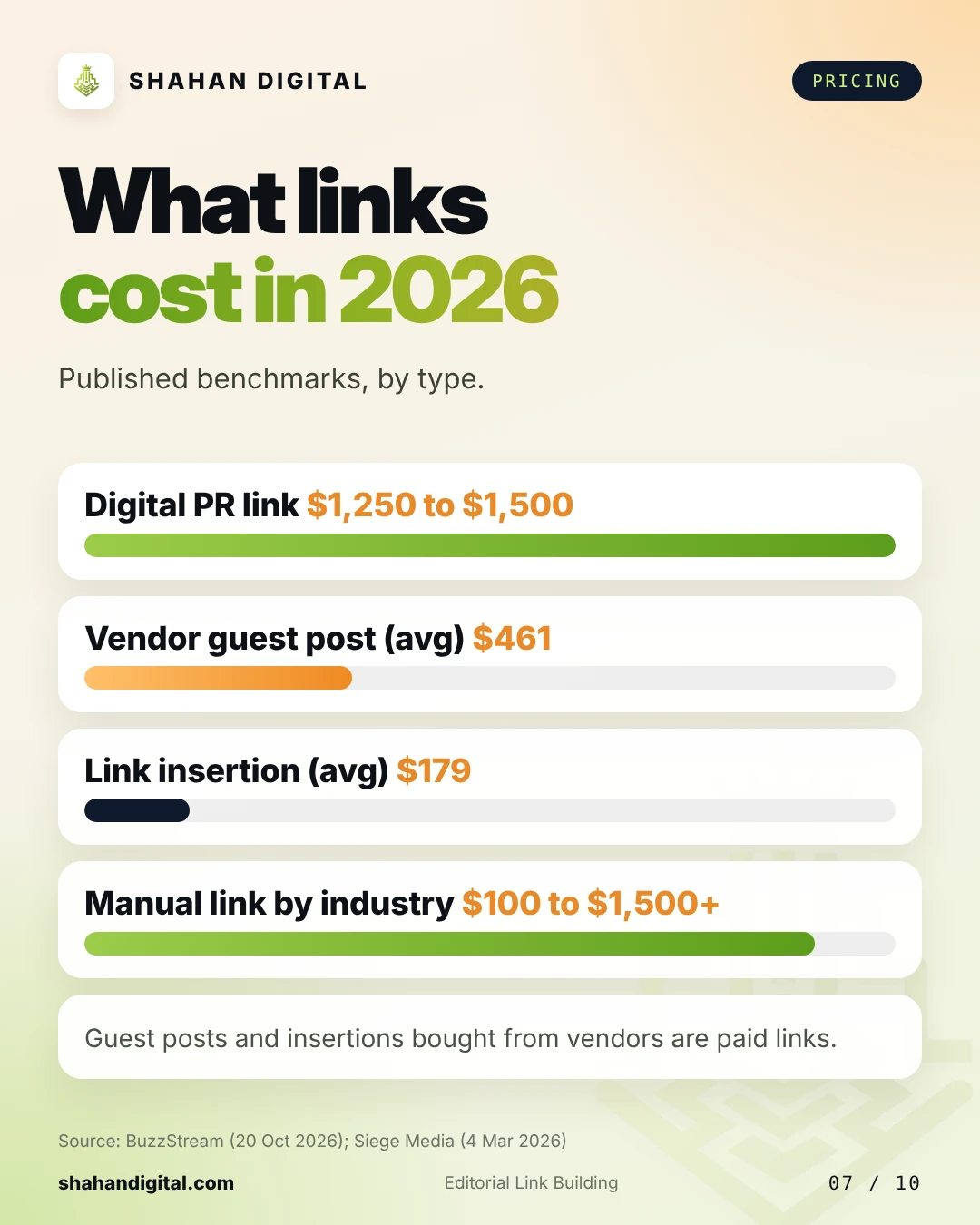
Prices depend on what you buy. Earned coverage, paid placements and link insertions are different products. These published benchmarks show the range.
| What is measured | Published figure | Source and date |
|---|---|---|
| Digital PR link | $1,250 to $1,500 per link | BuzzStream, prices as of 20 October 2026 |
| Digital PR campaign | $5,000 to $10,000 per campaign | BuzzStream, 20 October 2026 |
| Guest post via vendor | $461 average | BuzzStream, 20 October 2026 |
| Link insertion | $179 average | BuzzStream, 20 October 2026 |
| Manual link, by industry | $100 to $1,500+ per link; up to about $2,000 in competitive niches | Siege Media, updated 4 March 2026 |
| Agency link building service | From $1,800 per month | SEO.com, checked 21 November 2026 |
| Shahan Digital | Scoped quote after a review | Asset, markets and languages set the scope |
Remember that guest posts and insertions bought from a vendor are paid links under Google’s policy. Their price is lower partly because they should be marked sponsored. Compare like with like.
What SEO professionals report in 2026
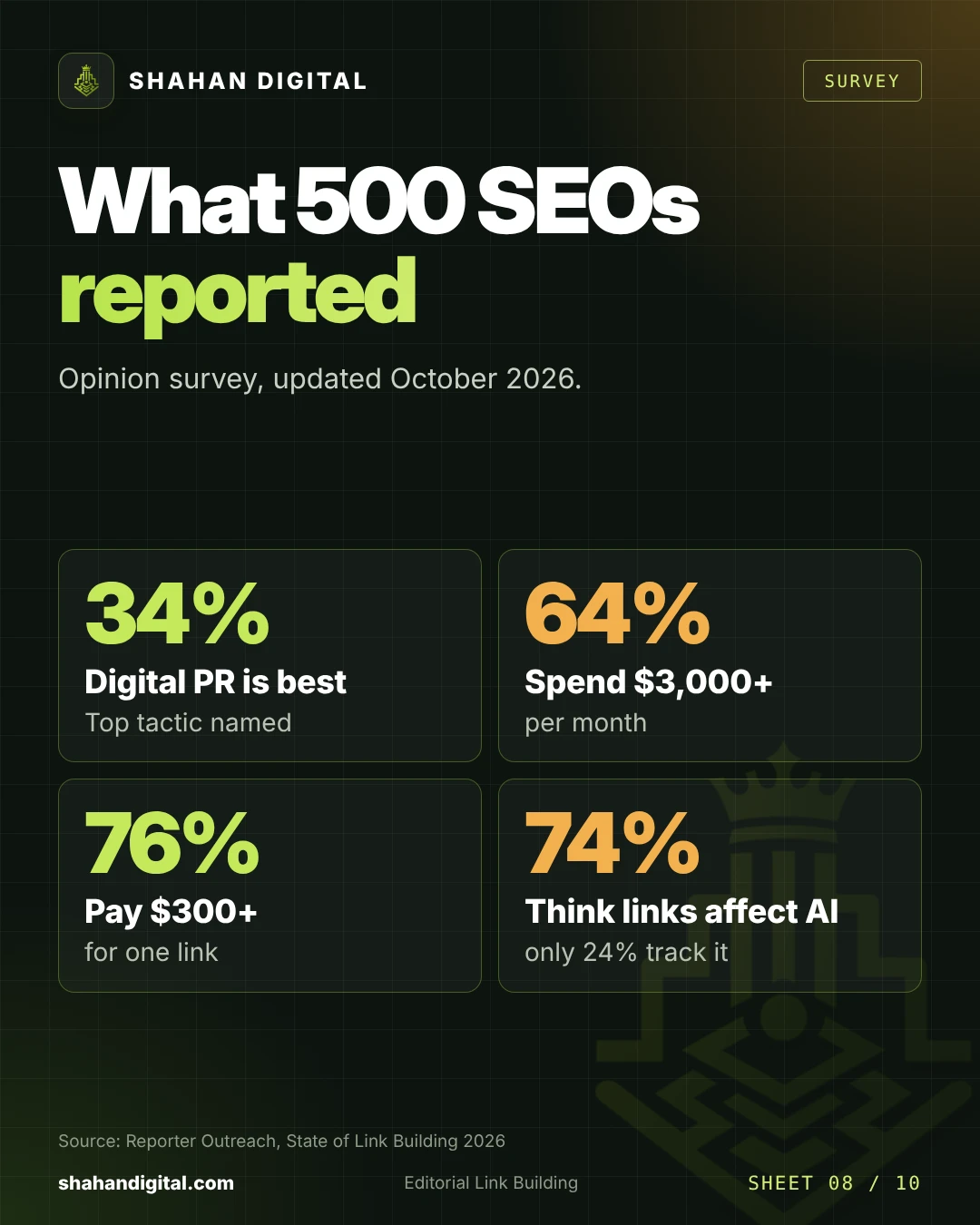
Reporter Outreach surveyed 500 SEO professionals (updated October 2026). It is an opinion survey run by a link building firm, so read it as market sentiment, not proof.
- 34% named digital PR their best link building tactic, ahead of journalist sourcing (21%) and guest posts (18%).
- 64% spend $3,000 or more a month on link building; the median falls between $3,000 and $6,000.
- 76% would pay $300 or more for a single link.
- 74% believe backlinks affect AI search visibility, but only 24% track it.
We reviewed the top results for editorial link building
We reviewed the top English-language results for “editorial link building service” and “digital pr link building” on 21 November 2026. Several are useful, and we credit what they do well.
| Page | What it does well | What’s missing for a buyer |
|---|---|---|
| Editorial.Link | Clear service offer with case studies and reviews | Little on how Google treats paid placements |
| Siege Media | Honest per-link ranges and the lifetime link value idea | Focused on US costs; little on multilingual markets |
| BuzzStream | Dated price data by link type | Prices for paid links sit next to earned ones; buyers must separate them |
| Ranktracker agency list | Explains editorial-only work and lists agencies | Review list written by a vendor that ranks itself first |
| Digital Applied guide | Good outreach practice and asset ideas | No pricing or policy test for buyers |
| SEO.com | Published starting price and clear process | Sales page; no test for vendor links |
The gap: buyers get prices and agency lists, but rarely a simple way to tell an earned link from a paid one. The five-question test above is our answer.
How to choose an editorial link building service
- Ask for live examples of coverage, and how each link was earned.
- Ask whether any link involves payment to the publisher, and how those links are marked.
- Ask which pages the links will point to, and why those pages.
- Ask what the asset is, and who writes it.
- Ask how they report: coverage, referring domains, target page rankings and leads.
- Be careful with fixed promises of authority scores or links per month from top publications.
Authority scores are third-party estimates, not Google data. Our pages on growing DR and DA and backlink profile growth explain how we use them as a guide, not a goal. If you already have a link vendor, our SEO audit service includes a link review.
A realistic timeline
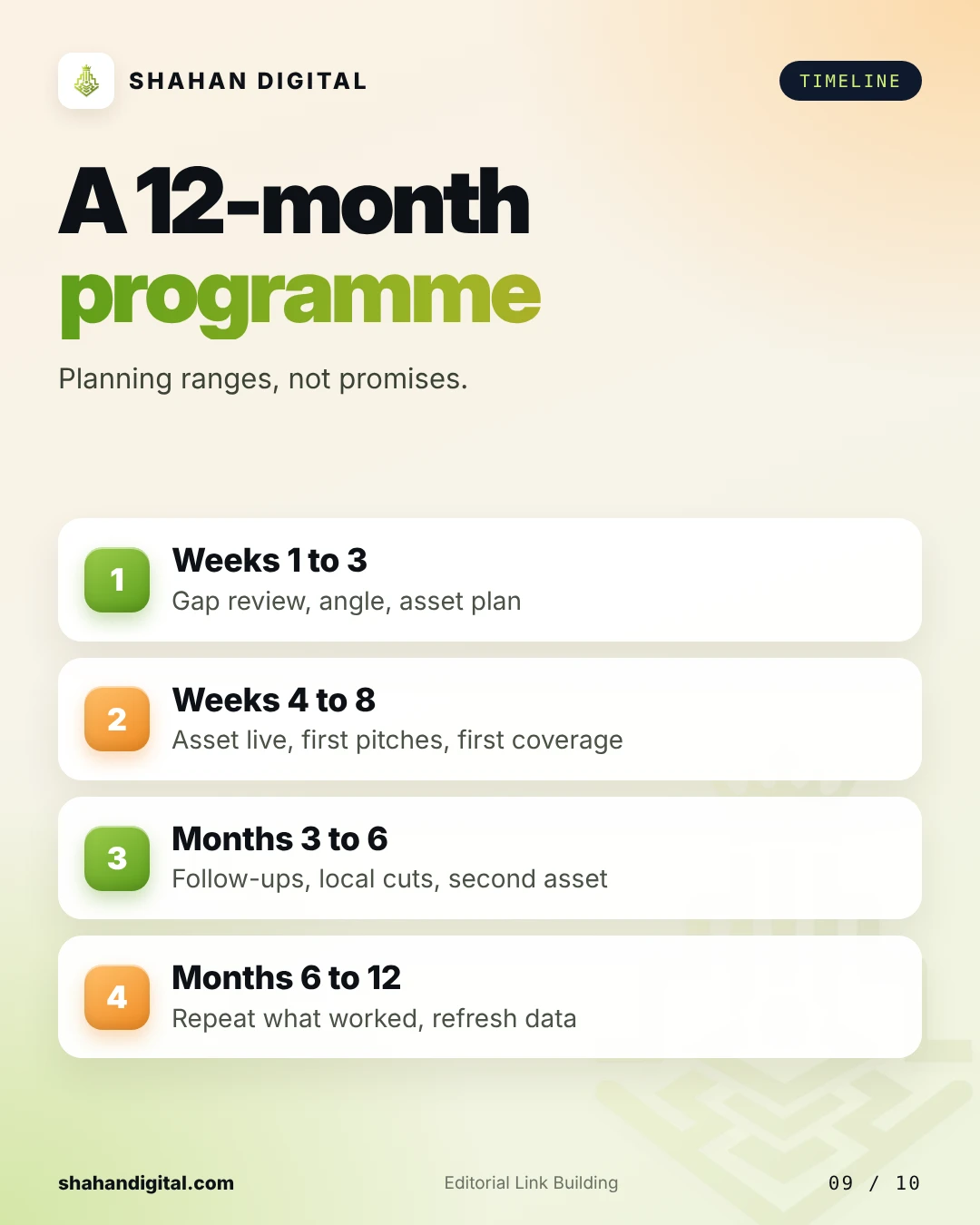
| Period | Main work | What you can expect to see |
|---|---|---|
| Weeks 1 to 3 | Link gap review, angle and asset plan | Target pages and one tested story |
| Weeks 4 to 8 | Asset built, list built, first pitches | First replies and coverage |
| Months 3 to 6 | Follow-up pitches, local cuts, second asset | Referring domains to target pages grow |
| Months 6 to 12 | Repeat what worked; refresh data | Rankings and leads on target pages, where links were the gap |
These are planning ranges. Our guide on how long SEO takes explains why authority work is slower than technical fixes.
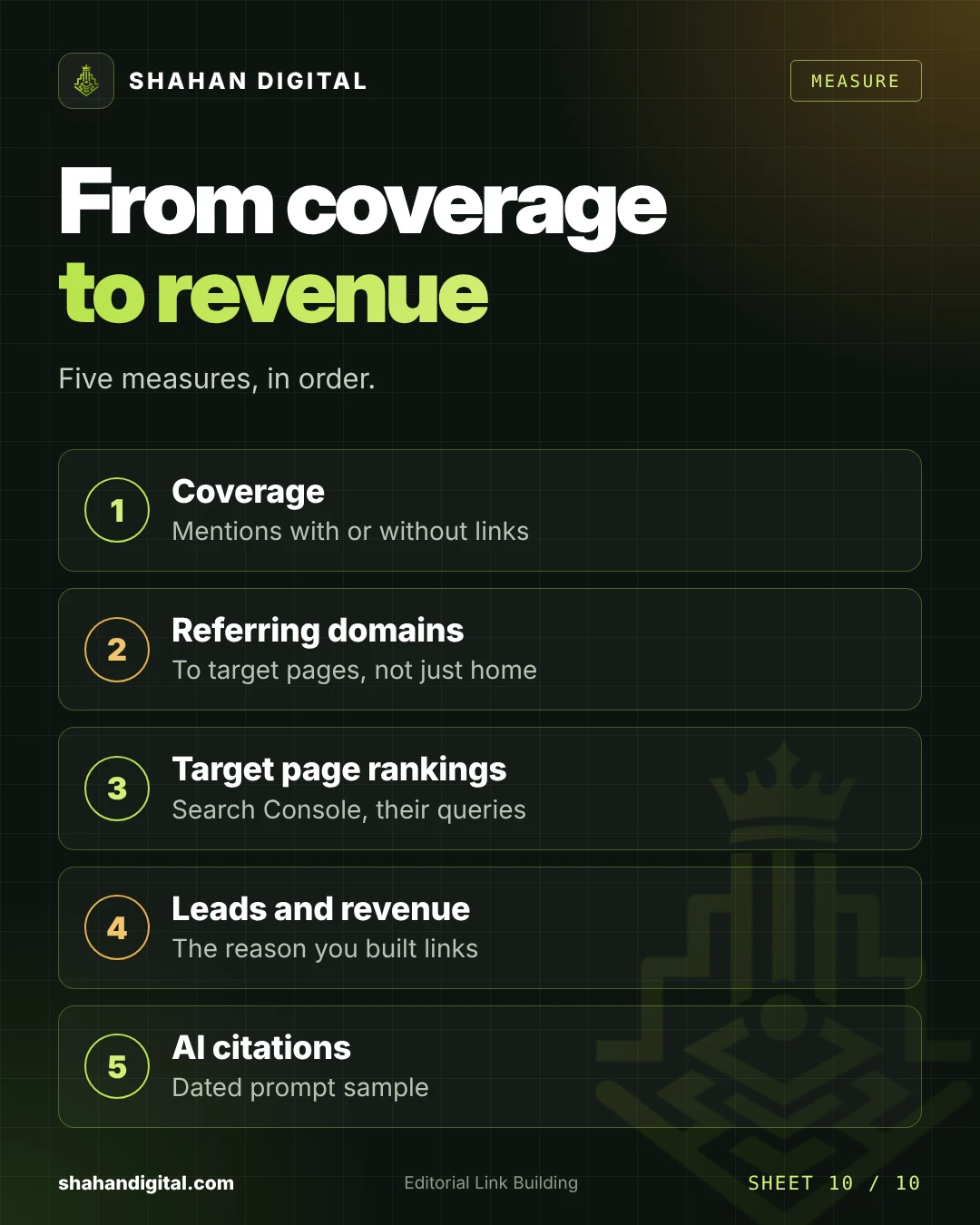
How to measure editorial link building
- Coverage. Every article that mentions you, with or without a link.
- Referring domains to target pages. Not total links, and not links to the homepage only.
- Target page rankings and clicks. In Search Console, for the queries those pages serve.
- Leads and revenue from those pages. The reason you built links in the first place.
- AI answer citations. A dated sample of prompts on the AI tools your buyers use.
Our article on measuring SEO success has a full reporting set. For AI answers, see our AI search optimization guide and our AI search optimization service.
How we work on editorial link building
We start with a link gap review. Then we build one asset worth citing and pitch it to a short list of relevant writers. We do not buy links that pass ranking credit, and any paid placement a client chooses is marked sponsored. The service sits inside our link building and digital PR work and our wider off-page SEO services. If you are unsure whether links or content are your gap, our guide to on-page vs off-page SEO helps you decide.
We work in English, Arabic, Persian and Turkish, with native writers for each target country. That lets us pitch local press in each market, not only English sites. See our international SEO and Arabic SEO services pages, or start from the Shahan Digital home page.
Sectors with strict trust needs, such as finance and B2B, gain most from expert commentary and data. If you publish guest content, our guest posting page explains how we keep it editorial and relevant. For the wider goal, see organic traffic growth.
Frequently asked questions
What is editorial link building?
It is the work of earning links that an editor or site owner chooses to add because the content is useful to their readers. The link is not bought, swapped or written into a contract. You create something worth citing, such as original data or expert input, and pitch it to the right people.
Is paying for a link on a news site editorial?
No. If money, goods or services were exchanged for a link, Google treats it as a paid link. Google says paid links are fine for advertising only when they carry rel=“sponsored” or rel=“nofollow”. A paid link that passes ranking credit breaks Google’s link spam policy, wherever it appears.
How much do editorial links cost?
Published benchmarks vary. BuzzStream’s October 2026 data puts digital PR links at about $1,250 to $1,500 each. Siege Media (March 2026) gives $100 to over $1,500 per link depending on the industry. SEO.com’s link building service starts at $1,800 a month. Your cost depends on the asset, the sector and the markets.
What is high PR link building?
The phrase usually means links from high-authority publications, often through digital PR. Ask what the provider means. If it means earned coverage from journalists, that is editorial work. If it means paid placements on well-known domains, check how those links are marked.
How long does editorial link building take to work?
A campaign usually needs four to eight weeks from idea to first coverage. Ranking effects, when they come, usually show over the following months. Measure coverage and referring domains first, then rankings and leads.
Can editorial links help with AI search?
They may. In Reporter Outreach’s 2026 survey of 500 SEO professionals, 74% said backlinks affect AI search visibility, but only 24% were tracking it. That is an opinion survey, not Google data. We track AI answer citations in a dated test sample alongside normal rankings.
Find out whether links are your real gap
Send us your website, the pages you want to rank and the markets you serve. We’ll scope the first review around one question: what would make editors want to cite you, and which pages need it most?
Editorial note: Google policy text was checked against Google Search Central on 21 November 2026 (spam policies last updated 28 August 2026). Prices come from BuzzStream (20 October 2026), Siege Media (4 March 2026) and SEO.com (checked 21 November 2026). Survey figures come from Reporter Outreach’s 2026 survey of 500 SEO professionals. Query figures come from Shahan Digital’s own Search Console data, 20 August to 18 November 2026. Prices are third-party figures, not Shahan Digital quotes. No ranking, traffic or lead result is guaranteed. Written by Shahan Behkamrad.
Written by

Shahan Behkamrad
Author · Founder of Shahan Digital · SEO & GEO Strategist
Shahan Behkamrad is an SEO and GEO strategist and the founder of Shahan Digital. Since 2017 he has built search strategies for businesses in Persian, Arabic, English and Turkish markets, usually working alongside a client’s in-house team to decide what to fix first, what to build next and how to measure it.
- Strategy before tactics: every engagement starts with a diagnosis of where growth is being lost, then a ranked plan tied to enquiries and revenue, not to rankings alone.
- Current with how search works now: his work covers Google Search, Google Maps, AI Overviews and AI assistants such as ChatGPT, and he checks Google’s documented updates before changing a client’s plan.
- Specialist depth: technical, international and multilingual SEO, local SEO and AI search visibility (GEO).
- Has trained more than 650 students in SEO and digital marketing, including as an official instructor at Iran’s Technical and Vocational Training Organization.
- Host of the Shahan Behkamrad Podcast on business growth, branding, SEO and AI.
- Master’s student in Strategic Marketing and Brand Management at Nişantaşı University, Istanbul; holds 25+ international digital marketing certifications.