AI Search Optimization in 2026 and 2027 The Full Guide, From Data to a 90-Day Plan
The short answer: AI search optimization in 2026 means making it easy for ChatGPT, Gemini, Google’s AI Overviews and AI Mode to find your brand, understand it, trust it and say its name. The newest data shows that sitting on the pages AI cites isn’t enough, because ChatGPT has often decided which brands it will consider before it searches at all. On the other side, when Google shows an AI Overview, pages that get cited earn more than twice the clicks of pages that don’t. So AI search optimization means winning two things at once: the model’s memory, and the citation.
Start with a simple question
You’ve just checked into a hotel in Istanbul. You walk up to the concierge and ask: “Where’s the best kebab around here?”
The concierge does two things. First, he pulls a few names out of his head. Places he’s eaten at, places past guests raved about. Then, if he isn’t sure, he grabs his phone and runs a quick search to check the address and opening hours.
Here’s the part that matters. He only searches for the names that were already in his head. Your kebab shop could be the best in the city. If he’s never heard of it, he’ll never look it up.
ChatGPT is that concierge. AI search optimization is the work of getting into his memory, and making sure that when he does search, he finds you and likes what he sees.
The question I hear most from founders and marketing heads this year is: “How do we get ChatGPT to recommend us?” Most guides answer with a checklist. You’ll get a checklist from me too. First, though, I want to walk you through why, step by step, using published research and data from my own projects. Because the most expensive mistake in AI search optimization right now is spending money on the wrong layer.
This is an educational guide. If you want this done for your business, see our AI search optimization services.
What you’ll learn here
| # | Topic | The question it answers |
|---|---|---|
| 1 | What AI search optimization actually is | How is it different from SEO? |
| 2 | How AI decides who to name | Why do some brands never show up? |
| 3 | Why answers change every time | How should we measure this? |
| 4 | What it’s worth in clicks | Is it worth the money? |
| 5 | Where AI gets its sources | Where do we need to be? |
| 6 | Case study: my team’s report on four sites | What have I seen in practice, and how did we measure it? |
| 7 | Three AI search optimization myths | Where should we not spend money? |
| 8 | The 7-step plan | Where do we start? |
| 9 | AI search optimization by industry | What makes my industry hard? |
| 10 | The first 90 days and choosing a consultant | What’s the next step? |
| 11 | AI search optimization in 2027 | What should we watch from now on? |
1. What is AI search optimization, really?
It goes by a lot of names: GEO, AEO, AIO, LLM SEO. Danny Sullivan, Google’s Search Liaison, rolled them all into one joke during his talk at WordCamp US:
“Good SEO is good GEO, or AEO, AIO, LLM SEO, or LMNOPO. So, they’re all fine.”
He added something more useful: “Don’t panic.”
I agree with Sullivan, with one big “but.” The foundation of AI search optimization is good SEO. Three things have shifted, though, and classic SEO never paid them much attention:
| Topic | Classic SEO | AI search optimization |
|---|---|---|
| Goal | Rank in a list of ten blue links | Get named and cited inside an answer |
| Unit of measure | Keyword position | Share of answers you appear in, over time |
| Role of your site | The main source | One source among many, next to Reddit, YouTube, LinkedIn and the press |
| Role of brand memory | Indirect | Direct. The model already “knows” certain brands |
| Language and market | Usually one market per page | The model sees every language at once and catches contradictions |
So Sullivan is right, as long as you stretch “good SEO” to cover every place your name shows up, on your site and off it. Your website is only one of them.
2. How does AI decide whose name to say?
Back to the hotel concierge. This month a study showed how accurate that picture is.
Graphite, a growth agency that sells AEO services itself, compared logged-out ChatGPT answers to comparison questions twice: once with web search on, once with it off. Search Engine Journal reported the results on October 26, 2026:
- Brands ChatGPT rarely named without search were also named less often with search. That held even when the brand appeared on plenty of the pages ChatGPT cited. Among brands that were meaningfully featured on at least 15% of cited pages, the ones that showed up in fewer than a quarter of the no-search answers had a median visibility of just 11% with search turned on.
- ChatGPT puts brand names into its own searches. Of roughly 957,000 background searches, 59.6% contained a brand name. None of the original prompts mentioned a brand.
- Citations are now the default. The share of ChatGPT answers with citations went from 56.6% in early August to 88.5% by late September.
Same as the concierge: he searches the names already in his head. An unknown brand gets picked less, even when it sits on the right pages. For AI search optimization, that changes where you start.
Two studies, side by side. The same SEJ piece quotes a number from Ahrefs: only 14.4% of 66.6 million ChatGPT answers in August and September involved a background search. That doesn’t contradict Graphite’s 59.6%. Graphite only looked at comparison prompts, the exact questions a buyer asks. Ahrefs looked at general prompts. My rule, every time: before you repeat a number from a study, check what it actually measured.
Google says the same thing happens on its side. Its documentation states that AI Overviews and AI Mode use “query fan-out”, running “multiple related searches across subtopics and data sources” to build an answer. So this isn’t a ChatGPT quirk.
Cause and effect: unknown brand → missing from the model’s memory → its name doesn’t go into background searches → even its good pages get seen less → it shows up less in the final answer.
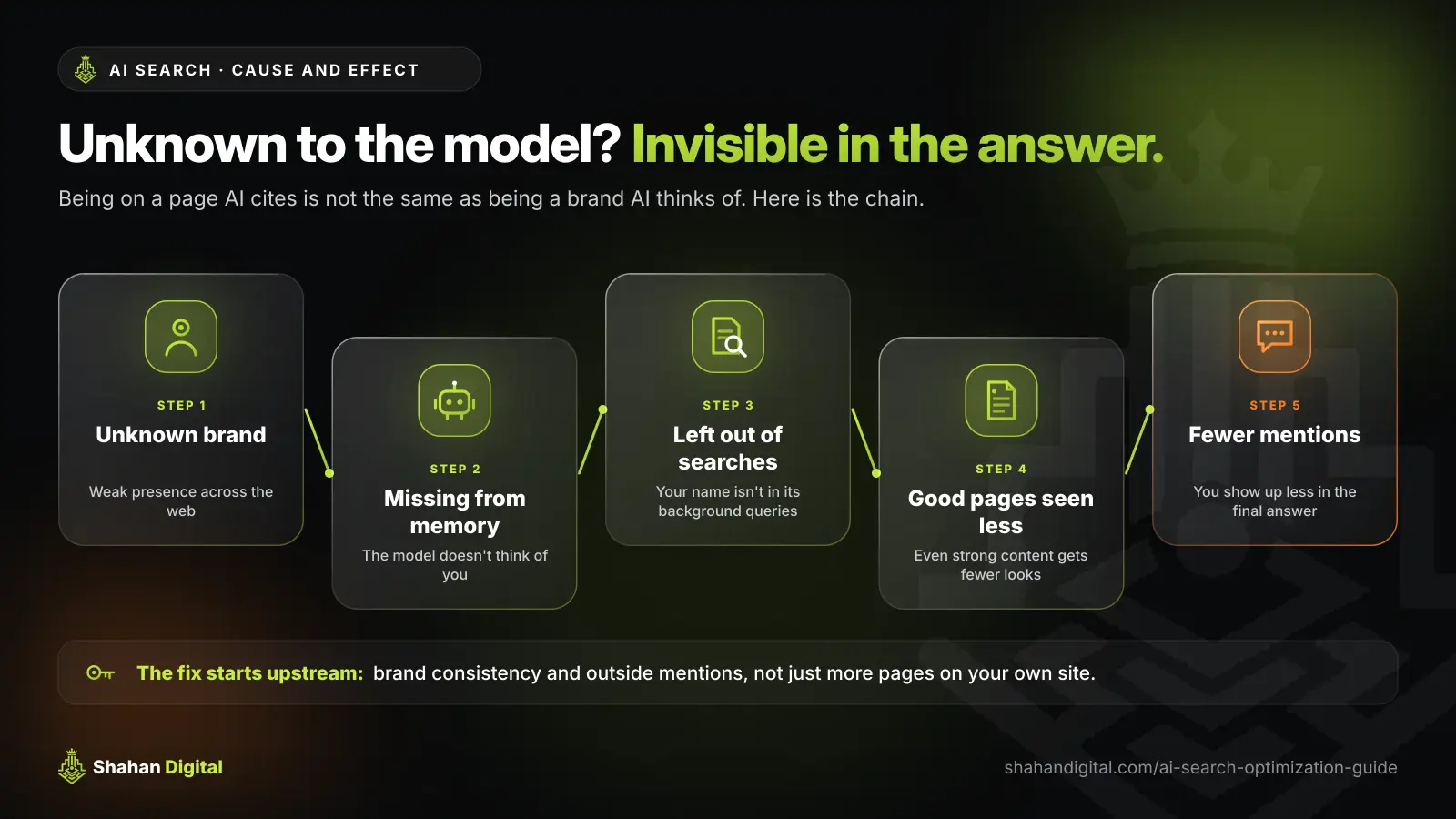
The study is exploratory and shows correlation, not causation. The direction matches everything I’ve seen in client work, though: being on a page ChatGPT cites is a different thing from being a brand ChatGPT thinks of. Good AI search optimization works on both.
3. Why does the answer change every time you ask?
Try this. Ask ten taxi drivers in Istanbul where to find the best Iranian restaurant in the city. You’ll get ten different lists. Two or three names will probably show up on most of them, though. Those two or three are the brands that are genuinely known.
Rand Fishkin (SparkToro) and Patrick O’Donnell (Gumshoe.ai) ran that exact experiment on AI. 600 volunteers put the same 12 prompts into ChatGPT, Claude and Google’s AI about 3,000 times. Search Engine Land reported it in January 2026:
| Finding | Number |
|---|---|
| Chance of getting the same brand list twice | Less than 1 in 100 |
| Chance of the same list in the same order | About 1 in 1,000 |
| How often strong brands appear for a given intent | 60–90% in some categories |
Their own summary: “Repeat presence means something. Exact rank does not.”
Now put that next to Graphite. Graphite says the model’s memory decides who gets considered. Fishkin says the list and the order change every single time, while the strong brands keep coming back. They’re saying the same thing from two directions: in AI search optimization, the goal is to show up in as many answers as possible. “Rank one” is a mirage.
The practical takeaway for AI search optimization: any tool selling you a “ChatGPT ranking” is measuring something that doesn’t hold still. What you need to measure is presence rate, across lots of prompts and lots of runs. It’s the same discipline behind measuring SEO success in general: trends over time, never a single snapshot.
4. What is AI search optimization worth in clicks?
Executives ask me this constantly. If AI answers cut clicks anyway, is AI search optimization even worth it? Let’s line up three studies:
| Study | Period | Headline finding |
|---|---|---|
| Ahrefs (first version) | March 2024 vs March 2025 | Position-one CTR about 34.5% lower when an AI Overview appears |
| Ahrefs (re-run) | December 2023 vs December 2025 | About 58% lower |
| Seer Interactive | January 2025 to February 2026 | CTR recovered from 1.3% in December to 2.4% in February. Cited pages about 2.1%, uncited about 0.9% |
At first glance they clash. One says the drop got worse, the other says things are bouncing back. Read them closely and both are right:
- Ahrefs averaged everyone, winners and losers together. So it sees the overall decline.
- Seer split brands apart and showed that cited pages get more than twice the clicks of uncited ones. AI Overviews move clicks around more than they simply destroy them.
- Seer’s recovery covers only two months. Seer itself calls it “early signs.”
Think of it like this. “Rain cut the number of shoppers in the market” and “the shops with an awning got more customers than everyone else” can both be true on the same day. AI search optimization is the awning.
One more number from Seer that matters a lot for any business:
| Search type | Share of searches that showed an AI Overview |
|---|---|
| Comparison | About 95% |
| Question | About 86% |
| Informational | About 36% |
| Transactional | About 5% |
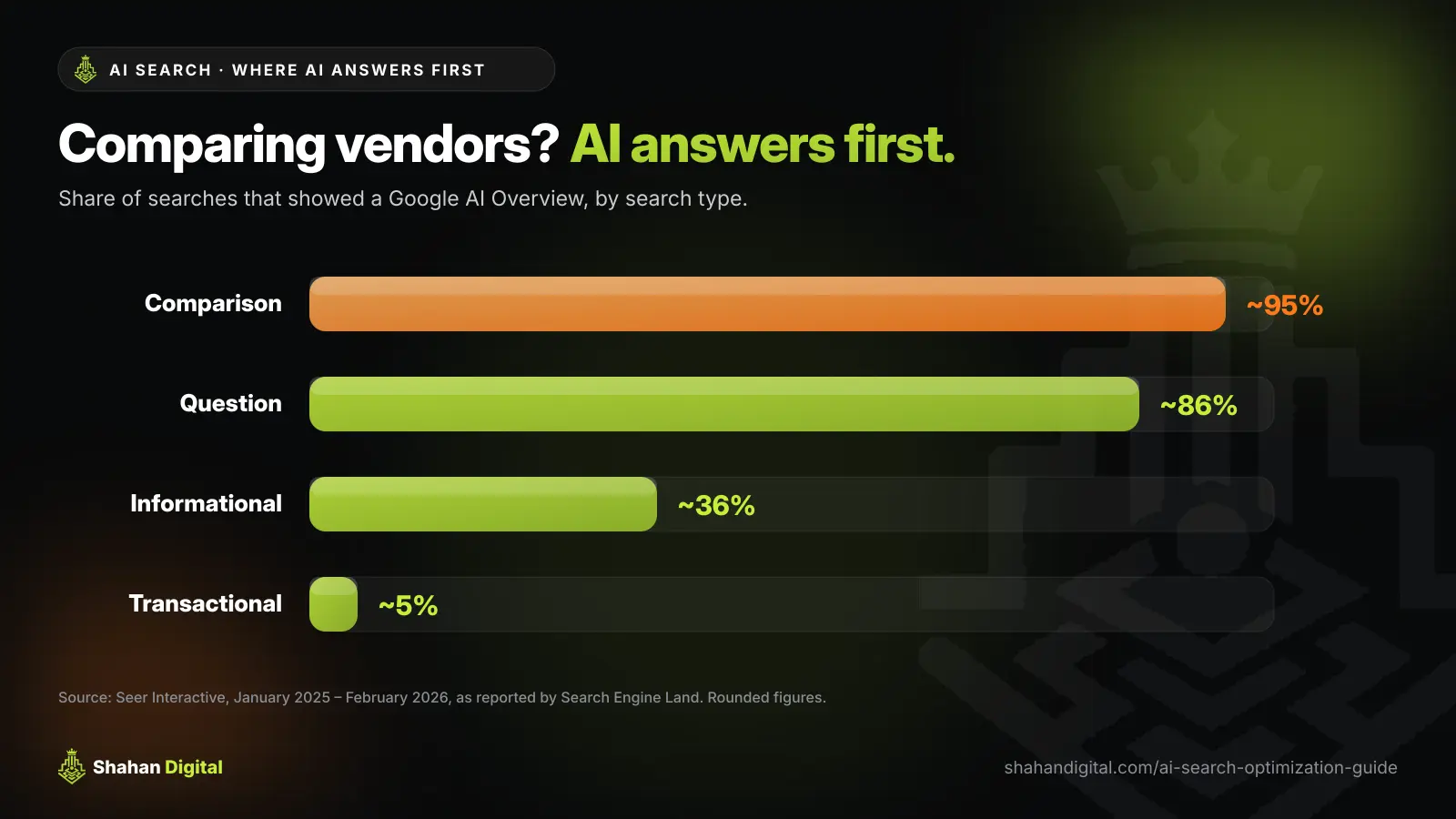
Read that first row again. At the exact moment a buyer is comparing you to a competitor, AI almost always answers first. That’s the moment where AI search optimization pays for itself.
5. Where does AI get its sources?
Think about how a family checks out someone who wants to marry their daughter. They don’t just read the CV he brought along. They ask the neighbours, his colleagues, people who know him. AI does the same, which is why AI search optimization can’t stop at your own website.
Profound analysed around 680 million citations from August 2024 to June 2025. Here’s each source’s share among the ten sites each platform cited most:
| Platform | Most-cited sources (share of top 10) |
|---|---|
| ChatGPT | Wikipedia 47.9%, Reddit 11.3%, Forbes 6.8%, G2 6.7% |
| Google AI Overviews | Reddit 21%, YouTube 18.8%, Quora 14.3%, LinkedIn 13% |
| Perplexity | Reddit 46.7%, YouTube 13.9%, Gartner 7% |
This data is more than a year old and the platforms have changed since. Treat it as a compass, not a law. Put it next to Graphite, though, and the picture snaps together: outside sources earn you citations now, and over time they shape the model’s memory too. Your website is just the suitor’s CV.
One warning. Reddit sits near the top almost everywhere. This month, Reddit CEO Steve Huffman said people should be able to tell whether they’re talking to a marketing team, a bot or an actual person. The old AI search optimization shortcut of flooding Reddit with comments is exactly what’s getting harder.
6. Case study: my team’s report on four sites
So far that’s other people’s research. Now my own AI search optimization data, and the method we used to measure it.
On confidentiality: these are real projects, but I’m under NDA, so I’m only naming each site’s general field and I’m not publishing any absolute numbers. Instead you’ll see indices and percentages: every figure is measured against a baseline. That shows what actually matters, the direction and size of the change, without exposing the real size of anyone’s business.
How we measured AI search optimization results
In June 2026 Google added a generative AI performance report to Search Console. According to Google’s official help page, it covers AI Overviews and AI Mode, and each impression means a link to your site was shown to a user inside a Google AI feature. So this number means more than “appeared on the results page”. It means Google’s AI linked to you.
My team exported that report for four sites in four different fields and put them side by side in one analytics dashboard.
| Item | Value |
|---|---|
| Period | July 26 to October 25, 2026 (92 days) |
| Metric | Impressions in Google AI features (AI Overviews and AI Mode) |
| Sites | 4 sites in 4 general fields |
| Combined growth index, all four sites (previous 28 days = 100) | 100 → 156 (+56%) |
| What this data does not show | Clicks, CTR, leads or revenue |
Results by field
| General field | Last-28-day index (previous 28 days = 100) | Change | Mobile share |
|---|---|---|---|
| B2B professional services (international) | 65 | −35% | 13% |
| Health and beauty (Persian-language) | 183 | +83% | 97% |
| Lifestyle content (Persian-language) | 508 | +408% | 96% |
| New finance and tech blog | Can’t be calculated | Growth from a near-zero base | 22% |
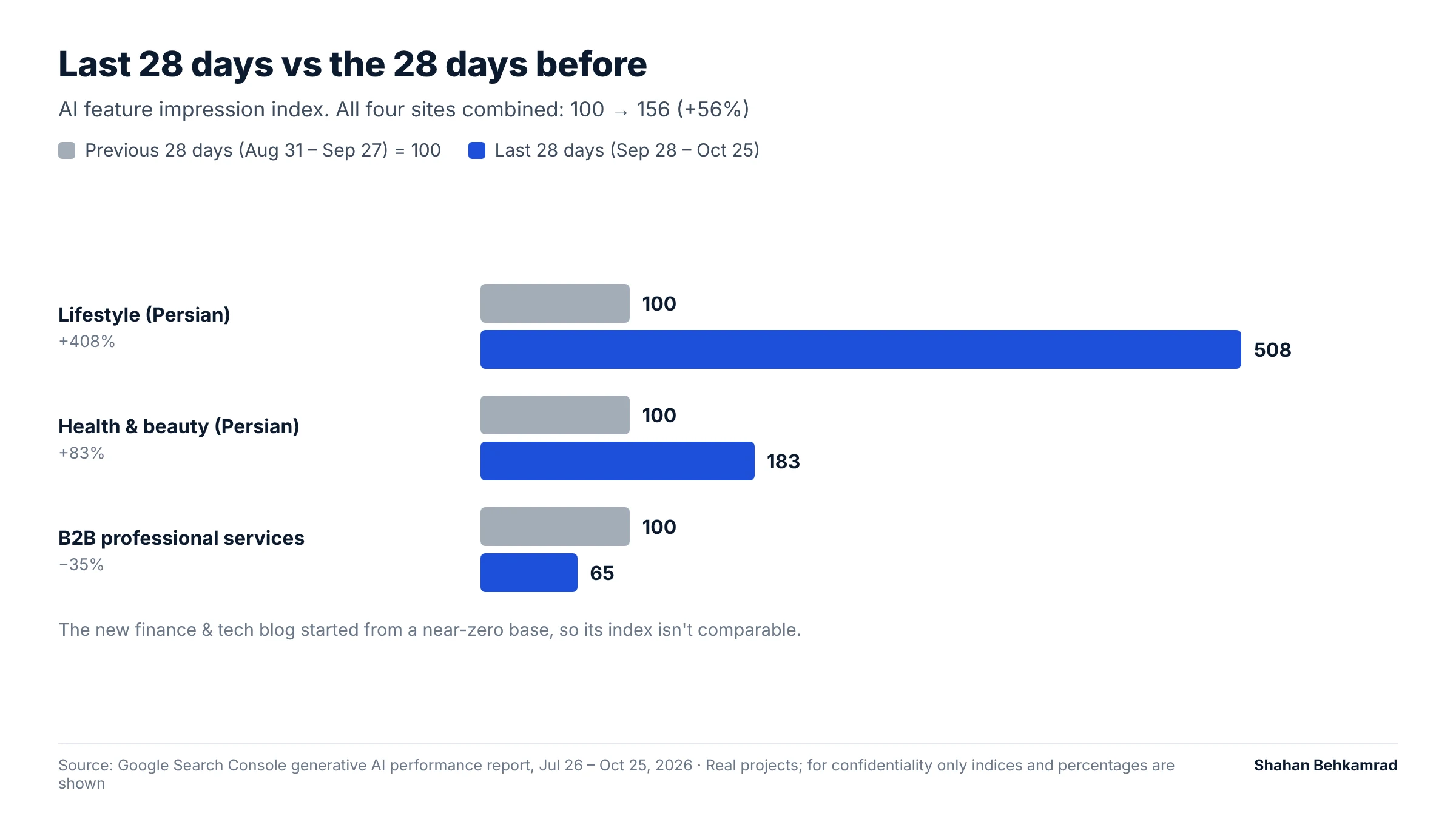
And the weekly trend. Here each site is measured against itself: each site’s peak week = 100.
| Week starting | B2B services | Health and beauty | Lifestyle | Finance and tech |
|---|---|---|---|---|
| July 27 | 39 | 43 | 0 | 3 |
| August 10 | 100 | 57 | 1 | 0 |
| September 21 | 42 | 67 | 25 | 6 |
| October 19 | 32 | 100 | 100 | 100 |
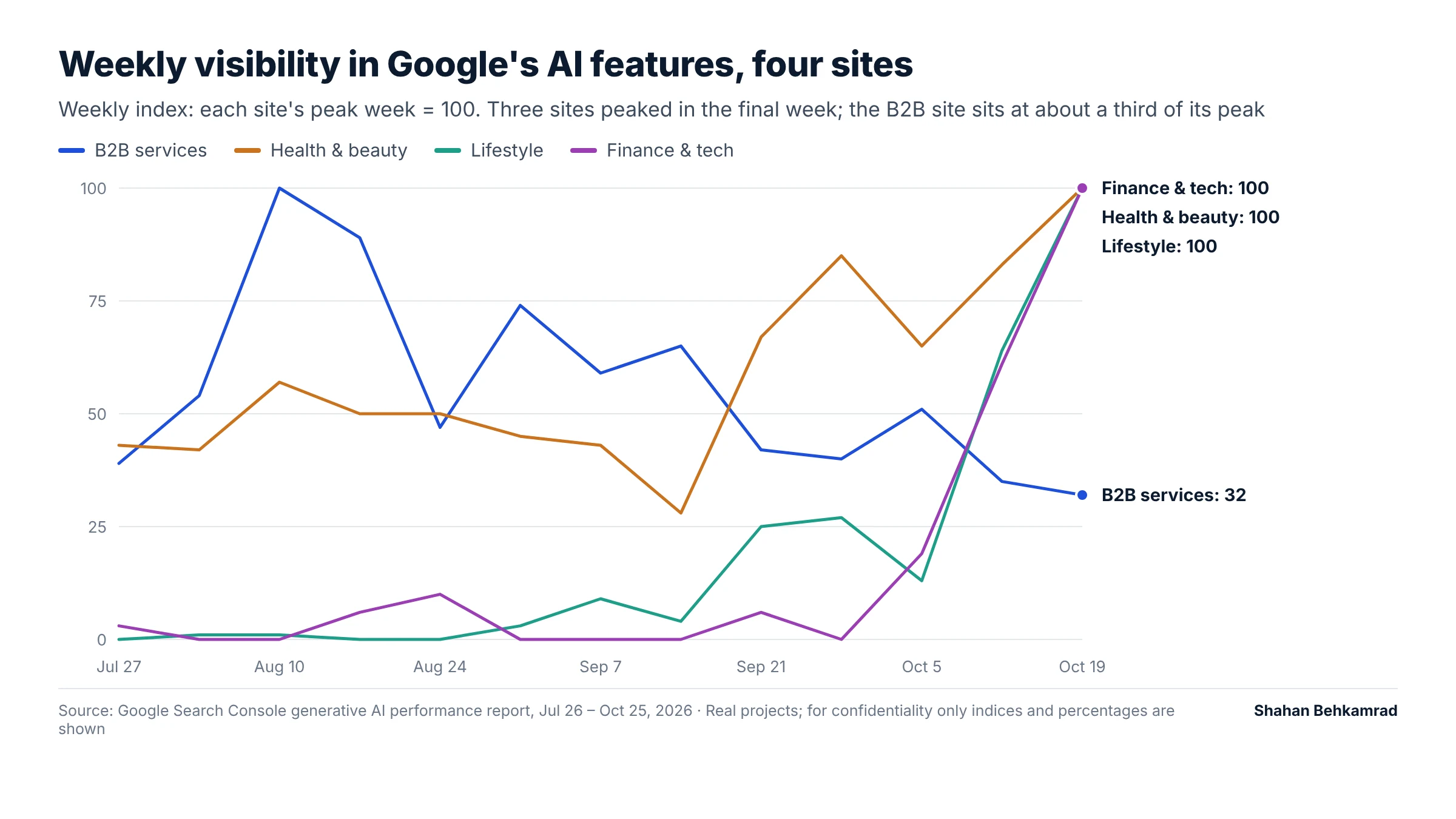
Three sites hit their best week in the final week of the report. The B2B site is sitting at about a third of its peak.
The biggest AI search optimization finding: page count doesn’t matter, focus does
When we split each site’s pages into topic clusters, the most interesting pattern jumped out. The last column shows how many times more an average page in that cluster was seen in Google’s AI features, compared with a general page on the same site:
| Field | Topic cluster | Pages | Share of the site’s page impressions | Strength per page vs general content |
|---|---|---|---|---|
| B2B services | One specific, specialised service | 4 | 12% | 10× |
| B2B services | Country and city market pages | 20 | 51% | 8× |
| B2B services | General content | 43 | 13% | 1 (baseline) |
| Health and beauty | Treatment guides for one specific condition | 18 | 67% | 27× |
| Health and beauty | Guides for a second specific condition | 5 | 17% | 24× |
| Health and beauty | General topics | 9 | 1% | 1 (baseline) |
| Lifestyle | One single cluster built on a repeated question pattern | 24 | 94% | No general cluster to compare |
| Finance and tech | Comparison pages | 5 | 42% | No general cluster to compare |
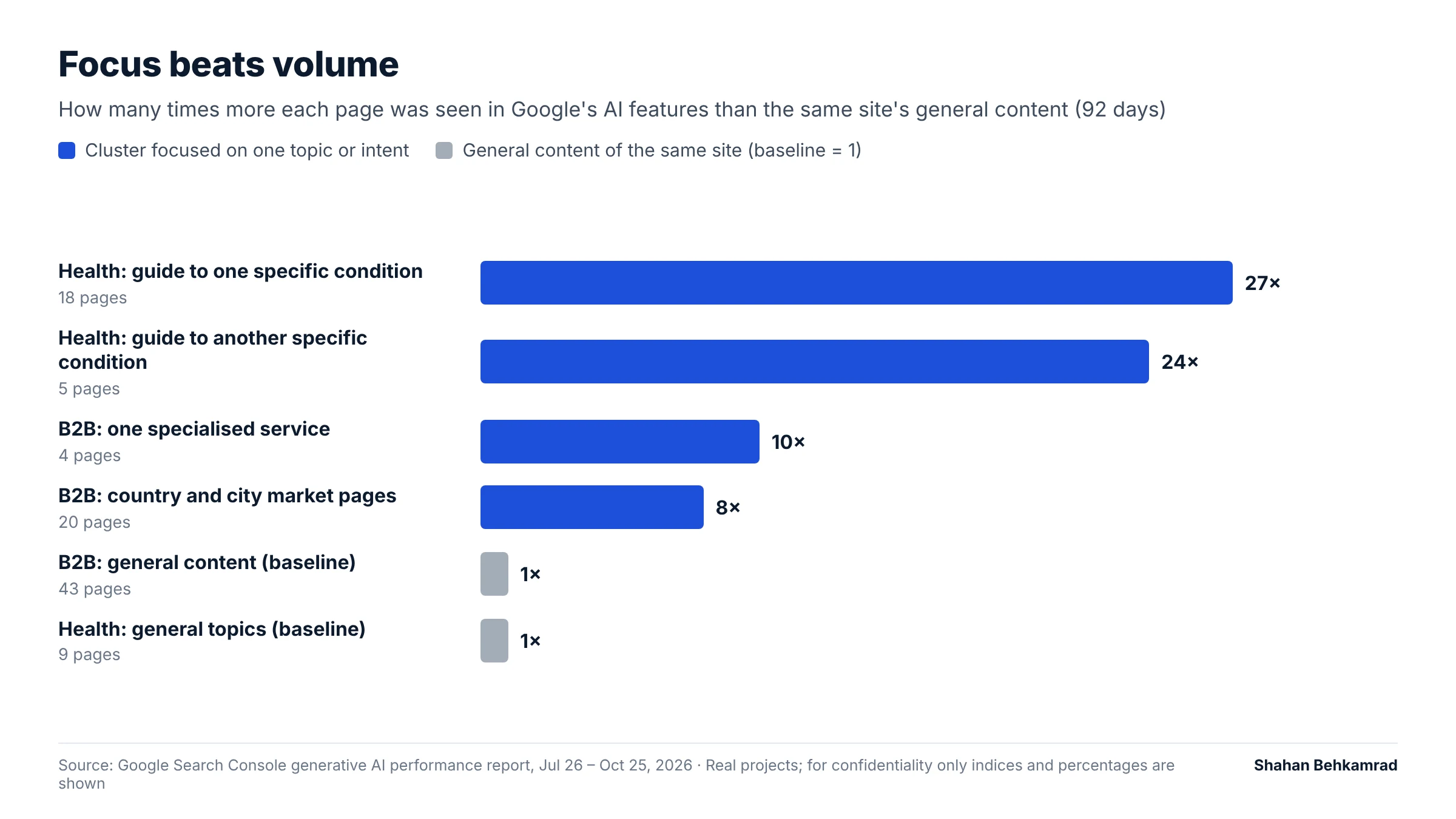
Look at that table twice. On the B2B site, 4 specialised pages took almost the same share as 43 general pages. Each specialised page was seen about ten times as often as a general one. On the health site, general pages barely registered (1%), while 18 pages focused on one specific condition took 67% of all page impressions. On the lifestyle site, 94% of page impressions came from a single cluster.
It’s like restaurants. The place with a hundred-page menu usually isn’t famous for anything. The place that’s famous for one dish, everybody knows its name. In AI search optimization, topical focus beats page count.
In AI search optimization, language decides your market
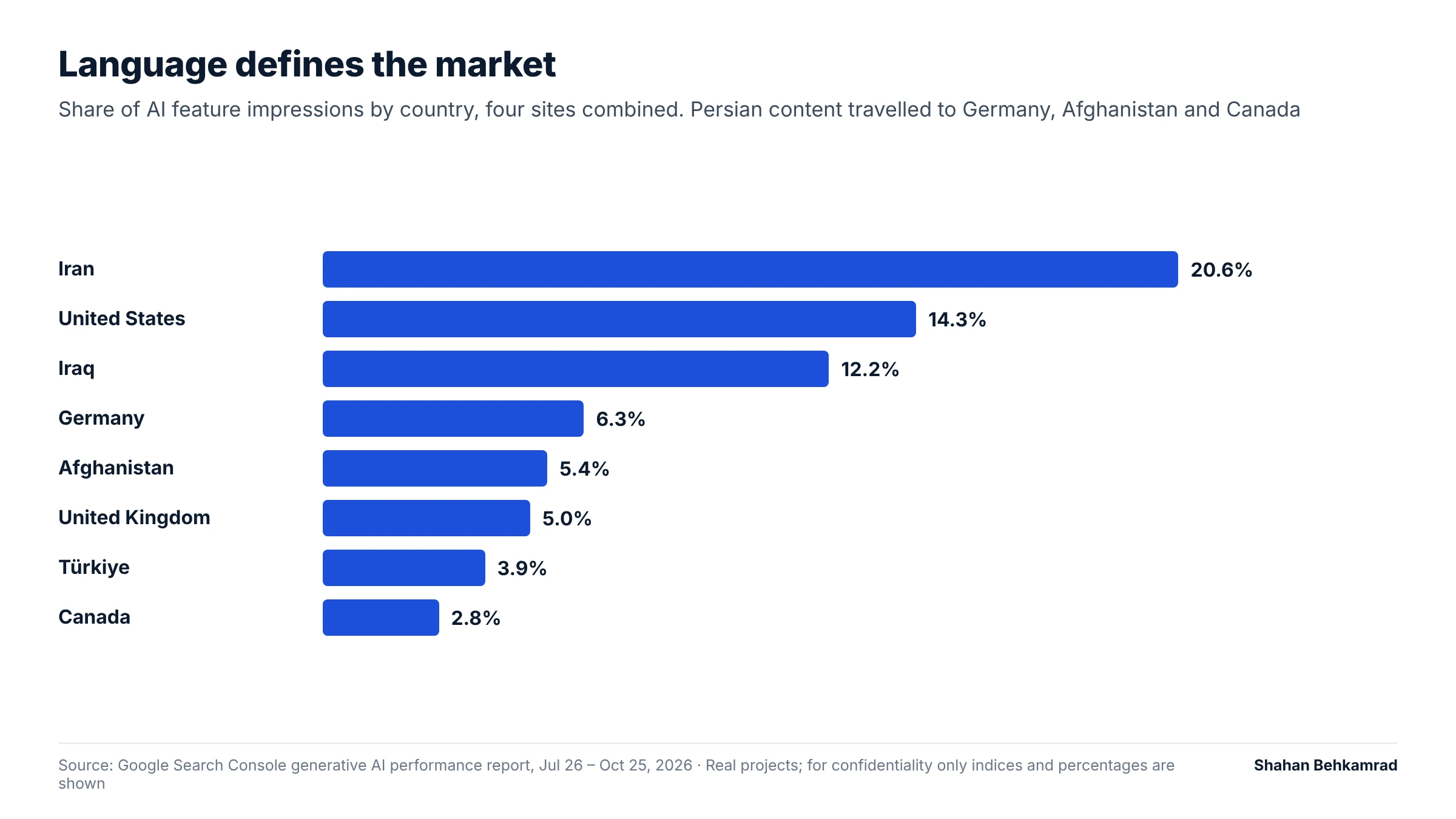
Each country’s share of AI impressions, all four sites combined:
| Country | Share |
|---|---|
| Iran | 20.6% |
| United States | 14.3% |
| Iraq | 12.2% |
| Germany | 6.3% |
| Afghanistan | 5.4% |
| United Kingdom | 5% |
| Türkiye | 3.9% |
| Canada | 2.8% |
The Persian-language health site wasn’t only seen in Iran. It showed up in Afghanistan, Germany, the US and the UK as well. The B2B site’s strongest presence was in one of the Arab markets it had built dedicated pages for. If you publish in Persian, Arabic or Turkish, your audience in AI search isn’t one country. It’s everywhere that language is read.
Device tells you how to write
The B2B audience saw AI answers 87% of the time on desktop. The health and lifestyle audiences were over 96% mobile. A manager at their desk hunting for a service provider and someone on the sofa at night looking up a health problem are two very different readers. For the second one, the answer has to sit in the first two or three lines of the page. AI search optimization has to be written for the device your reader is holding.
Where I honestly don’t know
The B2B site dropped 35% in the last 28 days, and its weekly trend fell from a peak in the week of August 10 to about a third of that by the week of October 19. I don’t know the definitive reason yet. There are a few possible explanations that need testing against data: changes to the models Google added during this period, changes in which queries trigger an AI Overview at all, or competitors getting stronger in the same markets. I’m not going to pretend I know.
One more warning, to myself and to you: the lifestyle site’s 408% growth started from a small base. The team’s own report wrote right next to that number: “low base, risk of exaggerated interpretation.” Whenever someone shows you growth in the tens of multiples, ask first what number it started from.
How we built this report so we wouldn’t lie to ourselves
This part may matter more than the numbers themselves, because it’s the same method I’d recommend for your own AI search optimization reporting:
| Rule | Why |
|---|---|
| Always compare equal windows (7 days vs 7 days, 28 vs 28) | Comparing a 30-day month with a week manufactures fake growth or fake decline |
| Always put the base number next to the growth rate | “80×” without “from what” is misleading |
| Don’t add impressions, clicks and leads together | Each measures something different, and they overlap |
| Log every claim in an evidence register: source, date, method, limitation | So every number you publish can be defended |
| Next to every explanation, write at least three rival explanations | Having one explanation doesn’t rule out the others |
| Test every content change against a control group | Without a control, you’ll credit an algorithm update or a seasonal swing to your own work |
| In YMYL fields (health, finance, immigration), make expert review mandatory | Mistakes in these fields hurt people |
To measure the effect of any change, we use a simple formula: adjusted effect = (after ÷ before in the test group) ÷ (after ÷ before in the control group) − 1.
Simulation lab: the formula on a worked example
⚠️ This example is fully simulated and for teaching only. The numbers in this section come from a practice dataset built to teach experiment design. They are not the result of any real project or any client.
Picture a hypothetical dental clinic. On 20 pages it moves the main answer into the first 150 words, and it leaves 20 similar pages untouched:
| Group | Before (average impressions per page) | After | After ÷ before |
|---|---|---|---|
| Test: answer in the first 150 words | 55 | 86 | 1.56 |
| Control: no change | 56 | 62 | 1.11 |
Look only at the test group and you’d say “we grew 56%.” The control group grew 11% with no work at all, maybe because of seasonality or an algorithm change. The adjusted effect is 1.56 ÷ 1.11 − 1, which is about 40%. Not 56%. And even that 40% isn’t proof. A backlink or some other change happening at the same time could explain part of it.
That’s the gap between a report that makes you feel good and a report you can actually make decisions on.
The real experiments we’ve registered
We’ve defined and registered 22 experiments across the four real sites. For example:
- Health and beauty: a physician reviews five treatment guides, adding medical sources and a review date.
- B2B services: adding local evidence and FAQs to market pages, compared with market pages left unchanged.
- Finance and tech: an updated comparison table with transparent sources and an update date.
None of them has run long enough to give a result you could rely on. When they do, I’ll publish the results right here, good or bad.
The team also built one ambitious scenario. If we wanted to grow visibility in Google’s AI features 100× within 12 months, we’d need compound growth of about 47% every single month. That’s a planning tool. It is neither a forecast nor a promise. It lets us see, in numbers, the gap between where we are and where we want to be, and it makes clear that business-as-usual won’t get us there.
7. Three AI search optimization myths you can safely ignore
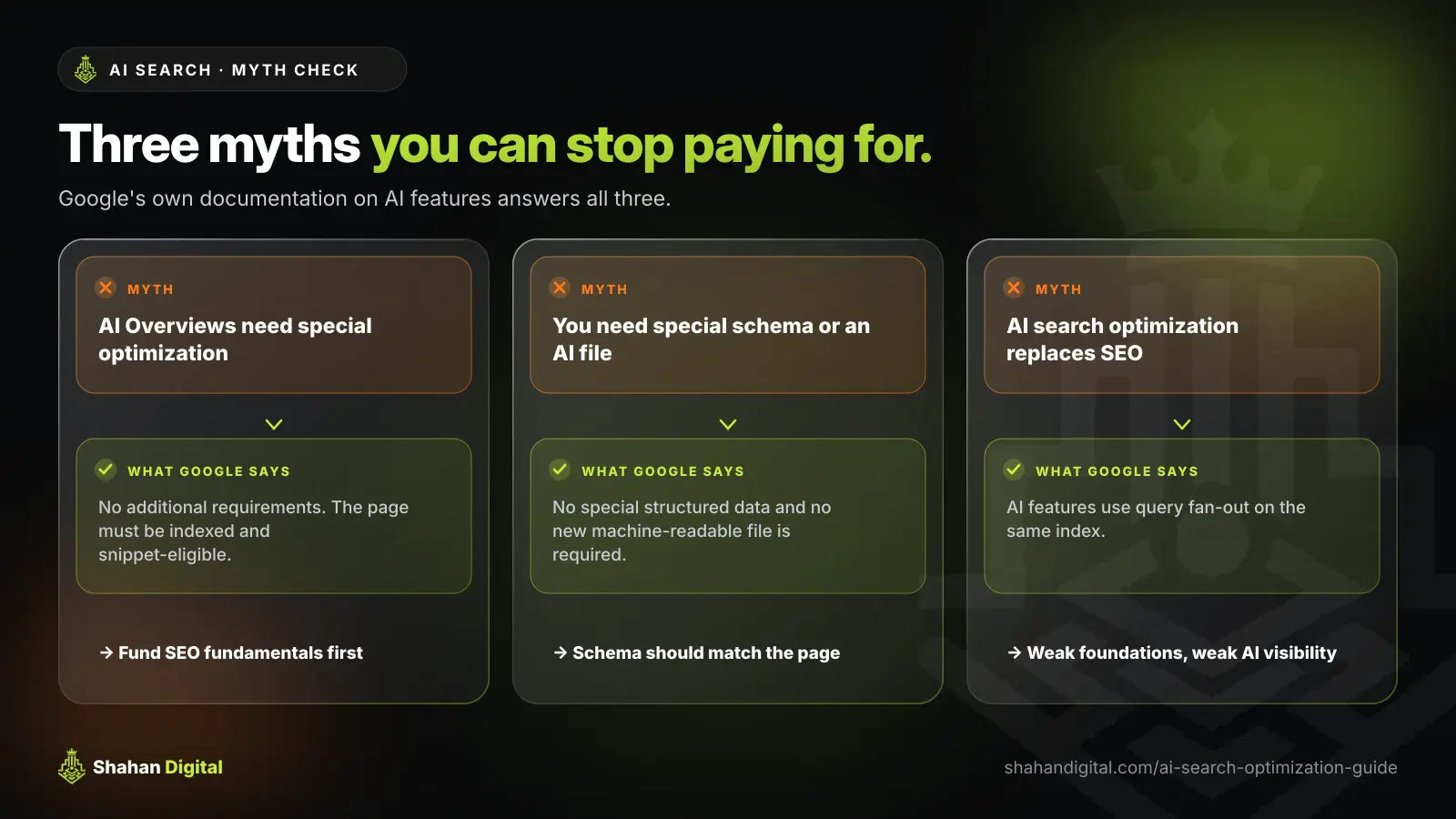
Google’s own documentation, AI features and your website, is very clear on a few points. Plenty of people are still selling services under the AI search optimization label on exactly these points:
| Myth | What Google says | What it means in practice |
|---|---|---|
| AI Overviews need special optimization | “There are no additional requirements” and no “special optimizations” needed. The page just has to be indexed and eligible to show with a snippet | Spend money on SEO fundamentals first |
| You need special schema or an AI-specific file | “No special schema.org structured data” is required, and no new machine-readable file either | Schema just has to match what’s on the page |
| AI search optimization replaces SEO | AI features use query fan-out on the same index | Weak foundations mean weak AI visibility |
Gary Illyes from Google also said one short line on October 21 that clears up a lot of confusion: robots.txt is “an access preference protocol.” It controls crawling. It doesn’t control what happens to your content after the crawl.
So where is the real work in AI search optimization? In the things Google can’t do for you: being known, being consistent, being cited by others, and being the best answer to one specific question in one specific market.
8. The 7-step AI search optimization plan for 2026
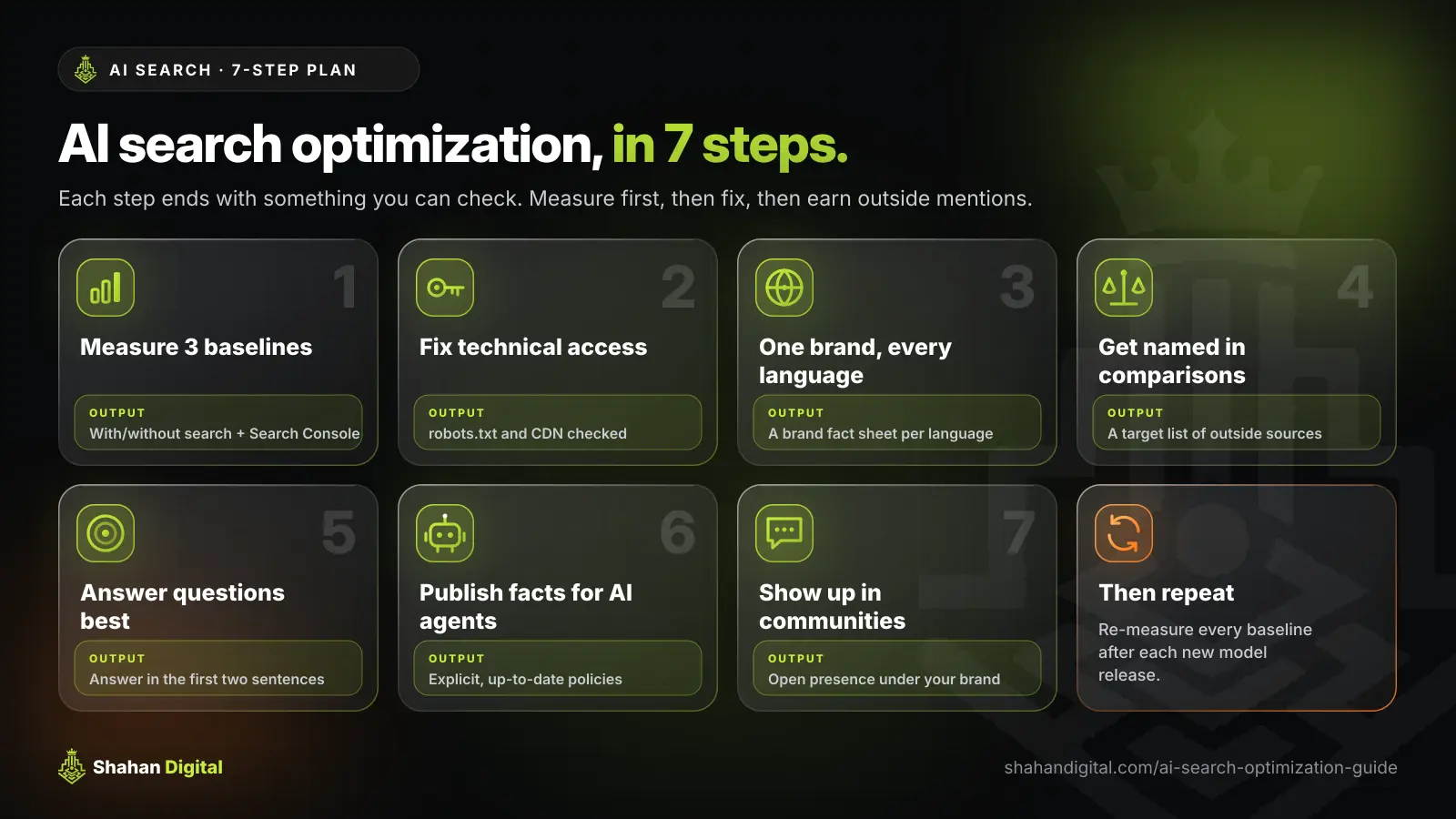
Before the details, here’s the whole AI search optimization map at a glance:
| Step | What to do | Why | Output |
|---|---|---|---|
| 1 | Measure three baselines | Without a starting point, progress means nothing | Presence report with and without search, plus a Search Console report |
| 2 | Fix technical access | A blocked bot means an invisible page | robots.txt and CDN checked |
| 3 | Make your brand entity consistent in every language | Contradictions force the model to guess | A brand fact sheet in each language |
| 4 | Get named where comparison happens | About 95% of comparison searches show an AI Overview | A target list of outside sources |
| 5 | Answer specific questions better than anyone | Precise answers get picked | Pages with the answer in the first two sentences |
| 6 | Publish clear facts for AI agents | Agents read them directly | Policies and details, explicit and up to date |
| 7 | Show up for real in communities | Reddit and forums are top sources | Transparent presence under your brand name |
Step 1: Measure three AI search optimization baselines
Picture a teacher calling the register from memory, without looking at the attendance book. The kid who never raised a hand gets forgotten. The no-search baseline tells you whether the teacher remembers your name.
- Visibility with search: put your customers’ most important questions into ChatGPT, Gemini and Perplexity. Log who gets named and who gets cited.
- Visibility without search: run the same questions through the API with search switched off. The SEJ piece recommends at least 50 responses per prompt, repeated after every new model. If you’re missing here, your problem is brand memory.
- Google AI features: open the generative AI report in Search Console. See which pages, countries and devices get shown, and compare the last 28 days with the 28 days before.
Why repeat so much? Because, per Fishkin’s study, the same brand list comes back less than once in a hundred runs. And why after every new model? Because models keep changing. On October 13, Google added Gemini 4 Argon to AI Mode for Pro and Ultra subscribers, and Google’s Robby Stein said the model brings “big improvements to tackling nuanced, multi-step tasks.” The answers your customers see can change with every model, which is why AI search optimization in 2026 is a measurement habit, not a one-off project.
Step 2: Fix technical access
- Keep crawling open in robots.txt and in your CDN or firewall. Google points to both.
- OAI-SearchBot (ChatGPT search) and GPTBot (training OpenAI’s models) are separate. You can leave search open and block training.
- Google-Extended controls Gemini training and grounding. Google says it doesn’t affect Search.
- Keep important content as text. Don’t bury it inside images or scripts.
This is the least exciting step and the cheapest one, which is exactly why it comes first. No strategy works if the bot is stuck outside a locked door. It’s also the first thing any proper SEO audit should check.
Step 3: Make your brand entity consistent in every language
A kitchen example. In one Iranian city a dish is called “dizi.” In another it’s “abgoosht.” People know it’s the same stew. AI doesn’t always. If your brand is an “international SEO agency” in English, an “advertising company” in Persian and an “ajans” in Turkish, the model may think it’s dealing with three businesses.
Write down the facts you want AI to learn: who you are, what you do, for whom, where, and who runs the company. Then make sure your site, founder profiles, LinkedIn, directories and press coverage all say the same thing, in every language your customers use.
This is where most international brands fall apart. As head of SEO , a forex broker, I worked on its English and Arabic sites and helped with the Kurdish side too. One brand, one set of services, and yet every language had its own audience, its own search behaviour and its own competitors. Arabic SEO isn’t one market. It’s at least seven. If your brand is crystal clear in English and fuzzy in Arabic, Persian or Turkish, you’re asking the model to guess. Multilingual AI search optimization starts by removing that guesswork.
Step 4: Get named where comparison happens
AI Overviews appear in about 95% of comparison searches, and ChatGPT’s background searches often include brand names. So you need your name on the pages that buyers and models read when they compare:
- Industry reviews and comparison articles
- Association and trade body listings
- Podcasts and YouTube
- Expert roundups in the press
Earn these mentions through real off-page SEO. Don’t buy fake versions of them. My own AI search optimization case study points the same way: on the new finance and tech blog, five comparison pages took 42% of all page impressions.
Step 5: Answer specific questions better than anyone
OpenAI’s own Signals data shows “practical guidance” was the biggest topic in ChatGPT messages in September 2026 at 28.1%, with “seeking information” at 20.2%. There’s an important catch here. The joint OpenAI and Harvard study from 2025 put information-seeking for mid-2025 about 5.7 points higher than Signals does. Neither is wrong. They sample differently. That’s why, whenever you quote one of these numbers, you always give the source and the date.
In practice, AI search optimization at page level means:
- Build pages that each answer one real question.
- Put the answer in the first two sentences, then explain.
- Add first-hand experience, clear steps and honest trade-offs.
That’s what good SEO content writing looks like now: written for the person asking, structured so a machine can lift the answer.
Step 6: Publish clear facts for AI agents
AI agents now read business facts directly. This month Shopify moved its AI knowledge base, which holds things like return policies, shipping times and similar facts, into the store admin. In a test by Bill Hunt that SEJ referenced, 88 Shopify stores had their policy tools checked. Only two gave a usable answer about cancelling an order.
Whatever platform you’re on:
- Make your policies, shipping, pricing logic and contact details explicit and current.
- Keep your Google Business Profile and Merchant Center data accurate. Google mentions both in its AI features guidance.
Step 7: Show up for real in communities
Reddit is among the most-cited sources on almost every platform. As I said in section 5, though, community presence only works when a real expert answers a real question, openly, under your brand name. One good answer from a genuine expert is worth more than a hundred promotional comments.
9. AI search optimization by industry
AI search optimization looks different in every industry, the same way industry-specific SEO always has. This table sums up what I’ve seen in the industries I’ve worked in:
| Industry | Why it’s hard | What AI looks for | First step |
|---|---|---|---|
| Medical and aesthetics | It’s YMYL. Mistakes hurt people’s health | Physician credentials, precise answers to specific questions, credible sources | One precise page per condition, with the physician’s name and credentials |
| Finance, forex and crypto | YMYL, regulation and high user distrust | Transparency, education, independent reviews | Put education and transparency ahead of promotion |
| International real estate | The buyer decides from another country and has never met the agency | A familiar name, current information, presence in comparisons | Make company and project details consistent in every buyer language |
| Education and study consulting | Tuition and requirements change every year | Current, dated information | Every page carries an update date and an official source |
| E-commerce | Agents read your policies directly | Explicit policies, accurate product data | Write complete return, shipping and cancellation policies |
| B2B services | Long buying cycles and lots of comparison | Presence in comparisons, market pages, provable expertise | Build a dedicated page for each target market |
| International trade | Buyers and sellers sit in different languages and countries | A clear company entity, official registration, directory presence | Publish a company fact sheet in every trading language |
A bit more depth:
Medical and aesthetics. I’ve worked with dermatology and dental clinics. In the health case study above, pages focused on one specific treatment problem were seen about 27 times as often as the same site’s general pages. In this industry, though, every sentence has to be medically correct and carry the name of the responsible physician. In medical AI search optimization, speed should never replace accuracy.
Finance, forex and crypto.on top of SEO, I rebuilt the email marketing programme and its automation and launched an education academy on the sites. In this industry people don’t trust “trust us.” Education and transparency build credibility, and they’re also exactly what AI prefers to cite.
International real estate. I’ve helped launch several real estate brands in Türkiye and Northern Cyprus from scratch. An Iranian or Arab buyer looking for a home in Istanbul from Dubai or Tehran asks AI first which agency they can trust. A brand without a familiar name and consistent information in that buyer’s language isn’t in the answer.
Education. I built Istanbul Fashion Academy’s digital visibility from zero in 2023 and 2024. In education, the biggest enemy is stale information. If AI reads last year’s tuition on your site, that’s exactly what it tells the student. For education brands, AI search optimization is mostly a freshness discipline.
10. The first 90 days and choosing a consultant
The first 90 days of an AI search optimization project
When a company hires me for AI search optimization, this is the order I work in:
| Period | Work | Output |
|---|---|---|
| Days 1–30: diagnose | Define 20–50 real buyer questions per market and language. Measure the three baselines. Audit technical access, brand consistency across languages and presence in outside sources | A prioritised list of blockers, ranked by business impact |
| Days 31–60: fix the foundation | Clear crawl and indexing blockers. Align brand facts across the site, founder profiles and directories in every language. Rebuild or create the pages that answer the most valuable questions | A ready technical and content foundation |
| Days 61–90: earn presence beyond the site | Target the comparison pages, publications, podcasts and communities that buyers and AI read. Re-measure every baseline | An honest report on what changed, including what didn’t move |
After 90 days you know what works, what doesn’t, and where the next investment should go. That’s the whole point of phase one: evidence, not promises.

How to choose an AI search optimization consultant
AI search optimization is new enough that anyone can call themselves an expert. Whether you come to me for AI search optimization consulting or go to someone else, ask these questions. They separate real work from old SEO in new packaging, and they work just as well when you hire an SEO expert for classic search:
| Ask the consultant | Good answer | Red flag |
|---|---|---|
| How do you measure AI visibility? | With- and without-search baselines, Search Console data, repeated measurement | A screenshot of one ChatGPT answer |
| Do you guarantee citations or rankings? | “No. Nobody controls that” | Any guarantee, or selling a “ChatGPT ranking” |
| What will you change outside my website? | A plan for outside sources, publications and communities | Only on-site content and schema |
| How do you handle each language and market? | Research into each market’s search behaviour, sources and competitors | “We’ll translate it” |
| What do you report, and how often? | Trends over time, with honesty about what didn’t work | Only the good numbers |
11. AI search optimization in 2027: five things to watch from now on
I’m not going to predict exactly what 2027 looks like. Anyone who does that with confidence is guessing. Five shifts have already started, though, and they’ll shape AI search optimization in 2027:
| Topic | What we know today | What to do now |
|---|---|---|
| New models | Google brought Gemini 4 Argon to AI Mode for Pro and Ultra subscribers and says the rest of the Gemini 4 family is coming. Which model becomes the default is still unclear | Re-measure all three baselines after every new model |
| Agents and protocols | Sundar Pichai says agents will both browse sites like people do and use protocols like UCP. Google’s agents (Google-Agent) generally don’t follow robots.txt | Test your forms, booking and checkout for automated browsing, and publish business facts explicitly |
| Ads next to answers | According to OpenAI, ChatGPT ads hit a $1 billion annual revenue run rate less than 200 days after launch. OpenAI says the ad system is separate from the answer system | Don’t mix organic presence with ad budget. Measure them separately |
| Control over content use | Gary Illyes co-authored an IETF draft for a rule called Content-Usage, which hasn’t been adopted yet. Meta’s new commercial terms, from November 20, 2026, allow it to crawl business pages | Write your crawler policy on purpose and review it every few months |
| Reporting | Search Console’s AI report only shows impressions for now | Start saving weekly data now, so you’ll have history when more metrics arrive |
All five rows share one point. In AI search optimization in 2027, the winner won’t be whoever knows the newest trick. It’ll be whoever started measuring earlier, has a history of data, and knows exactly what changed when the rules shift.
Where are you on the AI search optimization path?
Read this table and find the row that looks like you:
| If… | It means… | Your next step |
|---|---|---|
| You’ve never asked AI what it says about your brand | You have no baseline | Today, ask ChatGPT and Google 10 real customer questions and log the answers |
| You show up in answers, but only with search on | You have citations, not brand memory | Focus on steps 3 and 4: brand consistency and outside sources |
| You’re visible in one language and invisible in another | You have a multilingual entity problem | Build a brand fact sheet in every language |
| Search Console shows AI impressions, but the trend is falling | Your visibility is unstable | Review changes month by month, broken down by page and country |
| You’re in a YMYL industry (medical, finance) | Small mistakes cost a lot | Audit the credibility and accuracy of your existing content before producing more |
| You have all of this and don’t know where to start | You need an outside view | Let’s look at your three baselines together |
Frequently asked questions
What is AI search optimization? It’s the work that makes it easy for AI systems like ChatGPT, Gemini, AI Overviews, AI Mode and Perplexity to find your brand, understand it, trust it and name it in their answers. It’s built on SEO and adds brand entity consistency, presence in outside sources and AI-specific measurement.
Is AI search optimization different from SEO? It’s an extension of SEO, not a replacement. Google’s AI features run on the same index, so technical SEO and helpful content still come first. The differences are in how you measure, how much weight outside sources carry, and how brand memory shapes which names the AI considers.
Do I need llms.txt or special schema for Google’s AI features? For Google, no. Google says you don’t need a new machine-readable file or special schema to appear in AI Overviews or AI Mode. Spend your AI search optimization budget on fundamentals first.
Why does ChatGPT give a different answer every time I ask? Because answers are variable by nature. In the SparkToro research, the chance of getting the same brand list twice was less than 1 in 100. That’s why you measure presence rate across many runs instead of rank.
How long does AI search optimization take? Technical fixes can pay off within weeks, in line with how long SEO takes in general. Brand entity consistency and presence in outside sources usually take months. New models ship often and can move results either way, so plan for continuous measurement, not a one-off project.
How do I measure my visibility in AI? Measure AI search optimization in three layers: Search Console’s generative AI report for Google, repeated prompt testing with search on, and API testing with search off. Track the trend by market and language, not individual answers.
What will change in AI search optimization in 2027? The foundations stay the same: sound technical SEO, a consistent brand entity, presence in outside sources and continuous measurement. What changes is how fast models change, the bigger role of agents, and ads next to answers. That’s why having baselines and data history from today is the most important preparation.
Can anyone guarantee that ChatGPT will recommend my brand? No. Anyone who guarantees that is overpromising. What good AI search optimization can do is strengthen the signals that make your brand easier to find, trust and name.
Conclusion
If you remember only three things from this guide:
- Memory beats a single page. Like the hotel concierge, AI says the names it already knows first.
- Presence beats rank. Answers change every time. Strong brands keep coming back.
- Language is your market. A brand described differently in every language looks, to AI, like several incomplete brands.
AI search optimization in 2026 and 2027 isn’t a trick for squeezing into one answer. It’s the work of becoming a brand that AI systems already know, consistently, in every language your customers use, so that when the model decides who to consider, your name is on the list before it ever searches.
If your brand is strong in the real world but invisible or inconsistent in AI answers, that gap can be measured and closed with deliberate AI search optimization.
I work with founders and marketing leaders who want an outside view of their AI search optimization across markets and languages. If that sounds like you, I’d be glad to grab a coffee, in Istanbul, Dubai or online, and look at your three baselines side by side.
Shahan Behkamrad is the founder of Shahan Digital, an international SEO and GEO agency. He has worked in SEO and digital growth since 2017 across Persian, Arabic, English and Turkish markets.
Sources
- ChatGPT Rarely Named Some Brands Even When Sources Mentioned Them, Search Engine Journal, Oct 26, 2026
- AI recommendation lists rarely repeat: study (SparkToro), Search Engine Land, Jan 28, 2026
- Danny Sullivan: Good SEO is good GEO, Search Engine Land
- ChatGPT Signals: consumer messages and information seeking, Search Engine Journal, Oct 27, 2026
- Google adds Gemini 4 Argon to AI Mode, Search Engine Journal, Oct 13, 2026
- AI features and your website, Google Search Central
- Search Console Help: Generative AI performance report, Google
- Search Generative AI performance reports in Search Console, Google Search Central Blog, June 2026
- AI Overviews Reduce Clicks by 34.5%, Ahrefs
- Ahrefs study: AI Overviews cut clicks by 58%, MediaNama, Feb 6, 2026
- Google AI Overviews CTR shows early signs of recovery (Seer Interactive), Search Engine Land
- AI platform citation patterns, Profound
- SEO Pulse: Google explains 503s, robots.txt limits, bracket URLs, Search Engine Journal, Oct 24, 2026
- Shopify AI agent knowledge base, Search Engine Journal, Oct 27, 2026
- Pichai on AI agents and browsing protocols, Search Engine Journal, Oct 22, 2026
- OpenAI details ChatGPT’s ad stack, Search Engine Journal, Oct 22, 2026
- Meta delays business terms with crawling clause, Search Engine Journal, Oct 26, 2026
- Reddit’s CEO at Mod World, Search Engine Journal, Oct 26, 2026