Quick answer: Multilingual keyword research means researching what people actually type in each language and each country, instead of translating your English keyword list. A good study starts from the buyer’s problem, collects native-language seeds, checks the live results in that market, and keeps volume, intent and script variants separate for every language and country pair. Translation is a starting point for seeds. It is not the research.
Who this guide is for
This guide is for founders, marketing leads and in-house SEO teams who sell in more than one language. It also suits anyone who has already paid for translated pages and wonders why they get impressions but few enquiries.
- You are entering a new country: start with the decision aid and the market checks.
- You already have translated pages: jump to “Why translated keywords fail” and the audit checklist.
- You are comparing providers: read the price table, the SERP review and the “Choose a provider” checklist.
Key takeaways
- Research each language and country pair on its own. Arabic in Riyadh, Cairo and Beirut can need three different keyword lists.
- Collect script and spelling variants: Cyrillic and Latin, Arabic script and Arabizi, Persian and Finglish, Turkish with and without special characters.
- Check which search engine people use. Google is above 95% in Saudi Arabia, the UAE and Egypt, but Yandex holds about 22% in Turkey and 70% in Russia (Statcounter, October 2026).
- Treat tool volumes as rough. Google rounds Keyword Planner volumes, and they depend on the location and language settings you pick.
- Your own Search Console data by country is often the most honest source of real queries.
We see the same pattern in our own data again and again. Pages written in English attract searches from countries we never targeted, while the language the local buyer uses goes unanswered. In the 90 days to 20 November 2026, our international SEO service page collected 83 impressions for “multilingual keyword research services” and another 48 for “multilingual seo dubai (arabic + english)”. People are literally typing two languages into one query. That is the problem this guide is about.
Before you commission multilingual keyword research: confirm three things. First, can you actually serve buyers in that country, in that language, with local payment, delivery or support? Second, who will write the pages? Research is wasted if a translator then rewrites the keywords back into textbook language. Third, do you have Search Console access split by country? Without it, nobody can tell you which markets already show interest.
What multilingual keyword research actually is
Multilingual keyword research is the process of finding the words, scripts and phrasings that real buyers use in each target language and country. It covers search volume, intent, competition and the shape of the results page for each pair. It ends with a keyword map that tells writers which page answers which query in which market.
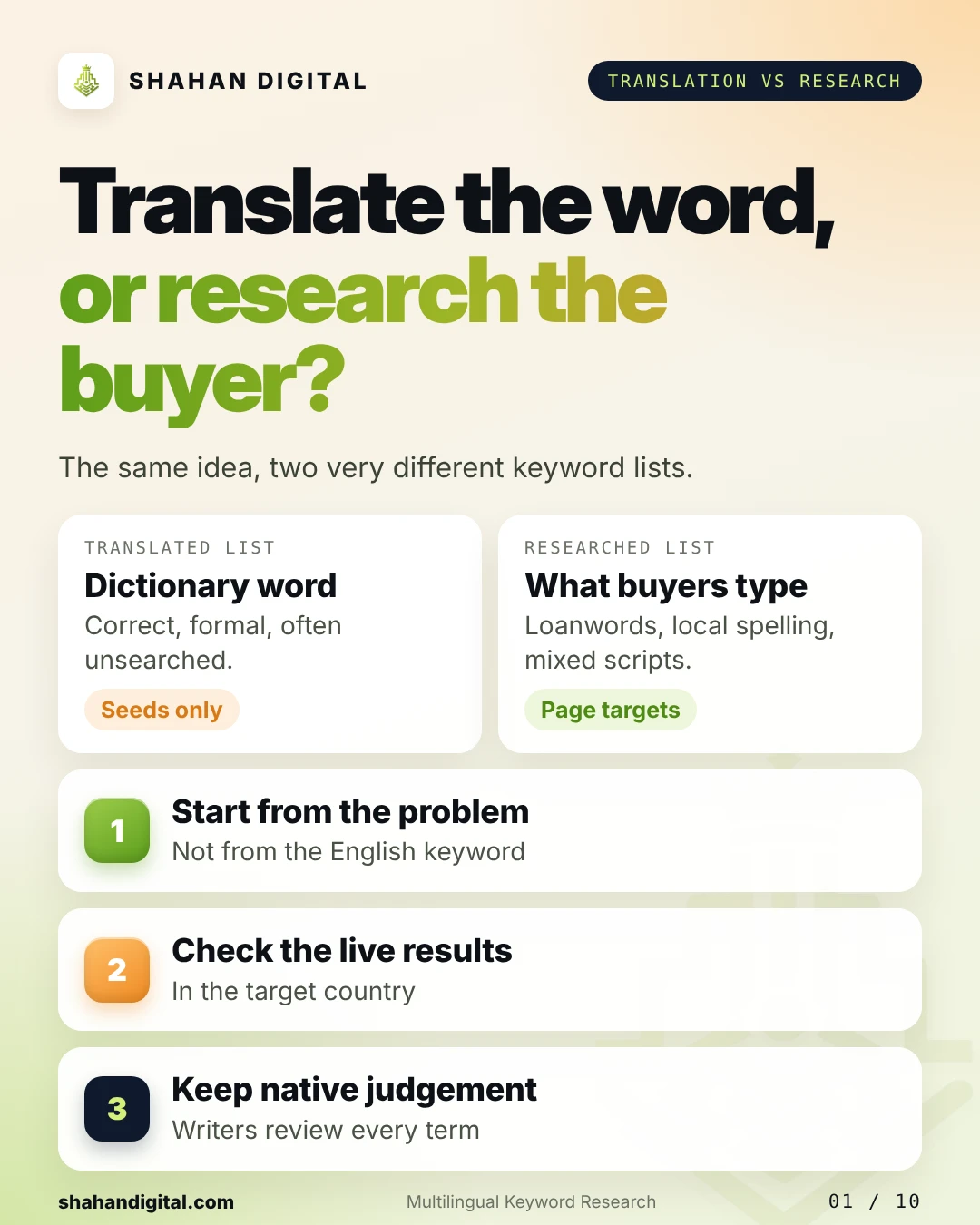
It is different from translation in one important way. A translator asks “what does this word mean in Turkish?” A researcher asks “what does a Turkish buyer type when they have this problem?” The answers are often different. Sometimes the buyer uses an English loanword. Sometimes they use a brand name as a generic term. Sometimes they search in a second language entirely.
You will also see the work called international keyword research, keyword localization or keyword research in other languages. The labels overlap. What matters is that the research is done per market, with native judgement, and checked against live results.
Why translated keywords fail
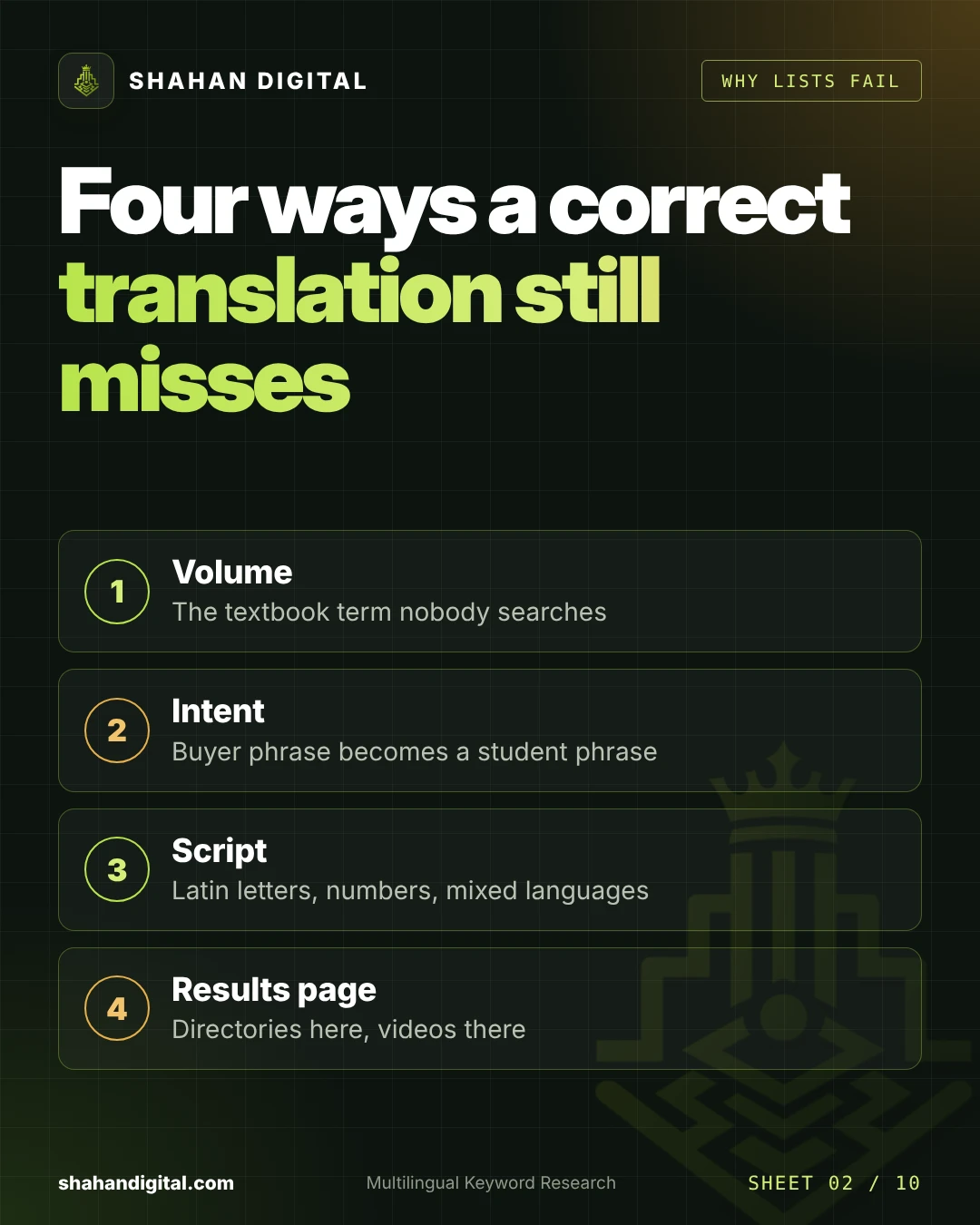
Translated keyword lists fail for four predictable reasons.
- The translated term is correct but nobody searches it. Formal or literary words often lose to everyday or borrowed terms.
- The intent changes. A phrase that signals a buyer in English can signal a student or a job seeker in another language.
- The script changes. Many people type their language in Latin letters on a phone, or mix two languages in one query.
- The results page changes. The same idea can show local directories in one country, videos in another and marketplace listings in a third.
Google itself warns against shortcuts here. Its guidance on multi-regional sites says it uses the visible content of a page to work out its language, not the lang attribute or the URL, and it advises against side-by-side translations on one page (Google Search Central, last updated 10 December 2025). If the words on the page are not the words people search, labels will not save it.
“When we audit a translated site, we export Search Console queries by country and compare them with the keywords the translator used. In most audits the top local queries contain a loanword, a Latin-script spelling or a second language that never appears on the page. That gap is usually worth more than any new content.”
Shahan Behkamrad, Founder of Shahan Digital
Market first: language and country pairs
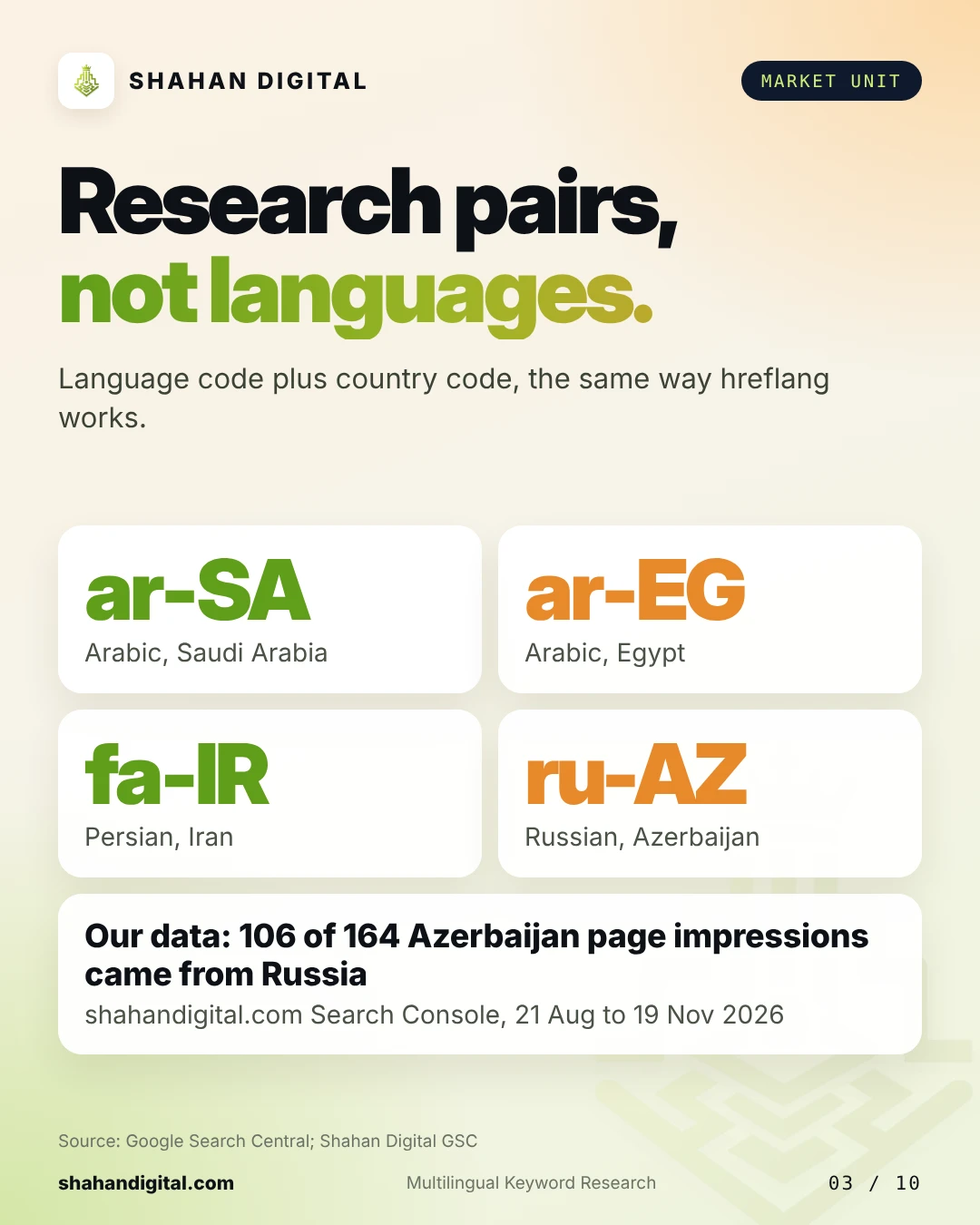
The unit of keyword research is not a language. It is a language and country pair, such as Arabic in Saudi Arabia (ar-SA) or Russian in Azerbaijan (ru-AZ). Google’s hreflang system works the same way: a language code in ISO 639-1, optionally followed by a region code in ISO 3166-1 Alpha 2 (Google Search Central on localized versions, last updated 21 September 2026).
That pairing matters because demand rarely follows the map you expect. Some examples from our own Search Console data, recorded during the last few weeks of nightly reviews:
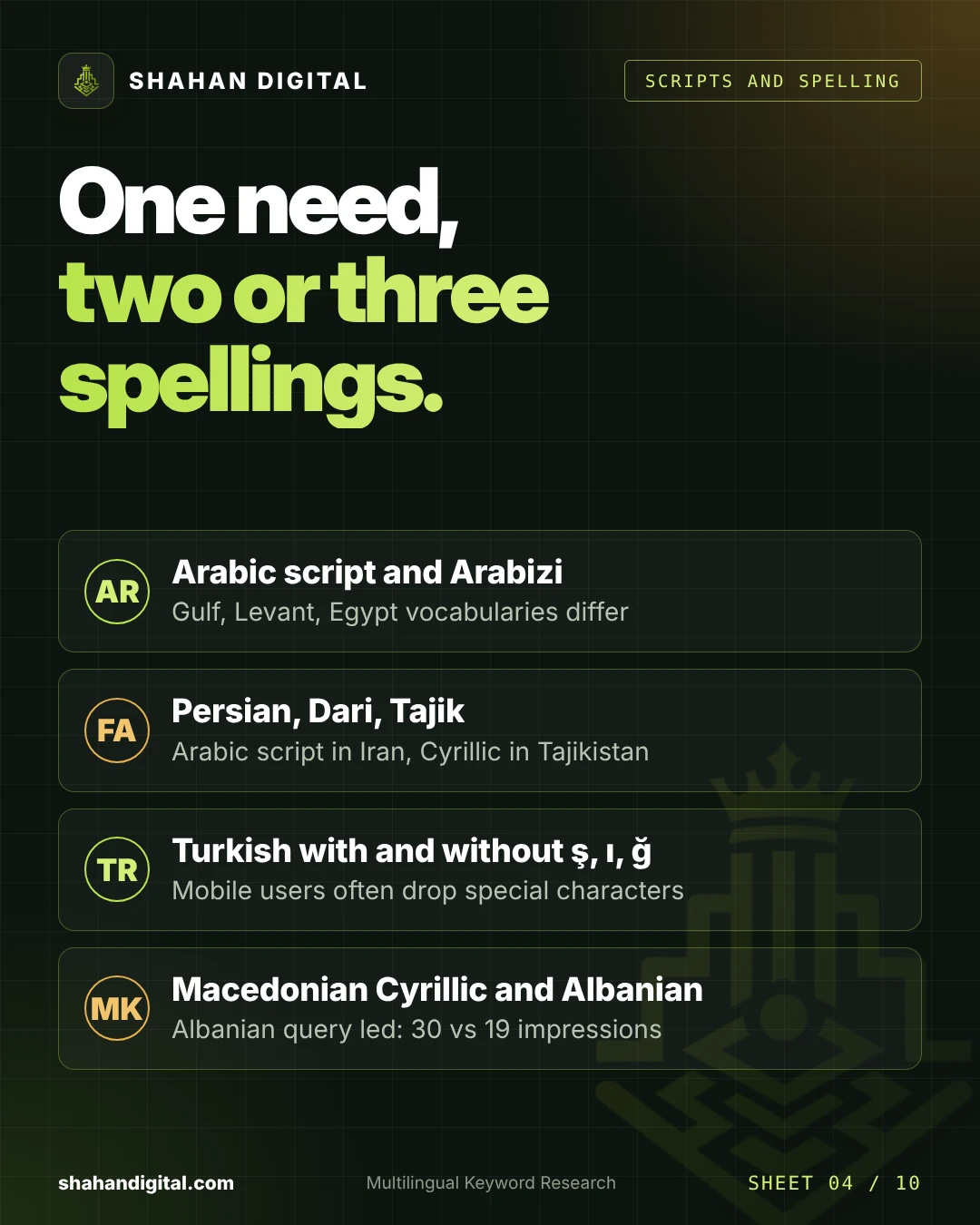
- North Macedonia: the strongest local query was Albanian, not Macedonian. The Albanian query “agjenci seo maqedoni” had 30 impressions at an average position of 16.6, against 19 for the Macedonian Cyrillic query (20 August to 18 November 2026). Our guide to Macedonian and Albanian search in North Macedonia was rebuilt around that finding.
- Azerbaijan: 106 of 164 impressions for our Azerbaijan page came from Russia, for Russian-language queries (21 August to 19 November 2026). The plan for Azerbaijani, Russian and English search now treats Russian as its own market.
- Italy and the Netherlands: 62 of 85 impressions for our Italy page came from outside Italy, with no Italian-language queries. Only 9 of 83 impressions for the Netherlands page came from the Netherlands. English pages attract foreign researchers, not local buyers. That is why our guide to winning Italian search in Italian and our page on how foreign brands win Dutch search both recommend native-language versions.
These are observations from one site over a short window, not market statistics. They still show the point. You only see these patterns when you split data by country and language.
Scripts, dialects and mixed-language queries
This is where most multilingual keyword research goes wrong, and where native researchers earn their fee.
Arabic: one language, several search vocabularies
Modern Standard Arabic is shared, but everyday search vocabulary differs between the Gulf, the Levant, Egypt and North Africa. Buyers also switch between Arabic and English inside one session, and many type Arabic in Latin letters and numbers, often called Arabizi. We do not know of a published, verifiable study of how often Arabizi appears in search queries, so we treat it as something to test in each market, not as a number. Our guide to what Arabic SEO involves covers the right-to-left and spelling issues in more depth.
Persian, Dari and Tajik
Persian is written in Arabic script in Iran and Afghanistan, where the local variety is usually called Dari, but Tajik is written in Cyrillic. The same idea can therefore need two scripts and different vocabulary. Many Iranian users also type Persian in Latin letters, often called Finglish. Our notes on search in Tajikistan show why a Tehran keyword list cannot simply be reused in Dushanbe.
Turkish
Turkish buyers often drop special characters on mobile, so “şirket” and “sirket” can both carry demand. English terms such as “SEO” and “e-ticaret” sit next to Turkish words. Our Turkish keyword research guide walks through those variants, and how SEO works in Türkiye explains the wider market.
Kurdish, Greek and other neighbours
In the Kurdistan Region of Iraq, Kurdish sits alongside Arabic and English, which is why our page on Kurdish, Arabic and English search in Erbil plans three vocabularies. In Greece and Cyprus, Greek queries can also be typed in Latin letters, which our Greek SEO guide covers.
Which search engine are you researching for?
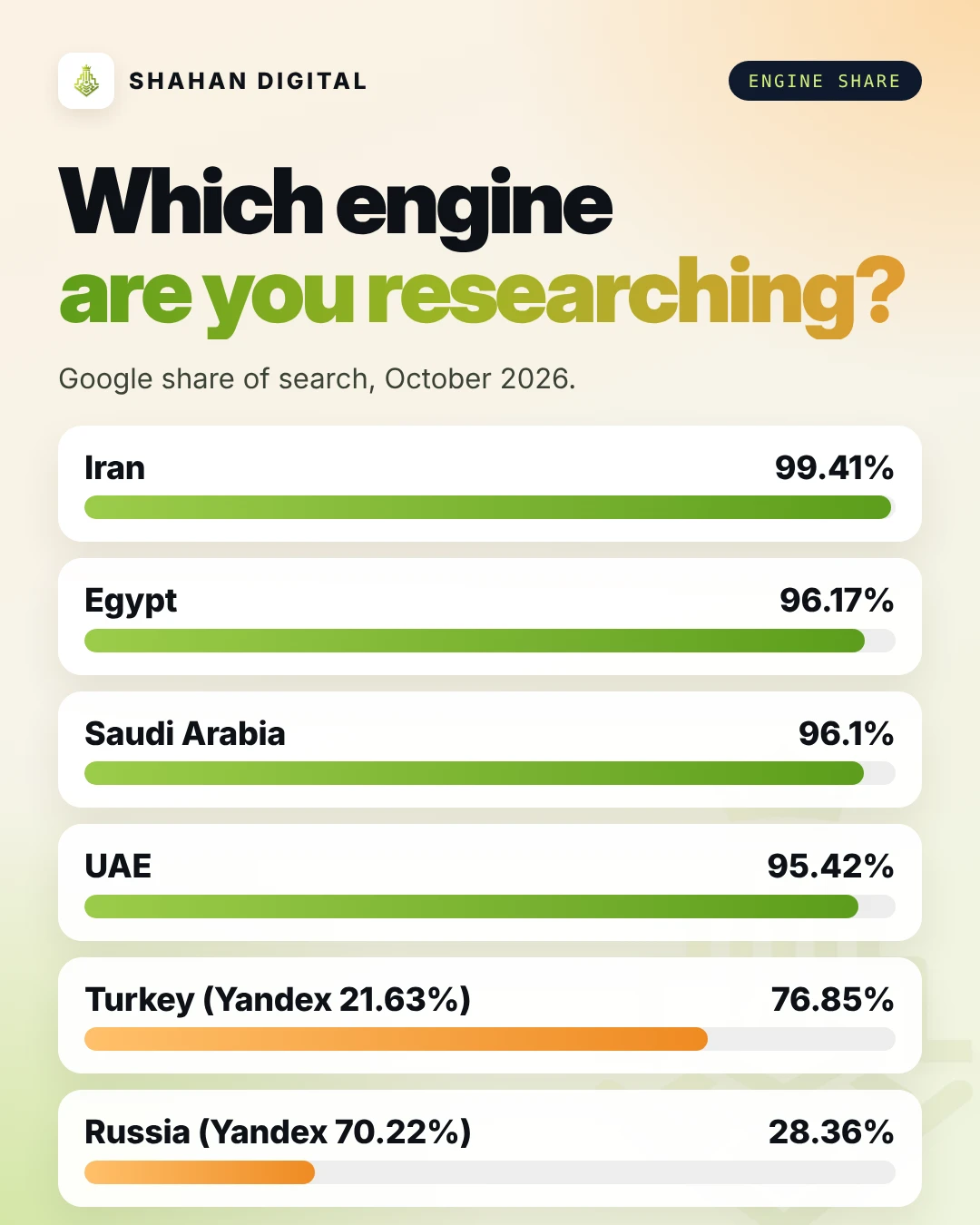
Google is the main target in most of the markets we work in, but not all of them. Statcounter’s October 2026 figures make the difference clear.
| Country | Second engine | What it means for research | |
|---|---|---|---|
| Iran | 99.41% | Bing 0.49% | Google data is the main source |
| Egypt | 96.17% | Bing 2.42% | Google data is the main source |
| Saudi Arabia | 96.10% | Bing 2.69% | Google data is the main source |
| United Arab Emirates | 95.42% | Bing 2.71% | Google data is the main source |
| Turkey | 76.85% | Yandex 21.63% | Check Yandex results for priority terms |
| Russia | 28.36% | Yandex 70.22% | Research Yandex first |
Source: Statcounter Global Stats, search engine market share by country, October 2026. Statcounter measures page views on sites that use its tracking code, so treat these as indicators rather than census figures.
How to do multilingual keyword research, step by step
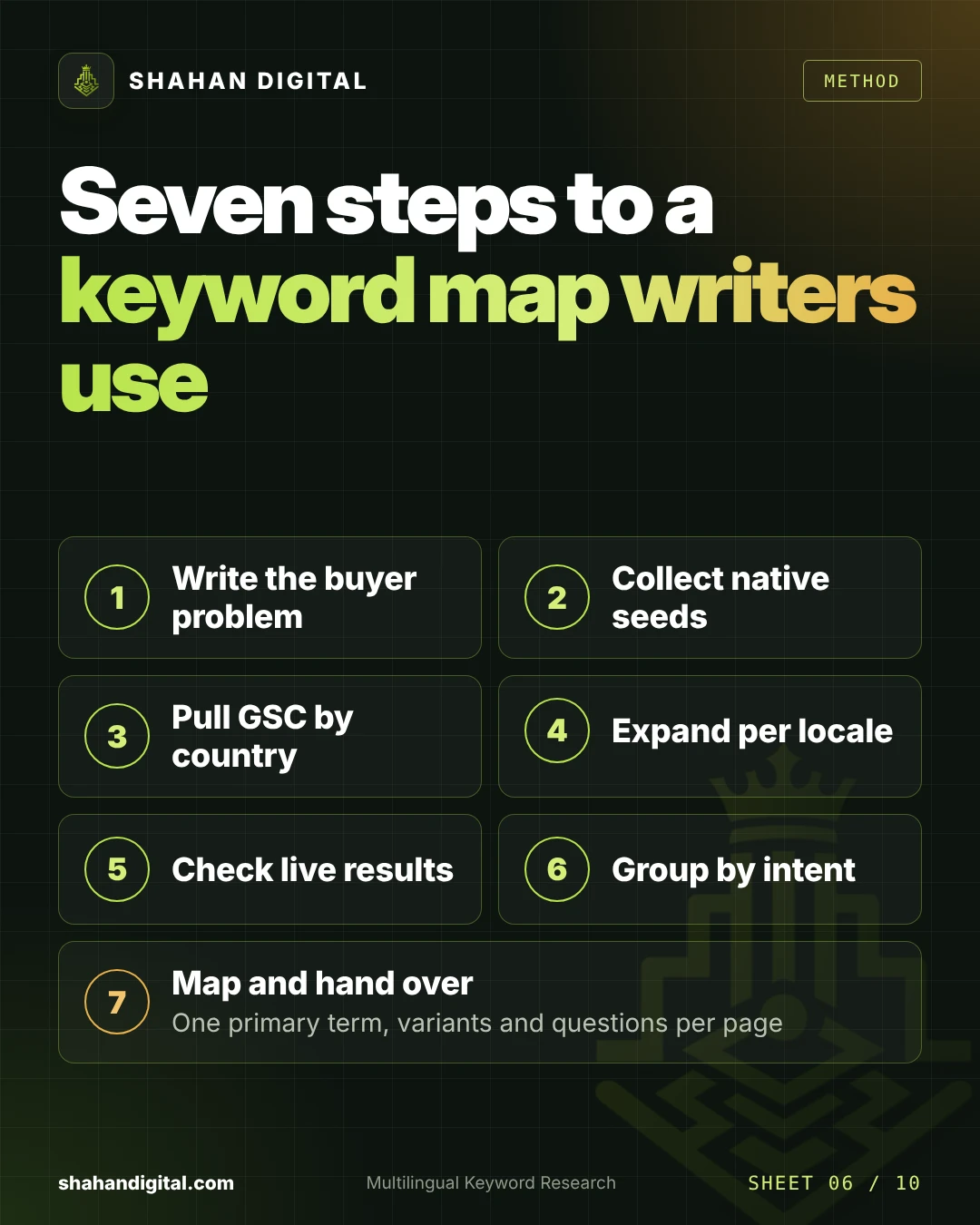
- Write the buyer problem in plain words. Not “SEO services” but “my shop gets visits from Kuwait and no orders”.
- Collect native seeds. Ask native speakers, sales staff and customers how they would describe the problem. Read local forums, reviews and competitor pages.
- Pull your own data. Export Search Console queries filtered by country. Look for queries in scripts and languages you never wrote for.
- Expand with tools, per locale. Set location and language explicitly. Note the tool, the setting and the date beside every volume.
- Check the live results. Search each priority term from the target country where possible. Record what ranks: directories, local agencies, videos, AI answers, maps.
- Group by intent, not by word. Two spellings that show the same results belong on one page. Two phrasings with different results may need two pages.
- Map and hand over. Give writers one primary term, variants and the questions each page must answer, in their language.
Rank checking needs the same care. Results differ by location, language and device, which we explain in our guide to checking competitor rankings by market.
Tools and their limits for keyword research in other languages
Every keyword tool is weaker outside English. Volumes for small languages and small countries are often zero, rounded or missing. That does not mean nobody searches.
Google’s own tool is honest about this. Keyword Planner’s “average monthly searches” is the average for a keyword and its close variants, based on the month range, location and network settings you choose, and Google notes that the search volume statistics are rounded, so totals for several locations may not add up (Google Ads Help, checked 23 November 2026). You also choose the language and the locations explicitly when you refine ideas (Google Ads Help on refining keyword ideas).
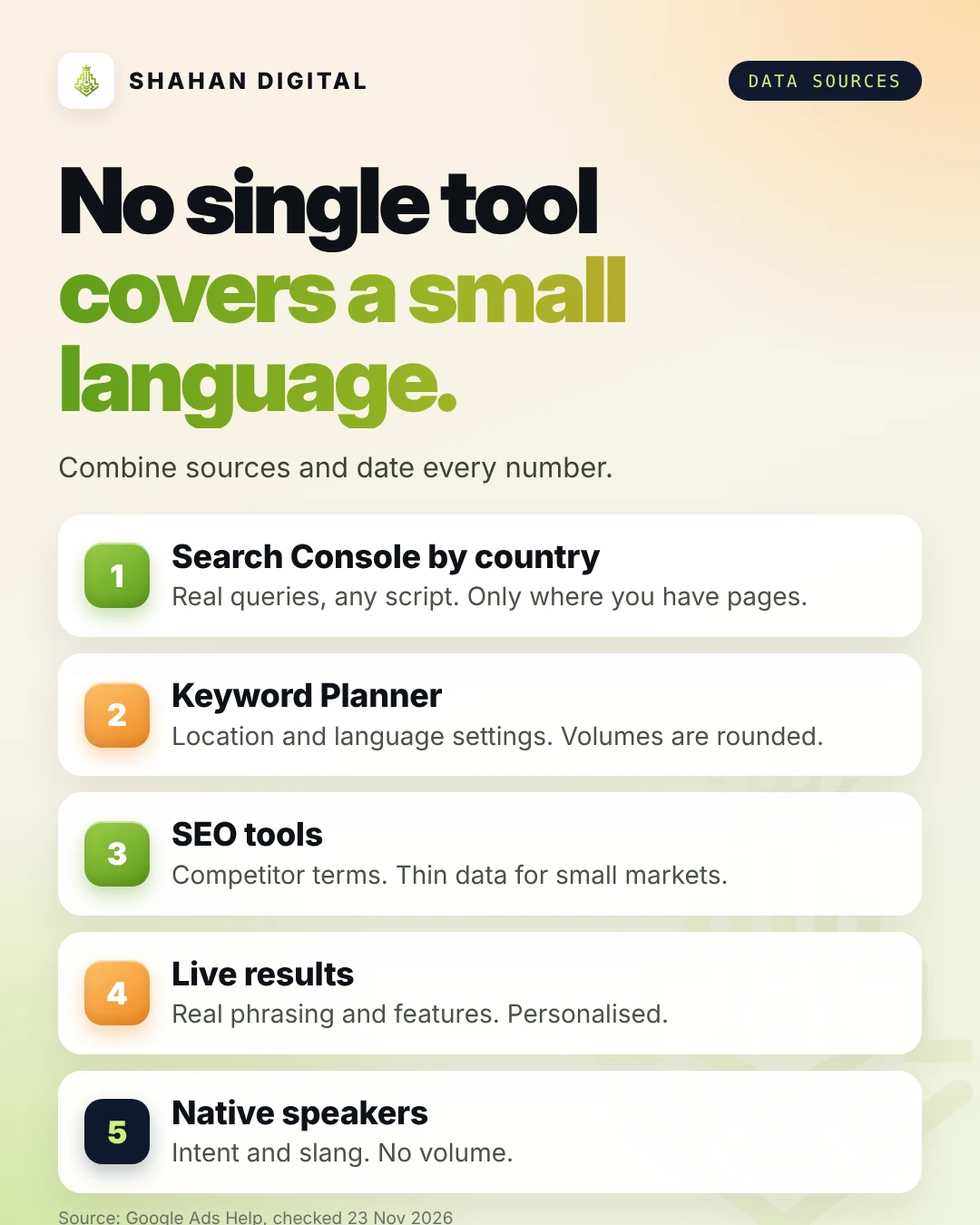
| Source | Good for | Limit |
|---|---|---|
| Google Search Console by country | Real queries you already appear for, any script | Only shows demand where you already have pages |
| Google Keyword Planner | Volume ranges by location and language | Rounded, grouped close variants, needs an Ads account |
| Third-party SEO tools | Competitor keywords, difficulty, idea expansion | Thin databases for small languages and countries |
| Live results and autocomplete | Real phrasing, results-page features | Personalised by location and history |
| Native speakers and sales calls | Intent, slang, script habits | No volume, needs careful notes |
Decision aid: how deep should your multilingual keyword research go?
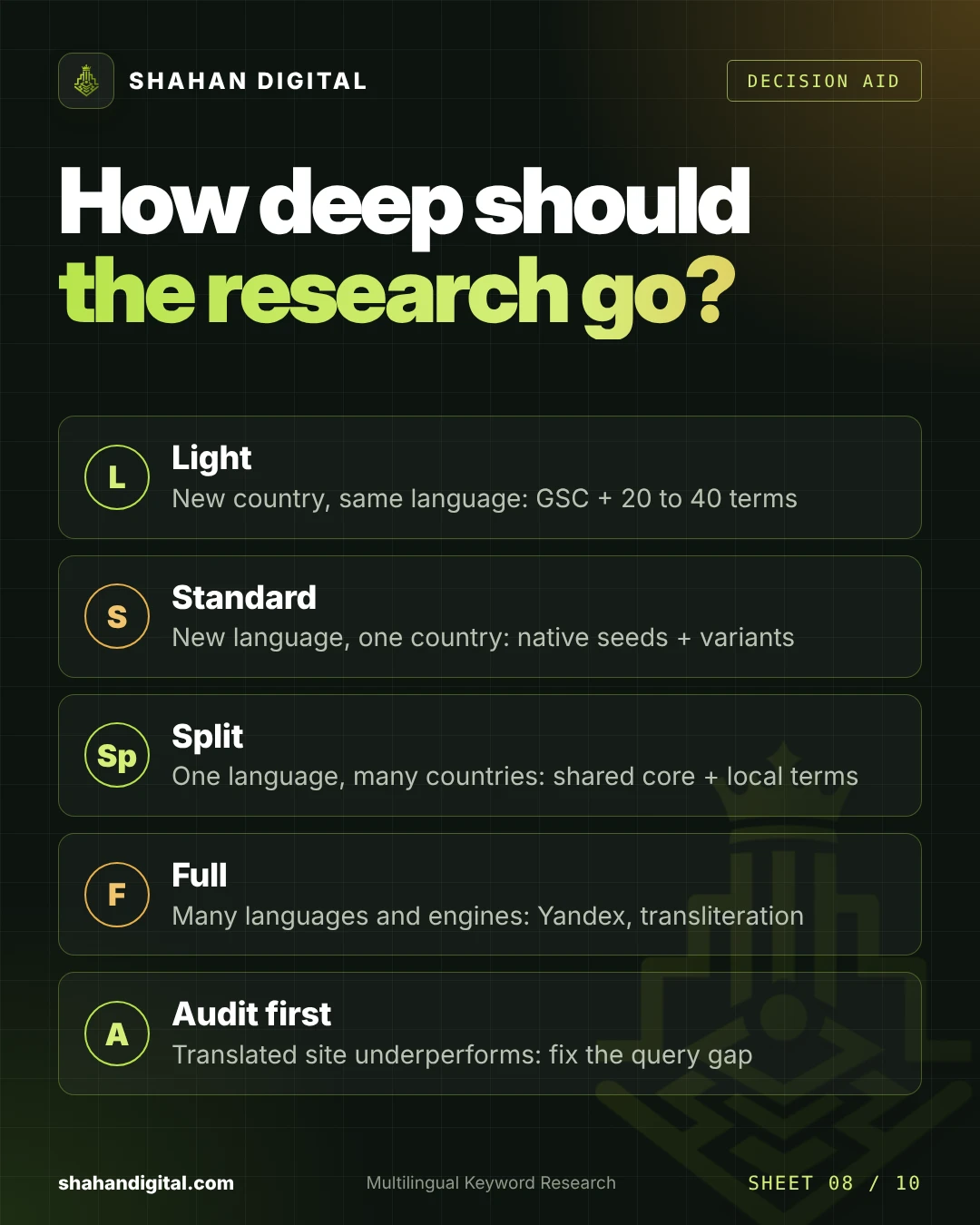
Not every market deserves a full study. This decision aid matches research depth to the situation. It is our own framework, built from the patterns above.
| Your situation | Research depth | What it includes | Main output |
|---|---|---|---|
| Testing one new country in a language you already use | Light | Search Console by country, 20 to 40 priority terms, live results check | Updated page plan for existing pages |
| New language, one country | Standard | Native seeds, tool expansion per locale, script variants, competitor pages | Keyword map for 5 to 15 pages |
| One language across several countries (for example Arabic in the Gulf and Egypt) | Split | Shared core plus country-specific vocabulary and results checks | Shared map plus country variants and hreflang plan |
| Several languages and engines (for example Turkish, Russian and Azerbaijani) | Full | Everything above, Yandex checks, transliteration tests, native review | Market-by-market map, priorities and measurement plan |
| Translated site that underperforms | Audit first | Query gap between page wording and real searches by country | Fix list for existing pages before new content |
Not sure which depth you need? Send us your website, the countries and languages you want to grow in, and what your buyers should do on the site. We will tell you where the first research hours should go. Contact us or message us on WhatsApp.
What multilingual keyword research services cost
We did not find many providers that publish a price for multilingual keyword research on its own. Most quote per project or include it in an international SEO retainer. The benchmarks below give a dated frame of reference.
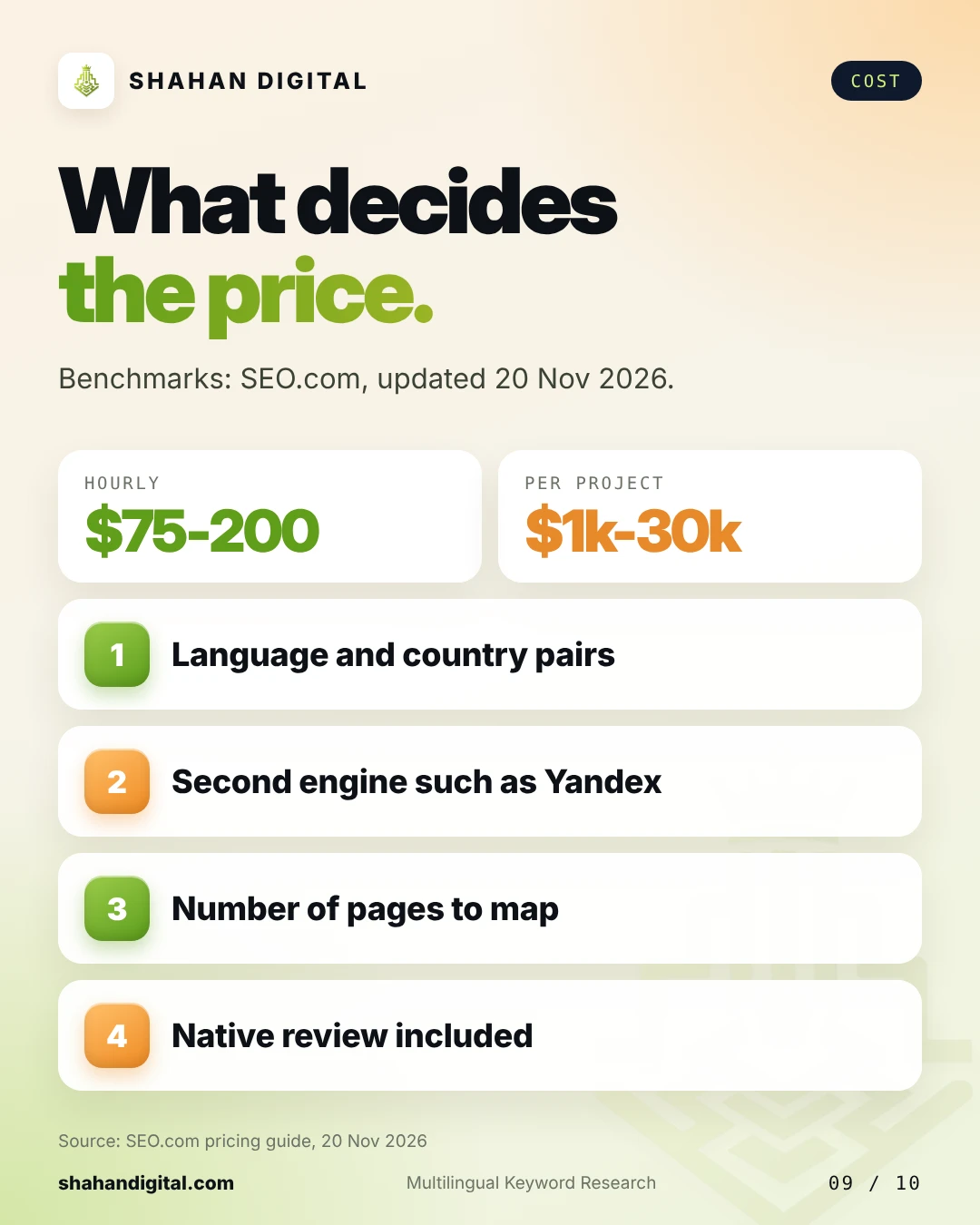
| Benchmark | Price | Source and date |
|---|---|---|
| Professional SEO, hourly | $75 to $200 per hour | SEO.com pricing guide, updated 20 November 2026 |
| SEO projects | $1,000 to $30,000 per project | SEO.com, updated 20 November 2026 |
| International SEO retainer | $3,000 to $20,000 per month | SEO.com, updated 20 November 2026 |
| Shahan Digital multilingual research | Scoped quote | Depends on languages, countries, engines and page count |
Source: SEO.com, How Much Does SEO Cost?, last updated 20 November 2026. These are US-market figures. What drives the price is the number of language and country pairs, whether a second engine such as Yandex is involved, how many pages need mapping and whether native review is included.
We reviewed the top results for multilingual keyword research
We reviewed the top English-language results for “multilingual keyword research” and “multilingual keyword research services” on 23 November 2026, from a non-personalised search. Several are useful, and we credit them here.
| Page | What it does well | What is missing for a buyer |
|---|---|---|
| Sitebulb (Veruska Anconitano) | Clear three-step method, culture and intent, Amazon and Rakuten examples; updated March 2026 | No guidance on scripts in Arabic, Persian or Turkish, and no help deciding how deep to go |
| BeTranslated | Clear deliverables per language: intent classification, competitor gap, People Also Ask mining | No published price and little on how results are checked per country |
| Linguise | Agency workflow, Keyword Planner settings, local engines such as Yandex and Naver | Few dated figures; written for agencies rather than the business buying the work |
| Welocalize | Five common pitfalls, clearly explained, including direct translation | No search engine share data and no market examples outside major languages |
| Semrush | Full multilingual SEO process from markets to hreflang and links | Keyword research is one short step, centred on its own tool |
The gap we saw: none of these pages helps a decision-maker choose research depth, and none deals with Arabizi, Finglish, Cyrillic Tajik or Turkish character dropping. This guide tries to fill that gap.
Choose a provider: checklist
- Do native speakers of each target language do or review the research, not only translate it?
- Do they split findings by language and country pair?
- Do they check the live results from each target country?
- Do they record the tool, setting and date for every volume?
- Do they test script and spelling variants?
- Do they check a second engine where it matters, such as Yandex in Turkey and Russia?
- Will they start from your Search Console data by country?
- Does the output map keywords to pages, with briefs writers can use?
If you are still choosing a team for the whole project, our SEO audit service guide explains what a first review should check, including international set-up.
“Two spellings belong on one page when Google shows the same results for both. If the top ten change, the intent has changed, and we test a separate page or section. We decide that from the results page in the target country, not from the dictionary.”
Shahan Behkamrad, Founder of Shahan Digital
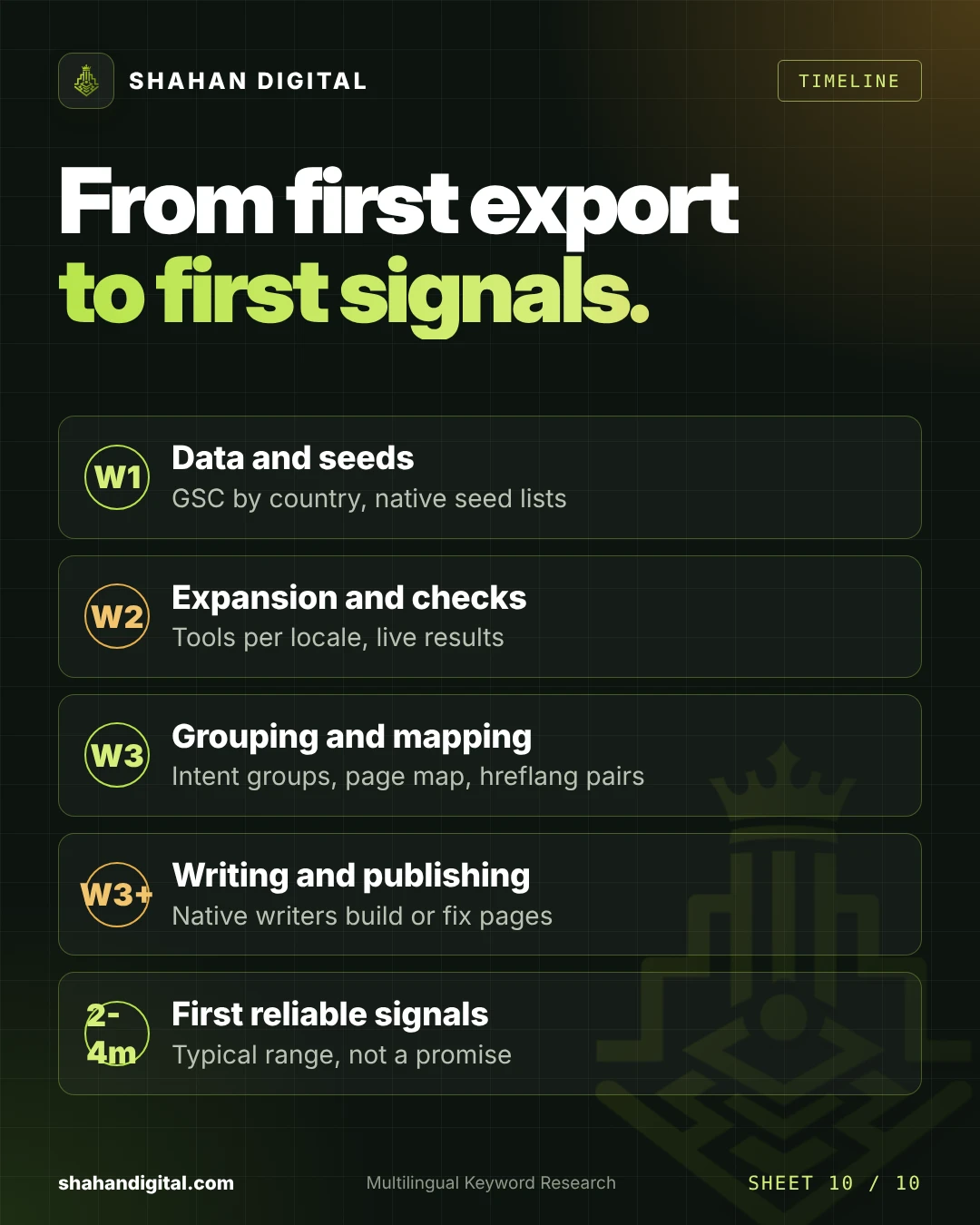
Timeline: what to expect
| Phase | Typical duration | What happens |
|---|---|---|
| Data and seeds | Week 1 | Search Console export by country, native seed lists, buyer interviews |
| Expansion and results checks | Weeks 1 to 2 | Tool expansion per locale, live results checks, script variants |
| Grouping and mapping | Weeks 2 to 3 | Intent groups, page map, hreflang pairs |
| Writing and publishing | From week 3 | Native writers produce or fix pages |
| First reliable signals | Often 2 to 4 months after publishing | Impressions and queries by country start to show whether the map was right |
These are typical ranges for a small set of markets, not a promise. Competition, site history and how fast pages get crawled all change them. Our guide on how long SEO takes explains what moves those timelines.
How to measure whether the keyword research worked
- Impressions and clicks by country and language: filter Search Console by country and compare queries before and after.
- Share of target terms in local script: are you now appearing for the native and transliterated variants you mapped?
- Enquiries by market: forms, calls and WhatsApp messages tagged by country and language.
- Wrong-market traffic: impressions from countries you cannot serve should fall as a share of the total.
Our guide to measuring SEO success covers baselines and reporting in more detail.
How we work on multilingual keyword research
Shahan Digital works across English, Arabic, Persian and Turkish, with native writers for each target country. We start from your Search Console data by country, then build native seed lists, check live results per market and hand over a keyword map with briefs. When the research shows real demand, we can carry it into page builds and technical set-up through our international SEO services, or into Arabic markets through our Arabic SEO services. You can see our full range on the services page, and the writing side in our SEO content writing guide. The research is led by Shahan Behkamrad.
We can do the research only, guide your in-house team through it, or run the whole project. We do not promise rankings. We do promise to show you the data behind every recommendation.
Multilingual keyword research FAQ
What is multilingual keyword research?
It is research into what people type in each language and country you target, including script and spelling variants, intent and competition. It replaces translating an English keyword list with native, market-specific research.
Can I just translate my English keywords?
You can use translations as seeds, but not as the final list. Translated terms are often correct but rarely searched, and they miss loanwords, Latin-script spellings and mixed-language queries.
Do I need separate research for each country that speaks the same language?
Often yes. Arabic, Persian, Russian and Spanish all vary by country in vocabulary and results. Start with a shared core and add country-specific terms where the live results differ.
How accurate are keyword volumes in other languages?
Treat them as rough. Google rounds Keyword Planner volumes and groups close variants, and third-party tools have thin data for small languages. Combine tools with your own Search Console data.
Should I research Yandex as well as Google?
Only where people use it. In October 2026 Statcounter put Yandex at about 22% in Turkey and 70% in Russia, but under 2% in Saudi Arabia, the UAE and Egypt.
How much does multilingual keyword research cost?
It depends on the number of language and country pairs, engines and pages. As a reference, SEO.com lists SEO projects at $1,000 to $30,000 and international SEO retainers at $3,000 to $20,000 per month (updated 20 November 2026). We give a scoped quote.
Ready to find the words your next market actually uses? Tell us your website, the countries and languages you want to grow in, and the result you need. We will scope the research around your biggest question. Request a free review, contact us or message us on WhatsApp.
Editorial note: Last reviewed 23 November 2026. Search engine shares are from Statcounter (October 2026). Google guidance was checked on the pages linked above on 23 November 2026. Shahan Digital observations come from our own Search Console data for shahandigital.com, with the dates given; they describe one site and are not market statistics. Prices are third-party benchmarks with their own dates. Nothing here is a promise of rankings or results.
Written by
Shahan Behkamrad
Author · Founder of Shahan Digital · SEO & GEO Strategist
Shahan Behkamrad is an SEO and GEO strategist and the founder of Shahan Digital. Since 2017 he has built search strategies for businesses in Persian, Arabic, English and Turkish markets, usually working alongside a client’s in-house team to decide what to fix first, what to build next and how to measure it.
- Strategy before tactics: every engagement starts with a diagnosis of where growth is being lost, then a ranked plan tied to enquiries and revenue, not to rankings alone.
- Current with how search works now: his work covers Google Search, Google Maps, AI Overviews and AI assistants such as ChatGPT, and he checks Google’s documented updates before changing a client’s plan.
- Specialist depth: technical, international and multilingual SEO, local SEO and AI search visibility (GEO).
- Has trained more than 650 students in SEO and digital marketing, including as an official instructor at Iran’s Technical and Vocational Training Organization.
- Host of the Shahan Behkamrad Podcast on business growth, branding, SEO and AI.
- Master’s student in Strategic Marketing and Brand Management at Nişantaşı University, Istanbul; holds 25+ international digital marketing certifications.