Arabic SEO is the practice of optimizing a website for Arabic-language search. It is fundamentally different from translating an English site. Arabic includes many regional varieties, multiple common spellings, and a right-to-left writing system, while search vocabulary can change significantly between markets such as Saudi Arabia, the UAE, and Egypt. If your focus is the Emirates specifically, our work as an SEO company in Dubai covers that market directly. Treat Arabic as a translation project and you risk building pages that read correctly but match little of the demand that actually exists.
That is the short version, and it is also the mistake that costs businesses the most money in this market. This guide covers what makes Arabic SEO genuinely different, the linguistic and technical traps that catch even experienced teams, how to research Arabic keywords properly, and how to decide whether Arabic belongs in your strategy at all.
What Arabic SEO actually means
At its simplest, Arabic SEO is search engine optimization performed for Arabic-speaking audiences: Arabic keyword research, Arabic content, and the technical configuration that lets search engines correctly crawl, understand, and serve right-to-left pages.
The distinction that matters is between translation and optimization. Translation converts your existing English page into Arabic words. Arabic SEO starts from a different question: what do Arabic speakers in this specific market actually type into Google, and what answer are they looking for? Those two processes produce very different pages, and only the market-informed version is designed around real search demand.
The Arabic SEO opportunity is substantial. Arabic is one of the world’s most widely used languages, used daily by more than 400 million people according to UNESCO, and its audience spans multiple countries, regional varieties, and highly distinct commercial markets. The Gulf markets in particular combine high internet penetration with strong purchasing power.
Arabic also remains underrepresented online relative to the size of its audience. W3Techs currently identifies Arabic as the content language of only a small share of websites, while English accounts for close to half. This can create meaningful opportunities in some markets and industries, but competition must still be evaluated at the level of each query, country, and search intent.
![[Arabic SEO is the practice of optimizing a website for Arabic-language search. It is fundamentally different from translating an English site. Arabic includes many regional varieties, multiple common spellings, and a right-to-left writing system, while search vocabulary can change significantly between markets such as Saudi Arabia, the UAE, and Egypt. If your focus is the Emirates specifically, our work as an SEO company in Dubai covers that market directly. Treat Arabic as a translation project and you risk building pages that read correctly but match little of the demand that actually exists. That is the short version, and it is also the mistake that costs businesses the most money in this market. This guide covers what makes Arabic SEO genuinely different, the linguistic and technical traps that catch even experienced teams, how to research Arabic keywords properly, and how to decide whether Arabic belongs in your strategy at all.]](https://shahandigital.com/wp-content/uploads/2026/07/Arabic-SEO-is-the-practice-of-optimizing-a-website.webp)
Why Arabic SEO is not translation
This is the central point of Arabic SEO, so it is worth being concrete about why direct translation fails.
One English term may map to several valid Arabic terms
An English keyword may correspond to several legitimate Arabic expressions, each with different regional usage, formality, and search demand. A translation tool selects a linguistically possible term. Keyword research reveals which variants the intended audience actually uses. Choosing the wrong variant can produce a technically correct page that matches far less of the real search demand than expected.
Arabic SEO in practice: one concept, several markets
Abstract warnings about Arabic SEO variation are easy to nod along to and hard to act on. Here is an illustrative example of how the same commercial concept, “SEO company,” may be expressed across three Arabic-speaking markets. The examples demonstrate the types of linguistic and intent variation that should be validated with live keyword and SERP data before targeting.
| Market | Common expression | Register | Typical intent |
|---|---|---|---|
| Saudi Arabia | شركة سيو | Transliterated, informal | Commercial |
| Saudi Arabia | شركة تحسين محركات البحث | Full MSA | Commercial / informational |
| Saudi Arabia | أفضل شركة سيو في السعودية | Transliterated + qualifier | Comparison, high commercial |
| UAE | شركة سيو في دبي | Transliterated + city | Local commercial |
| UAE | SEO company Dubai | English | Local commercial |
| UAE | شركة SEO | Mixed Arabic/Latin | Commercial |
| Egypt | شركة تسويق إلكتروني | MSA, broader category | Commercial, wider scope |
| Egypt | تحسين ظهور الموقع في جوجل | Descriptive MSA | Informational |
Each of these markets behaves differently in practice, which is why we approach work as an SEO company in Riyadh differently from work in the Emirates or Egypt. Several things are visible here that a translation tool would never surface. The transliterated form (سيو) and the full MSA translation (تحسين محركات البحث) coexist and are not interchangeable in volume or intent. UAE searches frequently include the city, and often appear in English or mixed script. Egyptian searches lean toward a broader service category rather than the specific term, and the descriptive phrasing signals informational rather than buying intent.
The practical consequence is that these are not variants of one keyword to place on one page. Some deserve separate commercial pages, some belong in supporting content, and some should not be targeted at all. That decision requires validating real demand and examining the live search results in each target country. Treat the table above as a model of the variation you should expect, not as a list of volumes, since volumes differ by market and change over time and must be checked against current data for your sector.
Mixed Arabic-English search behavior in Gulf SEO
Gulf markets add a complication most Arabic SEO guides ignore: many users search bilingually, and not always predictably. The same person may type the service name in English and the location in Arabic, keep brand names in Latin script, or search the same need in both languages on different occasions. Mixed-script forms such as شركة SEO or SEO في دبي can appear in multilingual Gulf search behavior and should be investigated rather than excluded from keyword research.
This matters because the assumption that each user belongs to exactly one language is not accurate in multilingual markets. Bilingual users do not necessarily search in the language of their device or interface settings. Planning Arabic and English as two sealed audiences will miss a meaningful share of how people actually search.
Many regional varieties, not one Arabic
Modern Standard Arabic (MSA) is the formal written standard used across media, education, and official communication. It is widely understood, which makes it a sensible default for formal content. But daily speech, and often daily search, happens in regional varieties: Gulf, Egyptian, Levantine, and North African among them, each with substantial internal variation. The exact number of dialects depends on how they are classified, but the practical point holds regardless.
The practical consequence is that a searcher in Saudi Arabia and a searcher in Egypt may use completely different words for the same service. Targeting one market with the other’s vocabulary produces content that reads as foreign, even when it is grammatically perfect.
Spelling variation changes keyword research and content decisions
Arabic users may type both formal and simplified spellings of the same word, including variations involving hamza, such as أ versus ا. These forms should be reviewed in keyword tools, in the actual search results, and in Search Console data.
They should not automatically be treated as separate page targets when the search intent and the results substantially overlap. The goal is natural coverage of the linguistic forms your audience uses, not repetition of every spelling variant on one page.
Rich morphology complicates matching
Arabic is highly inflectional. Words change form based on grammatical role, number, gender, and attached prefixes and suffixes. A single root can generate dozens of surface forms. This makes simple keyword matching less reliable than in English, and it means content needs to cover natural variations rather than repeating one exact string.
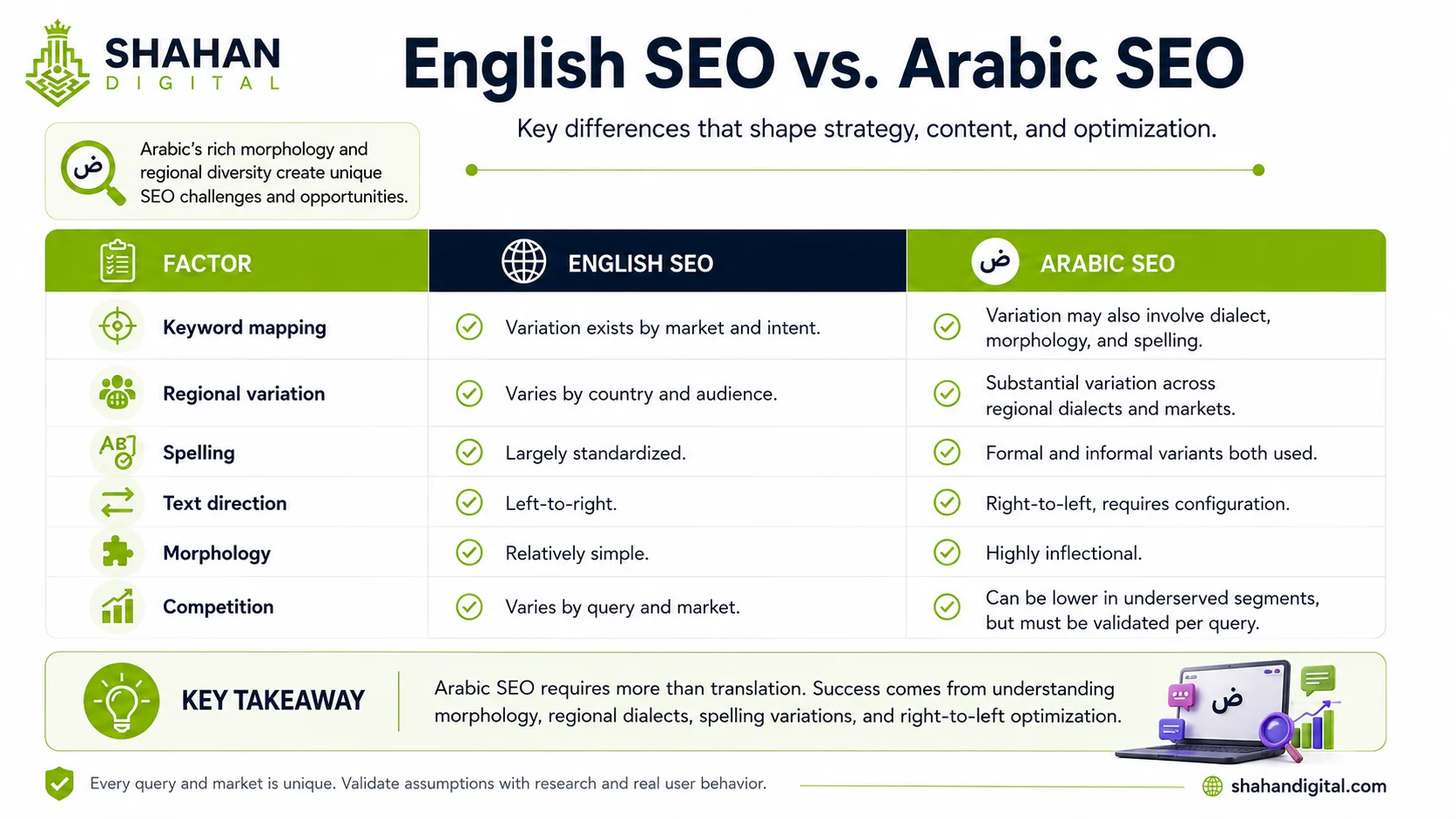
| Factor | English SEO | Arabic SEO |
|---|---|---|
| Keyword mapping | Variation exists by market and intent | Variation may also involve dialect, morphology, and spelling |
| Regional variation | Varies by country and audience | Substantial variation across regional dialects and markets |
| Spelling | Largely standardized | Formal and informal variants both used |
| Text direction | Left-to-right | Right-to-left, requires configuration |
| Morphology | Relatively simple | Highly inflectional |
| Competition | Varies by query and market | Can be lower in underserved segments, but must be validated per query |
The technical side of Arabic SEO
Arabic SEO introduces technical requirements that English-only sites never encounter. Getting these elements wrong can produce broken layouts, poor accessibility, incorrect language targeting, and inconsistent search presentation regardless of content quality.
Right-to-left configuration for Arabic SEO
Arabic reads right to left, and supporting it properly means more than mirroring a layout. For an Arabic document, use <html lang="ar" dir="rtl">. The dir attribute establishes the page’s default text direction, while lang supports accessibility and correct language handling by browsers and assistive technologies.
These attributes do not replace Arabic content or hreflang. In its guidance on multi-regional and multilingual sites, Google states that it uses the visible content of a page to determine its language and does not use code-level information such as lang attributes or the URL. Beyond the declaration, this is technical SEO work: CSS needs deliberate handling of margins, padding, alignment, and iconography, since simply flipping a left-to-right design usually produces awkward results.
Mixed-language content is a frequent breaking point. Arabic pages routinely include English brand names, product codes, or numerals, and poorly configured pages render these in the wrong order or position. For these cases, targeted use of <bdi>, dir="ltr", or dir="auto" handles bidirectional text correctly, as set out in W3C’s guidance on inline bidirectional markup. Test any page that mixes scripts before publishing.
Hreflang and site structure for multilingual SEO
If you serve both Arabic and English, hreflang tells Google the relationship between your language versions so it can serve the appropriate one. Google’s documentation on localized versions covers implementation.
Two requirements are easy to miss. Each localized page should reference itself and every corresponding language or regional version. And the relationship must be reciprocal: if the English page identifies the Arabic page as an alternate, the Arabic page should identify the English page as well. Incomplete or one-directional annotations may simply be ignored.
It is also worth being clear about what hreflang does not do. It helps Google understand the relationship between localized URLs. It does not translate the page, determine its language, consolidate weak content, or guarantee that a specific version will always be shown.
You also need a structural decision: subdirectory (/ar/), subdomain, or a country-code domain. A subdirectory such as /ar/ is often easier to manage when several language versions share one brand and domain. A country-code domain such as .sa or .ae provides a strong country signal, but it targets a country rather than the Arabic language as a whole, and it requires maintaining a separate web property. Our guide to international SEO covers the trade-offs in more depth.
URLs, metadata, and structured data in Arabic SEO
Arabic and transliterated Latin URLs can both be used. Google supports non-ASCII characters when URLs are encoded correctly, so transliteration is a management and usability choice rather than an SEO requirement. Choose a stable, readable structure that your CMS, analytics tools, and users can handle consistently, rather than assuming Latin slugs carry an inherent ranking advantage.
Title tags and meta descriptions should be written in Arabic rather than translated, and headings need to follow RTL structure correctly.
Structured data uses the same schema vocabulary in every language. On an Arabic page, human-readable text fields such as the headline and description should normally match the visible Arabic content. Do not translate schema property names or required enumerated values, and do not add information that users cannot see on the page.
How to do Arabic keyword research
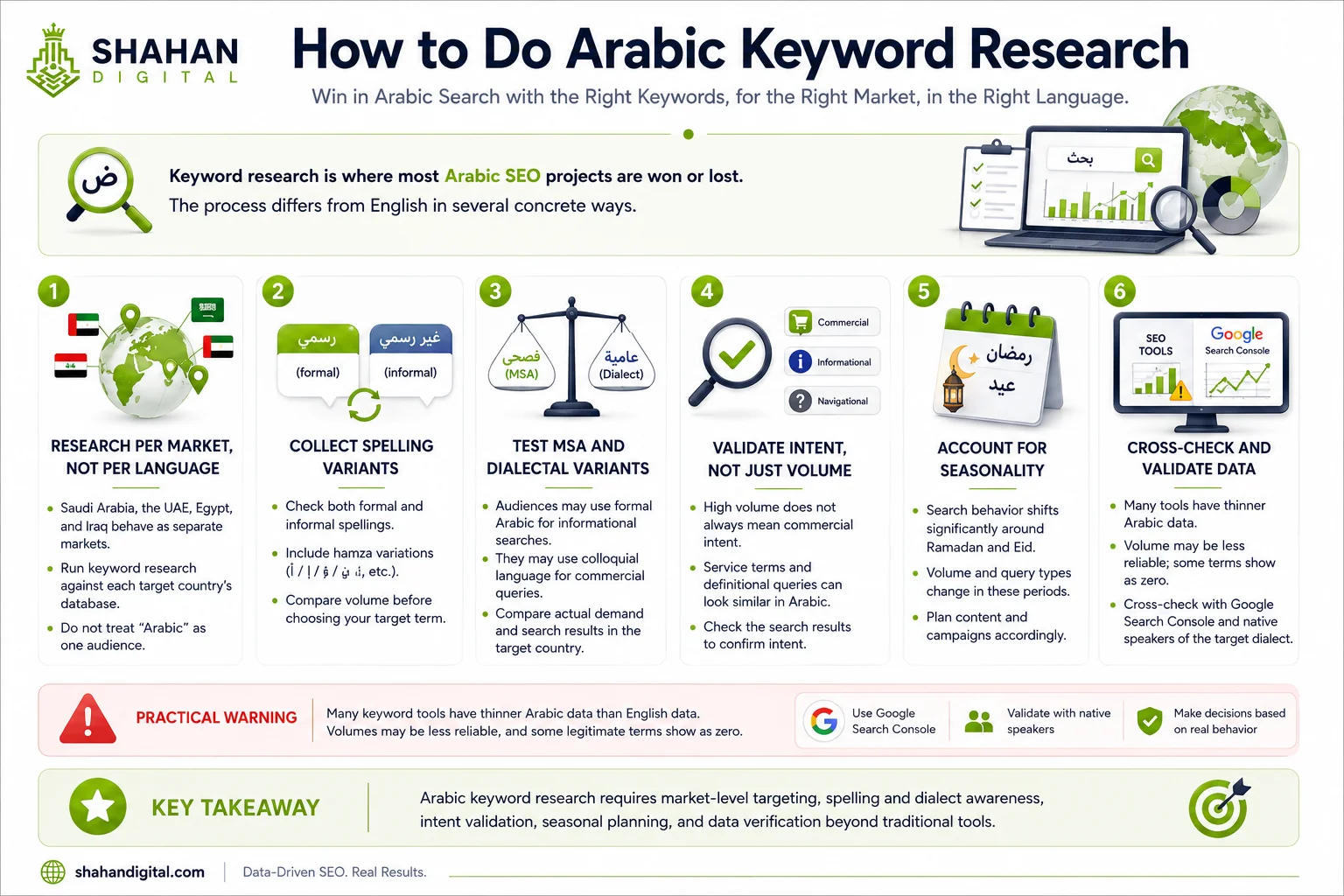
Keyword research is where most Arabic SEO projects are won or lost. The process differs from English in several concrete ways.
- Research per market, not per language. Saudi Arabia, the UAE, Egypt, and Iraq behave as separate markets. Run keyword research against each target country’s database rather than treating “Arabic” as one audience.
- Collect spelling variants. For each core term, check both formal and informal spellings, including hamza variations, and compare volume before choosing.
- Test MSA and dialectal variants. Some audiences use formal Arabic for professional or informational searches, while others use colloquial language even for commercial queries. Compare actual demand and search results in the target country rather than assigning one register to an entire business category.
- Validate intent, not just volume. A term with high volume may be informational when you assumed it was commercial. This is especially common in Arabic, where a service term and a definitional query can look similar.
- Account for seasonality. Search behavior across Arabic markets shifts significantly around Ramadan and Eid, both in volume and in the type of query.
One practical warning: many keyword tools have thinner Arabic data than English data. Volumes may be less reliable, and some legitimate terms show as zero. Cross-check with Google Search Console data and, where possible, with people who actually speak the target dialect.
Arabic SEO content that works
Once your Arabic SEO keywords are right, content still has to earn trust. High-quality Arabic content can demonstrate a deeper commitment to the market than a lightly translated page, particularly when terminology, examples, and user concerns are properly localized.
Practically, that means writing in the register your audience actually uses, which should be established from search data for that market rather than assumed. It means using local examples, local currency, and local regulatory context rather than generic international references. It means respecting cultural and religious norms in imagery, examples, and timing. And it means the content should answer questions Arabic speakers in that market actually ask, which is not always the same set of questions the English version answers.
The quality bar matters more than many teams expect. Because so much Arabic web content is machine-translated, genuinely well-written Arabic content stands out immediately, both to readers and in terms of engagement. It also matters increasingly for AI search optimization, since AI systems need content they can clearly access and understand before they can cite it, a point covered further below.
How to measure Arabic SEO separately
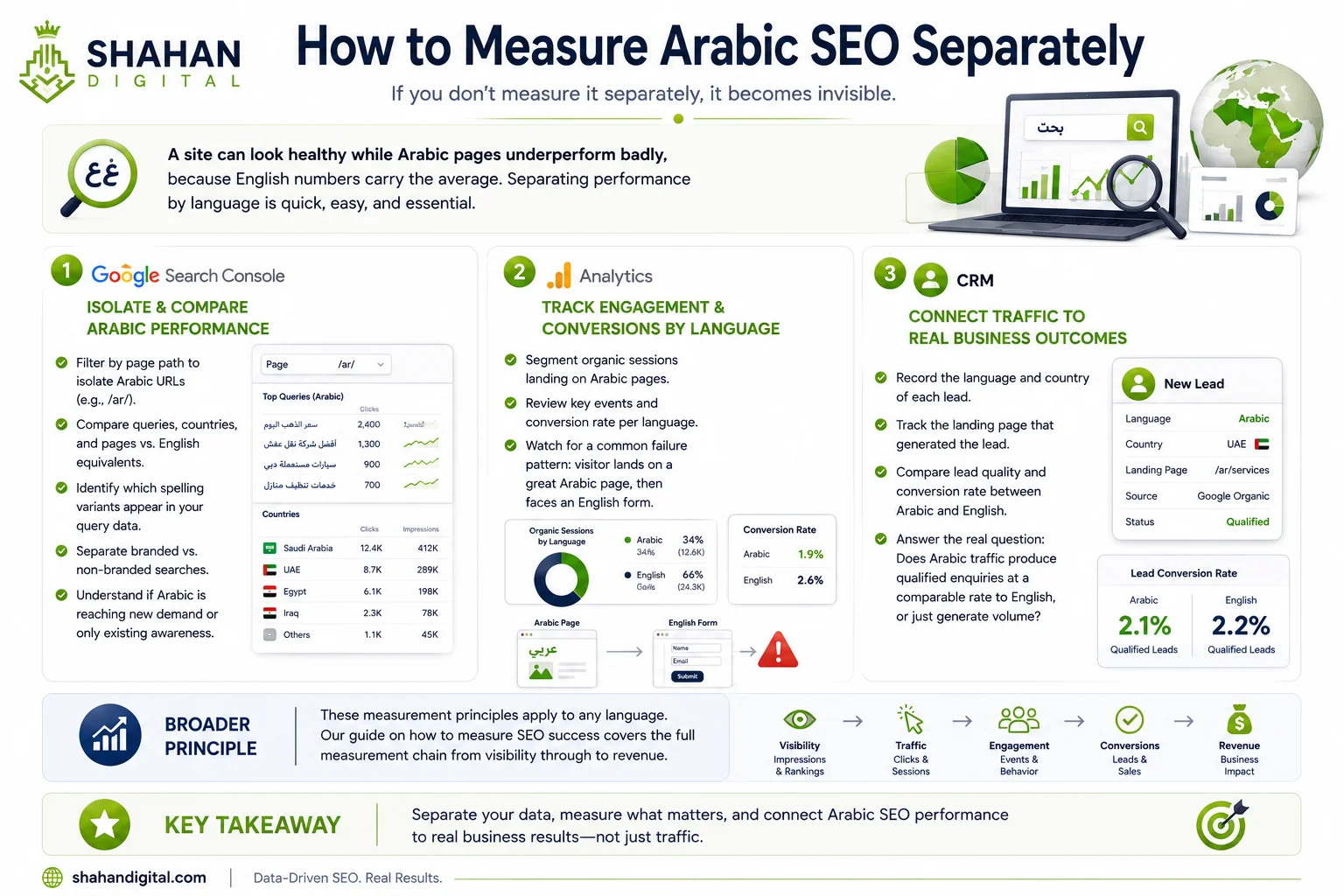
If Arabic SEO performance sits inside your overall reporting, it becomes invisible. A site can look healthy while its Arabic pages underperform badly, because English numbers carry the average. Separating the two is a reporting decision, and it takes minutes to set up.
In Search Console: filter by page path to isolate your Arabic URLs, such as /ar/, then compare query, country, and page performance against the English equivalents. Check which spelling variants actually appear in your query data, and separate branded from non-branded searches so you can tell whether Arabic is reaching new demand or only existing awareness.
In Analytics: segment organic sessions landing on Arabic pages, review key events and conversion rate per language, and watch for a common failure pattern where a visitor arrives on a well-written Arabic page and is then handed an English form.
In your CRM: record the language and country of each lead alongside the landing page. This is the only place you can answer the question that matters: does Arabic traffic produce qualified enquiries at a comparable rate to English, or is one language generating volume while the other generates revenue?
The broader principles behind this apply to any language, and our guide on how to measure SEO success covers the full measurement chain from visibility through to revenue.
Arabic AI search and GEO
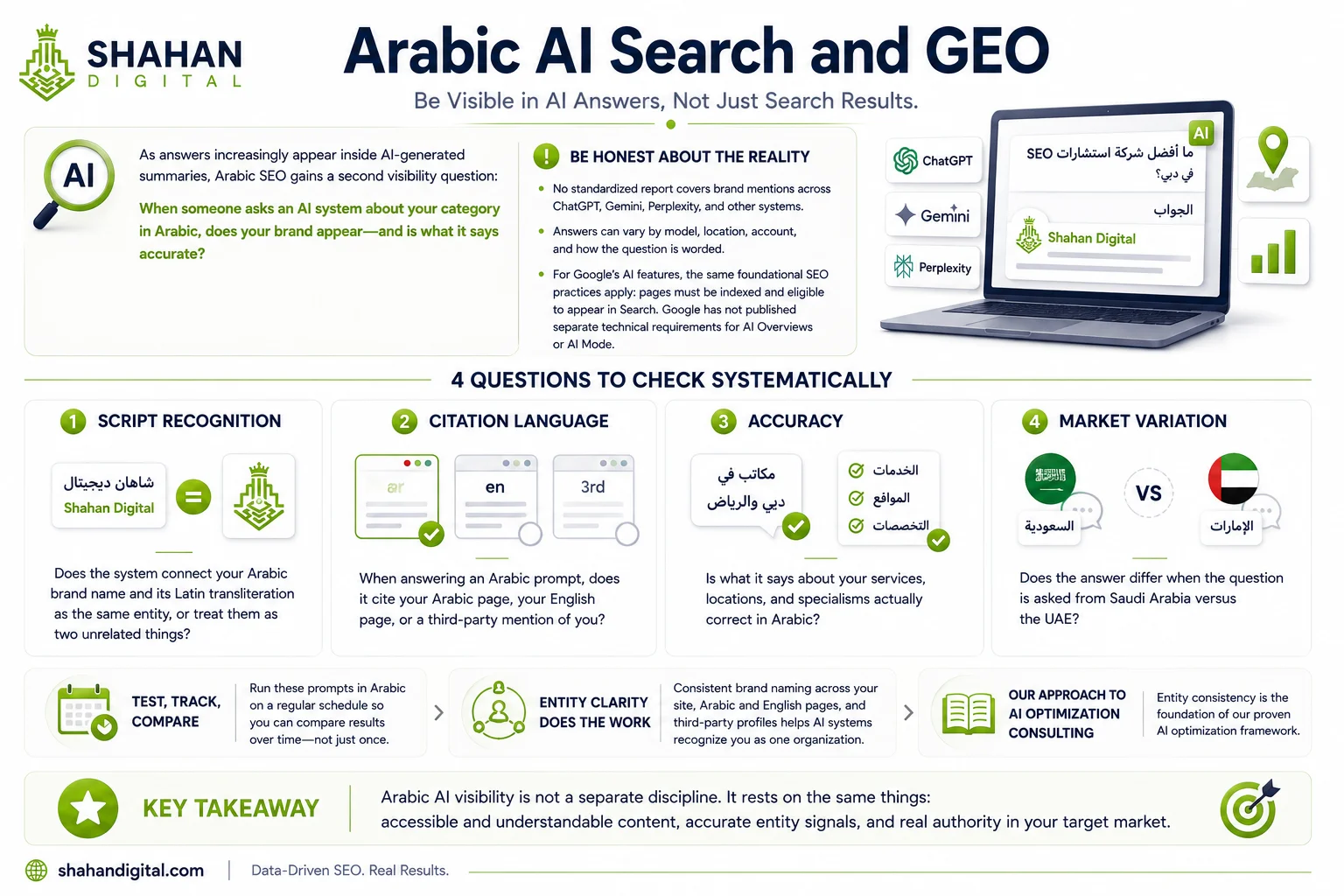
As answers increasingly appear inside AI-generated summaries, Arabic SEO gains a second visibility question alongside rankings: when someone asks an AI system about your category in Arabic, does your brand appear, and is what it says accurate?
This area is less settled than traditional search, and it is worth being honest about that. There is no standardized report covering brand mentions across ChatGPT, Gemini, Perplexity, and other systems, and answers can vary by model, location, account, and how the question is worded. For Google’s AI features specifically, the same foundational SEO practices apply: the page still needs to be indexed and eligible to appear in Search, and Google has not published separate technical requirements for AI Overviews or AI Mode.
What you can do is check systematically rather than anecdotally, the same way you would audit any other SEO signal. Four questions are worth answering for any brand operating in Arabic markets:
- Script recognition. Does the system connect your Arabic brand name and its Latin transliteration as the same entity, or treat them as two unrelated things?
- Citation language. When answering an Arabic prompt, does it cite your Arabic page, your English page, or a third-party mention of you?
- Accuracy. Is what it says about your services, locations, and specialisms actually correct in Arabic?
- Market variation. Does the answer differ when the question is asked from Saudi Arabia versus the UAE?
Run these against a fixed set of prompts, in Arabic, on a regular schedule, so results can be compared over time rather than judged from one-off checks. Entity clarity does much of the work here: consistent brand naming across your site, your Arabic and English pages, and third-party profiles makes it easier for any system to recognize you as one organization rather than several. That consistency is the same foundation described in our approach to AI optimization consulting.
The practical point is that Arabic AI visibility is not a separate discipline bolted onto Arabic SEO. It rests on the same things: content that can be accessed and understood, accurate and consistent entity signals, and genuine authority in the market you are targeting.
Common Arabic SEO mistakes
The same Arabic SEO errors appear repeatedly, and each one is avoidable.
Running the English site through translation. This often produces pages that match little of the market’s real search demand and can signal minimal localization effort to readers. It is the single most common failure.
Treating all Arabic markets as one. A single Arabic site targeting “the Arab world” competes poorly everywhere. Markets differ enough to warrant separate research, and often separate pages.
Ignoring spelling variants. Optimizing for the formal spelling while your audience types the informal one, or the reverse, costs traffic that was available.
Retrofitting RTL support. Adding Arabic to a site never designed for it usually produces layout problems that undermine credibility. Plan for it structurally.
Expecting authority to transfer automatically. Domain authority may support every language version, but search relevance does not transfer automatically. A site with strong English visibility may still need dedicated Arabic keyword research, localized content, internal linking, and regional authority before it can compete for Arabic searches.
From Shahan Digital projects
What we see in multilingual Arabic projects
Volume and intent diverge more in Arabic than in English. On multilingual projects targeting Arabic-speaking markets, we have repeatedly found that terms which look commercial by search volume mainly attract users seeking general information, while lower-volume terms produce the actual enquiries. Building an Arabic content plan from volume alone, without validating intent per market, commits months of work to the wrong demand.
Each language market runs on its own timeline. A brand with established English visibility can be starting close to zero in Arabic. Domain authority helps, but relevance in a new language market has to be built. Bilingual projects should be planned as two schedules, not one, and each follows its own version of the usual SEO timeline.
Note: These are observed patterns across specific client projects, not benchmarks or guarantees. Client identities are withheld for confidentiality, and results vary with market, competition, site condition, and implementation.
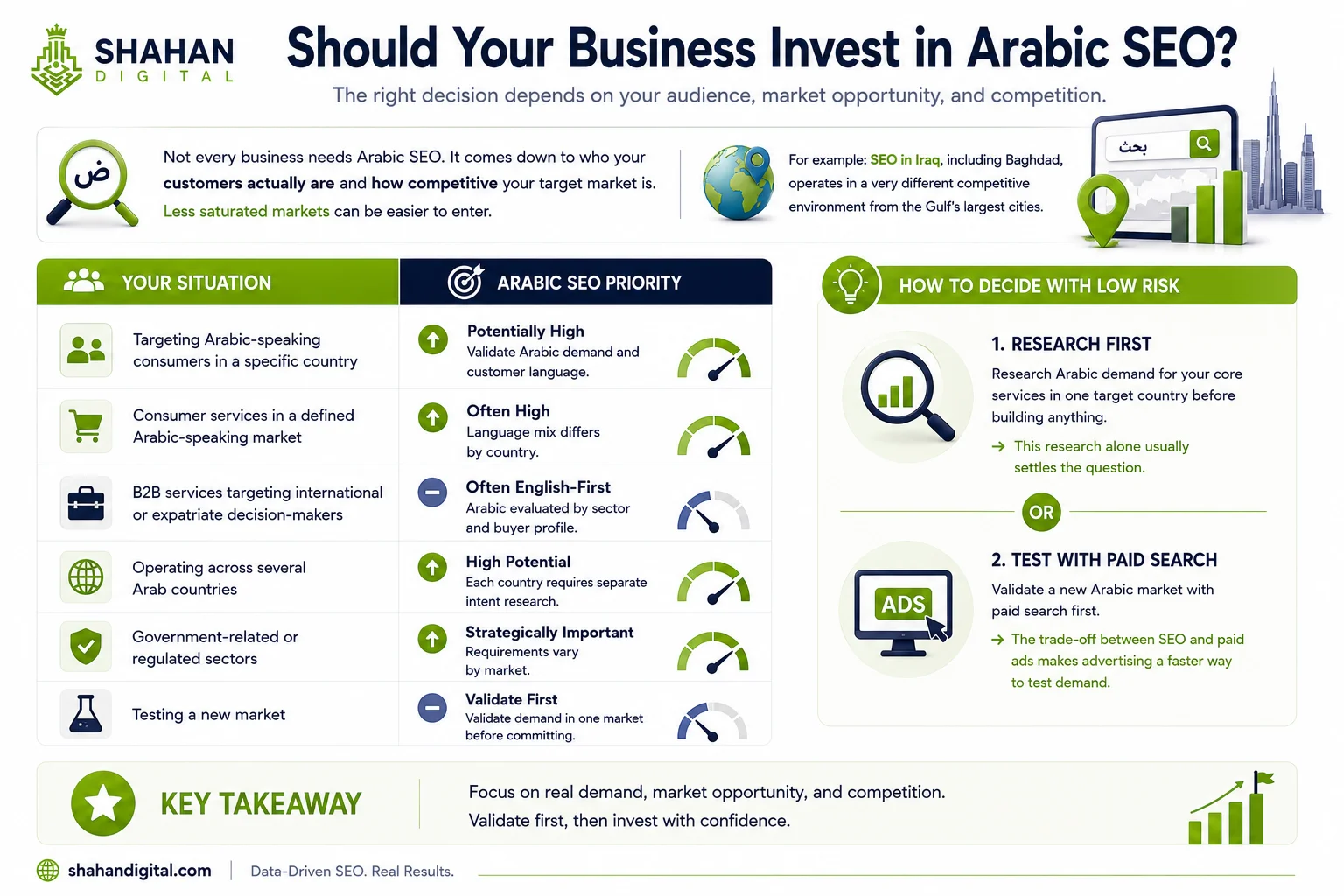
Should your business invest in Arabic SEO?
Not every business needs Arabic SEO. The decision comes down to who your customers actually are, and on how competitive your target market currently is. Less saturated markets can be easier to enter than the largest ones: our work as an SEO company in Iraq, including SEO in Baghdad, operates in a very different competitive environment from the Gulf’s largest cities.
| Your situation | Arabic SEO priority |
|---|---|
| Targeting Arabic-speaking consumers in a specific country | Potentially high — validate Arabic demand and customer language |
| Consumer services in a defined Arabic-speaking market | Often high, but language mix differs by country |
| B2B services targeting international or expatriate decision-makers | Often English-first, with Arabic evaluated by sector and buyer profile |
| Operating across several Arab countries | High potential, but each country requires separate intent research |
| Government-related or regulated sectors | Arabic may be strategically important; requirements vary by market |
| Testing a new market | Validate demand in one market before committing |
If you are unsure, the low-risk SEO path is to research Arabic demand for your core services in one target country before building anything. That research alone usually settles the question. Some businesses also validate a new Arabic market with paid search first, since the trade-off between SEO and paid ads makes advertising a faster way to test demand before committing to content.
Arabic SEO: key takeaways
Arabic SEO is not translated English SEO. It requires separate keyword research per market, deliberate handling of dialect and spelling variation, proper right-to-left technical configuration, and content written for the audience rather than converted into their language. Well-executed Arabic SEO may offer an attractive opportunity in underserved sectors, but timelines still depend on competition, authority, technical condition, and content quality.
The businesses that succeed here treat Arabic as a market with its own rules, not a language setting to switch on.
Arabic SEO checklist
If you take one practical list from this guide, take this. Arabic SEO succeeds when these are handled in order:
- Research per market. Run Arabic SEO keyword research against each target country separately, not against “Arabic” as one audience.
- Collect spelling variants. Check formal and informal spellings, including hamza variations, and compare volume before committing.
- Choose the register per page. Compare MSA and dialectal queries in the target market, then use the register that best matches the audience, intent, and expected level of formality.
- Configure RTL properly. Set
lang="ar"anddir="rtl", and adjust CSS deliberately rather than mirroring a left-to-right design. - Implement hreflang carefully. Use complete, reciprocal annotations and monitor whether the correct language URLs appear in Search.
- Write, do not translate. Arabic SEO content should be produced for the market, with local examples, currency, and context.
- Earn market-relevant authority. This is the off-page side of the work. Relevant Arabic-language and regional publications can strengthen local recognition, referral reach, and topical context. However, link quality, editorial relevance, and source credibility matter more than language alone, and strong English backlinks can still contribute to the wider domain.
- Measure per language. Segment your SEO reporting by language and country, or Arabic performance will be hidden inside English numbers.
Arabic SEO: frequently asked questions
What is Arabic SEO?
Arabic SEO is optimizing a website to rank in Arabic-language search results. It includes Arabic keyword research, content written for Arabic-speaking audiences, and technical configuration such as right-to-left support and hreflang. It differs from translation because it starts from what Arabic speakers actually search rather than converting existing English pages.
Is Arabic SEO just translating my English website?
No, and this is the most common and costly mistake. Translation produces pages that may not match any real Arabic search demand, because one English term often maps to several valid Arabic expressions with different volumes and regional usage. Arabic SEO requires its own keyword research, its own content, and often its own page structure.
Which Arabic should I use, Modern Standard Arabic or dialect?
Modern Standard Arabic is the safe default for formal, professional, and cross-regional content because it is understood everywhere. Regional dialects often match how people search for consumer services and local needs. The right choice depends on your audience and sector, and should be validated with keyword data for your specific target country rather than assumed.
Is Arabic SEO less competitive than English SEO?
Sometimes, in specific segments. Arabic content remains underrepresented online relative to the size of its audience, and some commercial Arabic keywords carry lower difficulty than their English equivalents. But this varies by query, country, and industry, so competition should be validated at keyword level rather than assumed across the language as a whole.
Do I need a separate website for Arabic?
Not necessarily. Many businesses choose a subdirectory such as /ar/ because it is generally easier to manage while keeping language versions under the same domain. A country-code domain sends a stronger geographic signal but requires maintaining separate properties. Whichever structure you choose, correct hreflang implementation matters more than the structure itself.
Where to go from here
If you are considering Arabic SEO, the first step is not building pages. It is researching whether real demand exists for your services in your target Arabic market, and in which words. That single exercise prevents most of the wasted effort in this space.
If you want a grounded assessment of the Arabic search opportunity for your business, the team at Shahan Digital works across English and Arabic search in the Gulf and can help you evaluate it. You can also explore our SEO services and our approach to multilingual content built around real market demand rather than translation.
Written by

Shahan Behkamrad
Author · Founder of Shahan Digital · SEO & GEO Strategist
Entrepreneur · Founder of Shahan Digital · SEO, GEO & Digital Growth Strategist
Shahan Behkamrad is the founder of Shahan Digital and the author of this article.
His published work explores English SEO, Arabic SEO, and Persian SEO, international and multilingual search, technical SEO, website architecture, content strategy, search-intent analysis, digital marketing, Generative Engine Optimization, AI-search visibility, and content optimization for emerging answer-driven platforms.
Through his articles, podcasts, and educational publications, he presents complex topics in a clear and practical format for entrepreneurs, business owners, executives, and marketing professionals.
The views and analysis presented in this article are provided in Shahan Behkamrad’s capacity as its author.
View Shahan Behkamrad’s full author profile and published work →
Official Links
About US Company · LinkedIn · YouTube · Spotify · Apple Podcasts · Instagram · Crunchbase · Shahan Digital on LinkedIn
Editorial and Legal Notice
This article and any related audio or video materials are published solely for educational and general informational purposes.
The content does not constitute legal, financial, investment, technical, or individualized digital marketing advice. Reading, viewing, or listening to this content does not create a consulting, agency, advisory, fiduciary, contractual, or other professional relationship with Shahan Behkamrad or Shahan Digital.
Any examples, observations, strategies, or opinions presented in this content should be evaluated according to the specific circumstances, objectives, market conditions, resources, and legal requirements of each business.
SEO, GEO, digital marketing, traffic, lead-generation, conversion, and revenue outcomes may vary. No specific ranking, traffic level, number of leads, conversion rate, commercial result, or revenue outcome is promised or guaranteed.
All company names, platform names, products, and trademarks mentioned in this content remain the property of their respective owners. References to third-party platforms do not imply sponsorship, endorsement, partnership, or affiliation unless expressly stated.