Quick answer
SEO in Austria works when you treat Austria as its own market, not as a smaller Germany. Austrians search in German but use their own words, compare prices that include Austrian VAT, expect an Impressum, and often see German .de sites competing for the same results. The first job is usually deciding whether you need a separate Austrian (de-AT) version, setting up hreflang correctly, and building pages for the regions and services where Austrian demand actually exists.
Below: the Austrian search market in numbers, what changes from Germany, a five-question check for whether you need a de-AT version, what SEO costs in Austria, what other agencies offer, and how to measure results from Austria only.
Who this guide is for. Austrian businesses looking for an SEO agency or expert, and international or German companies that want to win Austrian customers without losing visibility in Germany.
Pick your path:
- Already ranking in Germany → the de-AT decision and hreflang
- Austrian local business → regions and local SEO in Austria
- Online shop or exporter → business types and legal and trust pages
- Choosing an agency → what others offer and cost
Key takeaways
- Austria had about 9.22 million residents at the start of 2026, roughly 2.04 million of them in Vienna. Most of the market sits outside the capital.
- Google handles about four in five searches in Austria and about nine in ten on mobile, according to StatCounter.
- Austrian German has its own vocabulary. Check demand for both the Austrian and German term before choosing which to put in a title.
- If your prices, legal details or vocabulary differ for Austria, a separate de-AT version with hreflang usually beats one German page for both countries.
- Filter every report by country. Results from Germany can hide a weak position in Austria.
Before you invest in SEO for Austria
Open Search Console, filter by country = Austria, and look at which URLs get the impressions. If they’re your German pages, the question isn’t “how do we rank in Austria?” but “which page should Austrians land on?” Answer that first.
The Austrian search market in numbers
Austria is a small, wealthy market with a clear structure. Statistik Austria’s final figures put the population at 9,215,956 people on 1 January 2026, and the City of Vienna reports 2,042,036 residents in the capital. So roughly three in four Austrians live outside Vienna, in Graz, Linz, Salzburg, Innsbruck and many smaller towns.Google dominates. StatCounter’s data for 2026 shows Google with around 81% of all searches in Austria, Bing at roughly 10%, and Google at about 90% on mobile. Bing’s share on desktop is higher than in many countries, which matters for B2B sites where buyers search at work.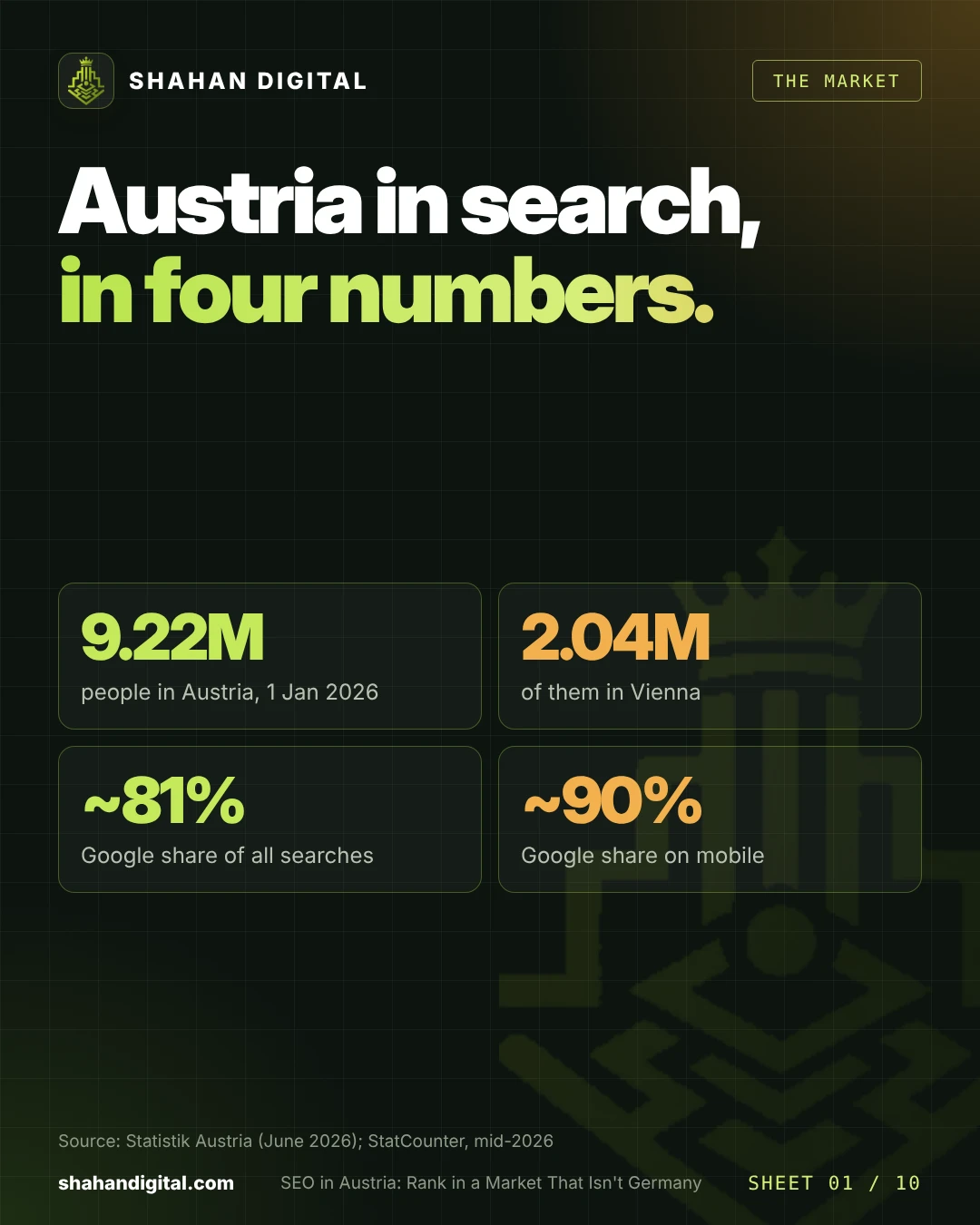
Nine states, different searches
Austria has nine federal states, and search demand follows the economy of each. Vienna is the centre for services, B2B and city tourism. Styria and Upper Austria are industrial. Salzburg and Tyrol live from tourism and alpine sport. Vorarlberg looks across the border to Switzerland and Germany.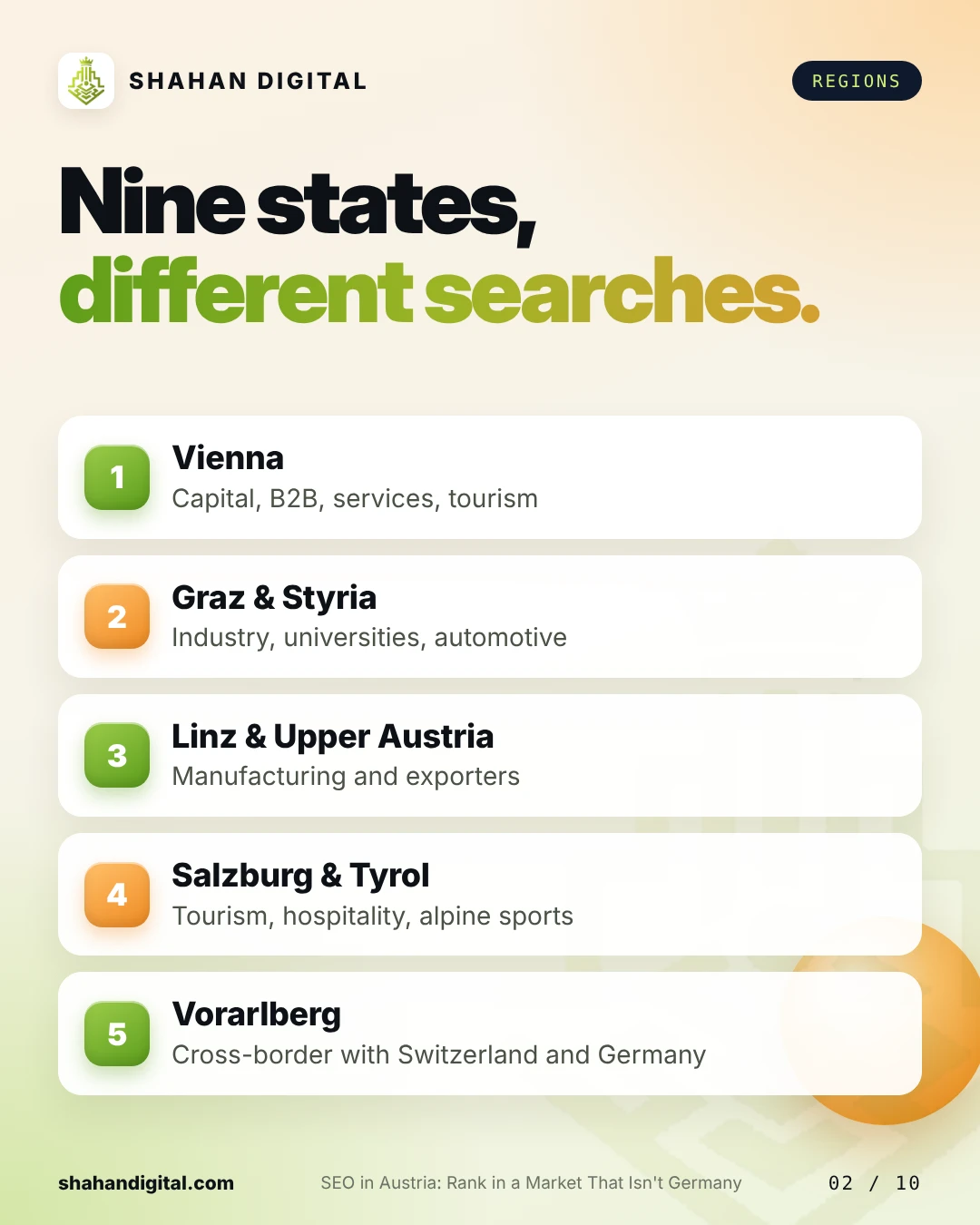
Same language, different words
Austrian German is standard German with its own vocabulary, and people search the way they speak. A recipe site that writes “Tomaten” when Austrians search “Paradeiser”, or a school that writes “Abitur” instead of “Matura”, is matching German search behaviour, not Austrian.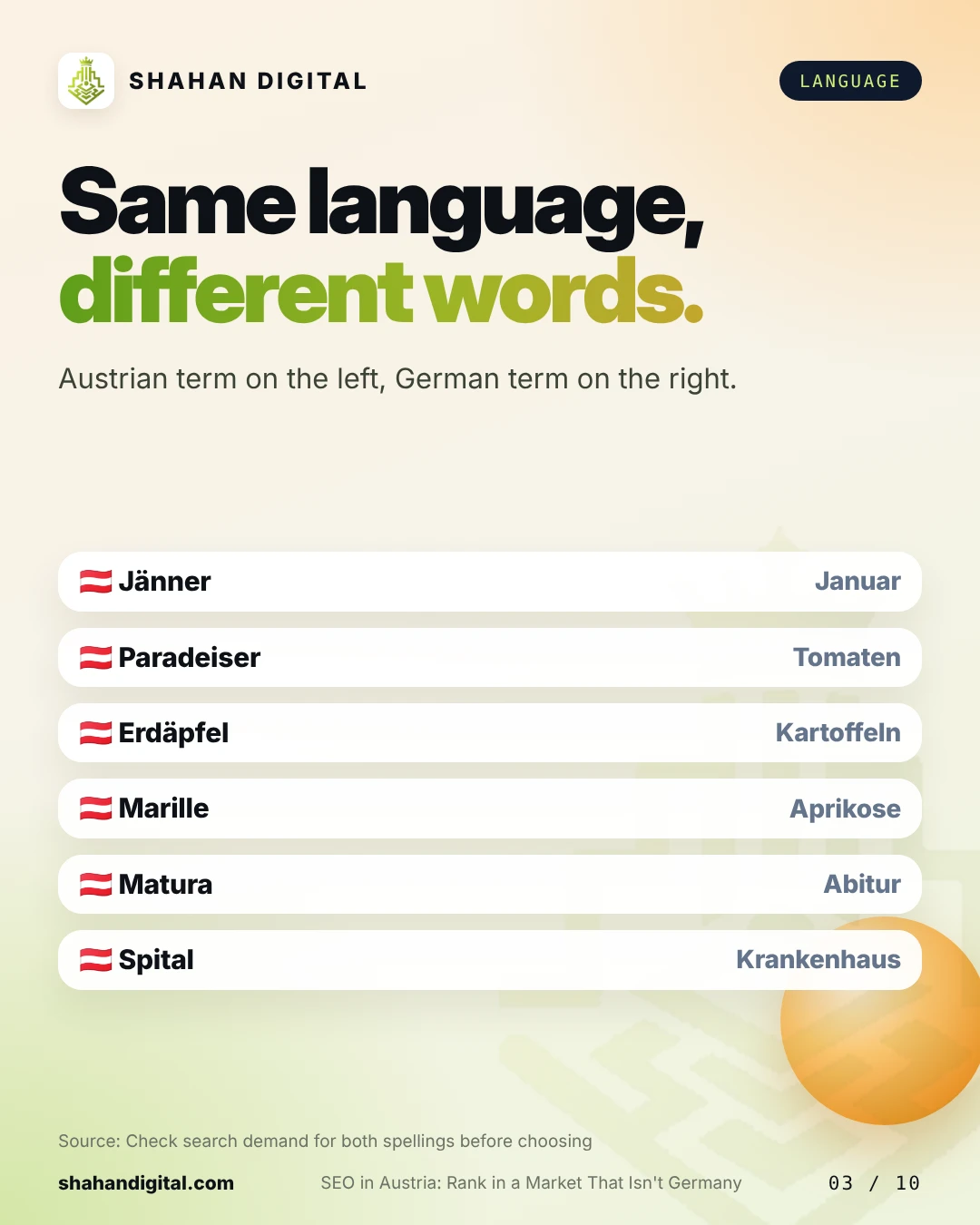
“Before writing for Austria I pull keyword data with the location set to Austria, not Germany, and compare the Austrian and German variant of each core term. Where the Austrian variant has the demand, it goes in the title and H1, and the German variant stays in the body so the page still matches both. Many sites never run that check, because their tools default to Germany.”
Shahan Behkamrad, Founder of Shahan Digital
Decision aid: do you need a separate Austrian version?
Not every business needs a de-AT site. If you sell the same thing at the same price under the same terms to Germany and Austria, one German page may be enough. But when something material changes for Austrian customers, a single page serves neither country well. Score your business on these five questions.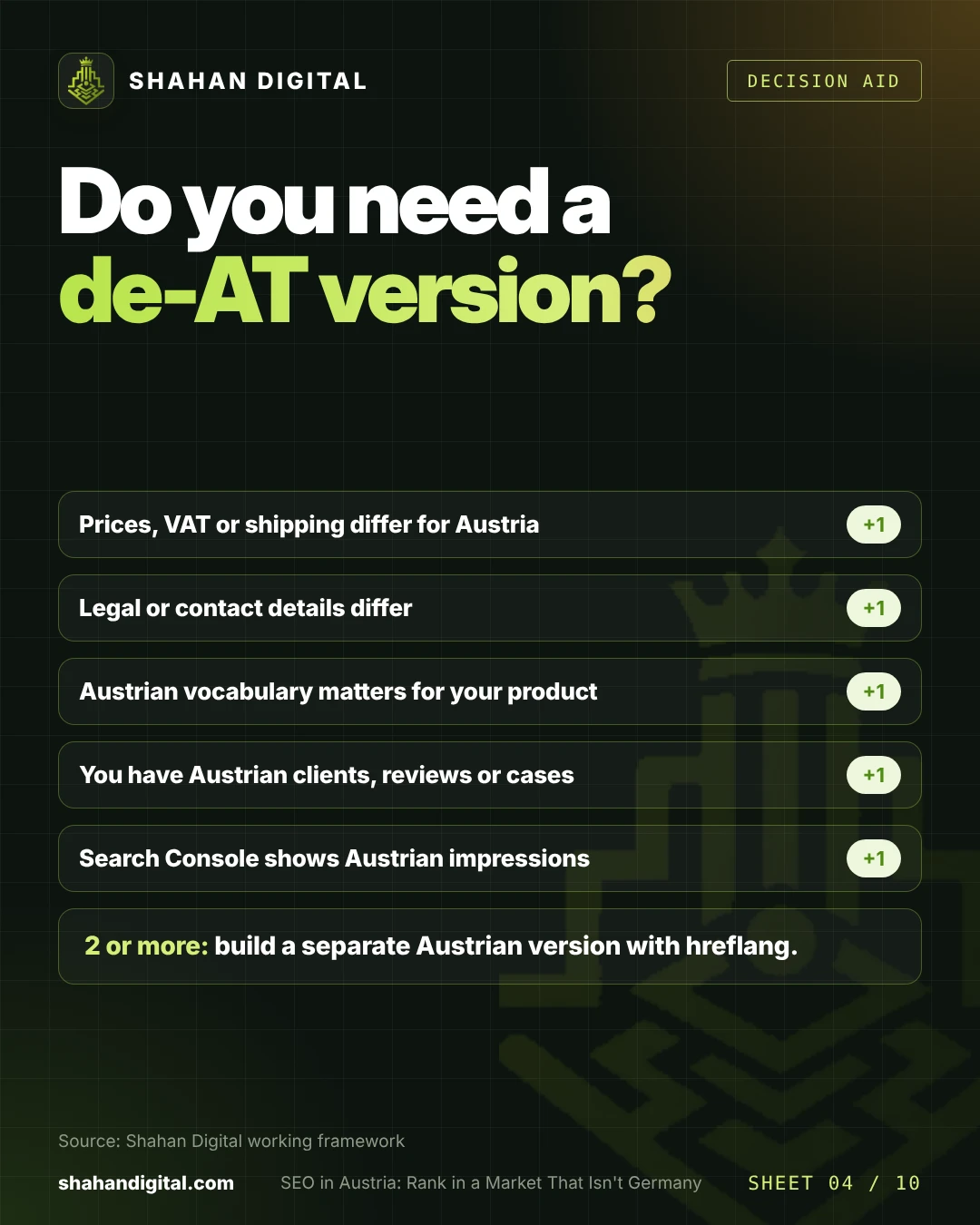
| Question | Why it matters | Score |
|---|---|---|
| Do prices, VAT, shipping or delivery times differ for Austria? | Austrian buyers see the wrong price or delivery promise on a German page | Yes = 1 |
| Do legal, contact or company details differ? | Austrian Impressum, phone number or local entity builds trust | Yes = 1 |
| Does Austrian vocabulary matter for your product? | Titles and H1s should match how Austrians search | Yes = 1 |
| Do you have Austrian clients, reviews or case studies? | Local proof is what makes an Austrian page worth more than a copy | Yes = 1 |
| Does Search Console show meaningful Austrian impressions? | Demand already exists; Google is testing you in Austria | Yes = 1 |
How to read your score: 0 or 1, keep one German version and add Austrian details where they matter. 2 or 3, build de-AT versions of your key commercial pages first. 4 or 5, treat Austria as a full market with its own pages, content plan and reporting.
Not sure where you land?
Send us your website and tell us what you sell in Austria. We’ll look at your Austrian impressions in Search Console, the pages Google shows for your main terms in Austria, and tell you whether a de-AT version is worth building. We’ll reply within two working days. No obligation.
hreflang: tell Google which page is for Austria
Once you have more than one German version, Google needs to know which one to show where. Google’s documentation on localized versions of a page explains the method: each version lists every other version, and itself, with a language-region code such as de-AT or de-DE, plus an x-default for everyone else.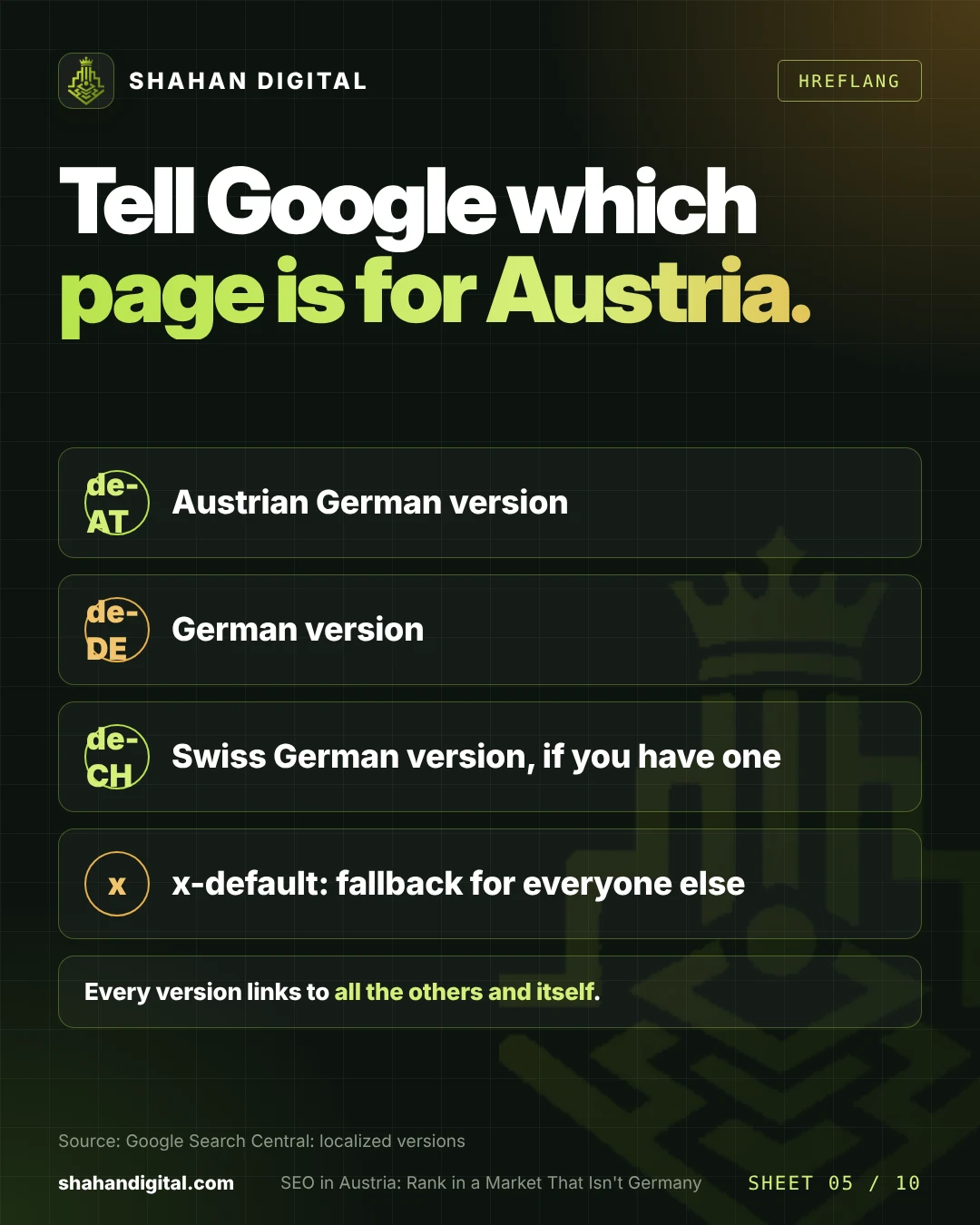
Domain choice matters less than people think. A .at domain signals Austria clearly; a /at/ folder on a strong .com or .de site can work just as well with correct hreflang and local content. Google’s guide to multi-regional and multilingual sites sets out the trade-offs. Our international SEO services cover the set-up, and more guides are in our multilingual and international SEO hub.“On DACH sites I filter Search Console by country and compare which URL Google shows Austrians for each commercial query. If the .de page still gets the Austrian impressions after a de-AT version goes live, I check three things in order: missing return tags, a canonical pointing from the Austrian page to the German one, and pages that are near-identical. One of those is almost always the cause.”
Shahan Behkamrad, Founder of Shahan Digital
Legal and trust pages Austrians expect
Austrian buyers, like German ones, expect to see who’s behind a website. Commercial sites in Austria have legal information duties, including the Impressum under the E-Commerce Act and a media owner disclosure under the Media Act. The Austrian Chamber of Commerce (WKO) publishes a practical guide to the correct website Impressum. These pages aren’t ranking factors in themselves, but a missing or German-only Impressum is a trust problem for Austrian visitors.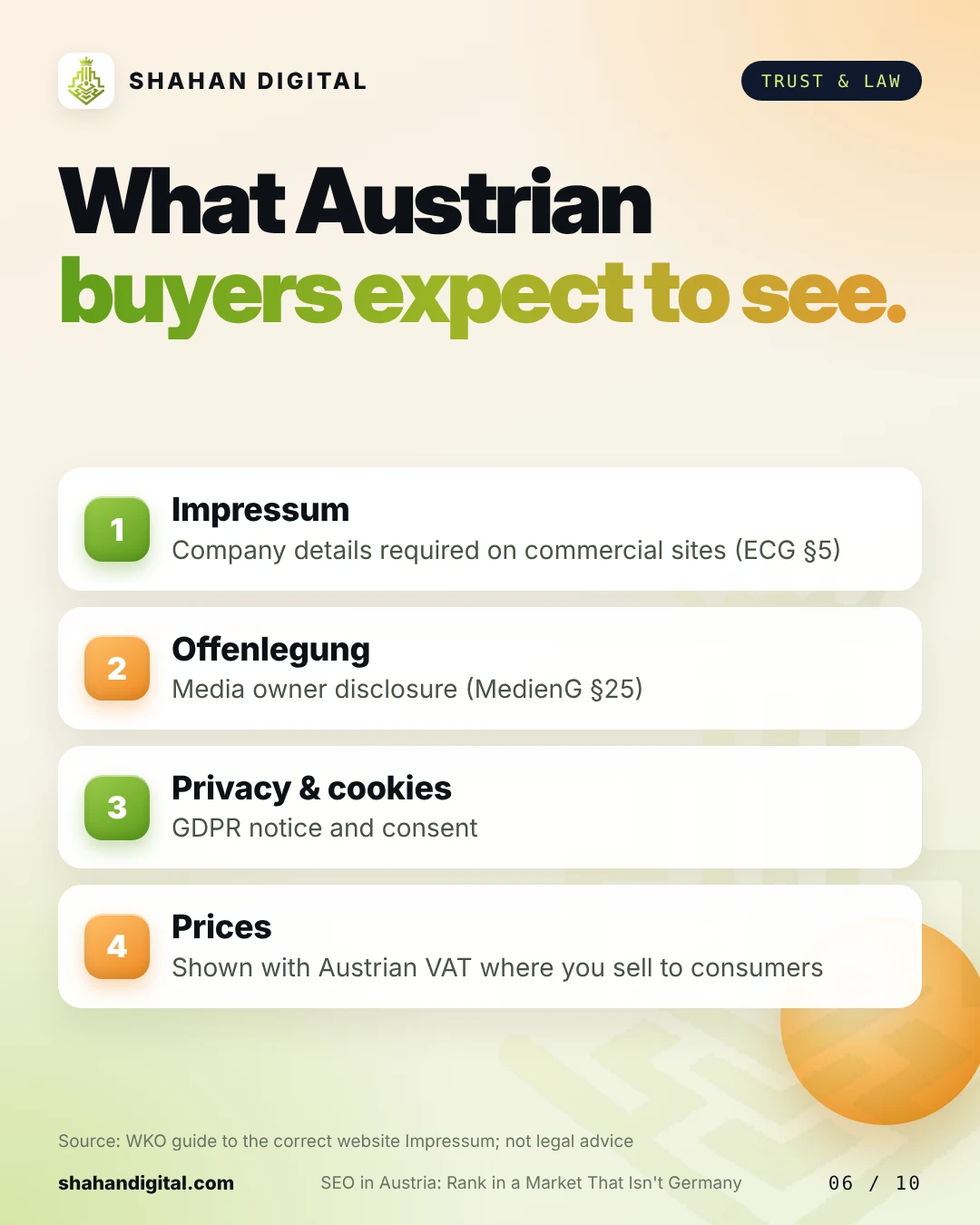
Four kinds of business, four starting points
The right first move depends on how you sell.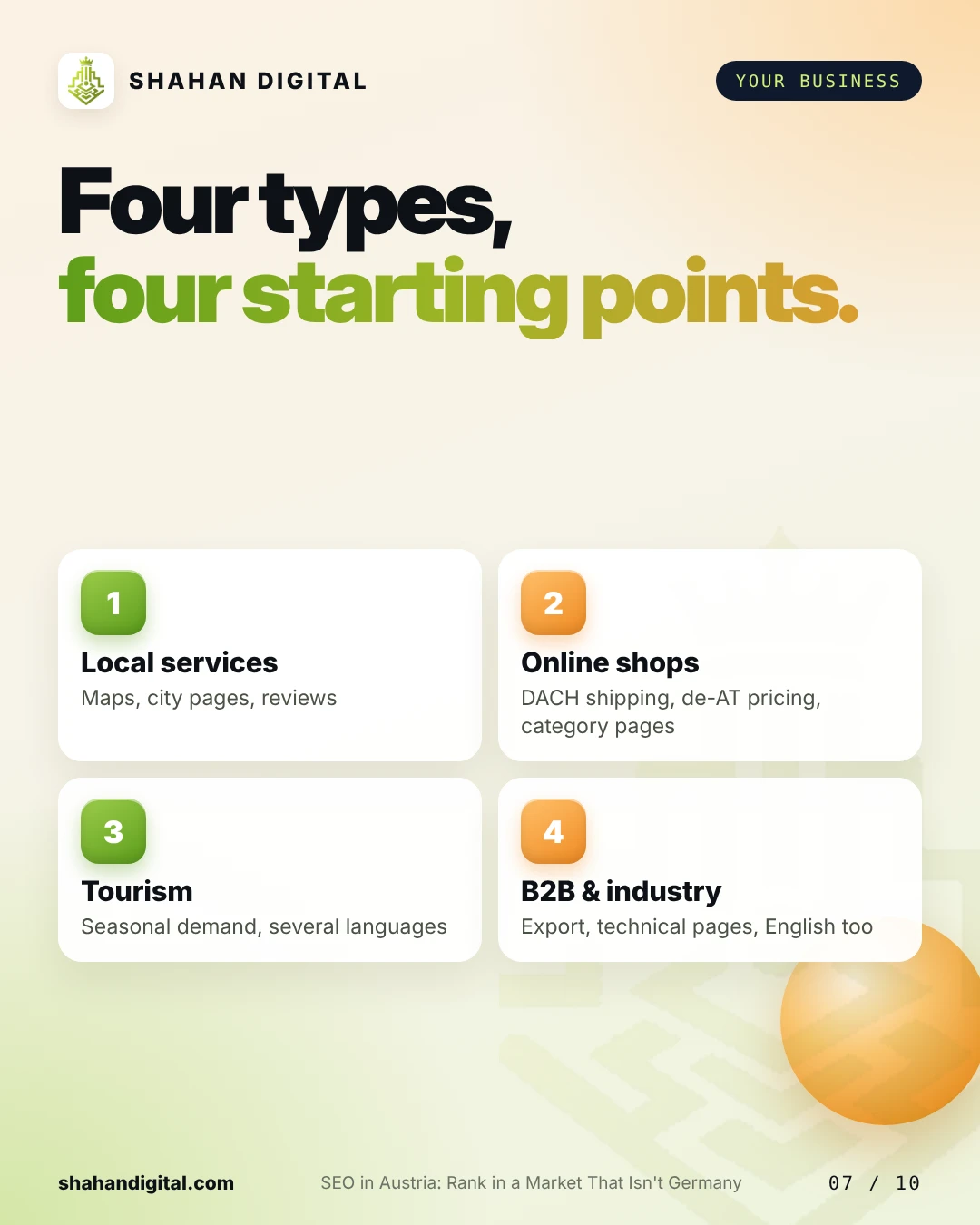
| Your business | What we’d check first | What tells us it worked |
|---|---|---|
| Local services (trades, clinics, lawyers) | Google Business Profile, city and district pages, reviews | Calls and bookings from Maps and local search |
| Online shop | de-AT pricing and shipping, category pages, competition from German shops | Orders from Austria, not just sessions |
| Tourism and hospitality | Seasonal demand, language versions for source markets, booking path | Direct bookings by season and market |
| B2B and industry | Technical product pages, English versions for export, Bing visibility | Qualified enquiries and RFQs |
Local SEO in Austria
For businesses with a physical location or service area, Google’s local results follow the same rules everywhere: they’re based mainly on relevance, distance and prominence. In Austria that means a complete Business Profile with the right category, consistent details across Austrian directories, genuine reviews, and a location page on your site for each real branch. Our local SEO services cover this in detail.AI search: Austrian buyers already use it
This isn’t a future trend. In our own Search Console for this page we see long German queries that read like instructions to an AI assistant: a company explaining that its product page rankings have been sliding for months and asking which agencies in Austria could run an in-depth SEO audit, and to search online and name specific providers.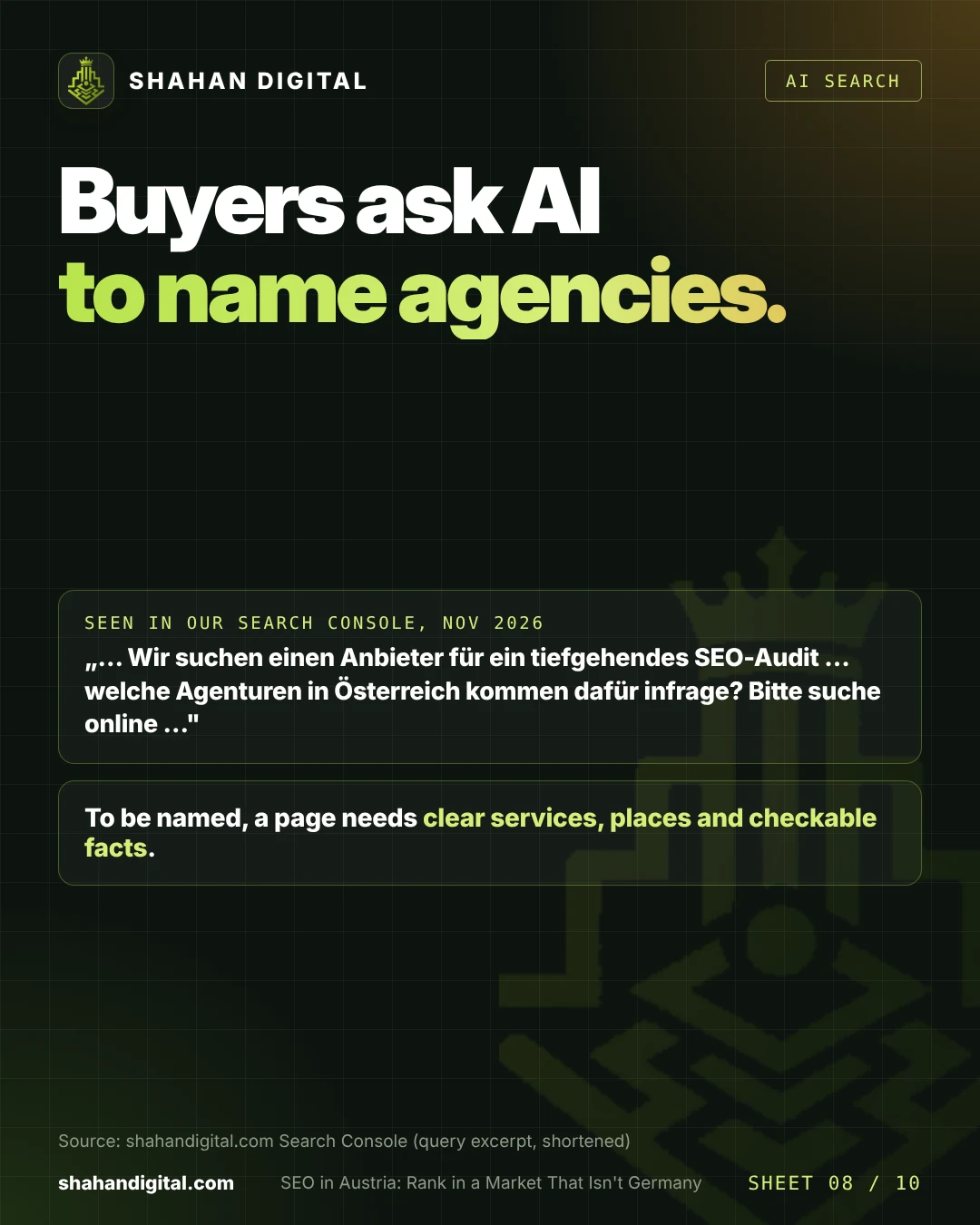
We cover how we approach this, without promising mentions, on our AI search optimization page.“When Search Console shows queries that are 30 or 40 words long and phrased as instructions, that’s an AI tool searching on someone’s behalf. I tag them separately, because they show exactly what the buyer asked for. In this case: an audit, clear priorities, a provider in Austria. A page that states those things plainly is far easier for the tool to find and name.”
Shahan Behkamrad, Founder of Shahan Digital
What other SEO agencies in Austria offer
We reviewed the first page of Google for “SEO agency Austria” on 17 November 2026. Austria has many capable agencies, and the directories are a good place to start a shortlist.| Result | Page type | What it does well | What’s missing for a buyer |
|---|---|---|---|
| NUOPTIMA | Agency list | Names agencies in Vienna, Graz, Salzburg and Linz with addresses and specialisms | Written by an agency that lists itself; little on how to choose |
| SE Ranking catalogue | Directory | Large catalogue of Austrian agencies with services and locations | Profiles are self-described |
| Clutch | Directory | Verified reviews, minimum project sizes and hourly rates | Sponsored placements sit at the top |
| Blck Alpaca | Agency service page | Covers AI assistants as well as Google; publishes a Vienna price comparison | Vienna-focused |
| Several “top 10” lists | Listicles | Quick overview of names | Often written by an agency that ranks itself first |
What does SEO cost in Austria?
Published prices vary widely, so it helps to know which kind of offer you’re looking at. HEROLD, the Austrian business directory, lists SEO packages from €90 to €375 a month on 12-month terms, aimed at small local businesses. Ahrefs’ German-language guide estimates agency retainers of €1,500 to €5,000 a month in the DACH market. A Vienna agency’s own comparison quotes €2,500 to €6,000 a month for SME packages. All three were checked on 17 November 2026 and are advertised ranges, not quotes.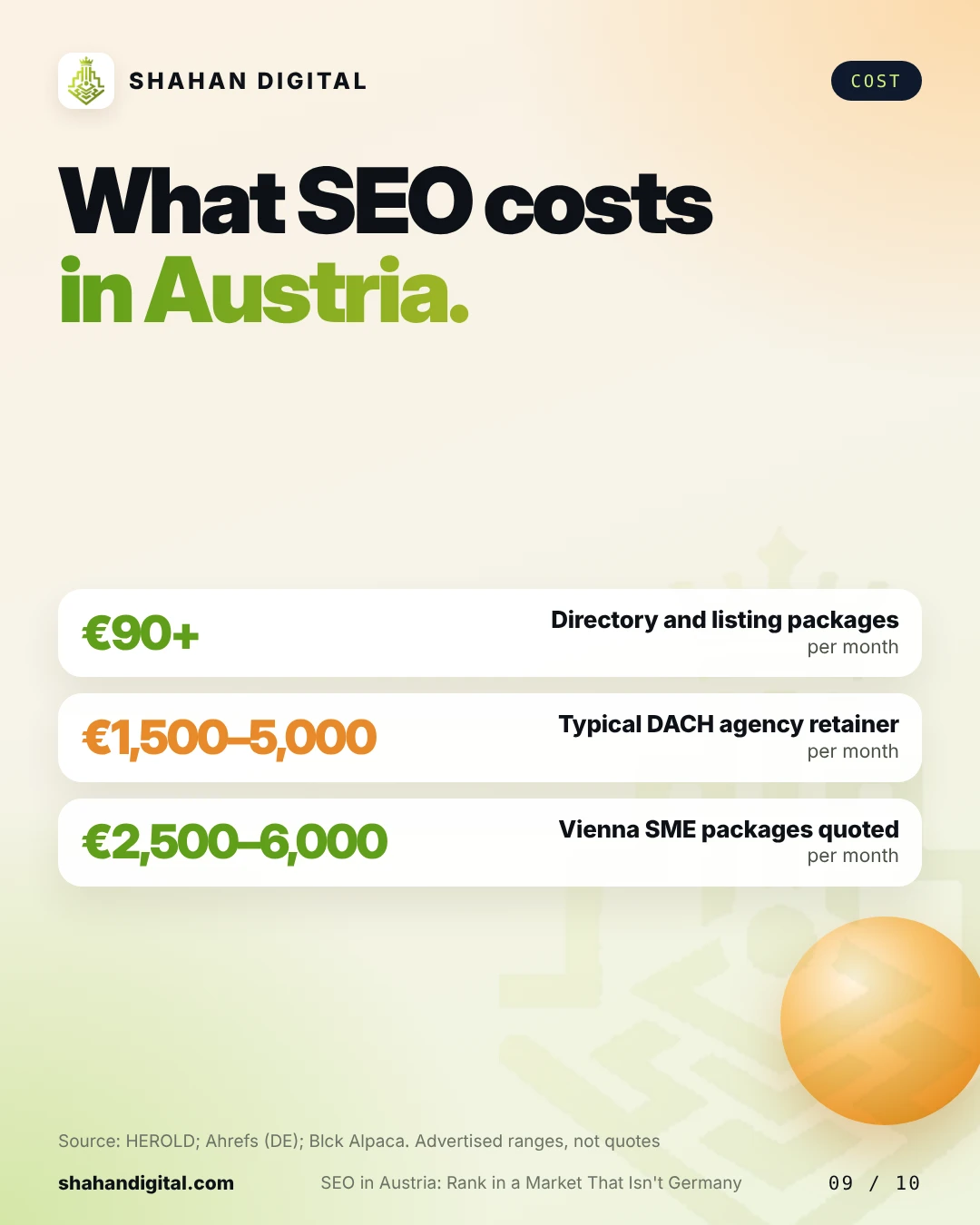
How to measure SEO in Austria
The most common reporting mistake we see for DACH sites is mixing countries. Total German-language traffic goes up, everyone’s happy, and nobody notices that Austrian visibility didn’t move. Filter every report by country, then follow Austrian impressions through clicks and enquiries to customers and revenue.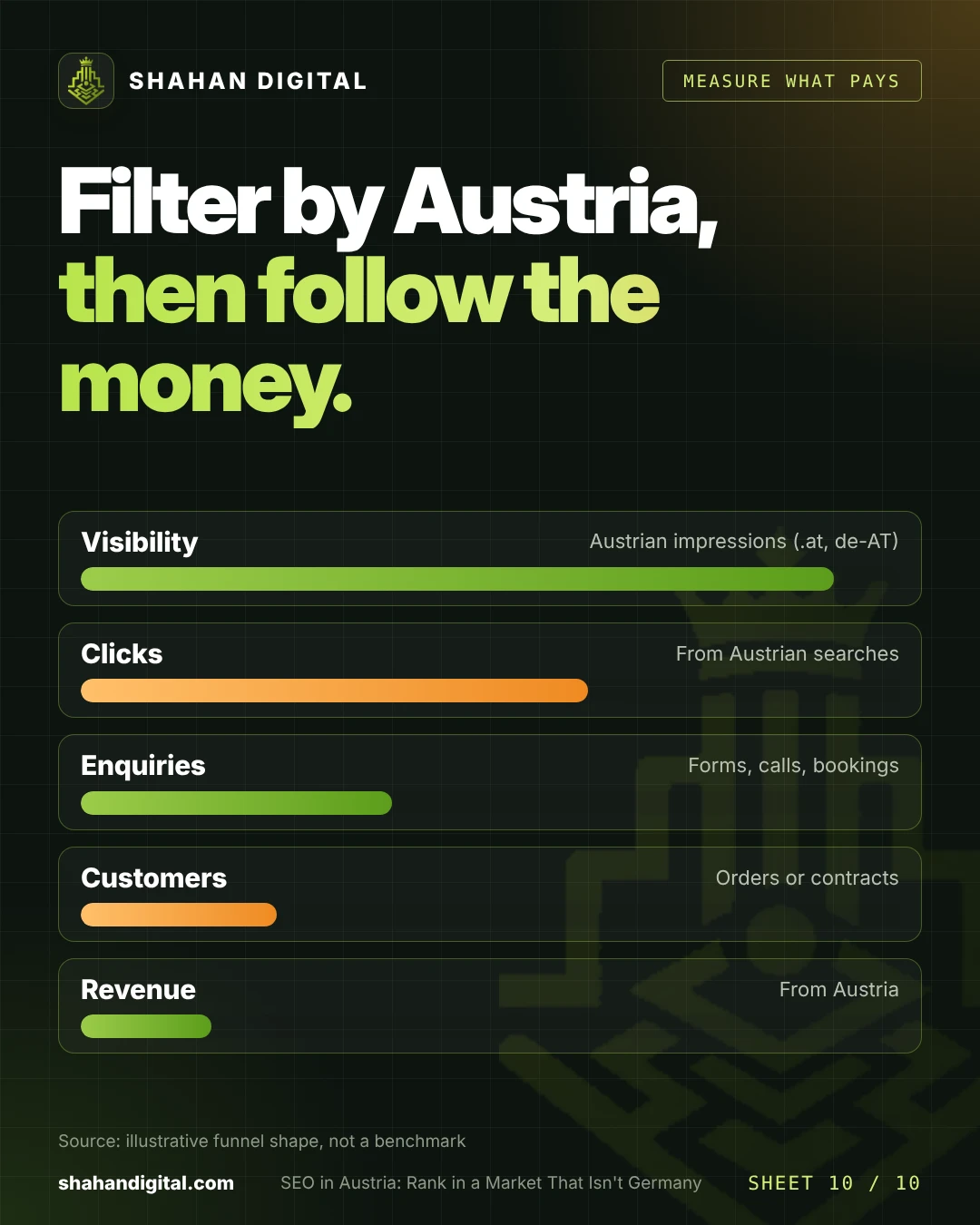
Austria and its neighbours
Many Austrian companies sell into Germany, Italy and beyond, and many foreign companies treat Austria as part of a DACH or Central European plan. If that’s you, our guides to SEO in Germany, Italy and the Netherlands follow the same approach.How we work with Austrian clients
We can run SEO end to end, advise your team, carry out a one-off audit, or help you hire an SEO expert in-house. We work remotely. A proposal from us sets out what we’d fix first, who owns each task, how we’ll measure Austrian results against today’s baseline, and what it costs. German content is written by our native Austrian writers as part of our SEO content writing work. We don’t promise rankings, AI mentions or revenue.Frequently asked questions
Is SEO in Austria different from SEO in Germany?
The principles are the same, but the market isn’t. Austrians use different words for many things, see prices with Austrian VAT, expect an Austrian Impressum, and often compete with German .de sites in their own results. If those differences matter for your business, a separate de-AT version with hreflang usually performs better than one German page.Do I need a .at domain to rank in Austria?
No. A .at domain signals Austria clearly, but a /at/ folder on a strong .com or .de site can work just as well with correct hreflang and genuinely Austrian content. The choice depends on your brand, your existing domain strength and how different your Austrian offer is.How much does SEO cost in Austria?
Advertised prices checked in November 2026 range from about €90 a month for directory packages for small local businesses, to €1,500 to €5,000 for typical DACH agency retainers, and €2,500 to €6,000 for Vienna SME packages. Your cost depends on scope, regions, languages and content. Ask for a written, itemised quote.Which search engines matter in Austria?
Google handles about four in five searches in Austria and about nine in ten on mobile, according to StatCounter. Bing has a noticeably larger share on desktop, which matters for B2B sites whose buyers search at work.Should I target Vienna or all of Austria?
Vienna has about 2 million of Austria’s 9.2 million residents. A local business should target the cities it really serves. A national brand should build one strong Austria page and add regional pages only where Search Console or keyword data shows real demand.How long does SEO take in Austria?
Fixing hreflang and existing pages can show early signs within weeks. New de-AT or regional pages usually take several months to settle, depending on competition and how much authority your site has in German-language search. No one can guarantee a timeline.Ready to see where you stand in Austria?
Send us your website, the regions and services you want to grow, and whether Germany is in scope too. We’ll scope a first review around one question: which searches in Austria should be bringing you customers, and which page should they land on.
Editorial note: Facts and figures were checked against the linked sources on 17 November 2026. Legal information is general and not legal advice; check current requirements with the WKO or a lawyer. No ranking, traffic or revenue result is guaranteed.
Written by

Shahan Behkamrad
Author · Founder of Shahan Digital · SEO & GEO Strategist
Shahan Behkamrad is an SEO and GEO strategist and the founder of Shahan Digital. Since 2017 he has built search strategies for businesses in Persian, Arabic, English and Turkish markets, usually working alongside a client’s in-house team to decide what to fix first, what to build next and how to measure it.
- Strategy before tactics: every engagement starts with a diagnosis of where growth is being lost, then a ranked plan tied to enquiries and revenue, not to rankings alone.
- Current with how search works now: his work covers Google Search, Google Maps, AI Overviews and AI assistants such as ChatGPT, and he checks Google’s documented updates before changing a client’s plan.
- Specialist depth: technical, international and multilingual SEO, local SEO and AI search visibility (GEO).
- Has trained more than 650 students in SEO and digital marketing, including as an official instructor at Iran’s Technical and Vocational Training Organization.
- Host of the Shahan Behkamrad Podcast on business growth, branding, SEO and AI.
- Master’s student in Strategic Marketing and Brand Management at Nişantaşı University, Istanbul; holds 25+ international digital marketing certifications.