
Quick answer
For a plastic surgeon, SEO and website design are one project: search brings a patient to a procedure page, and the design decides whether they trust you enough to book a consultation. In practice that means one detailed page per procedure you’re known for, a surgeon profile with verifiable credentials, a fast before-and-after gallery with documented consent, honest information about risks, recovery and cost factors, a Google Business Profile for each real clinic, and marketing that stays inside the rules for cosmetic surgery advertising in your country.
Below: the market in numbers, how patients choose a surgeon, site structure, the procedure page, a page priority score, advertising rules, speed and galleries, local and international patients, cost, what other agencies offer, and how to measure consultations.
Who this guide is for. Plastic and cosmetic surgeons, practice managers and clinic owners planning a new website, a redesign, or SEO for an existing site.
Pick your path:
- Planning a redesign → site structure and speed and galleries
- Not sure which procedures to build pages for → procedure-page priority score
- Worried about advertising rules → rules that shape your website
- Treating patients from abroad → local and international patients
Key takeaways
- Patients research a procedure first and a surgeon second. Your procedure pages have to win both searches.
- Google treats health content as “Your Money or Your Life”. Named, qualified authors and honest risk information matter more here than in most industries.
- Before-and-after galleries convert, but they’re often the slowest and least compliant part of the site.
- Advertising rules for cosmetic surgery (GMC and ASA in the UK, the FTC’s review rule in the US) apply to your website, not just your ads.
- Judge the project by consultations booked and attended, not by visits.
Before you invest in a redesign
Export your current site’s pages with Search Console clicks and impressions for the last 12 months. Pages that already bring patients keep their URLs, or get a proper redirect. Most traffic losses after a clinic redesign come from changed URLs that nobody redirected.
The aesthetic surgery market in numbers
Demand is large and still growing. The International Society of Aesthetic Plastic Surgery’s 2024 Global Survey, released in June 2025, counts more than 17.4 million surgical and 20.5 million non-surgical procedures in 2024, a 42.5% rise over four years. Eyelid surgery became the most common surgical procedure for the first time. The survey is based on responses from 2,975 surgeons, so treat the totals as estimates.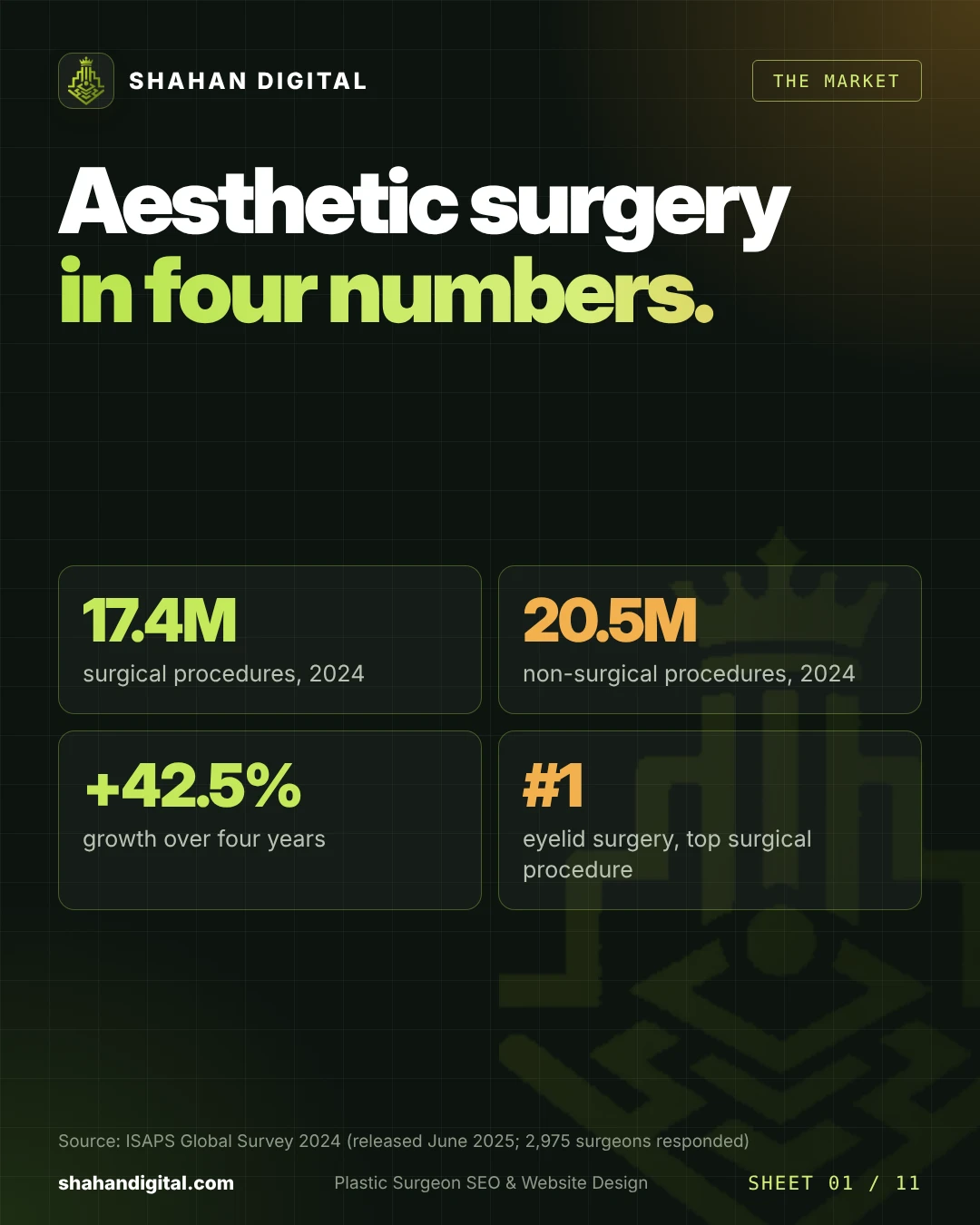
How patients choose a surgeon online
Cosmetic surgery is a considered decision. Patients often research for weeks or months. They start with the procedure (“is a mini facelift worth it”), move to cost and recovery (“tummy tuck recovery week by week”), then look for surgeons (“breast reduction surgeon Dubai”), and finally check the surgeon (“Dr [name] reviews”, “Dr [name] before and after”).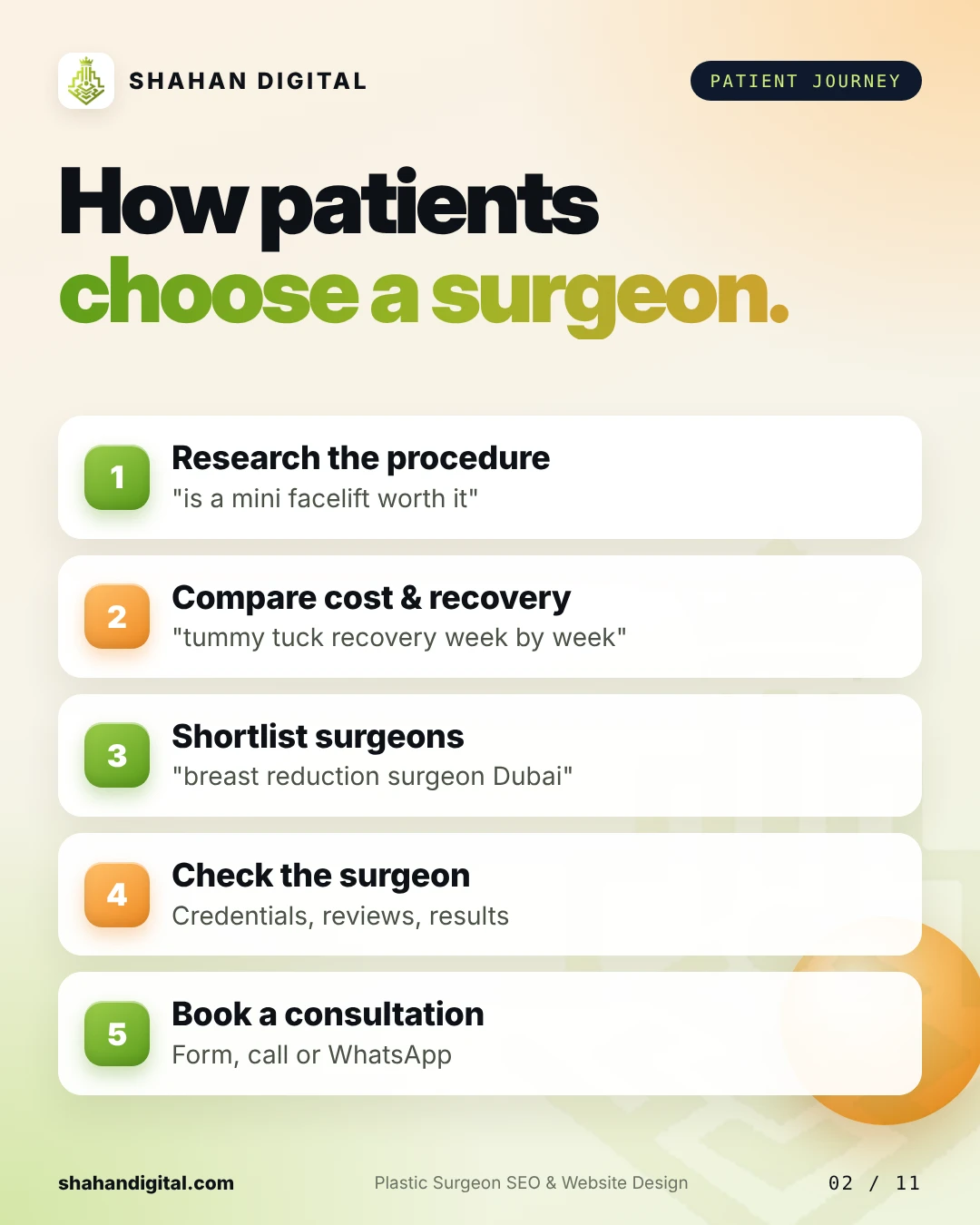
Site structure: where SEO and design meet
The structure of the site is where design and SEO decisions are really made. If the menu groups everything into “Face”, “Body” and “Breast” with one short page each, no amount of later SEO will make those pages rank for specific procedures.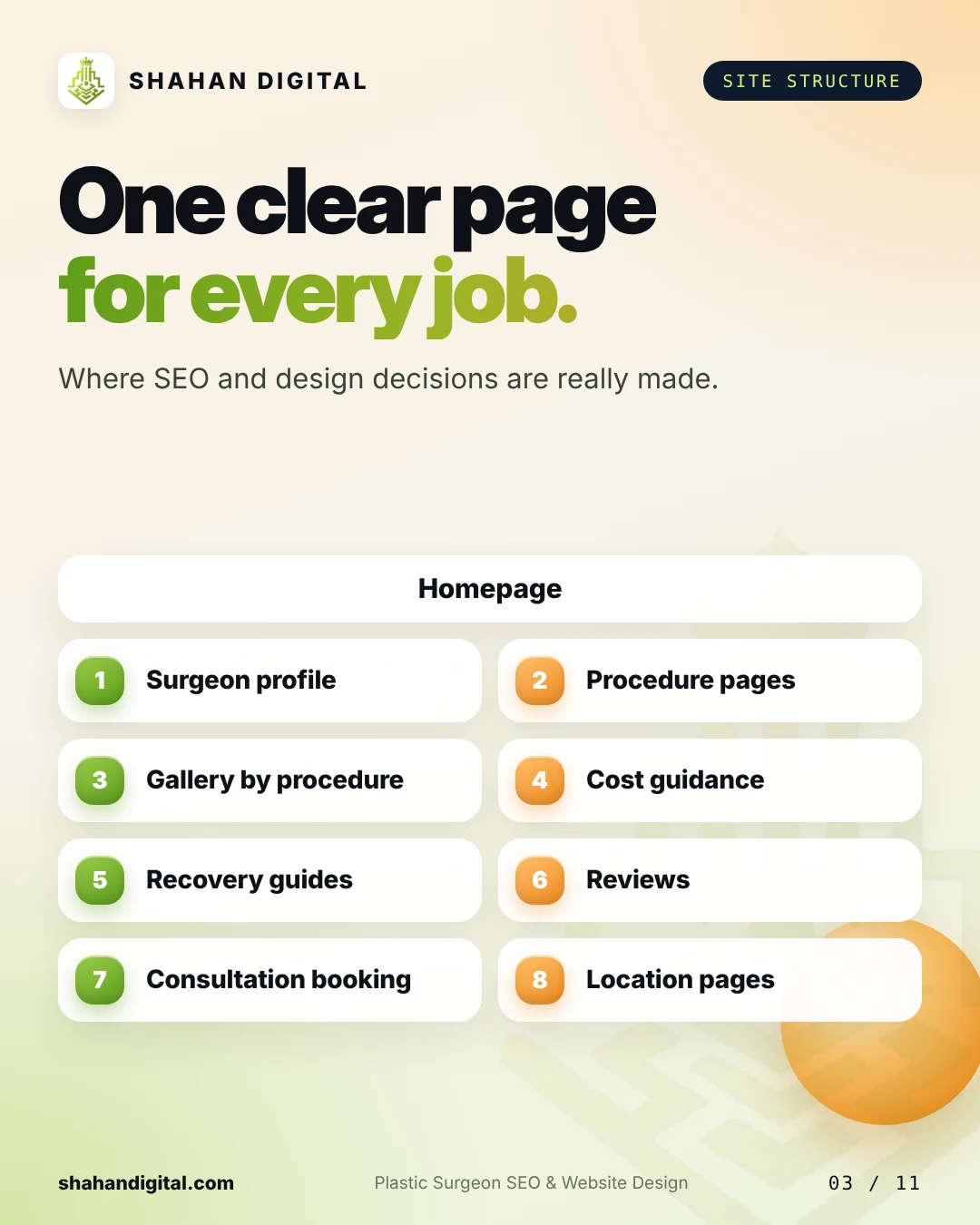
| Page | Patient question it answers | Design priority |
|---|---|---|
| Procedure page (one per procedure) | Is this right for me, what’s involved, what are the risks? | Readable on mobile, clear consultation button |
| Surgeon profile | Who is operating, and are they qualified? | Registration numbers and memberships that can be checked |
| Gallery by procedure | What results has this surgeon achieved? | Fast loading, consent recorded, no edited images |
| Cost guidance | Roughly what will this cost and what changes it? | Honest ranges or factors, no time-limited deals |
| Recovery guides | What will the weeks after surgery be like? | Written or reviewed by the surgeon |
| Consultation booking | How do I take the next step? | Short form, call, WhatsApp; clear about what happens next |
The procedure page that books consultations
The procedure page does most of the work. A patient reading about rhinoplasty wants to know who it’s for, how it’s done, what recovery looks like week by week, what the risks are, what results this surgeon has achieved, roughly what it costs and how to book.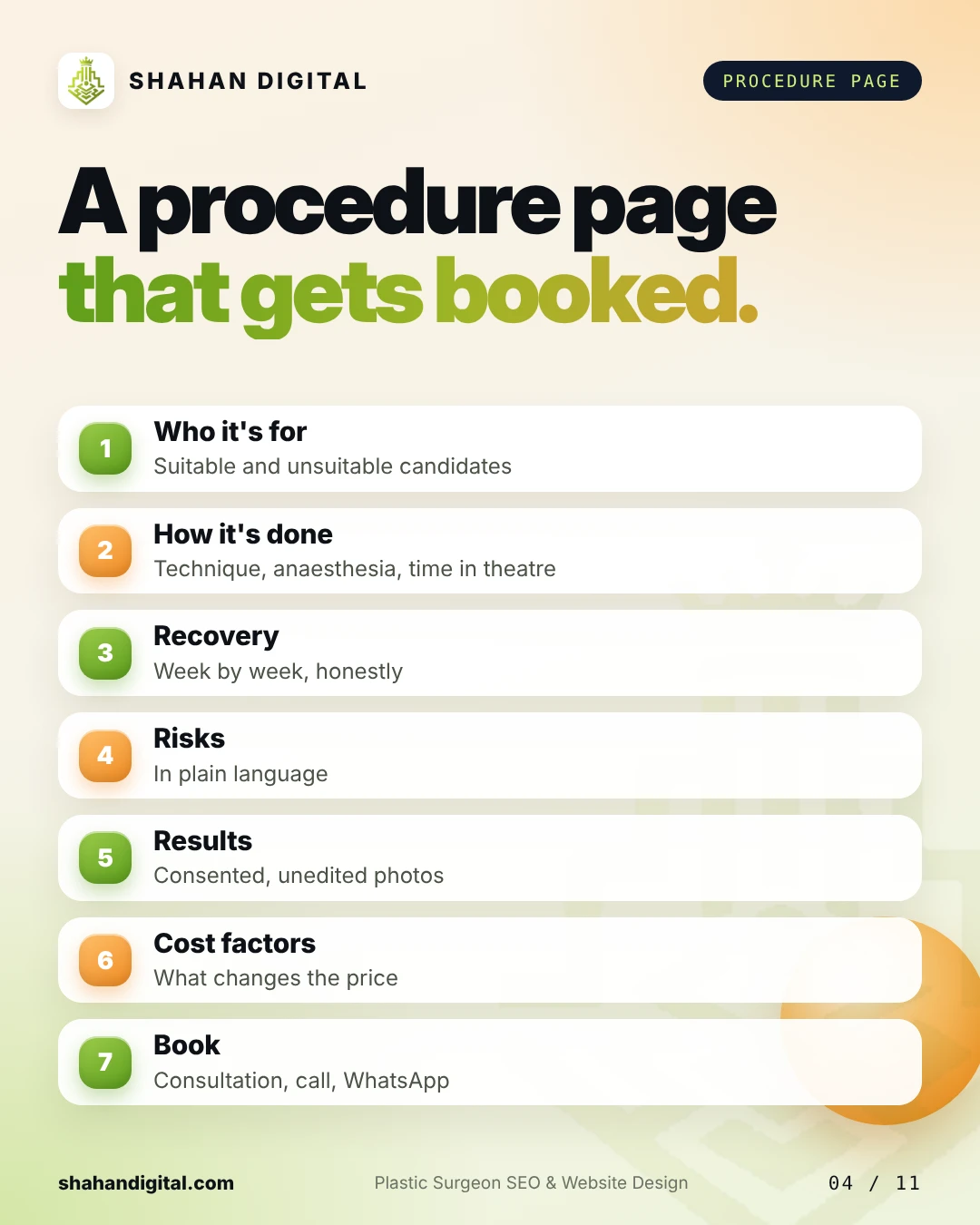
“The most useful section on a procedure page is usually the one clinics are most nervous about: risks and recovery, in plain language. Patients are searching for it anyway. If they find it on your page, written by the surgeon who’ll operate, that’s the moment they start to trust you.”
Shahan Behkamrad, Founder of Shahan Digital
Decision aid: the procedure-page priority score
A practice might offer thirty procedures. You don’t need thirty deep pages on day one. Score each procedure from 1 to 5 on five questions and build the top five first.
| Question | Score 1 | Score 5 |
|---|---|---|
| Revenue per case | Low | One of your highest |
| How many do you perform? | Occasionally | Every week |
| How often do consultations turn into surgery? | Rarely | Most of the time |
| Do patients search for it in your market? | No impressions or volume | Clear demand in Search Console or keyword data |
| How much proof can you show? | No consented photos or reviews yet | Strong gallery and reviews with consent |
Worked example (illustrative): Upper eyelid surgery scores 3 + 5 + 4 + 5 + 4 = 21. Brachioplasty (arm lift) scores 4 + 2 + 3 + 2 + 2 = 13. The eyelid page gets the full treatment first; the arm lift can start as a shorter page and grow as proof builds.
Want a second opinion on your site?
Send us your website, the procedures you want more of and where your patients come from. We’ll tell you which five pages we’d rebuild first and what we’d change in the design.
Rules that shape your website
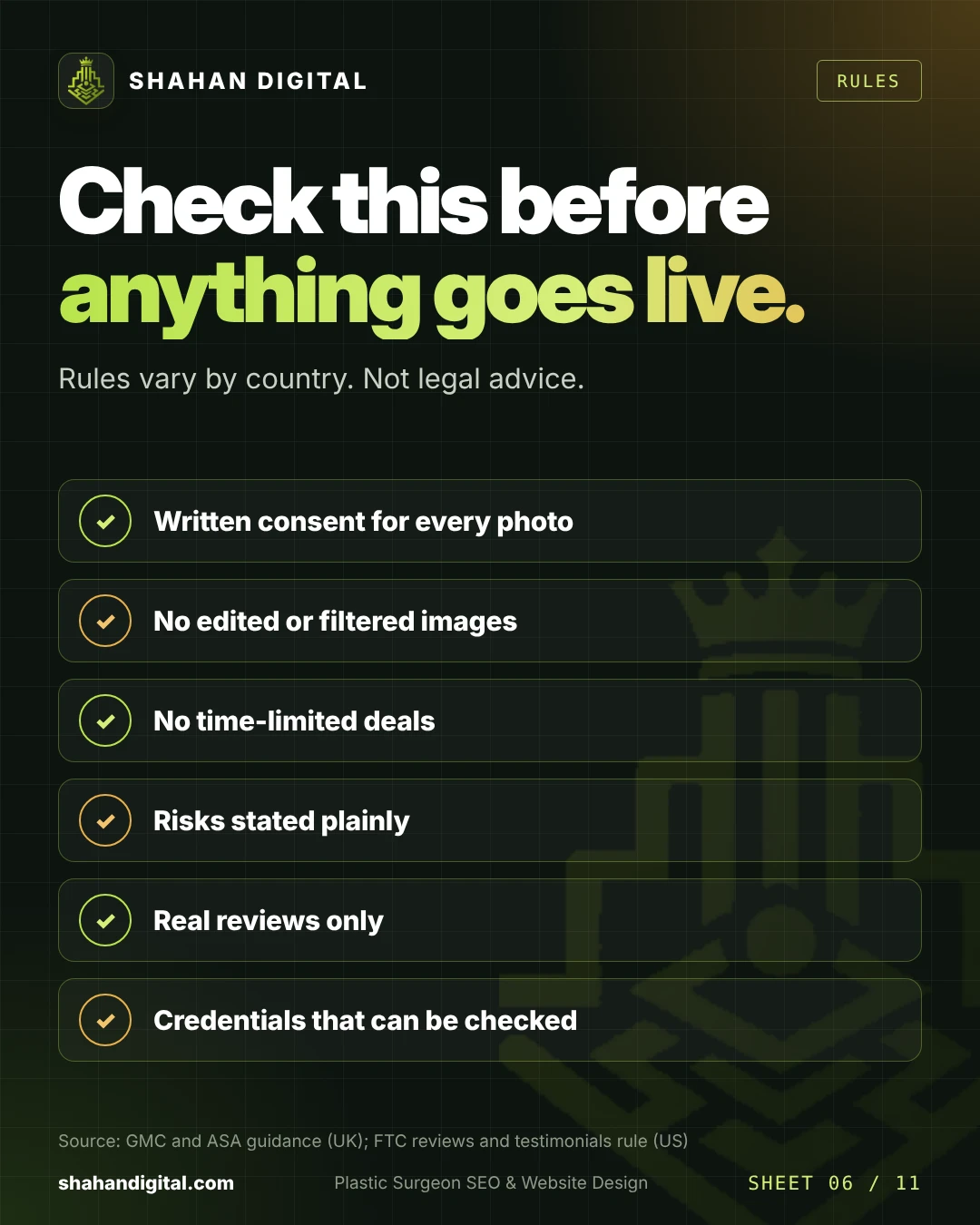
Cosmetic surgery marketing is regulated, and the rules apply to your website as much as to your ads. Requirements vary by country, so check with your regulator or lawyer. A few examples:- UK, doctors: the General Medical Council’s guidance on cosmetic interventions requires responsible marketing: no unjustifiable claims, no trivialising risk, and no promotional tactics that push people into ill-considered decisions, such as time-limited discounts.
- UK, all advertisers: the ASA’s cosmetic interventions guidance covers before-and-after photos, testimonials, time-limited offers and targeting under-18s.
- US: the FTC’s final rule on fake reviews and testimonials, in force since October 2024, bans fake or bought reviews and undisclosed insider reviews.
Speed, galleries and mobile design
Galleries are often the heaviest part of a surgeon’s site, and most patients open them on a phone. Google’s Core Web Vitals measure loading, responsiveness and visual stability. A gallery of uncompressed photos can fail all three.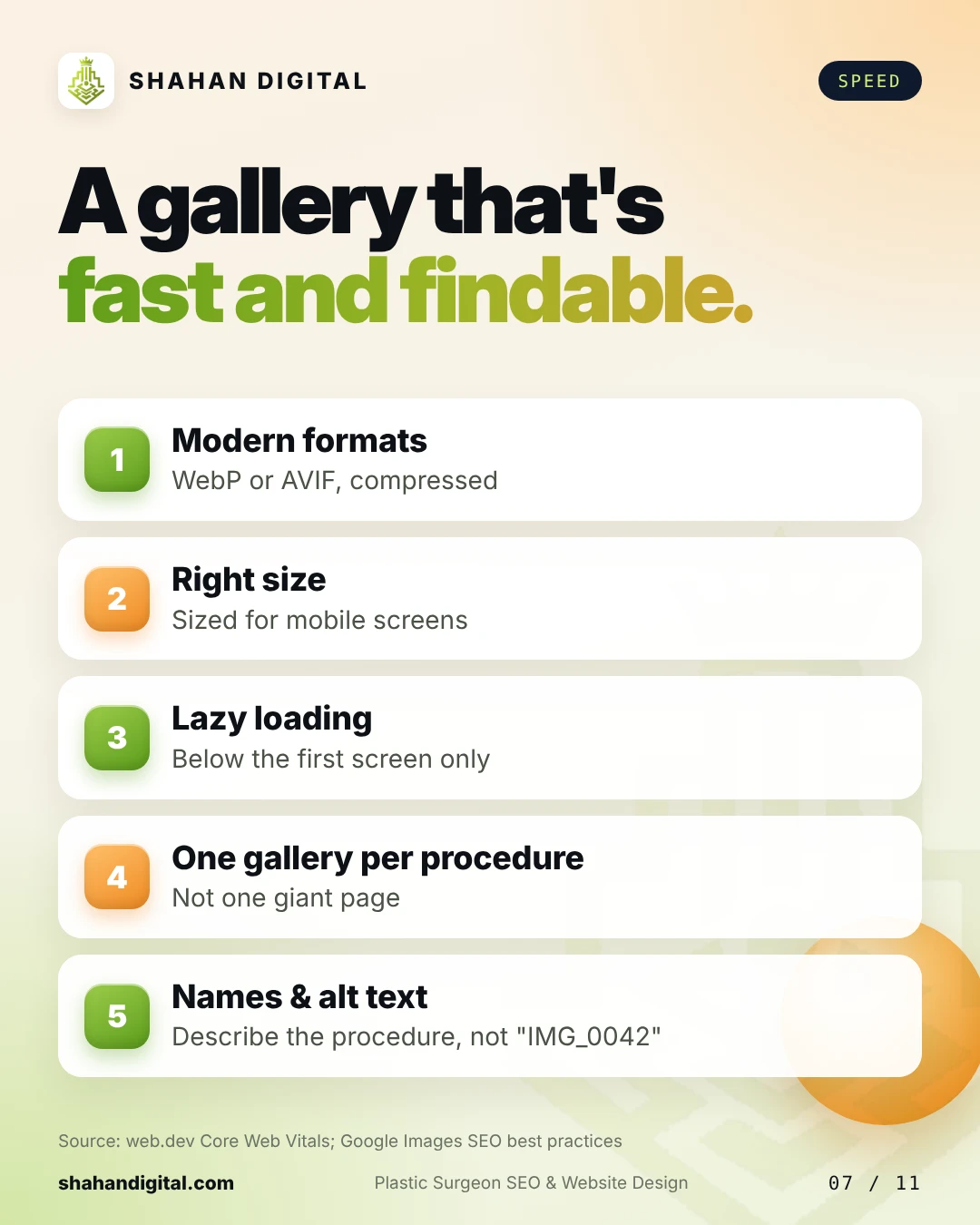
“I test every surgeon site on a mid-range phone on mobile data, because that’s how most patients see it. If the gallery takes longer to load than it takes to lose interest, the best results in the city don’t matter.”
Shahan Behkamrad, Founder of Shahan Digital
Local patients and patients from abroad
For local patients, Google Maps matters. Google says local results are based on relevance, distance and prominence: the right categories, an accurate clinic address, and genuine reviews. Each real clinic location can have its own profile linked to a matching location page. Our local SEO service covers this.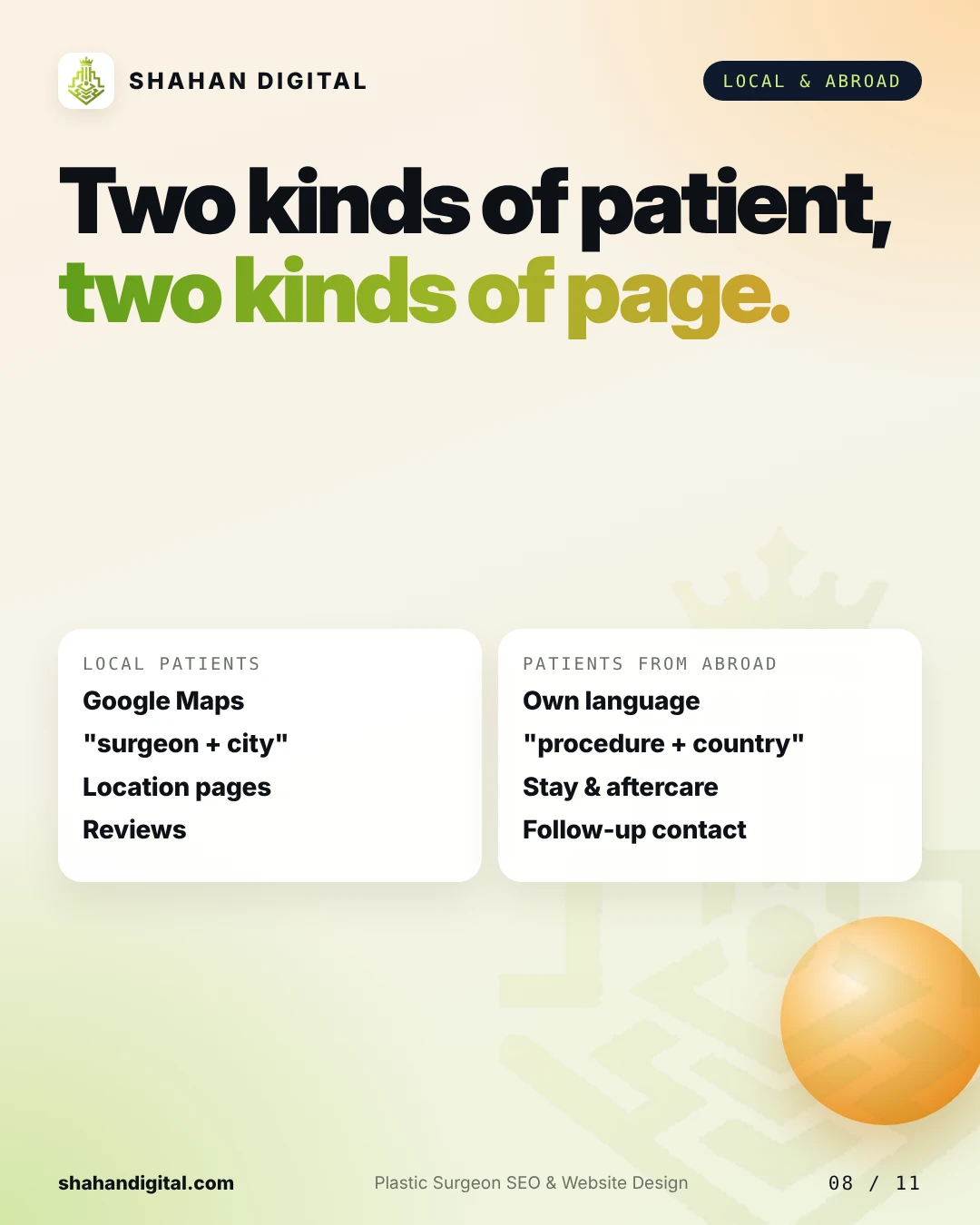
What SEO and website design cost
For SEO, Ahrefs’ survey of 439 providers found monthly retainers most often in the $501 to $1,000 range, with local SEO averaging $1,557 a month across industries (checked 17 November 2026). Healthcare usually sits at the higher end because of medical review, compliance checks and competition. Website design is a separate, one-off cost that depends on the number of procedure pages, languages, gallery size and booking integrations, so it needs a scoped quote.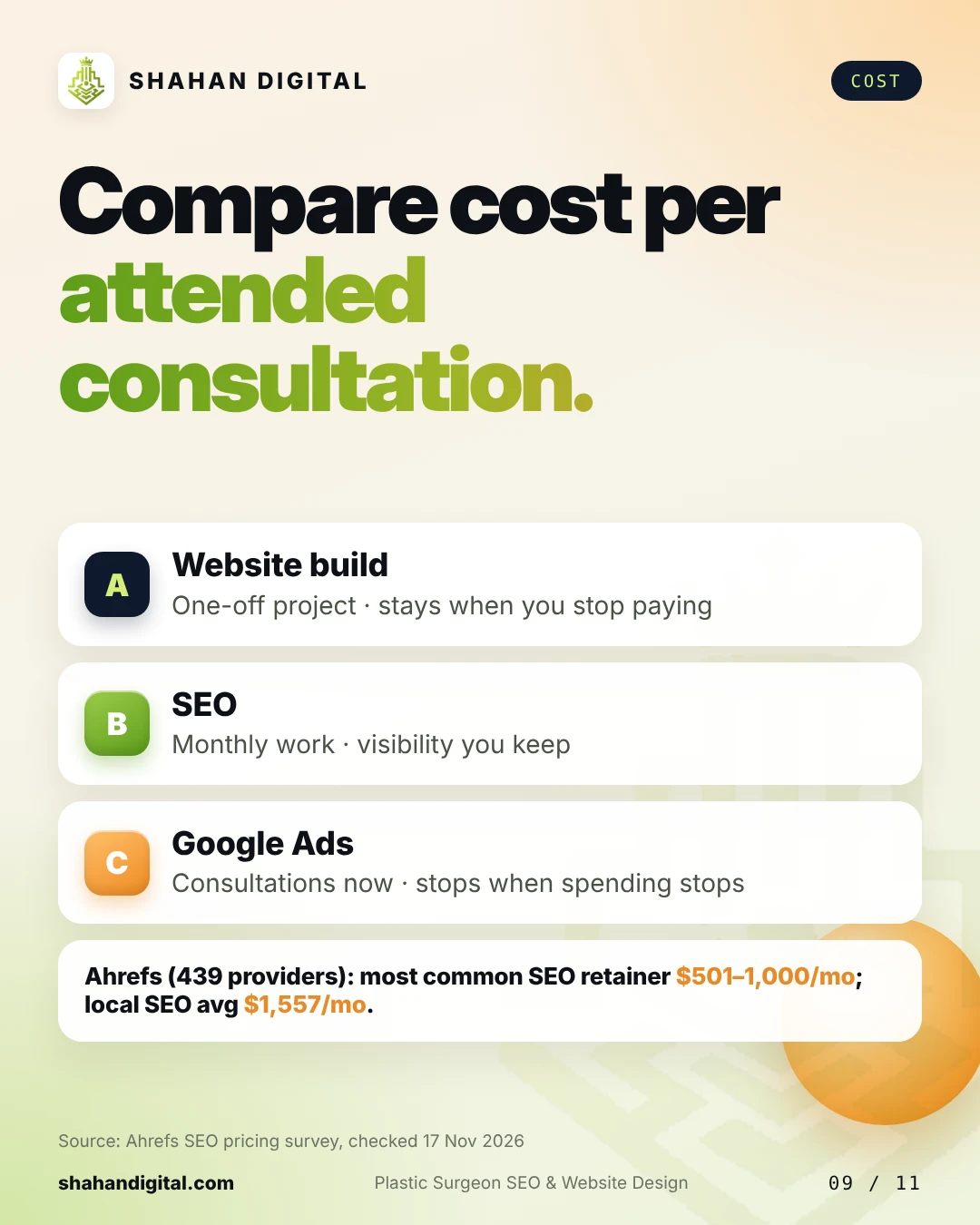
| Website build | SEO | Google Ads | |
|---|---|---|---|
| Type of cost | One-off project | Monthly work | Per click |
| Speed | Weeks to build | Months to compound | Immediate |
| When you stop paying | The site stays | Pages keep working, more slowly | Visibility stops |
| Watch out for | Lost URLs and slow galleries | Unreviewed medical content | Healthcare ad policies |
What other plastic surgery marketing agencies offer
We reviewed the first page of Google for “plastic surgeon SEO and website design” on 17 November 2026. Several results are worth reading before you hire anyone, including us.| Result | What it does well | What’s missing for a buyer |
|---|---|---|
| Rosemont Media | Specialist in surgeon sites; takes the emotional side of the decision seriously | Little on regulation or measurement |
| HigherVisibility | Connects design and SEO clearly | General best practice; few specifics by procedure |
| WebFX | Clear service list with call tracking and reporting | Large-agency sales page |
| Digital Logic | Practical on site structure and local SEO | Bold claims about results without context |
| TheeDigital | Good on WordPress builds and galleries | Little on compliance or international patients |
| Optimum7 | Useful checklist on mobile and speed | Light on content and trust signals |
How to measure the project
Track the path from search to surgery: impressions for your procedures and locations, consultation requests (forms, calls and WhatsApp), consultations attended, and procedures booked. If requests rise but attendance doesn’t, look at how fast your team responds and what happens between enquiry and consultation before changing the website.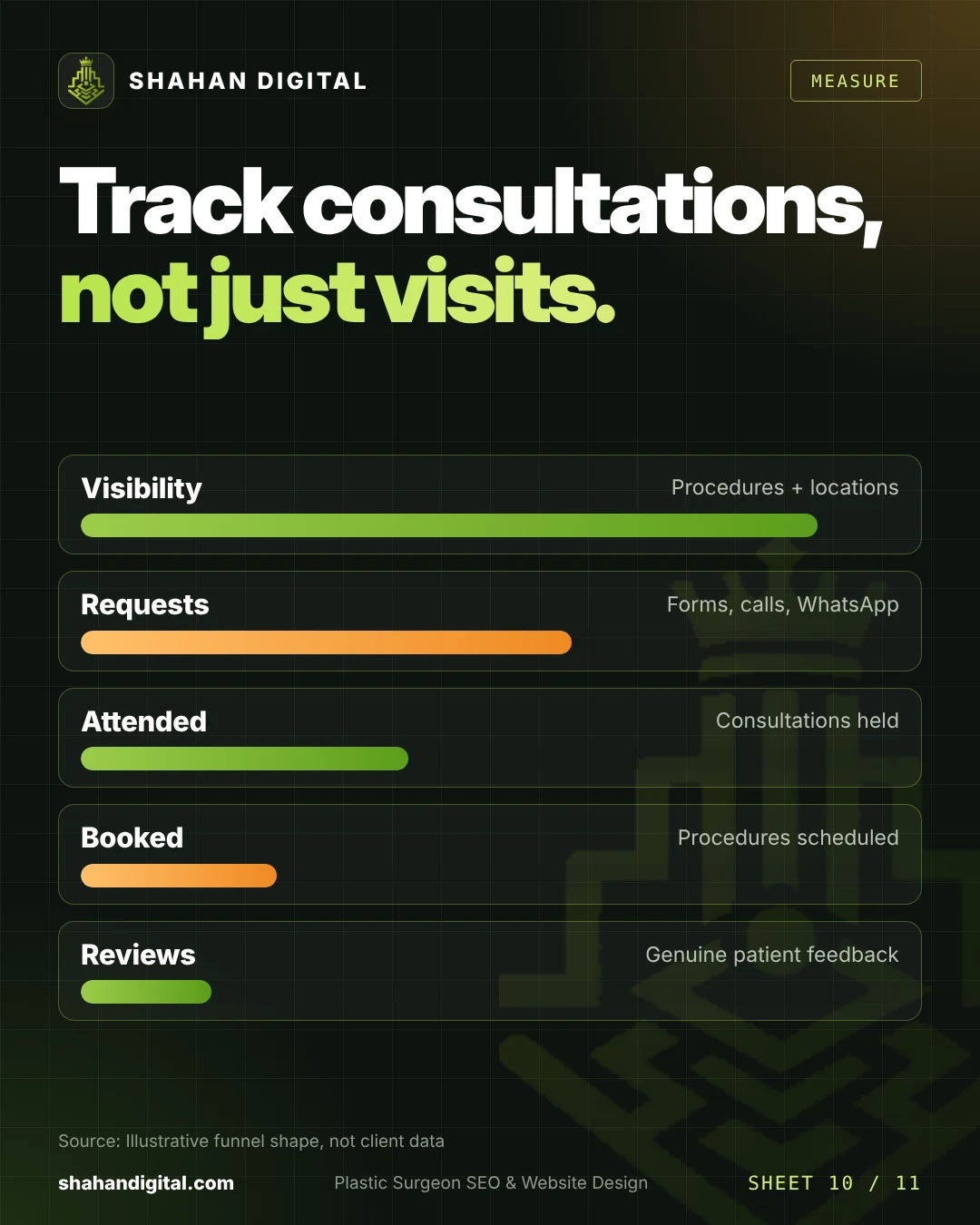
The first 90 days
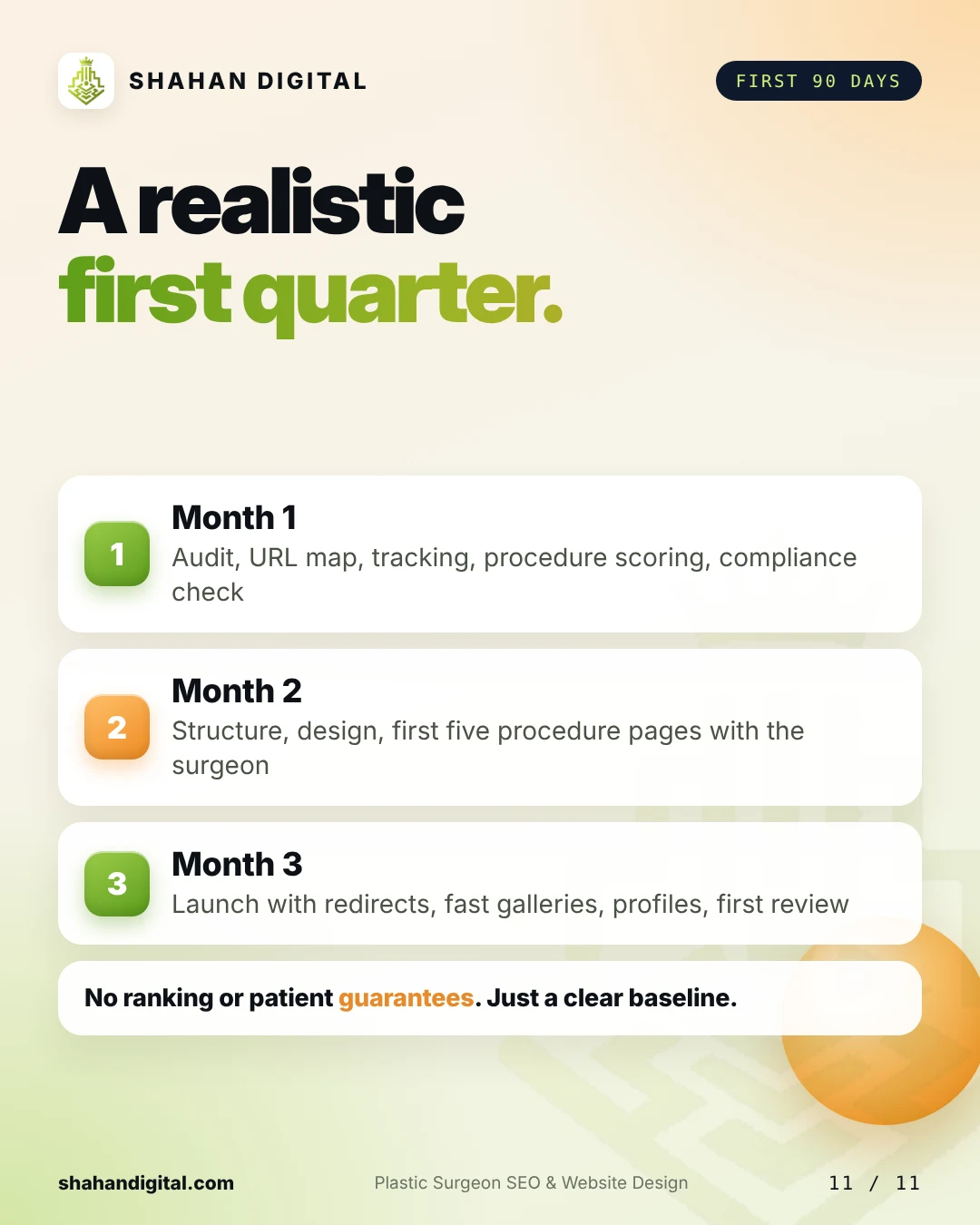
| Month | Work | What you should see |
|---|---|---|
| 1 | SEO audit, URL map of pages to keep, tracking, procedure scoring, compliance check | A clean baseline and a ranked page list |
| 2 | Site structure and design; first five procedure pages written with the surgeon | Approved designs and medically reviewed pages |
| 3 | Launch with redirects, compressed galleries, Business Profiles and review routine | No lost traffic at launch, first consultation requests from new pages |
How we work with plastic surgeons
We can design and build the site and run SEO afterwards, run SEO on an existing site, work alongside your current web team, or carry out a one-off audit before a redesign. We work remotely, with weekly updates and a monthly review. A proposal from us sets out what we’d fix first, who owns each task, how the surgeon reviews medical content, how we’ll measure consultations against today’s baseline, and what it costs. We don’t promise rankings or patient numbers, and we don’t write before-and-after claims or reviews for you. Related guides: SEO for dentists and Google Ads management if you need consultations sooner.Frequently asked questions
Should SEO and website design be done by the same team?
It helps. Most SEO problems on surgeon sites come from design decisions: thin procedure pages, heavy galleries, changed URLs. If two teams are involved, the SEO team should approve the site structure and URL map before design starts.How much does plastic surgeon SEO cost?
Ahrefs’ survey of 439 providers found monthly retainers most often between $501 and $1,000, with local SEO averaging $1,557 a month across industries (checked November 2026). Healthcare is usually at the higher end because of medical review and competition. Website design is quoted separately.Can we use before-and-after photos?
In most markets, yes, with the patient’s written consent for marketing use, unedited images and honest context. Check your regulator’s rules; in the UK the ASA and GMC guidance both apply.Should we publish prices?
Patients search for cost, so a page that explains price ranges or what affects the price usually helps. Avoid time-limited deals and discounts that could push patients into rushed decisions, which UK guidance specifically warns against.How do we reach international patients?
With separate language versions written by native writers, pages that answer travel and aftercare questions, and proper hreflang set-up. Machine-translated pages rarely earn trust on medical topics.How long does it take to see results?
Fixes to an existing site can show early signs within weeks. New procedure pages usually take a few months to settle, depending on competition and your site’s authority. No one can guarantee a timeline.Ready for a website patients trust?
Send us your website, the procedures you want to grow and where your patients come from. We’ll scope a first review around one question: where are patients finding you, and where are they leaving before they book?
Editorial note: Facts and figures were checked against the linked sources on 17 November 2026. Procedure figures are ISAPS survey estimates. Price figures are cross-industry averages from Ahrefs’ survey. Regulatory points are a summary, not legal advice; check the rules in your own country. The priority-score example is illustrative, not a client result. No ranking, consultation or patient result is guaranteed.
Written by
Shahan Behkamrad
Author · Founder of Shahan Digital · SEO & GEO Strategist
Shahan Behkamrad is an SEO and GEO strategist and the founder of Shahan Digital. Since 2017 he has built search strategies for businesses in Persian, Arabic, English and Turkish markets, usually working alongside a client’s in-house team to decide what to fix first, what to build next and how to measure it.
- Strategy before tactics: every engagement starts with a diagnosis of where growth is being lost, then a ranked plan tied to enquiries and revenue, not to rankings alone.
- Current with how search works now: his work covers Google Search, Google Maps, AI Overviews and AI assistants such as ChatGPT, and he checks Google’s documented updates before changing a client’s plan.
- Specialist depth: technical, international and multilingual SEO, local SEO and AI search visibility (GEO).
- Has trained more than 650 students in SEO and digital marketing, including as an official instructor at Iran’s Technical and Vocational Training Organization.
- Host of the Shahan Behkamrad Podcast on business growth, branding, SEO and AI.
- Master’s student in Strategic Marketing and Brand Management at Nişantaşı University, Istanbul; holds 25+ international digital marketing certifications.