
Quick answer
Yacht charter SEO works when someone planning a trip finds a page for the exact destination and type of charter they want, sees the boats, the real price range and what’s included, and can send an enquiry in a minute. For most charter companies that means destination pages written by people who know those waters, one page per yacht with honest specs and photos, pages ready before the booking season opens, a Google Business Profile for each real base, and tracking that shows which searches turn into booked charters rather than visits.
Below: the charter market in numbers, how clients search, destination and yacht pages, a page priority score, the booking calendar, platforms versus direct bookings, local and multilingual search, cost, what other agencies offer, and how to measure charters.
Who this guide is for. Owners and marketing leads at yacht charter companies, crewed and bareboat fleet operators, gulet companies, day-boat rental businesses and charter brokers.
Pick your path:
- Not sure which destinations to build first → page priority score
- Paying high platform commissions → platforms vs direct bookings
- Day charters and boat rental → local search
- Comparing agencies → what other agencies offer
Key takeaways
- Charter clients search by destination and experience (“crewed catamaran charter Greek islands”), not by company name.
- Destination pages written from real local knowledge beat thin pages copied from a booking-system feed.
- Pages need to be live and indexed months before the season. SEO started in June won’t fill July.
- Platforms bring bookings fast but take a commission. SEO builds direct bookings you keep.
- Judge yacht charter SEO by enquiries, booked weeks or days and margin, not by visits.
Before you invest in yacht charter SEO
List last season’s bookings by destination, boat, length of charter, value and source (direct, platform, broker, repeat). That shows which routes and boats are worth pages first, and how much you’re paying platforms for bookings you could win directly.
The charter market in numbers
The superyacht end of the market is tracked closely. Booking data from YachtFolio, the platform run by MYBA The Worldwide Yachting Association, showed 13,812 charters on yachts over 20 metres in 2025, up 10.28% on 2023, with an average charter of 8.2 days. The number of yachts available for charter grew 9.33% over the same period. IYC’s review of 2025 found charter weeks broadly level with 2024 and Greece the leading destination with 26% of bookings.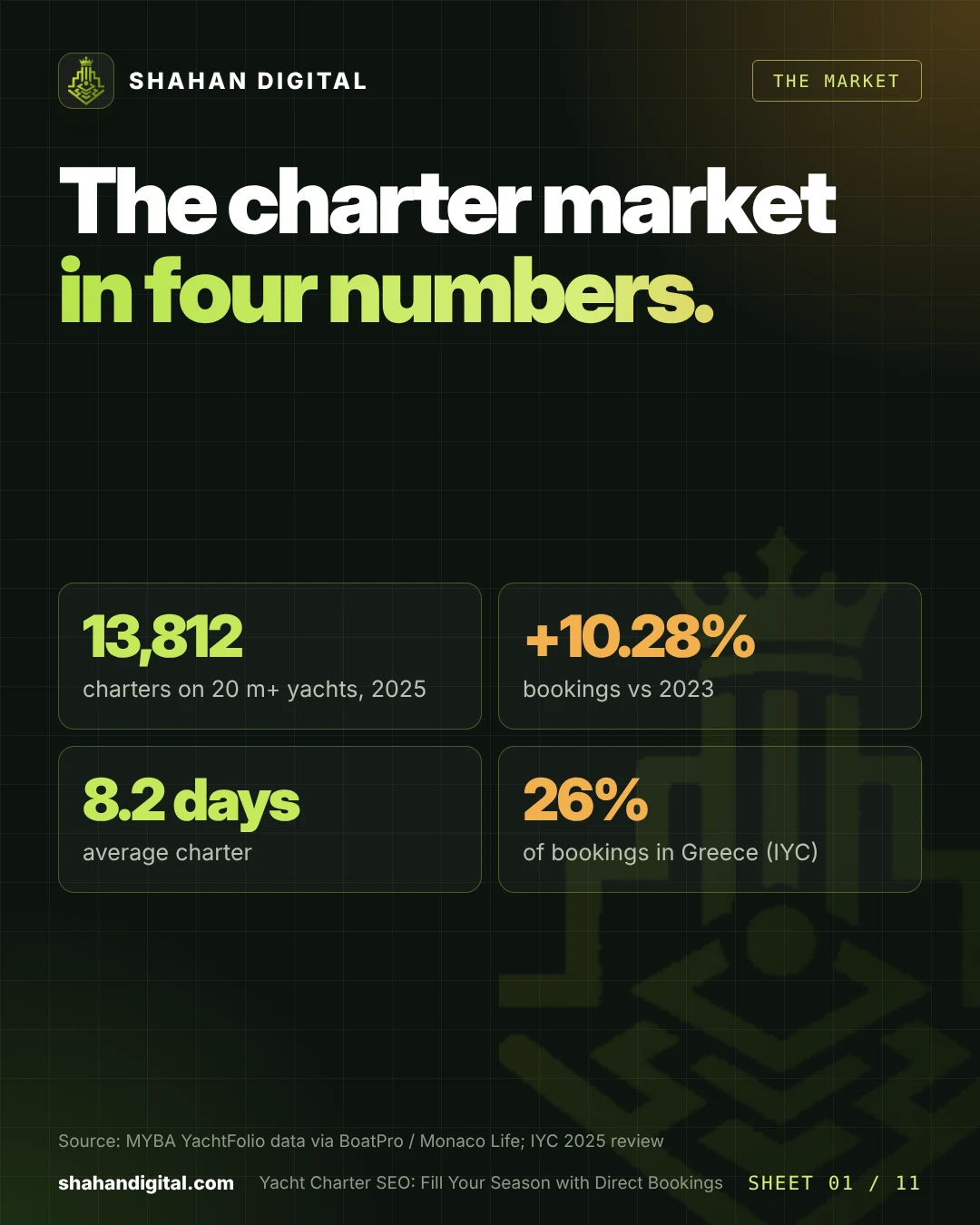
How charter clients search
Charter clients start with a place and an idea of the trip. They narrow down by boat type, group size, crew or no crew, and budget. Only near the end do they compare companies.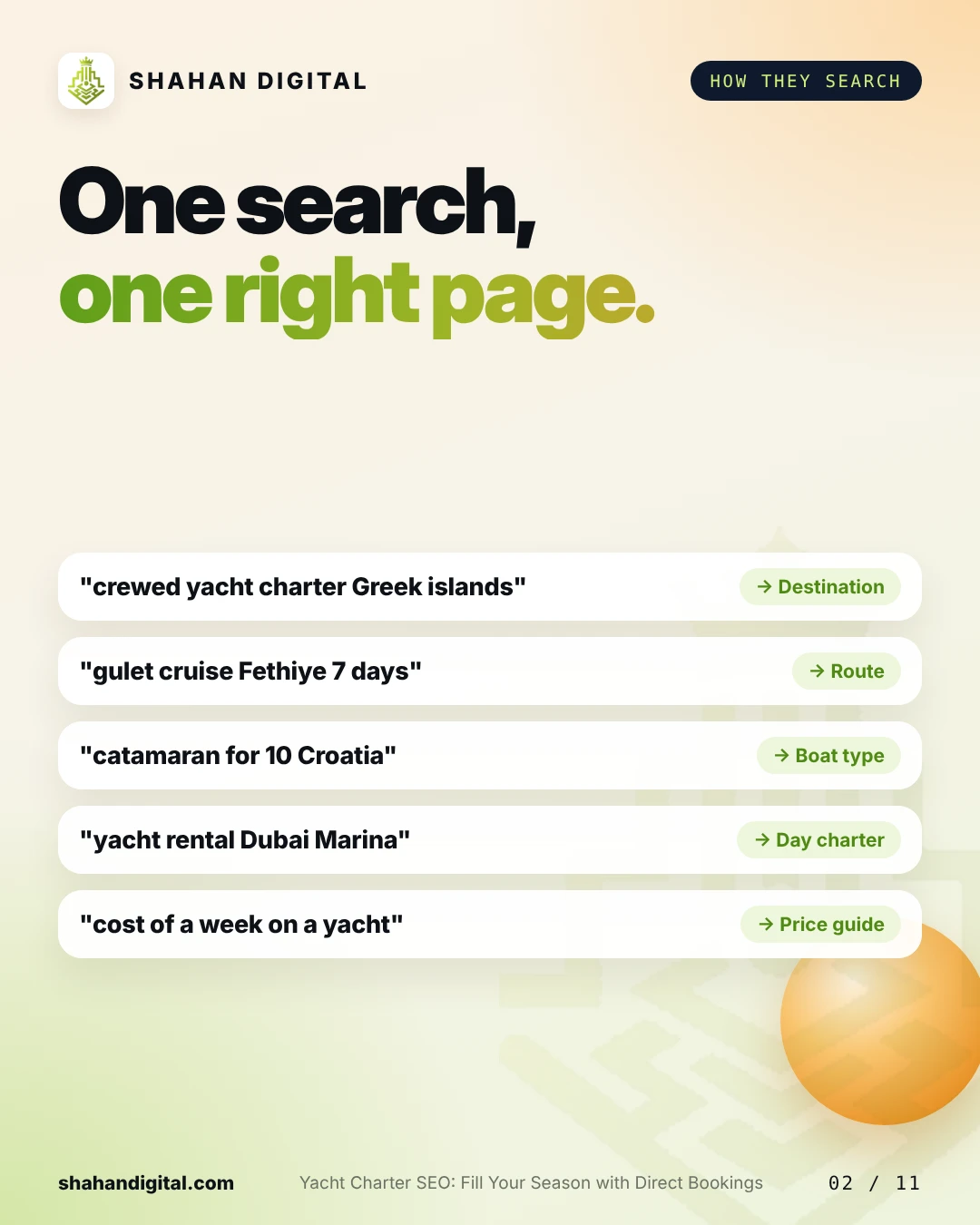
| Search (example) | What they want | Right page |
|---|---|---|
| “crewed yacht charter Greek islands” | A destination and a type of trip | Destination + charter type page |
| “gulet cruise Fethiye 7 days” | A route and a duration | Route page with itinerary |
| “catamaran charter for 10 people Croatia” | A boat that fits the group | Fleet filter or boat-type page |
| “yacht rental Dubai Marina 3 hours” | A day charter nearby | Day-charter page for that base |
| “how much does a week on a crewed yacht cost” | A budget | Pricing guide with real ranges |
| “bareboat charter licence requirements Greece” | A rule they need to meet | Guide linked to bareboat pages |
Destination and route pages that bring enquiries
The destination page is where most charter enquiries start. A good one reads like advice from a skipper who knows the area: which islands or bays are worth it, how many days a sensible route takes, when the wind picks up, which marinas fill early, and which of your boats suit that trip.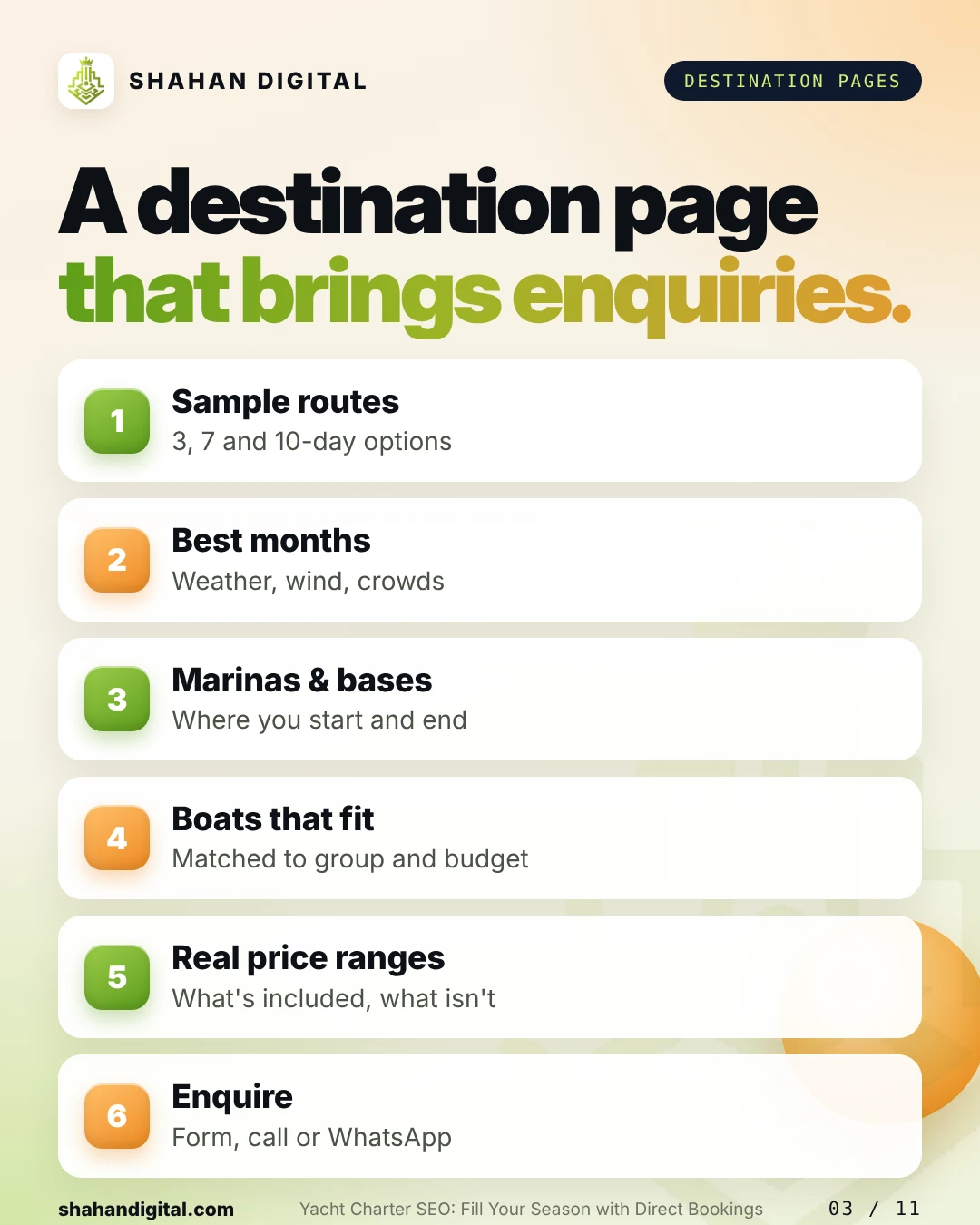
“Every charter company can copy the same boat specs from the booking system. What they can’t copy is your skipper explaining why he’d do the Kornati islands south to north in July, or which bay to skip when the meltemi blows. That’s the content that ranks, and it’s the content that makes a guest trust you with their holiday.”
Shahan Behkamrad, Founder of Shahan Digital
Yacht pages
Each yacht deserves its own page: real photos of that boat (not the brochure), cabin layout, crew, what’s included and what isn’t, where it’s based, and recent guest reviews. If your fleet comes from a booking system feed, the pages often share text with dozens of other sites. Adding your own photos, a short note from the crew and honest details about who the boat suits is what separates your page from the copies.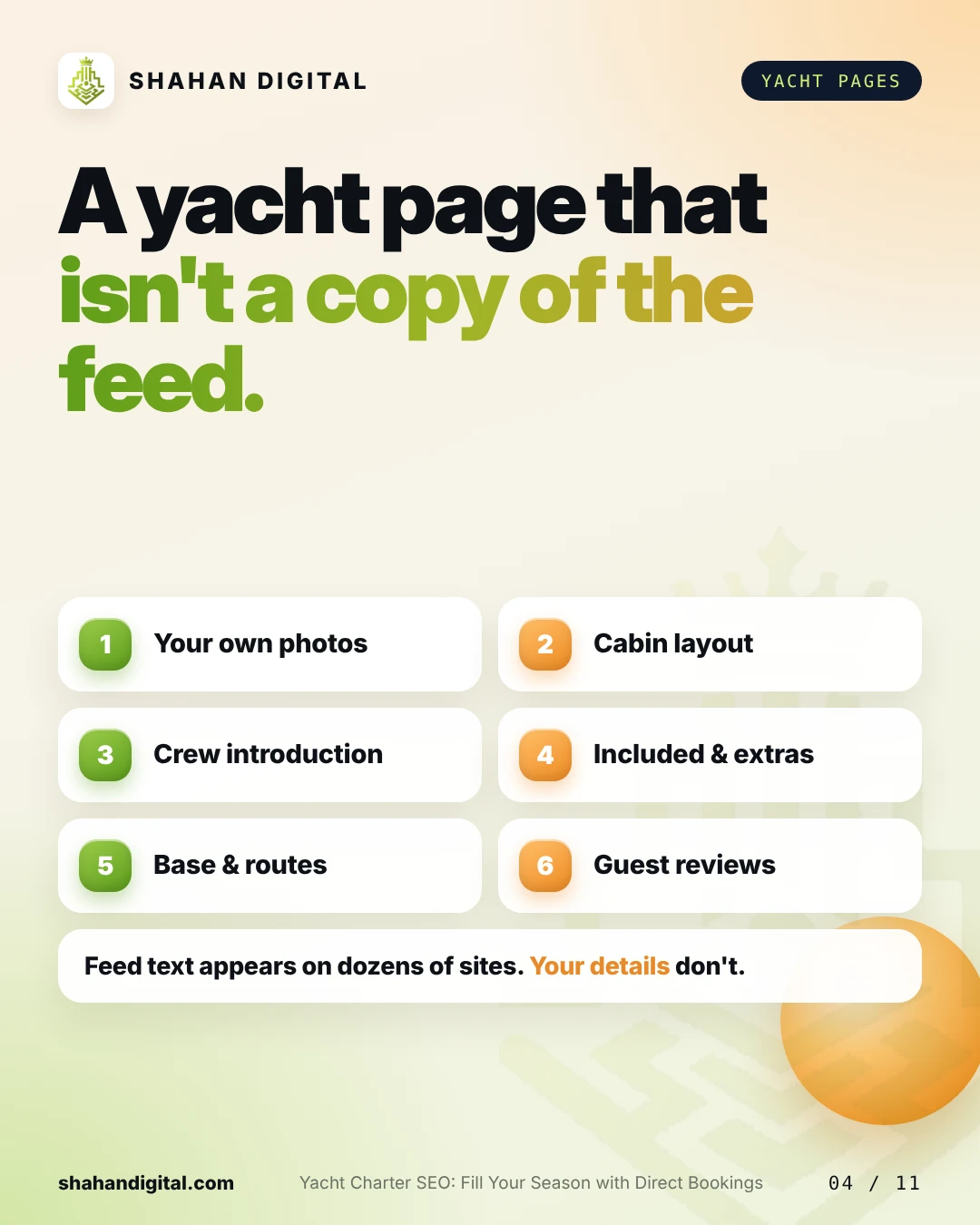
Decision aid: the destination-page priority score
You can’t build pages for every island, route and boat type at once. Score each destination-and-charter-type pair from 1 to 5 on five questions, then build the top five first.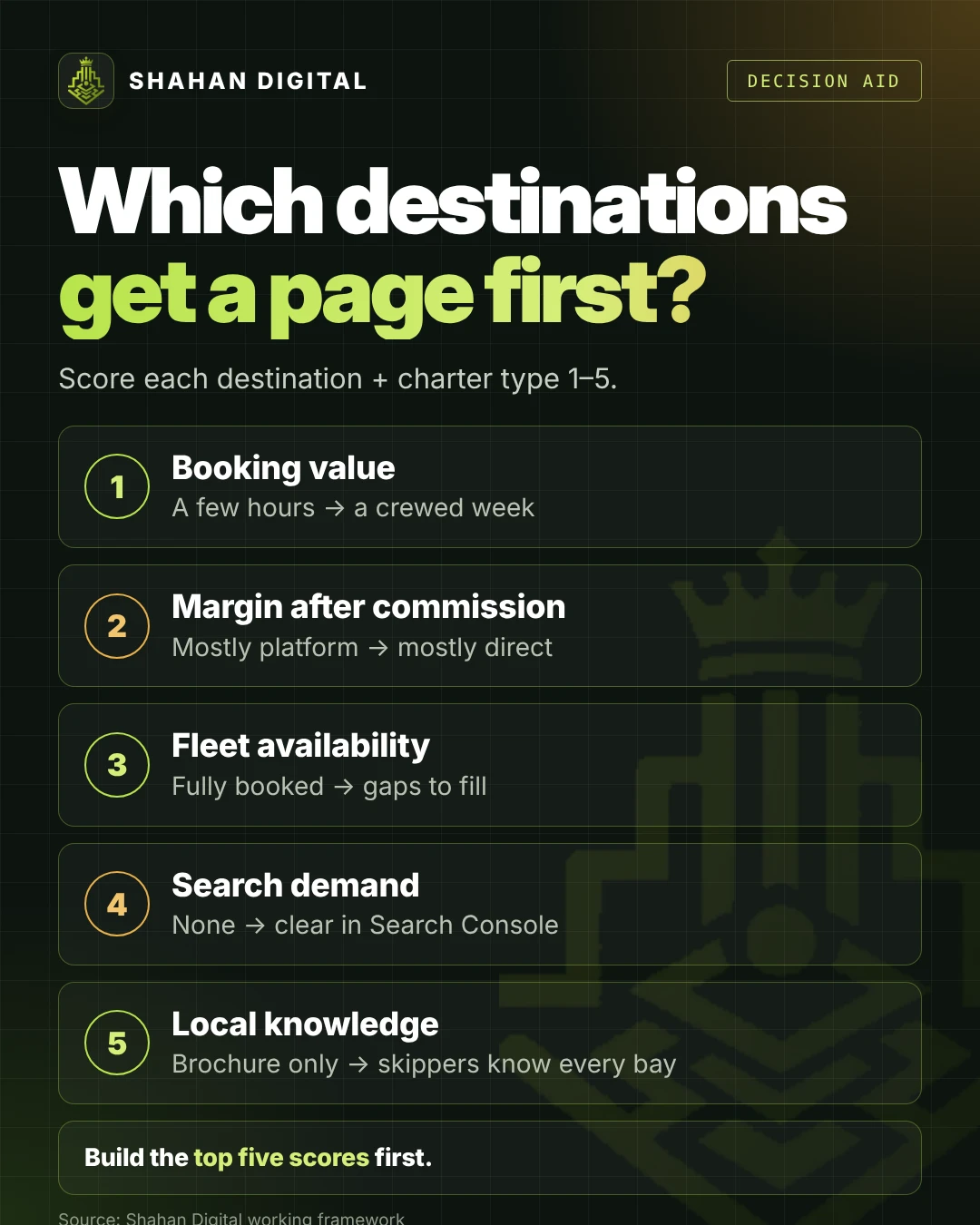
| Question | Score 1 | Score 5 |
|---|---|---|
| What’s a typical booking worth? | A few hours | A week or more on a crewed yacht |
| What’s your margin after commission? | Mostly platform bookings | Mostly direct bookings |
| Do you have boats free in season? | Fully booked already | Clear gaps to fill |
| Do people search for it? | No impressions or volume | Clear demand in Search Console or keyword data |
| How much local knowledge can you publish? | None beyond the brochure | Skippers who know every bay |
Worked example (illustrative): Crewed catamaran charters in the Cyclades score 5 + 3 + 4 + 5 + 4 = 21. Two-hour boat rental from the same base scores 1 + 4 + 3 + 3 + 3 = 14. The Cyclades page gets built first; short rentals can sit on a general day-charter page for now.
Want us to score your destinations?
Send us your website, your bases and fleet, and a rough split of last season’s bookings by source. We’ll come back with the five pages we’d build first and the date they need to be live.
Plan SEO around the booking calendar
Charters are seasonal, and so is search. Mediterranean summer charters run roughly May to October, and many guests plan months ahead, although recent market reports note more last-minute bookings. New pages usually need weeks to months to be crawled, indexed and settle in rankings. That means destination pages for next summer should be live in the autumn or winter before, not in May.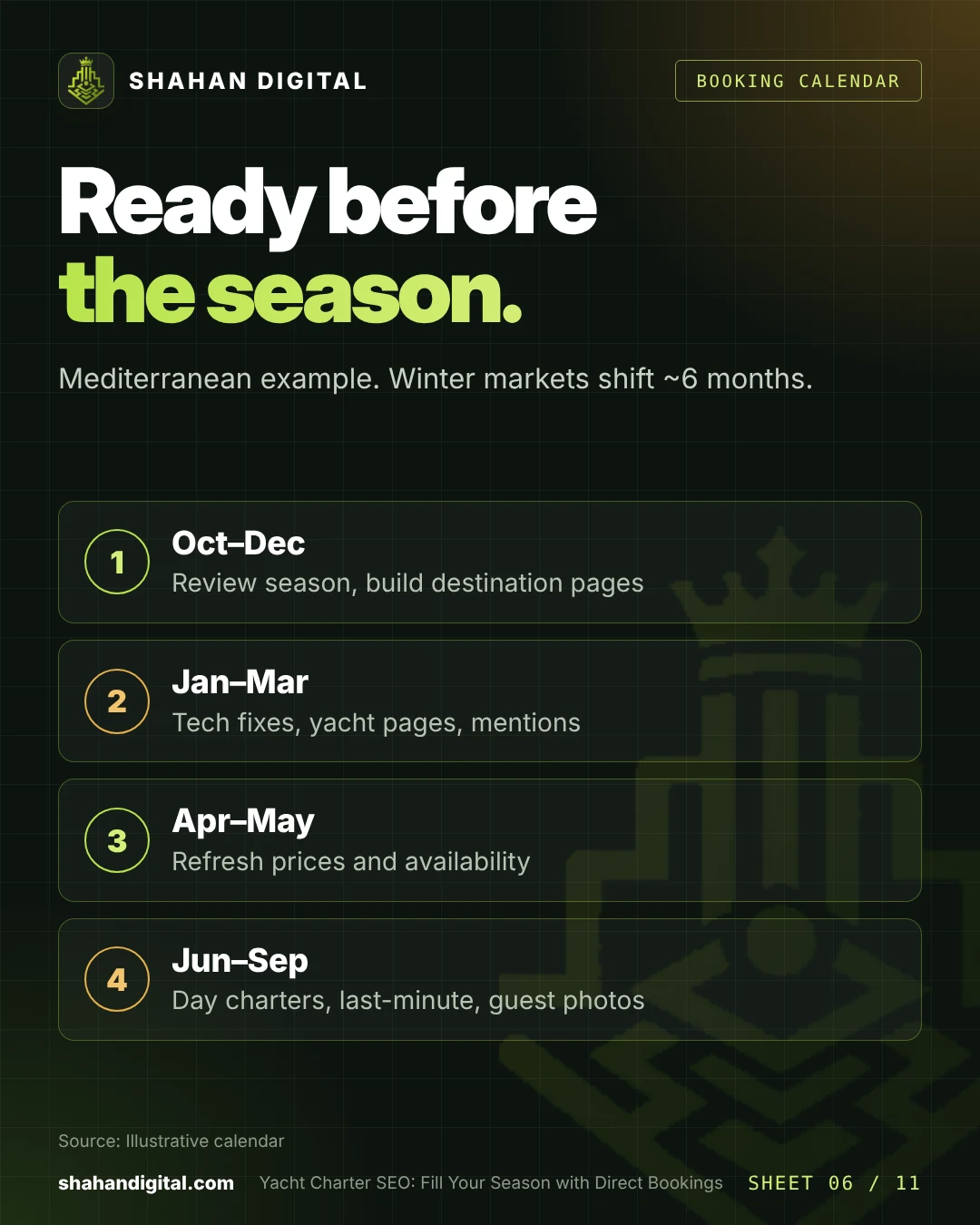
| When (Mediterranean example) | SEO work |
|---|---|
| October to December | Review last season; build and update destination and route pages |
| January to March | Technical fixes, new yacht pages, outreach for mentions, review collection |
| April to May | Refresh prices and availability, add early-season offers where honest |
| June to September | Day charters, last-minute availability, photos and reviews from guests |
Platforms versus direct bookings
Booking platforms are useful. They bring guests you’d never reach on your own, and many charter companies depend on them. They also take a share: Click&Boat’s own help centre says owners should deduct a commission of up to 23% from the displayed price unless otherwise agreed. Commissions differ by platform and contract, so check your own agreements.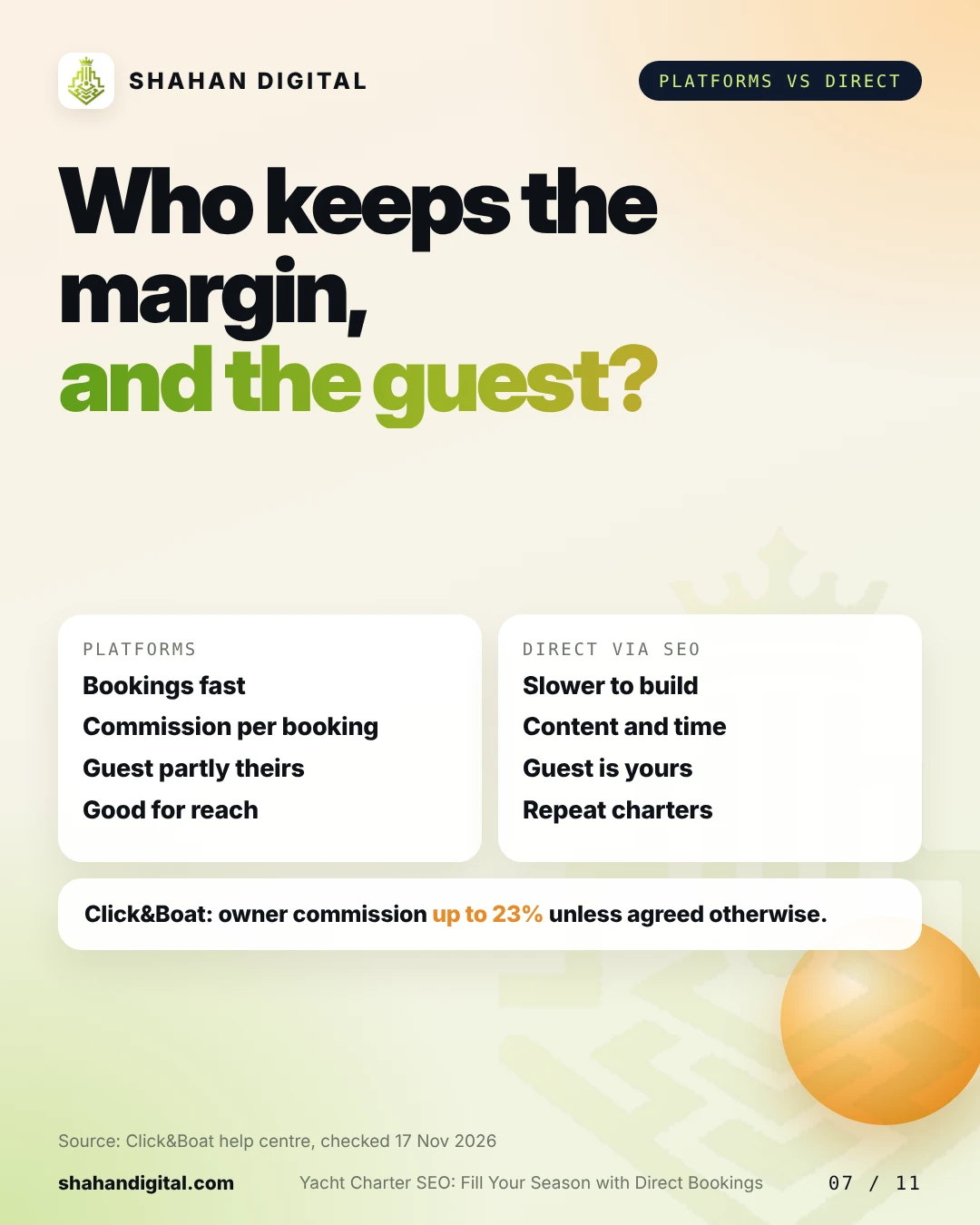
Local search for bases and day charters
Day charters and boat rentals are local searches: “boat rental Bodrum”, “yacht hire Dubai Marina”, “Bosphorus private boat tour”. For these, Google’s local results matter most. Google says local ranking is based on relevance, distance and prominence, which for a charter base means the right category, an accurate marina location, recent reviews with photos, and a link to the matching base page.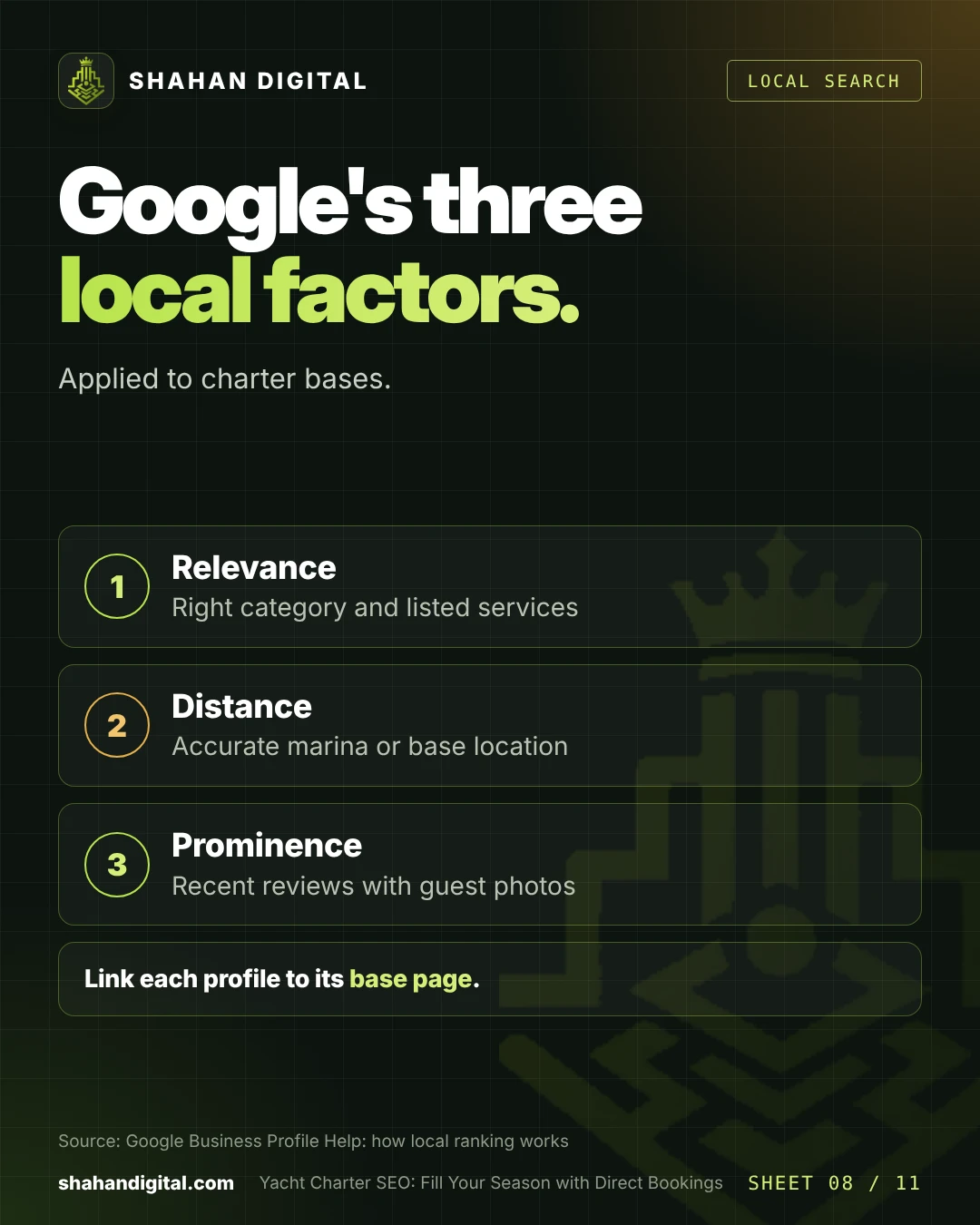
Guests from abroad and other languages
Charter guests are often international: Germans and Brits chartering in Croatia and Türkiye, Gulf families chartering in the Mediterranean, Europeans booking winter charters in Dubai. They search in their own language, and a translated page that sounds machine-made rarely wins a four- or five-figure booking. Google’s guidance on localized versions of a page explains how to set up hreflang so the right language version shows.Our international SEO work covers the set-up, with native writers for each language, including Arabic SEO for Gulf guests. Guests also ask AI assistants for charter ideas and companies. Our AI search optimization service tests what they’re told about you with dated prompts. No one can guarantee a mention.What yacht charter SEO costs
Ahrefs’ survey of 439 SEO providers found monthly retainers most often in the $501 to $1,000 range, with local SEO averaging $1,557 a month across industries (checked 17 November 2026). Those are cross-industry averages, not charter quotes. A single day-charter base needs far less work than a fleet operator in several countries and languages.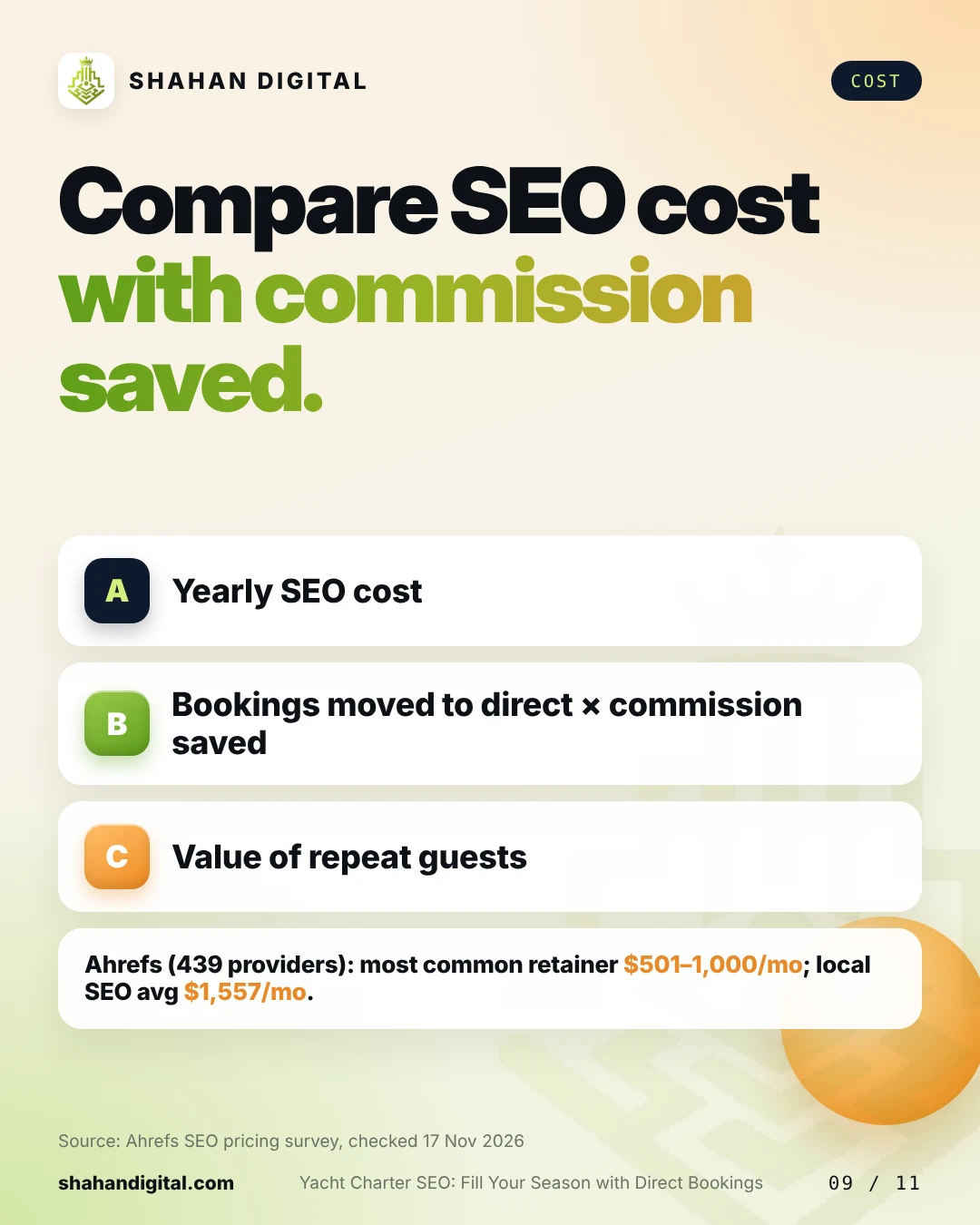
| Booking platforms | Google Ads | SEO | |
|---|---|---|---|
| Speed | Immediate | Immediate | Months, so start before the season |
| You pay | Commission per booking | Per click | Monthly work, not per booking |
| Guest relationship | Partly the platform’s | Yours | Yours |
| Best for | Reach and filling gaps | Peak season demand | Lasting direct bookings and repeat guests |
What other yacht charter SEO agencies offer
We reviewed the first page of Google for “yacht charter SEO” on 17 November 2026. Several results are worth reading before you hire anyone, including us.| Result | What it does well | What’s missing for a buyer |
|---|---|---|
| SEO Sherpa | Thoughtful on high-net-worth clients and AI search | Focused on superyachts; little for bareboat or day charters |
| Epic Edits | Understands charter seasons, brokers and enquiry tracking | Service page with headline claims but few specifics |
| Ranktracker | Useful list of destination and experience keywords | Short; written to sell a rank-tracking tool |
| 1Digital | Clear on seasonality and waterway-level searches | US-focused; mixes in its own platform |
| GOIGO | Practical on building yacht pages from a booking API | Pages built from feeds risk duplicating other sites |
How to measure yacht charter SEO
Track the path from search to booking: impressions for your destinations and boat types, enquiries by form, phone and WhatsApp, quotes sent, charters booked, booking value and the share booked direct. Compare season with season, not month with month, because charter search swings with the calendar.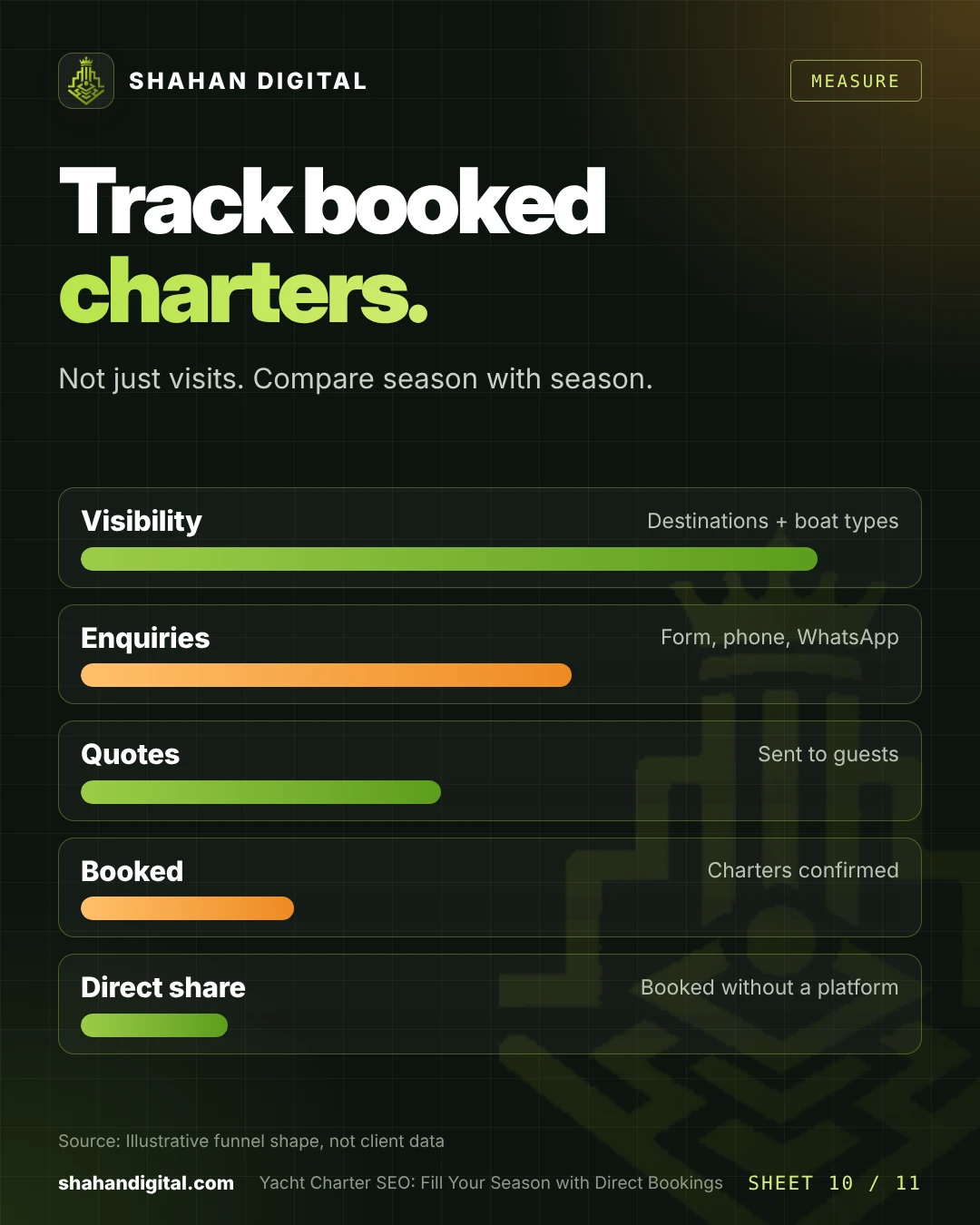
“For a charter company, the number I watch is the share of bookings that came direct, season on season. Rankings and traffic tell you whether the work is moving. That share tells you whether it’s paying.”
Shahan Behkamrad, Founder of Shahan Digital
The first 90 days
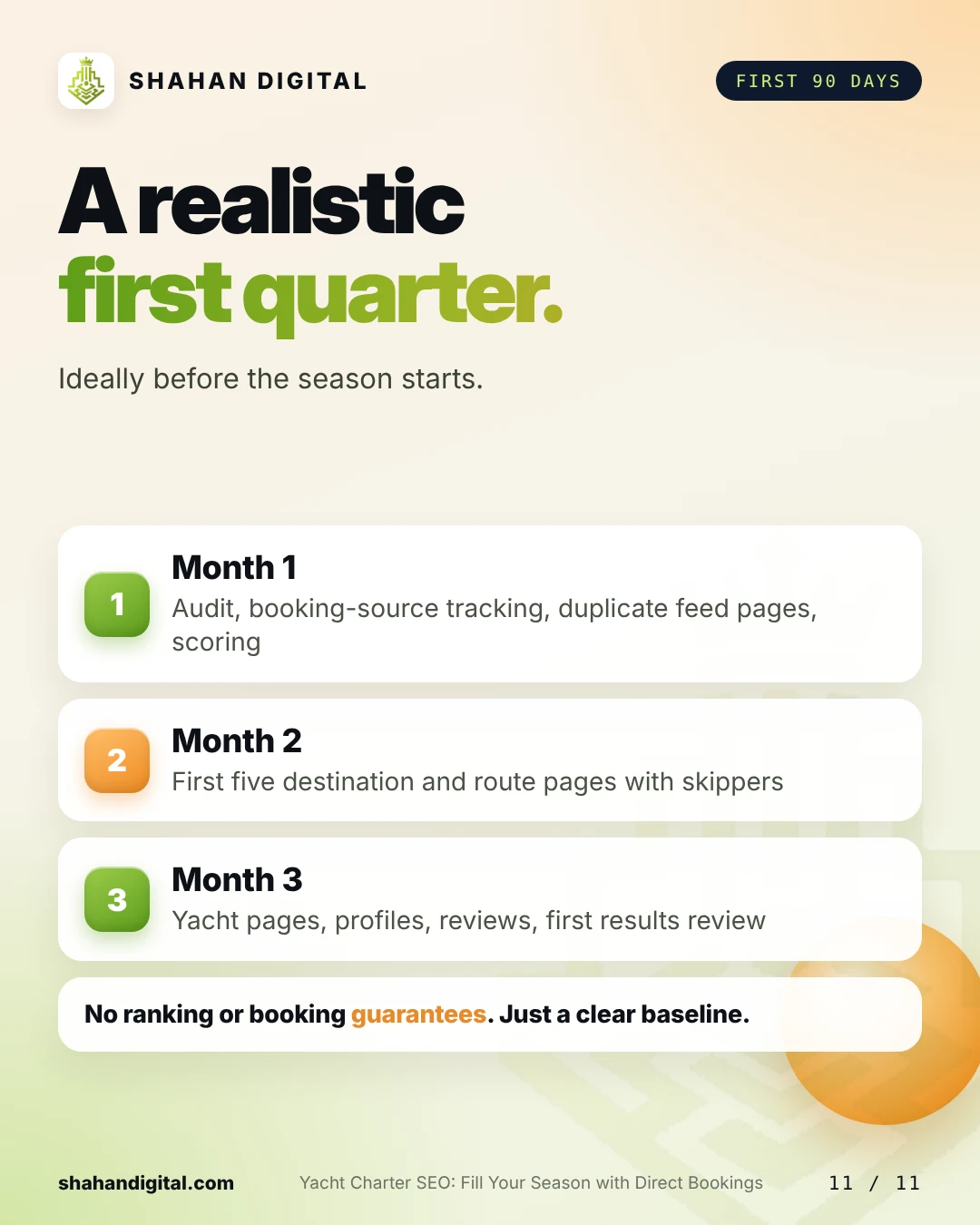
| Month | Work | What you should see |
|---|---|---|
| 1 | SEO audit, booking source tracking, duplicate feed pages, destination scoring | A clean baseline and a ranked page list |
| 2 | First five destination and route pages written with skippers and base managers | Pages indexed and first impressions |
| 3 | Yacht page upgrades, Business Profiles, review routine, first outreach for mentions | First direct enquiries from new pages and a plan for the season |
How we work with charter companies
We can run SEO end to end, work alongside your marketing team, train your staff to keep destination pages fresh, or carry out a one-off audit before the season. We work remotely, with weekly updates and a monthly review. A proposal from us sets out what we’d fix first, who owns each task (including anything your booking system provider has to change), how we’ll measure direct bookings against last season, and what it costs. We don’t promise rankings or bookings. Related reading: SEO for event planners, if you also sell corporate events on board, and competitor SEO analysis to see where rival charter companies are winning.Frequently asked questions
What does yacht charter SEO include?
Usually: destination and route pages written from local knowledge, one page per yacht, a pricing guide, Google Business Profiles for real bases, language versions for international guests, technical fixes for speed and duplicate feed pages, reviews, and tracking that links searches to booked charters.How much does yacht charter SEO cost?
Ahrefs’ survey of 439 providers found monthly retainers most often between $501 and $1,000, with local SEO averaging $1,557 a month across industries (checked November 2026). A single day-charter base needs far less work than a multi-country fleet. Ask for a written, itemised quote.When should we start SEO for next season?
As early as possible, ideally in the autumn or winter before. New pages usually take weeks to months to settle in search, and many guests plan their summer charters months ahead.Should we stop using booking platforms?
No. Platforms bring guests you’d struggle to reach yourself. The aim of SEO is to grow the share of direct bookings over time, especially repeat guests and high-value charters.Can we use the yacht descriptions from our booking system?
You can start with them, but many other sites use the same text. Add your own photos, crew notes, real inclusions and who each boat suits, so your pages offer something the copies don’t.How long does yacht charter SEO take?
Profile and technical fixes can show early signs within weeks. New destination pages usually take a few months, depending on competition and your site’s authority. No one can guarantee a timeline.Ready to fill next season with more direct bookings?
Send us your website, your bases, fleet and the destinations you want to grow. We’ll scope a first review around one question: which searches should be bringing you charters, and what it would take to win them before the season starts.
Editorial note: Facts and figures were checked against the linked sources on 17 November 2026. Market figures cover yachts over 20 metres and come from MYBA YachtFolio data as reported by Monaco Life, and from IYC. Commission figures are from Click&Boat’s help centre and vary by contract. Price figures are cross-industry averages from Ahrefs’ survey. Search examples, the calendar and the priority-score example are illustrative, not client results. No ranking or booking result is guaranteed.
Written by

Shahan Behkamrad
Author · Founder of Shahan Digital · SEO & GEO Strategist
Shahan Behkamrad is an SEO and GEO strategist and the founder of Shahan Digital. Since 2017 he has built search strategies for businesses in Persian, Arabic, English and Turkish markets, usually working alongside a client’s in-house team to decide what to fix first, what to build next and how to measure it.
- Strategy before tactics: every engagement starts with a diagnosis of where growth is being lost, then a ranked plan tied to enquiries and revenue, not to rankings alone.
- Current with how search works now: his work covers Google Search, Google Maps, AI Overviews and AI assistants such as ChatGPT, and he checks Google’s documented updates before changing a client’s plan.
- Specialist depth: technical, international and multilingual SEO, local SEO and AI search visibility (GEO).
- Has trained more than 650 students in SEO and digital marketing, including as an official instructor at Iran’s Technical and Vocational Training Organization.
- Host of the Shahan Behkamrad Podcast on business growth, branding, SEO and AI.
- Master’s student in Strategic Marketing and Brand Management at Nişantaşı University, Istanbul; holds 25+ international digital marketing certifications.