

Quick answer
SEO for recruitment agencies works when an employer with a hard-to-fill role finds a page for that exact sector and location, sees proof you’ve filled similar roles, and can send a brief in under a minute. Candidate traffic matters too, but it’s usually the employer side that pays the fees. For most agencies that means sector-and-location pages for your profitable desks, job pages that follow Google’s job posting rules, a Google Business Profile for each real office, and tracking that follows a search all the way to a signed brief.
Below: the recruitment market in numbers, how employers and candidates search, a page priority score, Google for Jobs, local search, trust assets, AI search, cost, what other recruitment SEO agencies offer, and how to measure placements.
Who this guide is for. Owners, directors and marketing leads at recruitment and staffing agencies, from two-desk boutiques to multi-office firms, who want more employer briefs and better candidates from search.
Pick your path:
- Not sure which pages to build → page priority score
- You post a lot of jobs → Google for Jobs and expired roles
- You have physical offices → local search
- Comparing agencies → what other agencies offer
Key takeaways
- Recruitment sites serve two buyers. Employers bring the fees; candidates bring the supply. They need different pages.
- Employers search by role, sector and city (“cyber security recruiters London”), not “recruitment agency”.
- Google wants JobPosting markup only on single job pages, matching what’s visible, and removed when the job closes.
- Job boards will usually win broad job-title searches. Agencies win on niche sector and location pages backed by real market knowledge.
- Judge recruitment SEO by briefs, placements and fees, not by visits.
Before you invest in recruitment SEO
Pull your last 12 months of placements from the CRM: sector, role level, location, fee and how the client first found you. That list tells you which desks deserve pages first, and whether “website” is even recorded as a source today. If it isn’t, fix that before you spend anything.
The recruitment market in numbers
Recruitment is a large, cyclical market, and the cycle is turning. The American Staffing Association reports US staffing sales of $113.5 billion in 2025, down 8.5% on 2024, followed by the first year-on-year growth since late 2022 in the second quarter of 2026, with total revenue up 3.3%. In the UK, the Recruitment & Employment Confederation puts the sector’s contribution at £40.6 billion of Gross Value Added in 2025, and counts 31,345 UK recruitment enterprises in 2025, up from 29,635 in 2023.More firms chasing a recovering market means more competition for the same employer searches. That’s where SEO earns its place: an agency that’s already visible for its sectors when hiring picks up gets the first calls.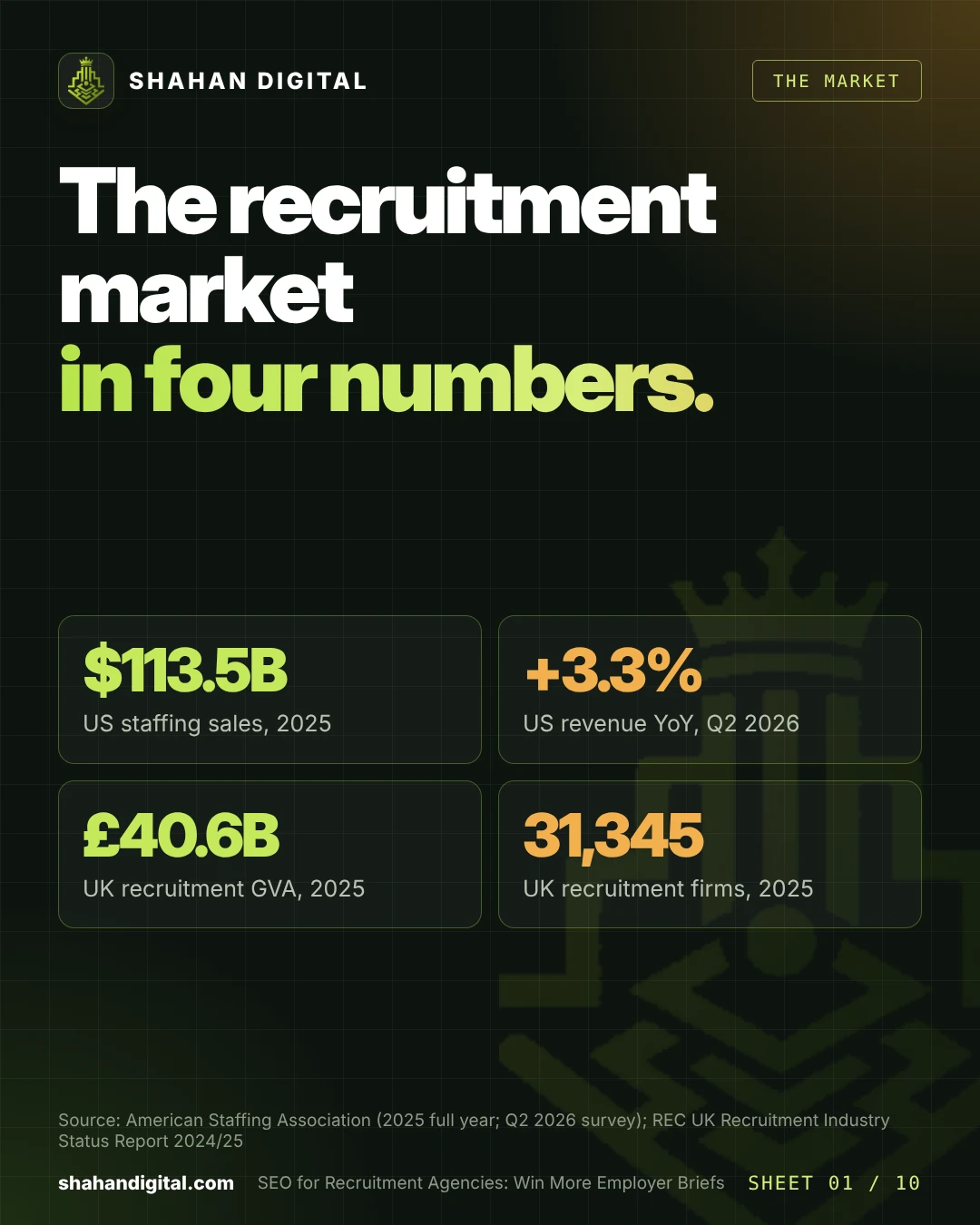
How employers and candidates search
A recruitment site has two buyers, and they almost never type the same thing. The employer has a business problem: a role that’s been open too long, a team to build, a contractor needed by Monday. The candidate wants a job, a salary benchmark or advice on a move. Mixing them on one page usually serves neither.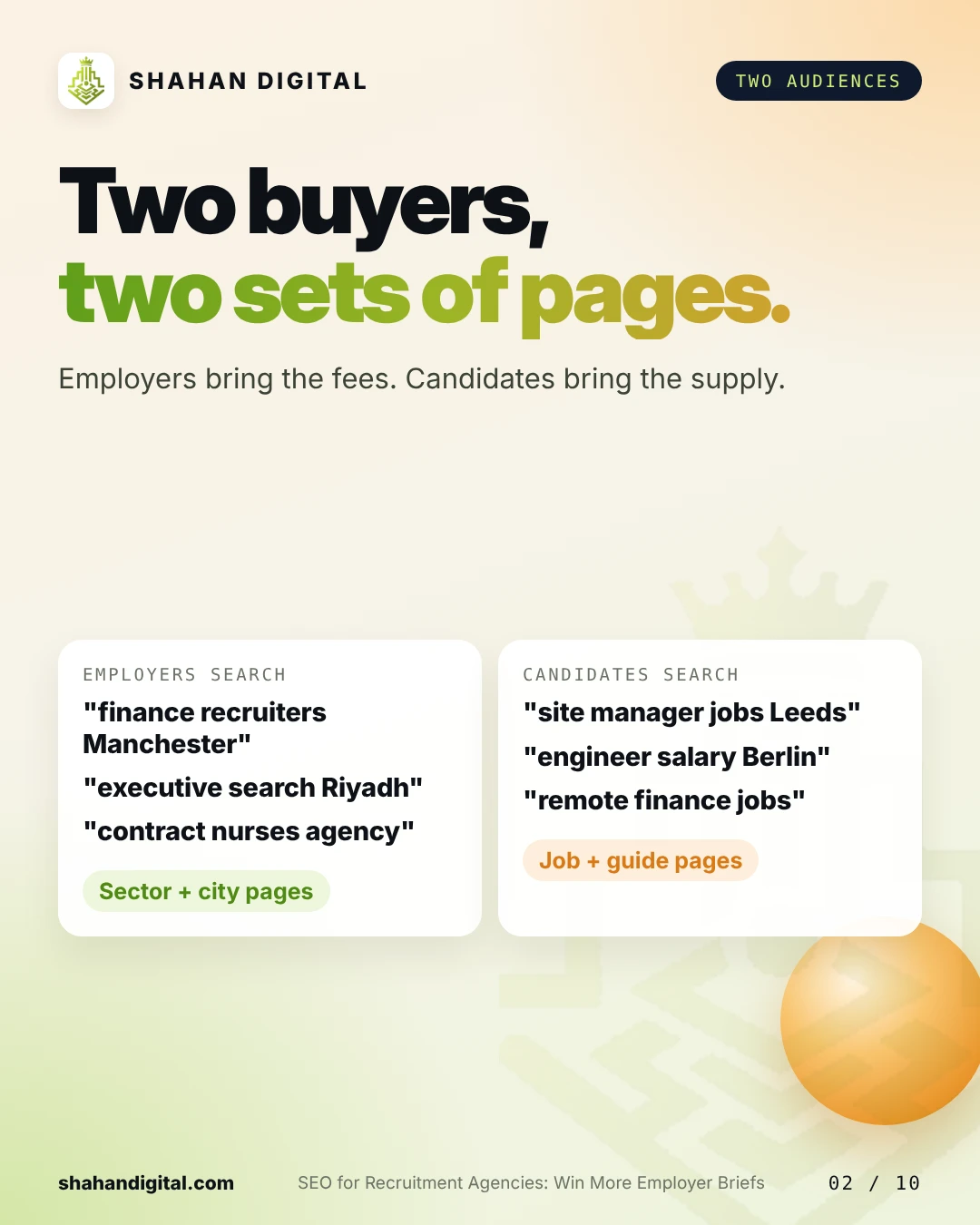
| Search (example) | Who’s searching | Right page |
|---|---|---|
| “accountancy recruitment agency Manchester” | Employer | Sector + location page |
| “executive search firm Riyadh” | Employer (board / HR director) | Executive search service page |
| “contract nurses agency” | Employer (clinic or care operator) | Contract staffing page for that sector |
| “software engineer salary Berlin 2026” | Both | Salary guide with a brief form and a jobs link |
| “site manager jobs Leeds” | Candidate | Jobs filtered by role and city |
| “how to resign from a job professionally” | Candidate | Career guide (low priority unless it feeds a desk) |
Employer pages that turn searches into briefs
The highest-value page on most recruitment sites is the one almost nobody builds properly: the sector-and-location page. “IT recruitment” on its own is a page that competes with every agency in the country. “Cyber security recruitment in Manchester”, written by someone who knows that market, competes with far fewer and speaks to a buyer who’s ready to call.
“An employer rarely searches for ‘recruitment agency’. They search for the role that’s been open for three months, in the city where they need it. If your site doesn’t have a page for that role and that city, the best consultant in the market is invisible at the exact moment the client is ready to pay.”
Shahan Behkamrad, Founder of Shahan Digital
Decision aid: the sector-page priority score
Ten sectors in five cities is fifty possible pages. You don’t need fifty. Score each sector-and-location pair from 1 to 5 on five questions, then build the top five first.
| Question | Score 1 | Score 5 |
|---|---|---|
| What’s the average fee on this desk? | Low-margin temp volume | High perm or executive fees |
| How many placements did it make last year? | A handful | Steady flow every month |
| How often do you win briefs once you’re asked? | Rarely | Most of the time |
| Can the desk take more work? | Consultants are maxed out | Capacity to grow |
| Do employers search for it in this city? | No impressions or volume | Clear demand in Search Console or keyword data |
Worked example (illustrative): Finance recruitment in Manchester scores 4 + 4 + 4 + 3 + 4 = 19. Warehouse temps in the same city score 2 + 5 + 3 + 2 + 3 = 15. The finance page gets built first; warehouse temps can wait or sit on a general industrial page.
Want us to score your desks for you?
Send us your website, the sectors and cities you recruit in, and a rough split of fees by desk. We’ll come back with the five pages we’d build first and why.
Job pages and Google for Jobs
Job pages bring candidates, and they’re also where recruitment sites most often break technically. Google’s job posting documentation is specific: put JobPosting structured data on the most detailed single-job page, not on lists of jobs; make sure every detail in the markup (salary, location, dates) also appears on the page; and remove the markup, add noindex or take the page down when the job closes. Google also offers the Indexing API to tell it when job URLs are added or removed.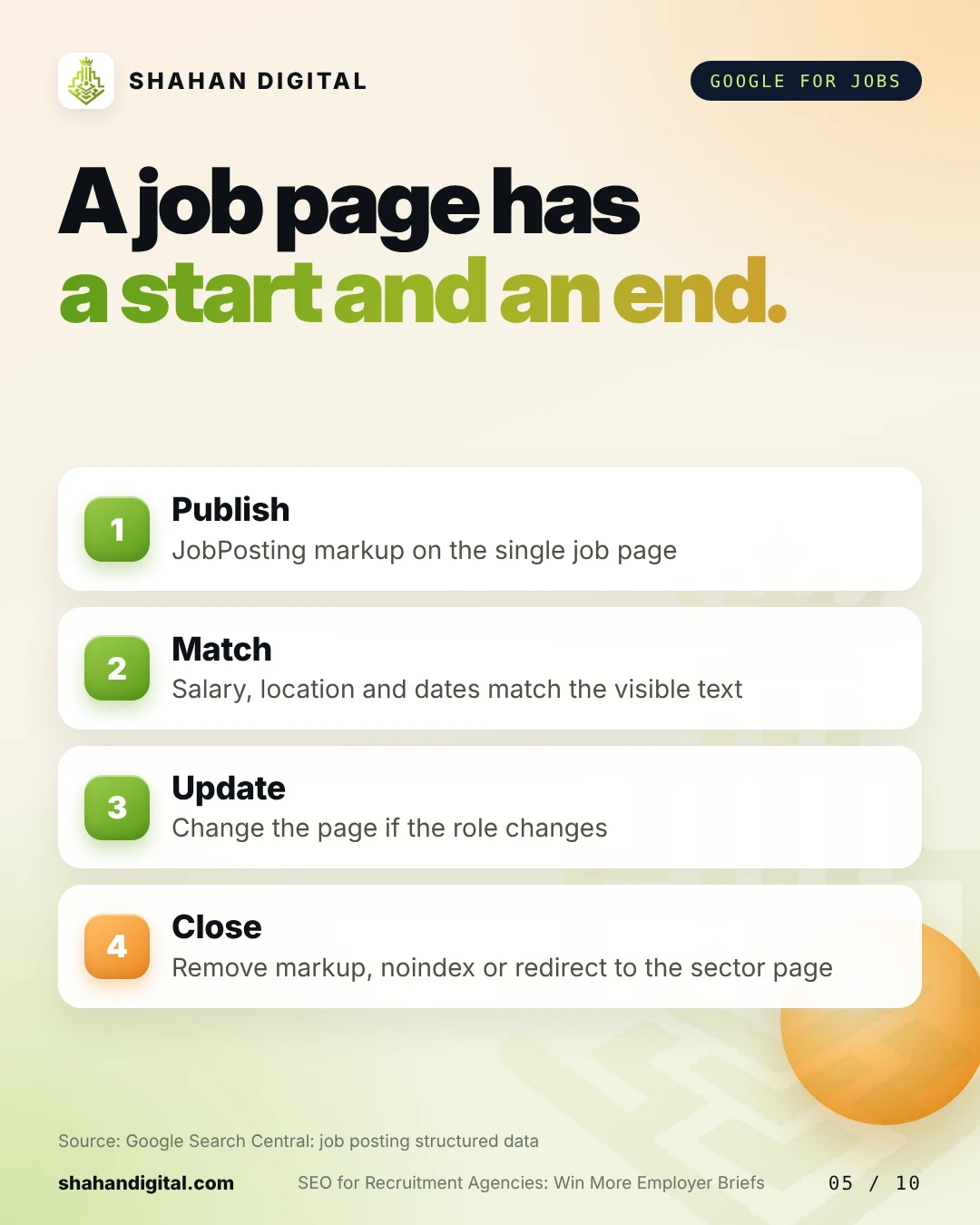
Be realistic about candidate search. For broad searches like “marketing jobs London”, the large job boards and aggregators usually take the top spots. Agencies do better on niche roles, specialist sectors and pages where they add something a board can’t, such as a salary range they’ve actually seen in recent placements.“On a recruitment site, the first export I ask for is every job URL from the last twelve months and what each one returns today. Closed jobs that still show as open, with markup saying they’re live, are a quick fix. When a role is filled, I’d rather send that URL to the sector page with a line saying ‘we filled this one, here’s how we work’ than leave a dead page.”
Shahan Behkamrad, Founder of Shahan Digital
Local search for agencies with real offices
If you have offices where clients and candidates actually visit, each one can have a Google Business Profile. Google says local results are based mainly on relevance, distance and prominence. For an agency, that means the right primary category, an accurate address, reviews from clients and candidates, and a link to the matching city page rather than the homepage.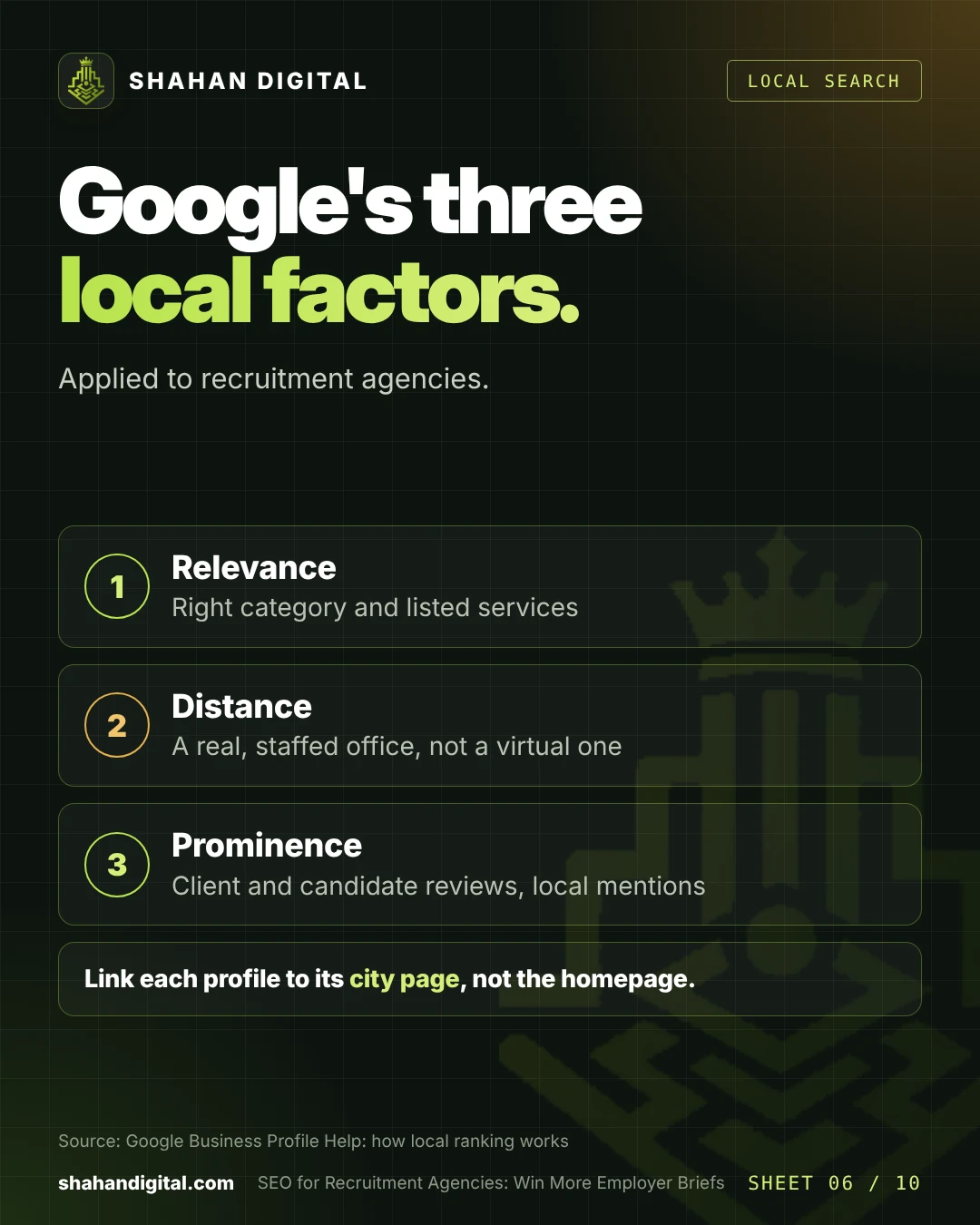
Trust assets employers check before they call
Hiring managers compare agencies before they pick up the phone. What they look for is usually simple: consultants with real names and LinkedIn profiles, the sectors each one covers, placements they can talk about, reviews, membership of a trade body such as the REC or APSCo where it applies, and clear terms.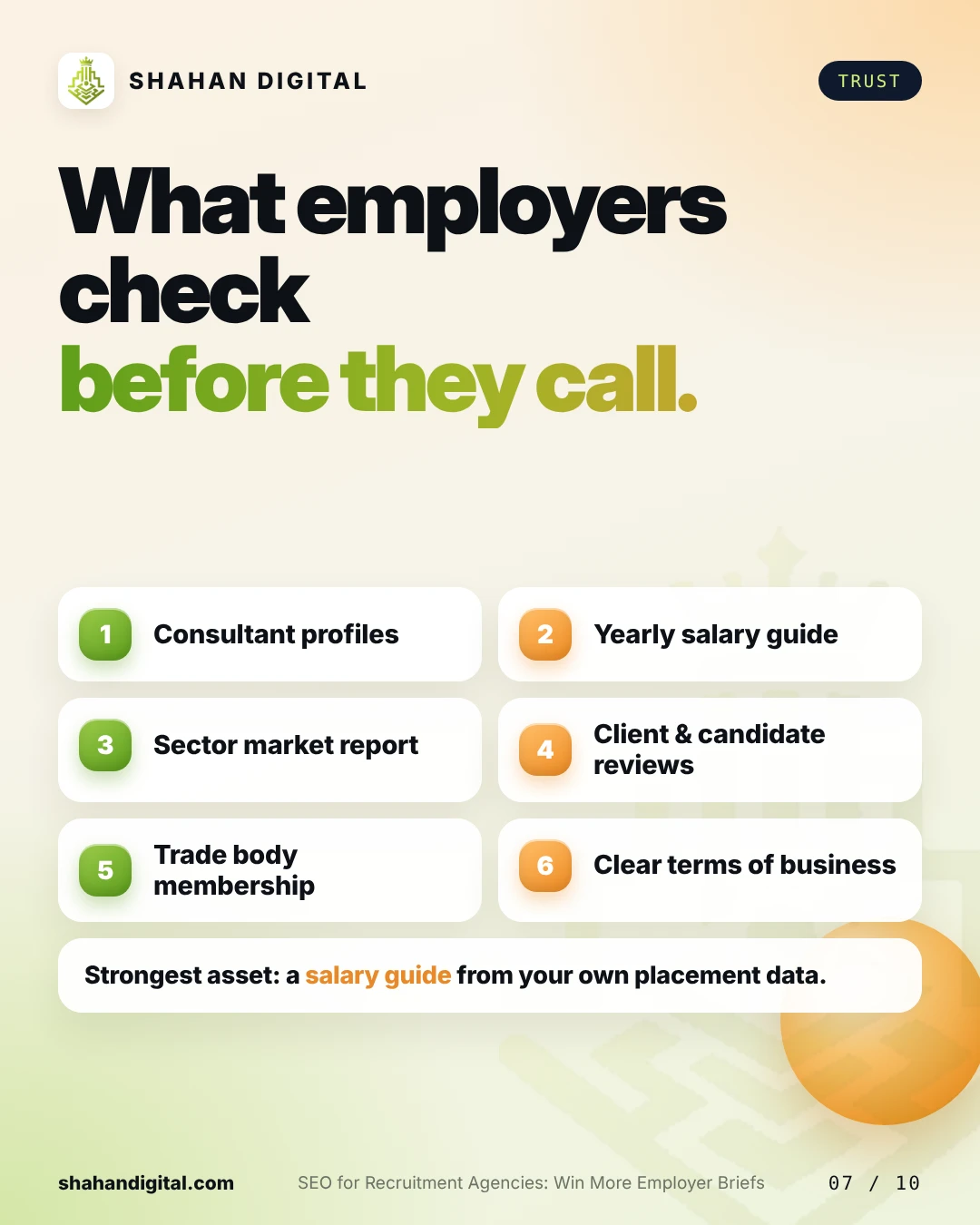
AI search: when employers ask ChatGPT for recruiters
Employers now also ask AI assistants and Google’s AI features for shortlists, such as “recommend specialist fintech recruiters in Dubai”. What these tools say about you depends on what’s published about you: consistent sector descriptions on your site, LinkedIn and directories, specific facts such as the roles you fill and the cities you cover, and mentions on third-party sites. Google’s own guidance on AI features and your website says the same SEO basics apply. We test this with dated prompts and record which sources get cited. Our AI search optimization service explains the method. No one can guarantee a mention.International and multilingual recruitment
Many agencies recruit across borders: Gulf employers hiring European engineers, UK firms placing contractors in Germany, Turkish companies hiring Arabic-speaking sales teams. Each market needs its own research, because employers search in their own language and with their own terms. In Saudi Arabia and the UAE, much employer research happens in Arabic as well as English. Our guides on international SEO and Arabic SEO cover the set-up, and our market pages for Dubai and Riyadh show how we approach those cities. Native writers in each market write the pages; we don’t machine-translate them.SEO cost compared with job boards and paid ads
Ahrefs’ survey of 439 SEO providers found monthly retainers most often in the $501 to $1,000 range, with local SEO averaging $1,557 a month across industries (checked 17 November 2026). Those are cross-industry averages, not recruitment quotes. A two-desk boutique in one city needs far less work than a multi-office firm with a large job feed and several languages.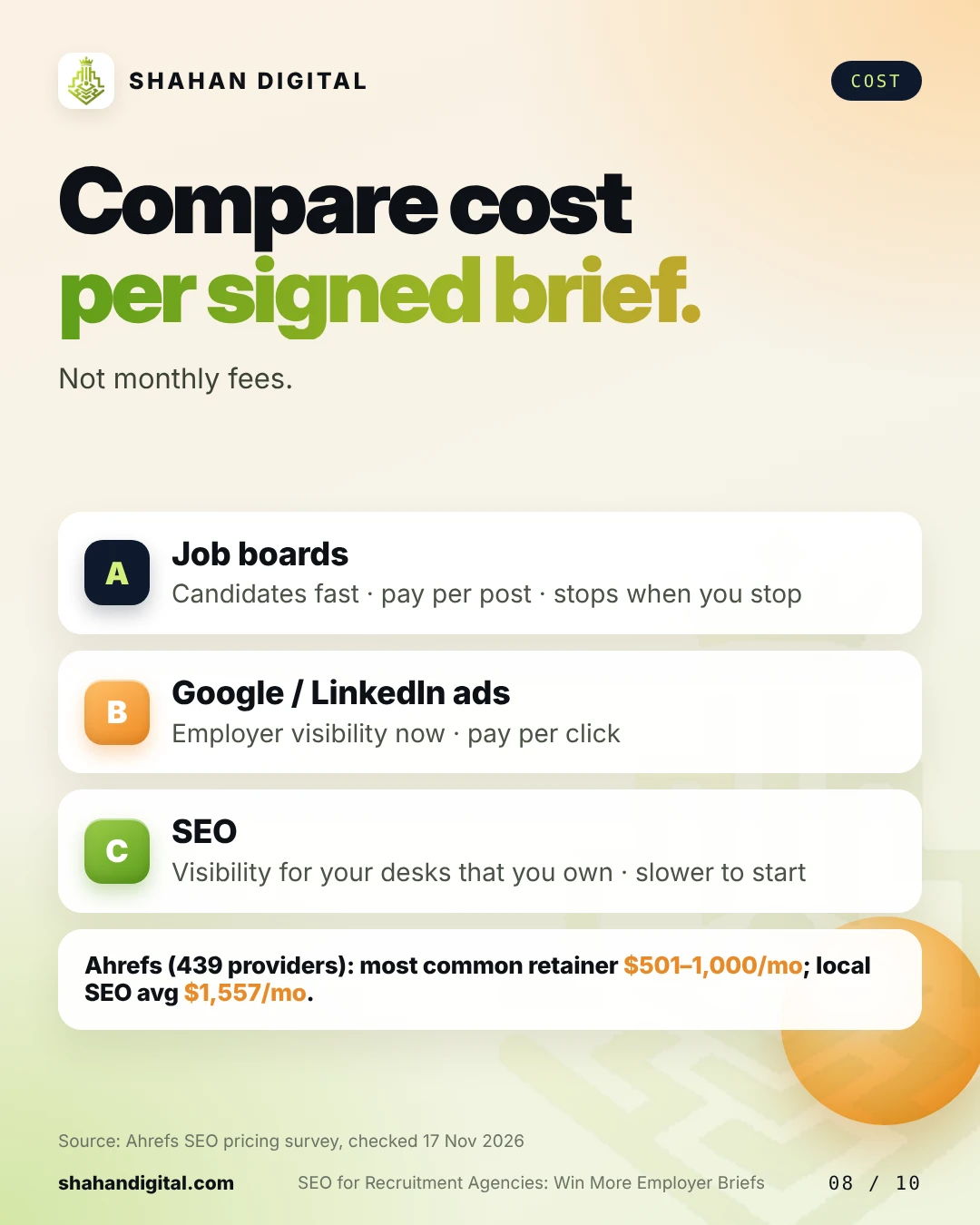
| Job boards | Google Ads / LinkedIn ads | SEO | |
|---|---|---|---|
| Main audience | Candidates | Employers or candidates | Both, by page |
| Speed | Immediate | Immediate | Weeks to months |
| You pay | Per post or subscription | Per click or impression | Monthly work, not per lead |
| When you stop paying | Visibility stops | Visibility stops | Pages keep working, more slowly |
| Best for | Filling live roles | Urgent briefs, new sectors | Lasting visibility for core desks |
What other recruitment SEO agencies offer
We reviewed the first page of Google for “SEO for recruitment agencies” on 17 November 2026. Several results are worth reading before you hire anyone, including us.| Result | What it does well | What’s missing for a buyer |
|---|---|---|
| LinkGraph | Broad guide covering on-page, technical and local SEO | Generic; little on choosing which desks to target |
| Recruiterflow | Good on job posting SEO and local search | Written by a CRM vendor; light on employer pages |
| Bullhorn | Practical list of content ideas such as salary guides and market insights | Ranking-factor framing; no measurement plan |
| ProfileTree | Frames the “two buyers, one site” problem clearly, with FAQs | Little on cost or international markets |
| InBound Blogging | Strong on niche authority and job content lifecycle | Commercial page for the publisher’s own service |
| WebFX | Clear explanation of recruitment SEO and link earning | Large-agency sales page; few specifics for small desks |
How to measure recruitment SEO
Track the path from search to fee: impressions for your sector and city terms, brief form submissions and calls, briefs qualified, placements, and fee value. On the candidate side, track applications from organic job pages and how many of those candidates get shortlisted. If briefs rise but placements don’t, look at qualification and consultant follow-up before blaming SEO.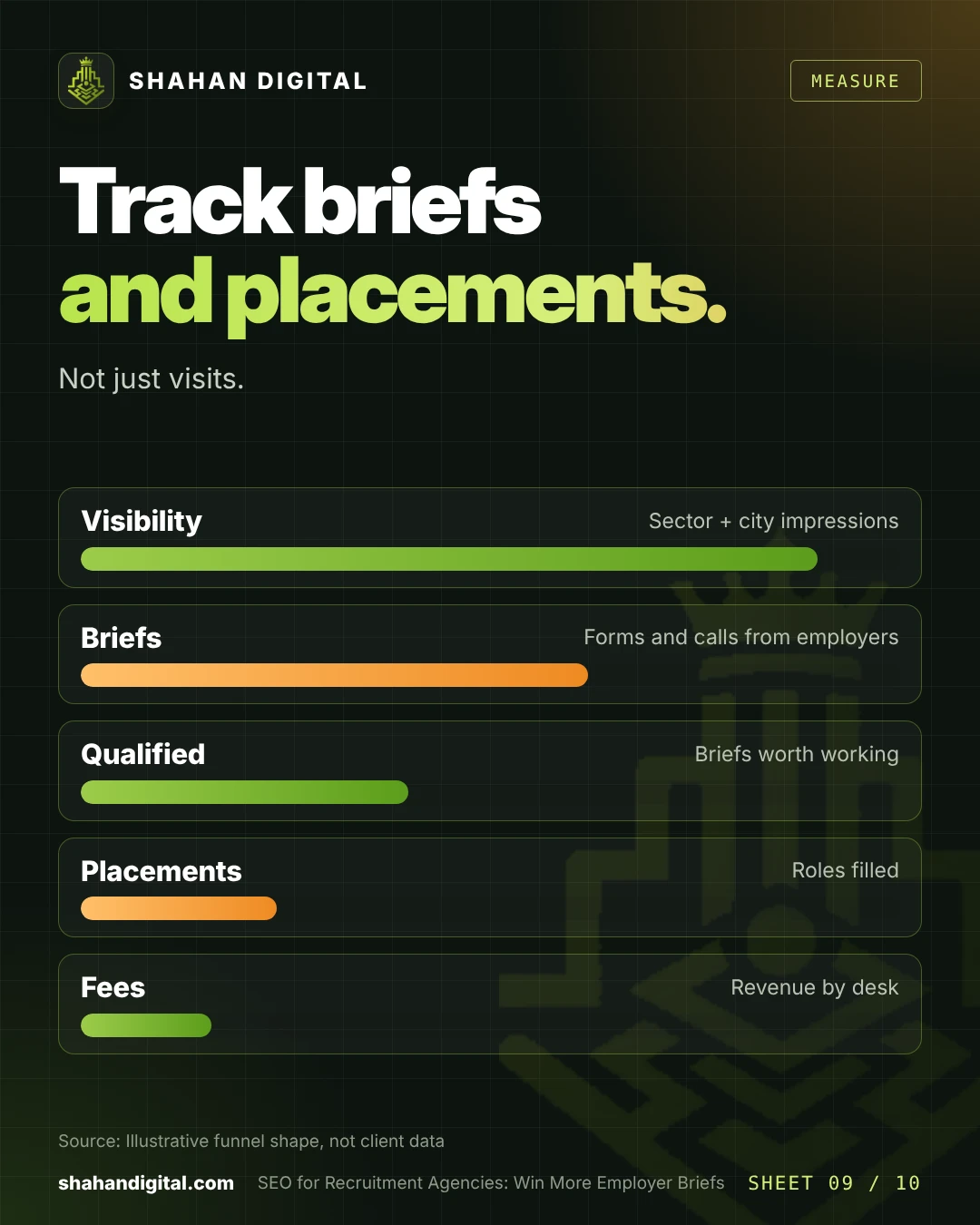
The first 90 days

| Month | Work | What you should see |
|---|---|---|
| 1 | SEO audit, source tracking in the CRM, job page and markup clean-up, desk scoring | A clean baseline and a ranked page list |
| 2 | First five sector-and-city pages written with consultants; Business Profiles fixed | Pages indexed and first impressions |
| 3 | Salary guide or market report, review routine, first outreach for mentions | First briefs from organic search and a review of what to build next |
How we work with recruitment agencies
We can run SEO end to end, work alongside your in-house marketing team, train your consultants to supply page content, or carry out a one-off audit. We work remotely, with weekly updates and a monthly review. A proposal from us sets out what we’d fix first, who owns each task (including anything your ATS provider has to change), how we’ll measure briefs and placements against today’s baseline, and what it costs. We don’t promise rankings, briefs or placements. Related reading: B2B SEO services, since selling recruitment to employers is a B2B sale, and how to hire an SEO expert if you’d rather build the skill in-house.Frequently asked questions
What does SEO for recruitment agencies include?
Usually: sector-and-location pages for your main desks, job pages that follow Google’s job posting rules, technical fixes for expired and duplicate jobs, Google Business Profiles for real offices, a salary guide or market report, reviews, and tracking that links searches to briefs and placements.How much does recruitment SEO cost?
Ahrefs’ survey of 439 providers found monthly retainers most often between $501 and $1,000, with local SEO averaging $1,557 a month across industries (checked November 2026). A single-city boutique needs far less work than a multi-office firm with a large job feed. Ask for a written, itemised quote.Can a recruitment agency outrank Indeed or LinkedIn?
For broad job-title searches, usually not. For niche sector and city searches from employers, and for specialist roles where you add real market knowledge, yes, many agencies can. That’s where most of the fee value is.Should we target employers or candidates?
Both, on separate pages. Employer pages usually bring the higher-value enquiries; candidate pages bring the supply you need to fill roles. Decide the balance from your revenue model.Do we need JobPosting structured data?
If you publish jobs on your own site and want them eligible for Google’s job search features, yes. Put it only on single job pages, keep it matching the visible text, and remove it when the job closes.How long does recruitment SEO take?
Technical fixes and profile work can show early signs within weeks. New sector pages usually take a few months to settle, depending on competition and your site’s authority. No one can guarantee a timeline.Ready to win more briefs from search?
Send us your website, the sectors and cities you recruit in, and the desks you want to grow. We’ll scope a first review around one question: which employer searches should be bringing you briefs, and what’s stopping them.
Editorial note: Facts and figures were checked against the linked sources on 17 November 2026. Market figures are from the American Staffing Association (US) and the REC (UK) and describe those markets only. Price figures are cross-industry averages from Ahrefs’ survey. Search examples and the priority-score example are illustrative, not client results. No ranking, brief or placement result is guaranteed.
Written by

Shahan Behkamrad
Author · Founder of Shahan Digital · SEO & GEO Strategist
Shahan Behkamrad is an SEO and GEO strategist and the founder of Shahan Digital. Since 2017 he has built search strategies for businesses in Persian, Arabic, English and Turkish markets, usually working alongside a client’s in-house team to decide what to fix first, what to build next and how to measure it.
- Strategy before tactics: every engagement starts with a diagnosis of where growth is being lost, then a ranked plan tied to enquiries and revenue, not to rankings alone.
- Current with how search works now: his work covers Google Search, Google Maps, AI Overviews and AI assistants such as ChatGPT, and he checks Google’s documented updates before changing a client’s plan.
- Specialist depth: technical, international and multilingual SEO, local SEO and AI search visibility (GEO).
- Has trained more than 650 students in SEO and digital marketing, including as an official instructor at Iran’s Technical and Vocational Training Organization.
- Host of the Shahan Behkamrad Podcast on business growth, branding, SEO and AI.
- Master’s student in Strategic Marketing and Brand Management at Nişantaşı University, Istanbul; holds 25+ international digital marketing certifications.