

Quick answer
A finance SEO company helps banks, lenders, advisers, accountants, insurers and fintechs win qualified search traffic without breaking the rules that govern financial marketing. The work is ordinary SEO done under stricter conditions: Google holds money topics to a higher quality bar, and regulators such as the SEC, FINRA and the FCA treat your website as advertising.
Below: what makes finance different, which search surfaces matter for your sub-sector, the tactics to refuse, how a compliant content workflow runs, what finance SEO costs, what other providers offer, and how to choose.
Who this guide is for. Marketing heads, founders and compliance-minded owners at financial firms who are comparing SEO agencies, or who already pay one and aren’t sure it understands their industry.
Pick your path:
- Not sure where to start → the sub-sector map
- Worried about compliance → the review workflow
- Comparing quotes → what finance SEO costs
- Shortlisting agencies → how to choose
Key takeaways
- Finance is a “Your Money or Your Life” topic, so Google’s raters apply their strictest quality standards to it.
- Your website is a financial promotion or advertisement in the eyes of most regulators. SEO copy needs the same review as an ad.
- A bank branch, a robo-adviser and a forex broker win on different search surfaces. Start from your sub-sector.
- Some common SEO shortcuts, like paid links or unverified testimonials, carry regulatory risk on top of ranking risk.
- Published finance SEO retainers we found ran from about £500 a month to $4,000 or more. Scope and compliance load explain the gap.
Before you hire a finance SEO company
Find out who signs off marketing content at your firm, and how long that takes. If compliance review takes three weeks, an agency promising 20 new pages a month is promising something your firm can’t approve. Agree the review workflow first, then the content plan. And make sure the agency knows which regulator and licence apply to you, because that decides what your pages are allowed to say.
Why a finance SEO company works differently
Two things set finance apart from most industries: how Google evaluates money topics, and how regulators treat your website.Google’s side. Google’s Search Quality Rater Guidelines class topics that could significantly affect people’s financial stability as “Your Money or Your Life” (YMYL). Raters are told to apply their highest standards to those pages. Raters don’t set rankings directly, but their feedback is used to check whether Google’s systems reward trustworthy pages. Google’s guide to helpful, reliable content spells out what that means in practice: clear authorship, first-hand expertise and accurate information.The regulator’s side. In the US, registered investment advisers follow the SEC’s marketing rule. The SEC’s compliance guide sets conditions for testimonials, endorsements and performance claims in any advertisement, websites included. Broker-dealers follow FINRA Rule 2210 on communications with the public, and FINRA’s Regulatory Notice 17-18 covers websites and social media. In the UK, the FCA says content about financial products posted online may be a financial promotion with its own rules.
“In finance I treat the compliance officer as part of the SEO team, not an obstacle at the end. I ask for the approved claims list and the required disclosures on day one, and I write to them. If a page needs a risk warning, it goes in the template, so it’s there on every page and nobody has to remember it.”
Shahan Behkamrad, Founder of Shahan Digital
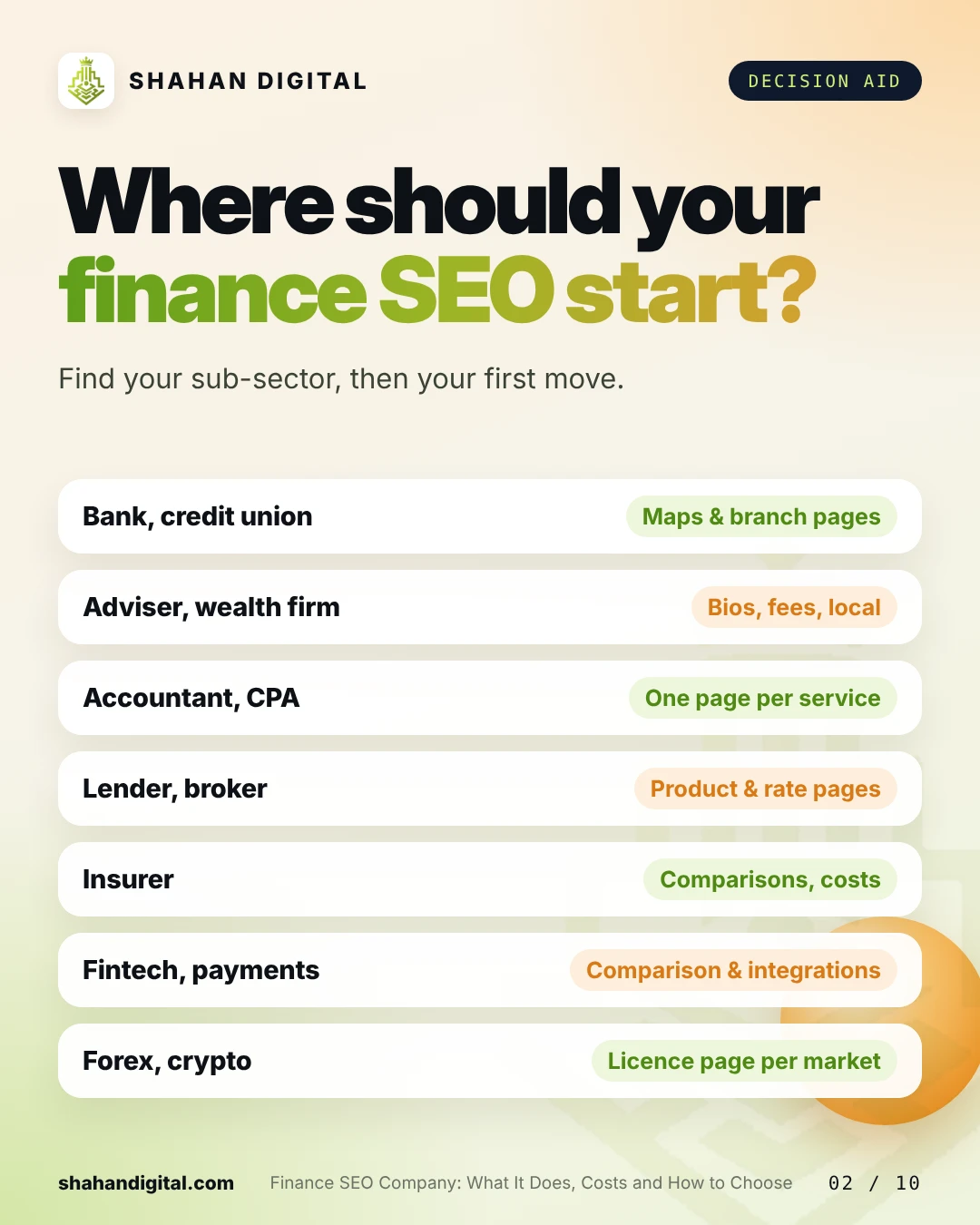
Decision aid: where your finance SEO should start
“Finance” covers businesses that win customers in very different ways. A credit union lives or dies on local searches near its branches. A payments company sells to finance teams through comparison and integration pages. Use this table to find your starting point.| Your business | Search surface that matters most | First move we’d investigate |
|---|---|---|
| Bank or credit union with branches | Google Maps and local results | Branch profiles, branch pages, review replies |
| Financial adviser or wealth firm | Local results plus “adviser near me” and specialist queries | Adviser bios, fee pages, compliant testimonials |
| Accountant or CPA firm | Local results and service queries (“bookkeeping for startups”) | One page per service, seasonal tax content |
| Lender or mortgage broker | Product and rate queries, calculators | Product pages with clear terms, tools |
| Insurance provider or broker | Product comparisons and “how much is” queries | Comparison pages, cost explainers |
| Fintech or payments (B2B) | Comparison, alternative and integration queries | Use-case pages, integration docs, fair comparisons |
| Forex, trading or crypto broker | Platform reviews, education, country-specific queries | Licence and regulation pages per market |
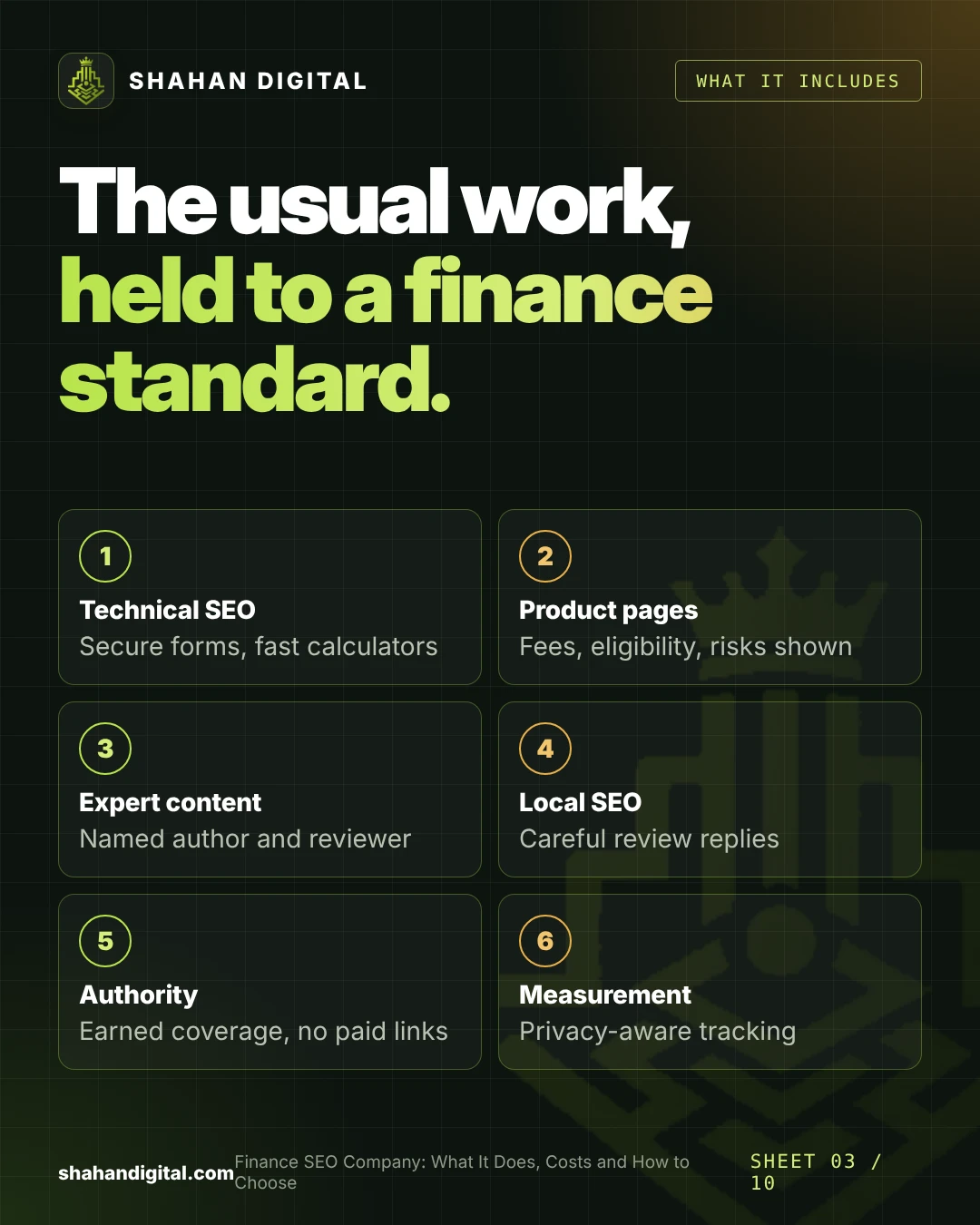
What finance SEO services should include
The components are familiar. What changes is the standard each one has to meet.| Component | What it covers | The finance-specific part |
|---|---|---|
| Technical SEO | Crawling, indexing, speed, templates, structured data | Secure forms, rate tables that render for Google, calculators that load fast |
| Service and product pages | One page per product or service, matched to search intent | Fees, eligibility, risks and licence details on the page, not hidden |
| Expert content | Guides, explainers, comparisons | Named authors with credentials, reviewer, review date, sources |
| Local SEO | Business Profiles, branch pages, reviews | Review replies that don’t give advice or disclose client details |
| Authority and PR | Mentions and links from relevant sites | Earned coverage only; no paid links dressed up as editorial |
| Measurement | Search Console, analytics, CRM | Tracking that respects privacy rules for financial data |
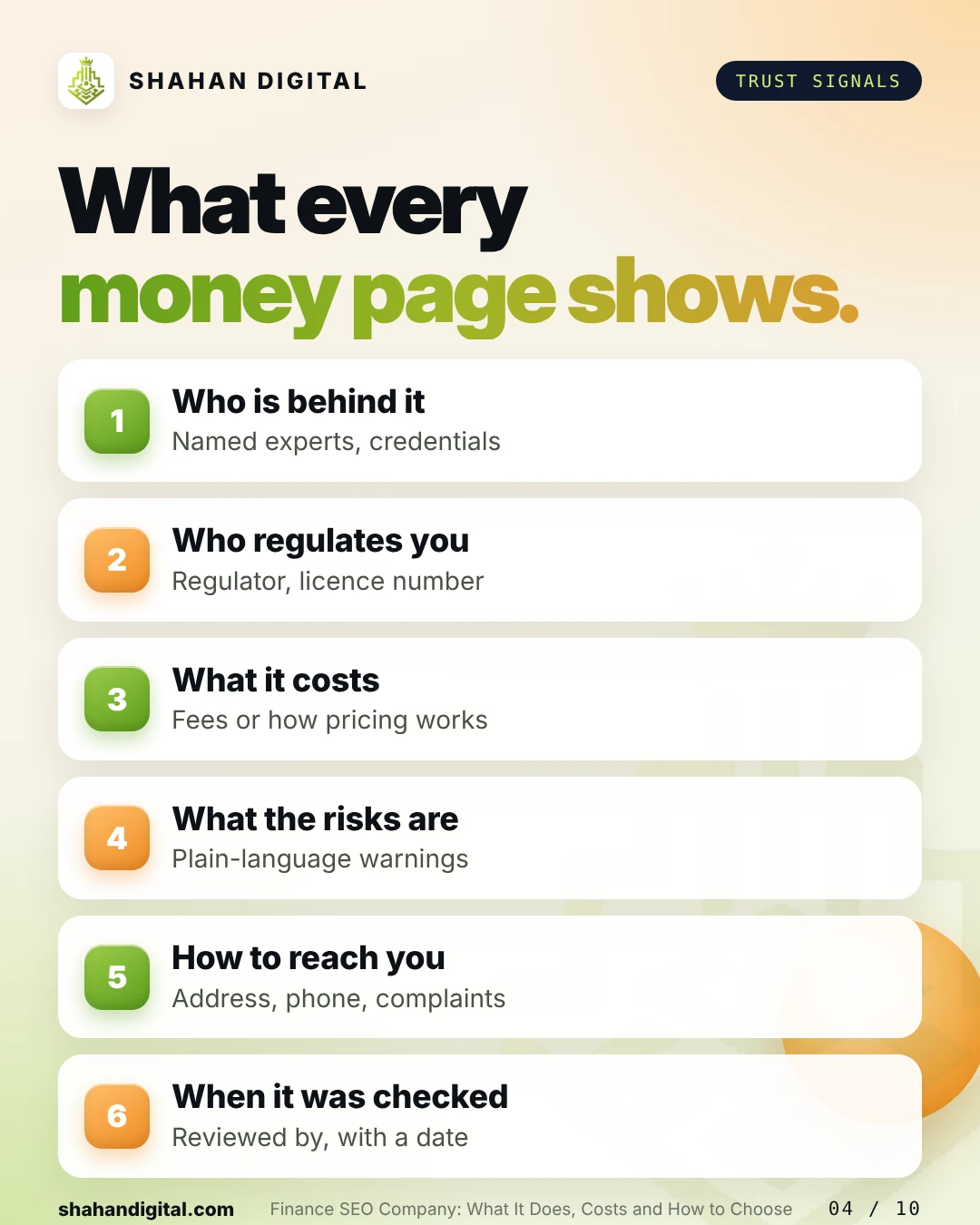
The trust signals finance pages need
A finance buyer is deciding whether to hand you their savings, their payroll or their mortgage. Search engines look for the same evidence that buyer looks for. These are the signals we check on every money page:- Who is behind it: named advisers or authors, their qualifications, and a link to a regulator register where one exists.
- Who regulates you: licence or registration number, regulator name, and the markets you’re permitted to serve.
- What it costs: fees, rates or at least how pricing works, with the date it was last updated.
- What the risks are: plain-language risk warnings where your rules require them.
- How to reach you: a real address, phone number and complaints process.
- When it was checked: a “reviewed by” line and date on guides that give financial information.
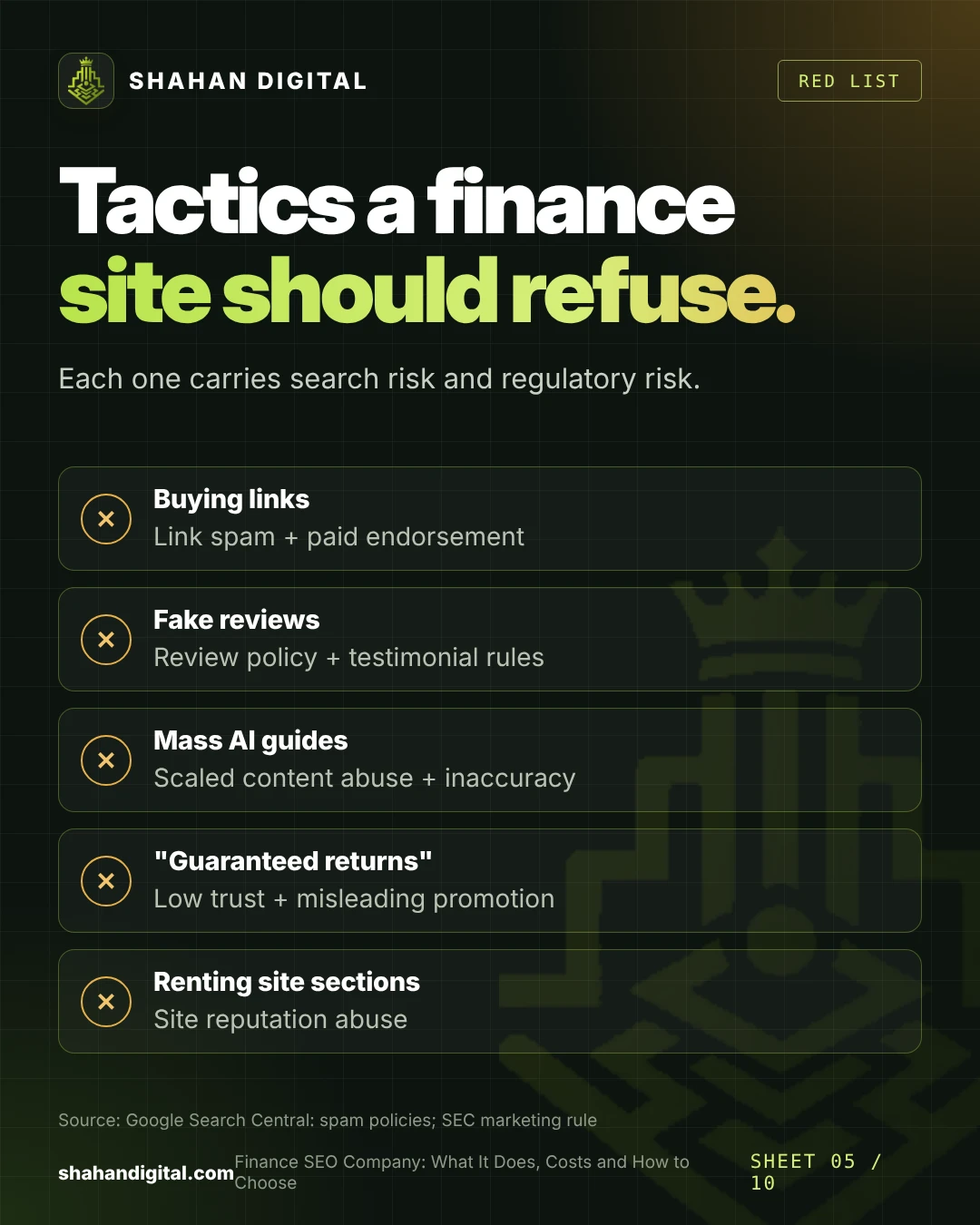
Finance SEO tactics to refuse
Some shortcuts that are merely risky in other industries become serious in finance, because they break a regulator’s rule as well as Google’s.| Tactic | Search risk | Regulatory risk |
|---|---|---|
| Buying links or “sponsored” guest posts | Breaks Google’s link spam policy | Paid placement may count as an endorsement or promotion |
| Fake or incentivised reviews | Breaks Google’s review policies | Testimonial rules (for example the SEC marketing rule) apply |
| Mass AI-written guides with no expert review | Google’s spam policies cover scaled content abuse | Inaccurate financial information, no sign-off record |
| “Guaranteed returns” or “best rates” headlines | Low trust, poor quality signals | Likely misleading under most promotion rules |
| Renting a section of another site for rankings | Site reputation abuse under Google’s spam policies | You may be responsible for promotions you can’t control |
A compliant finance SEO content workflow
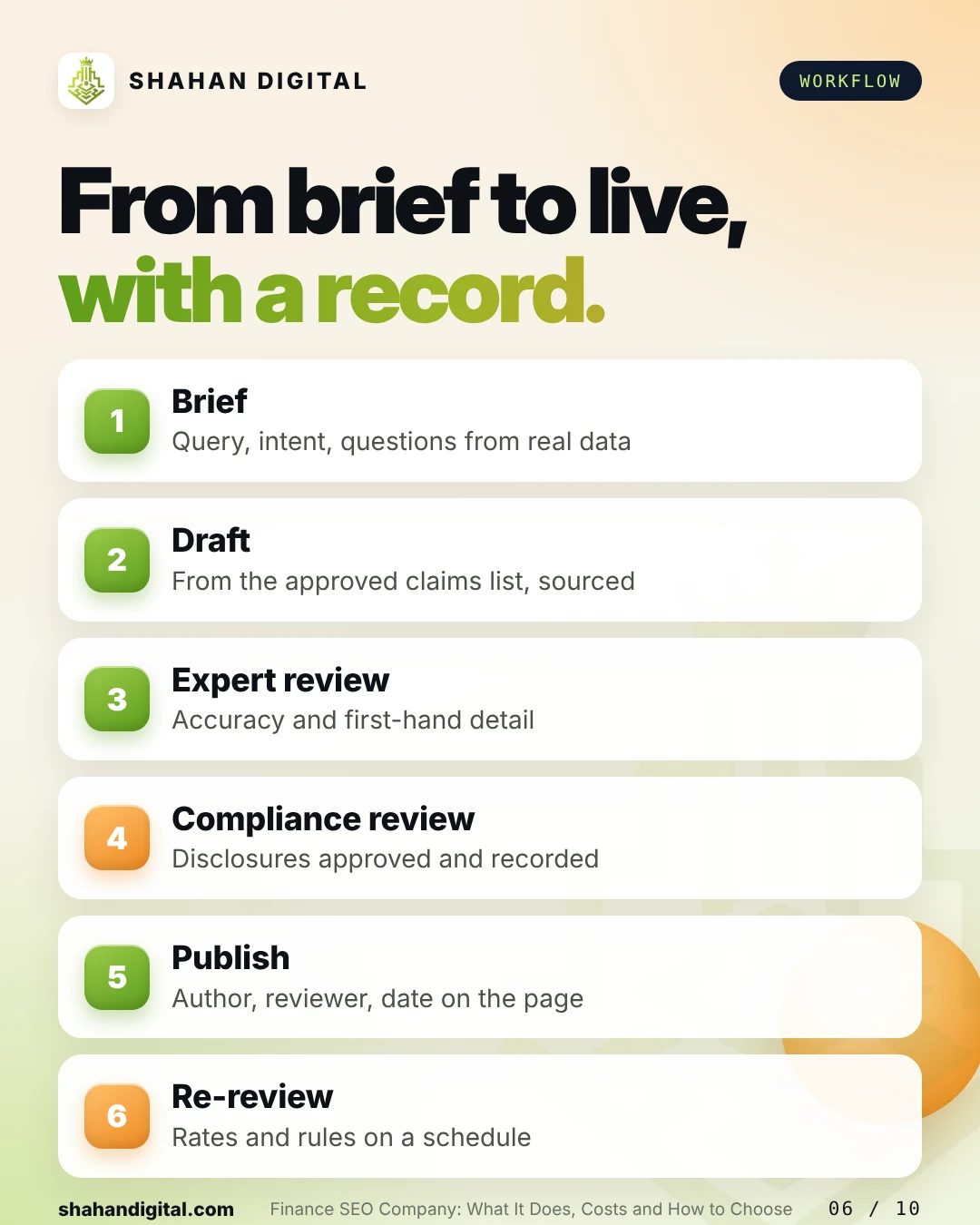
This is the part most generalist agencies skip. Here’s how a page moves from idea to live at a firm that takes both SEO and compliance seriously.- Brief: the SEO team picks the query, the intent and the questions the page must answer, using real search data.
- Draft: a writer drafts from the approved claims list, with sources for every number.
- Expert review: an adviser, accountant or product owner checks accuracy and adds first-hand detail.
- Compliance review: disclosures, risk warnings and claims are approved, and the approval is recorded.
- Publish: with the author, reviewer and review date visible on the page.
- Re-review: rates, fees and rules are checked on a schedule, and the page is updated or retired.
“The re-review step is where finance sites quietly lose. A rates page that says 4.5% when the product now pays 3.9% is a ranking problem, a trust problem and possibly a compliance problem. I put every page that shows a number on a review calendar, with an owner, before it goes live.”
Shahan Behkamrad, Founder of Shahan Digital
Want a finance SEO plan your compliance team can approve?
Send us your website, your licence or regulator, and the products you want to grow. We’ll review where search demand is going to competitors and what your pages would need to win it.
Finance SEO company or paid search?
Finance clicks are expensive. Markitors cites about $20 per click for “financial advisor” and about $25 for “financial advisor near me”. Organic rankings take longer to build, but you don’t pay per visit once you hold them.
What a finance SEO company costs
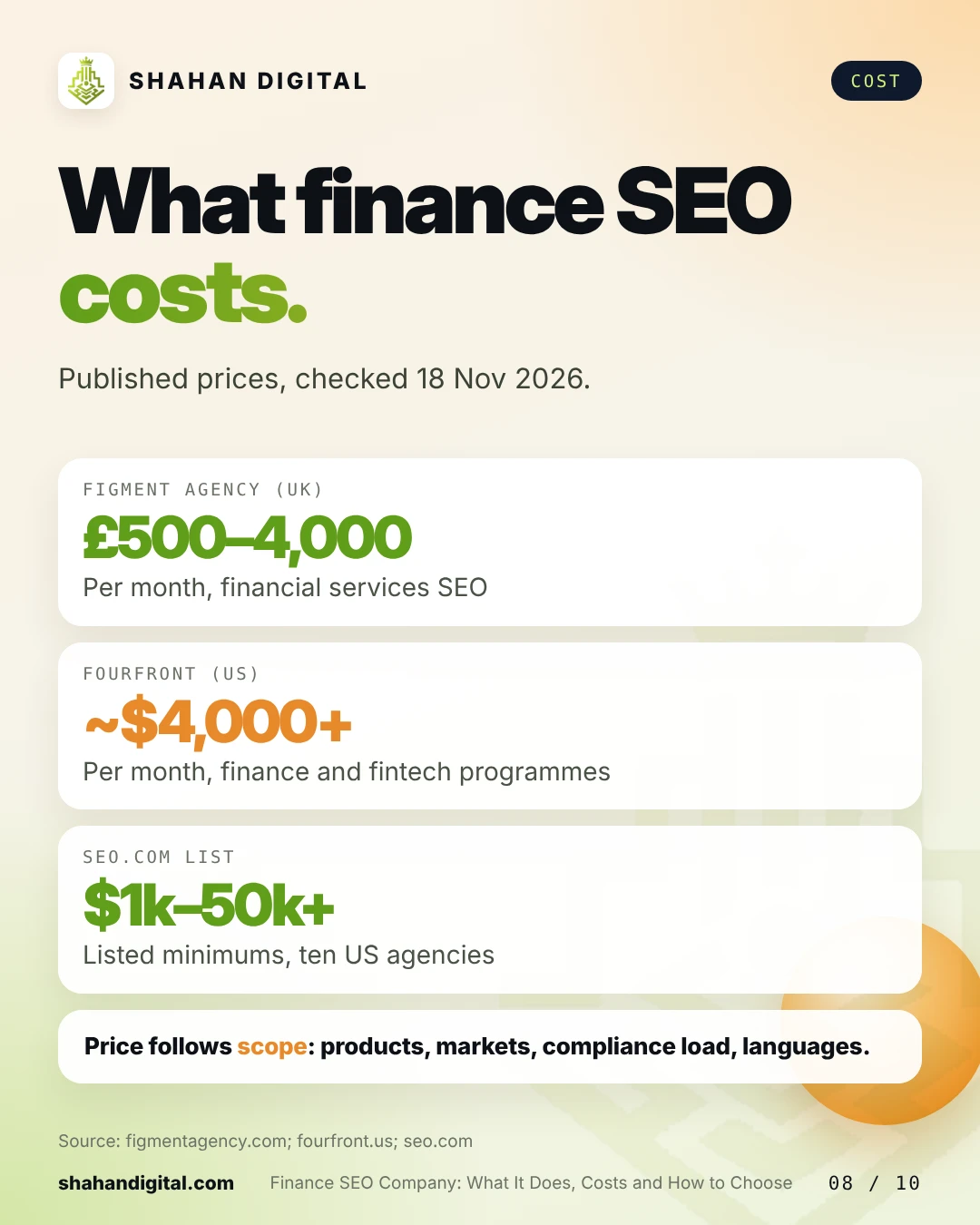
Few agencies publish prices. Here’s what we found when we checked on 18 November 2026.| Source | Figure | What it covers |
|---|---|---|
| Figment Agency (UK) | £500 to £4,000 a month | Financial services SEO campaigns |
| FourFront (US) | Often from around $4,000 a month | Comprehensive programmes for finance and fintech |
| SEO.com finance list | Minimums from $1,000+ to $50,000+ | Listed minimum spend for ten US agencies |
What other finance SEO companies offer
We reviewed the top English-language results for “finance SEO company” on 18 November 2026. Some of these pages are genuinely useful, and worth reading before you choose anyone.| Result | What it does well | What’s missing for a buyer |
|---|---|---|
| SEO.com finance list | Ten agencies with location, team size and minimum spend; updated September 2026 | No ranking method; published by an agency group that ranks its own firm first |
| Rankai | Clear evaluation criteria and a published entry price | Volume-led model; little on compliance review time |
| Accuracast | Frames finance as YMYL and covers AI search | No pricing or sample workflow |
| FourFront | Published starting price; mentions regulatory realities | Few specifics on how compliance fits in |
| NUOPTIMA | Plain list of content, links and technical work | Generic; little that’s specific to finance rules |
| W3era | Industry case-study format | Large growth percentages with little context to verify them |
How to choose a finance SEO company
Ask these questions of anyone you’re considering. A good finance SEO company will answer them without hesitating.
- Which financial regulators’ rules have you worked under, and in which markets?
- How does our compliance review fit into your content calendar?
- Who writes our pages, and which expert reviews them?
- How do you earn links and mentions? (Listen for “earned”, not “bought”.)
- Which tactics will you refuse to use on a finance site?
- How will you measure qualified leads, not just traffic?
- Do you avoid ranking guarantees? Google’s own advice on hiring an SEO treats them as a warning sign.
Finance SEO across markets and languages
Financial firms often serve several countries, and each one brings its own regulator, its own terms and its own competitors. A UK wealth manager and a Dubai one search under different phrases and need different disclosures. We build country and language versions with native writers in English, Arabic, Persian and Turkish, and set them up so Google shows the right version in each market. Our international SEO and Arabic SEO pages explain that side.AI answers matter here too. Buyers now ask ChatGPT or Google’s AI Mode which adviser or app to use. Those systems tend to describe firms using the facts they can find and verify, which is another reason to publish licence, fee and team details clearly. Our AI search optimization service covers it; nobody can guarantee a mention.How to measure finance SEO
Traffic is the wrong headline number for a financial firm. A thousand visits to a “what is an ISA” guide may produce nothing; ten visits to a mortgage broker’s product page may produce two applications. We report on:- Impressions and clicks for commercial queries, separated from informational ones.
- Rankings and visibility in Maps for each branch, where branches exist.
- Qualified enquiries, booked consultations or applications from organic search.
- Pages past their review date, because stale numbers are a risk.

How we work with financial firms
We can run finance SEO end to end, advise your in-house team through SEO consulting, or start with a one-off audit and roadmap. Either way the first weeks look the same: read-only access, a dated baseline, a review of your regulator’s content rules with your compliance lead, and a short list of what to fix first. This page is part of our industry-specific SEO series.Frequently asked questions
What does a finance SEO company do?
It improves how a financial firm’s website shows up in search, through technical fixes, product and service pages, expert content, local SEO and earned links. The difference from general SEO is that every page is written and reviewed to meet both Google’s quality standards for money topics and the firm’s regulatory rules.How much do finance SEO services cost?
Published prices we checked in November 2026 ranged from about £500 to £4,000 a month (Figment Agency) and often from around $4,000 a month (FourFront). SEO.com’s finance list shows minimums from $1,000 to $50,000+. Products, markets, compliance load and content volume explain most of the difference.How long does finance SEO take?
Technical fixes and better service pages can show movement within weeks. Ranking for competitive commercial terms like “financial adviser” in a big city usually takes many months, because trust and authority take time to earn. Plan and judge the work in quarters.Is SEO allowed for regulated financial firms?
Yes. Regulators don’t ban SEO; they regulate what your communications say. Your website content may count as an advertisement or financial promotion, so it needs the same review, disclosures and records as your other marketing.Can we use client testimonials on our website?
It depends on your regulator and licence. In the US, the SEC marketing rule allows testimonials for registered investment advisers only with specific disclosures and oversight. Check with your compliance team before publishing any client quote or review widget.Should a finance firm use AI to write content?
AI can help with research and first drafts. Google’s spam policies target content produced at scale mainly to manipulate rankings, and finance content needs an expert and compliance sign-off anyway. Treat AI output as a draft, never as the final word.Ready to grow search demand you’re allowed to win?
Send us your website, your regulator, your target markets and the products you want to grow. We’ll scope the first review around one question: where are qualified finance buyers going instead of you, and what would it take to win them back?
Editorial note: Facts, prices and search results were checked against the linked sources on 18 November 2026. This page is general information, not legal or compliance advice; check your obligations with your compliance team or regulator. Prices are published third-party figures, not Shahan Digital quotes. No ranking, traffic or lead result is guaranteed.
Written by

Shahan Behkamrad
Author · Founder of Shahan Digital · SEO & GEO Strategist
Shahan Behkamrad is an SEO and GEO strategist and the founder of Shahan Digital. Since 2017 he has built search strategies for businesses in Persian, Arabic, English and Turkish markets, usually working alongside a client’s in-house team to decide what to fix first, what to build next and how to measure it.
- Strategy before tactics: every engagement starts with a diagnosis of where growth is being lost, then a ranked plan tied to enquiries and revenue, not to rankings alone.
- Current with how search works now: his work covers Google Search, Google Maps, AI Overviews and AI assistants such as ChatGPT, and he checks Google’s documented updates before changing a client’s plan.
- Specialist depth: technical, international and multilingual SEO, local SEO and AI search visibility (GEO).
- Has trained more than 650 students in SEO and digital marketing, including as an official instructor at Iran’s Technical and Vocational Training Organization.
- Host of the Shahan Behkamrad Podcast on business growth, branding, SEO and AI.
- Master’s student in Strategic Marketing and Brand Management at Nişantaşı University, Istanbul; holds 25+ international digital marketing certifications.