

Quick answer
SEO competitor ranking means checking where competing sites rank for the searches your buyers make, in the right country, city, language and device. There is no single true ranking. Google results change with location, language and device. So the useful question is not “who is first?” but “who wins my money searches, where, and how often?”
Below: five ways to check competitor rankings, what each gets wrong, Google’s rules on rank checking, a decision aid, 2026 tool prices, share of voice and how to turn rankings into action.
Who this guide is for. Founders, marketing leads and SEO managers who want to know which competitors outrank them, and whether the numbers in their tools can be trusted. It also helps anyone choosing a rank tracking tool.
Pick your path:
- Want a quick check today → five ways to check
- Not sure which method fits → the decision aid
- Choosing a tool → 2026 tool prices
- Have the data, need a plan → from rankings to action
Key takeaways
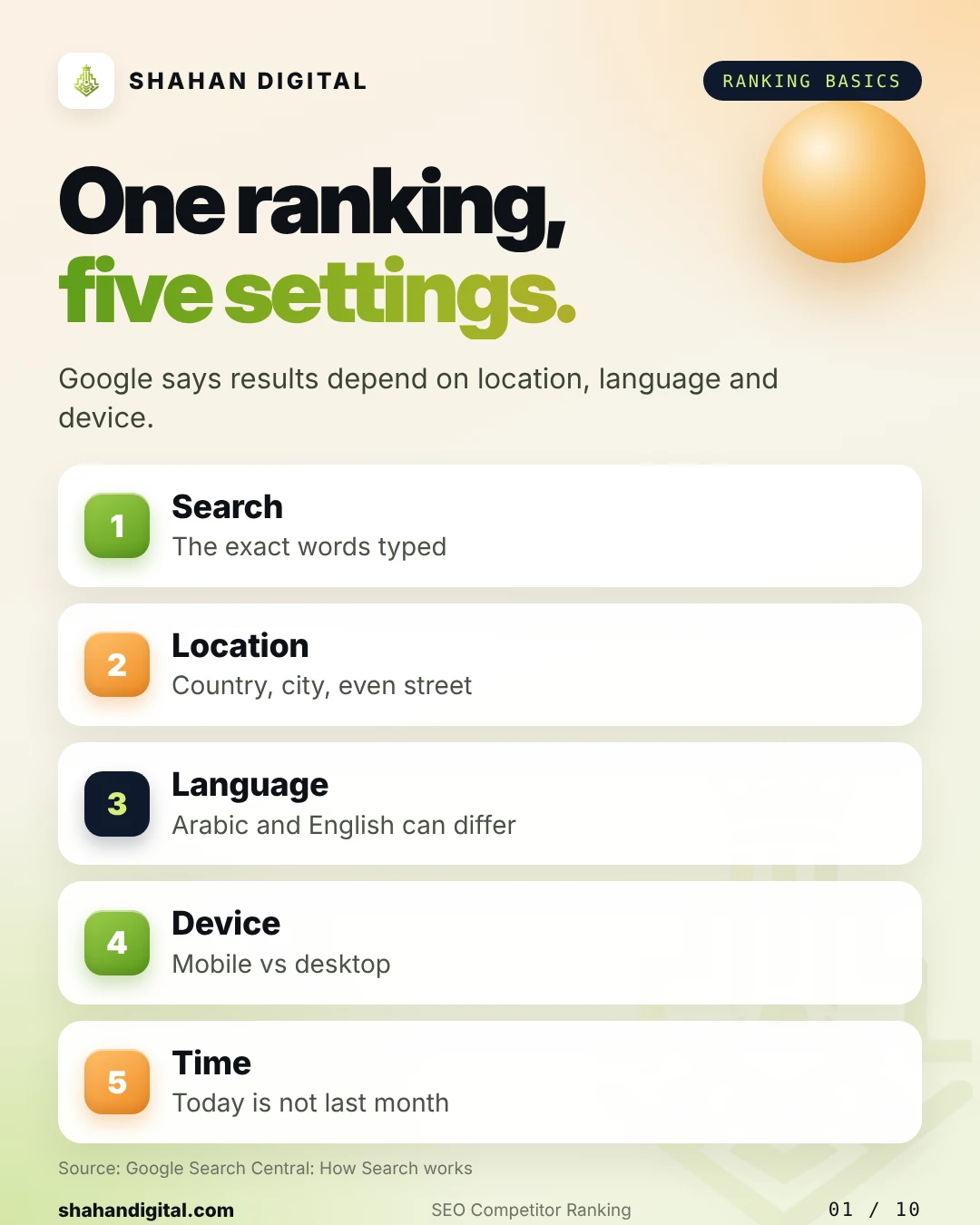
- Google says results depend on factors such as the user’s location, language and device. Every ranking report needs those settings written on it.
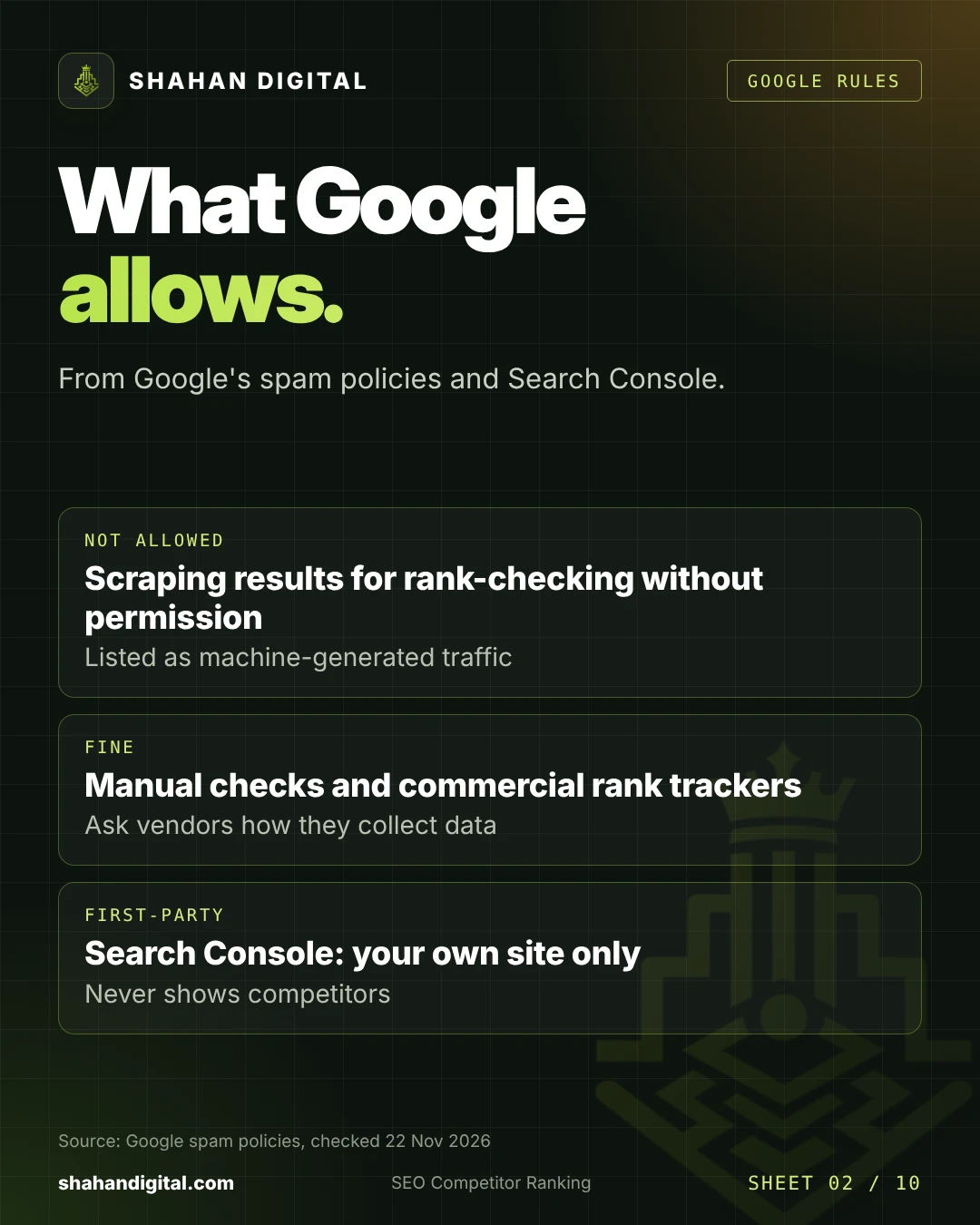
- Google’s spam policies list scraping results for rank-checking purposes without permission as machine-generated traffic.
- Search Console shows only your own site. Competitor rankings always come from third-party data.
- Since June 2026, Search Console has a separate report for impressions in AI Overviews and AI Mode.
- Track a fixed set of money searches and compare share of voice, not single positions.
Here is why we wrote this page. In our own Search Console data from 21 August to 19 November 2026, searches like “seo competitor ranking” (471 impressions), “seo competitors ranking” (140) and “seo competition ranking” (96) reached our competitor analysis guide. It ranked around position 70 for them. Most came from the United States, Luxembourg, France, the UK, Belgium and the Netherlands.
Our guide answers a bigger question: how to run a full competitor analysis. These searches ask something narrower. How do I see where my competitors rank, and can I trust what I see? This page answers that.
Before you check competitor rankings
Write down three things. The 20 to 50 searches that bring you paying customers. The countries, cities and languages you sell in. The two to five competitors your buyers compare you with.
Without that list, you will track hundreds of keywords that do not pay, in places you do not serve. The report will look busy and change nothing.
What SEO competitor ranking really measures
A ranking is the position of a page for one search, at one moment, for one kind of user. Google’s guide to how Search works says results depend on factors that could include the user’s location, language and device. Its example: “bicycle repair shops” shows different results to a user in Paris than in Hong Kong.
So when a tool says a competitor is “number three”, ask: for which search, where, on which device, and when? A competitor can rank third in London on mobile and not appear in Manchester on desktop. Local businesses see this most, because the map pack changes street by street.
Rankings are also not the whole page anymore. AI Overviews, the map pack, videos, People Also Ask and shopping results can push the first normal result far down. A competitor in position four with a cited AI Overview may get more attention than you in position two.
Google’s rules on checking rankings
Google’s spam policies define machine-generated traffic as sending automated queries to Google. This includes scraping results for rank-checking purposes, or other automated access to Google Search, without express permission. Google says it violates its spam policies and its Terms of Service.
In practice, do not write your own script to scrape Google. Do manual checks by hand, or use a commercial rank tracker and accept that its data collection is the vendor’s responsibility. Ask your vendor how they collect data and which locations they simulate.
For your own site, Search Console is the first-party source. It shows your average position, impressions and clicks per query. It never shows a competitor’s data.
Five ways to check competitor rankings
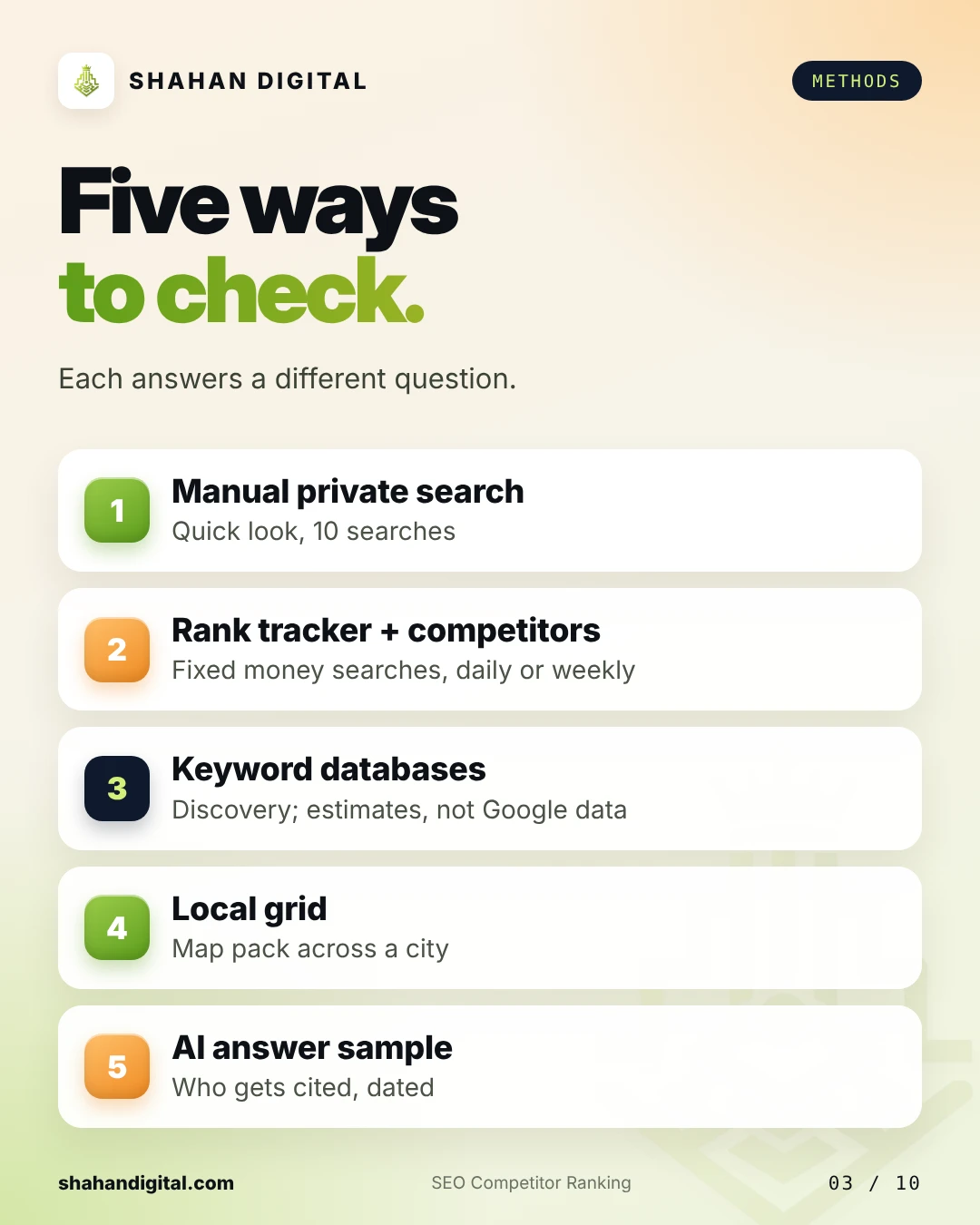
Each method answers a different question. None is perfect.
- Manual check in a clean browser. Search in a private window, signed out, with the right country set. Good for a quick look at ten searches. Weak for cities, devices and trends.
- Rank tracker with competitor domains. You set the searches, location and device. The tool records your position and your competitors’ every day or week. Best for a fixed list of money searches.
- Third-party keyword databases. Tools like Ahrefs, Semrush and SE Ranking estimate every search a competitor ranks for. Good for discovery. The numbers are estimates from their own crawls, not Google data.
- Local grid tracking. A grid of points across a city shows where each competitor appears in the map pack. Essential for local businesses.
- AI answer sampling. A dated list of questions run in AI Overviews, AI Mode, ChatGPT or Perplexity, noting which brands and pages are cited.
“Before we trust a rank tracker for a client, we compare it with Search Console for the client’s own site. We take 30 tracked queries, pull the average position from Search Console for the same country and device over 28 days, and put them side by side. If the tracker is within two or three positions on most queries, we trust its competitor data too. If it is far off, the location or device settings are usually wrong.”
Shahan Behkamrad, Founder of Shahan Digital
Which searches to track for SEO competitor ranking
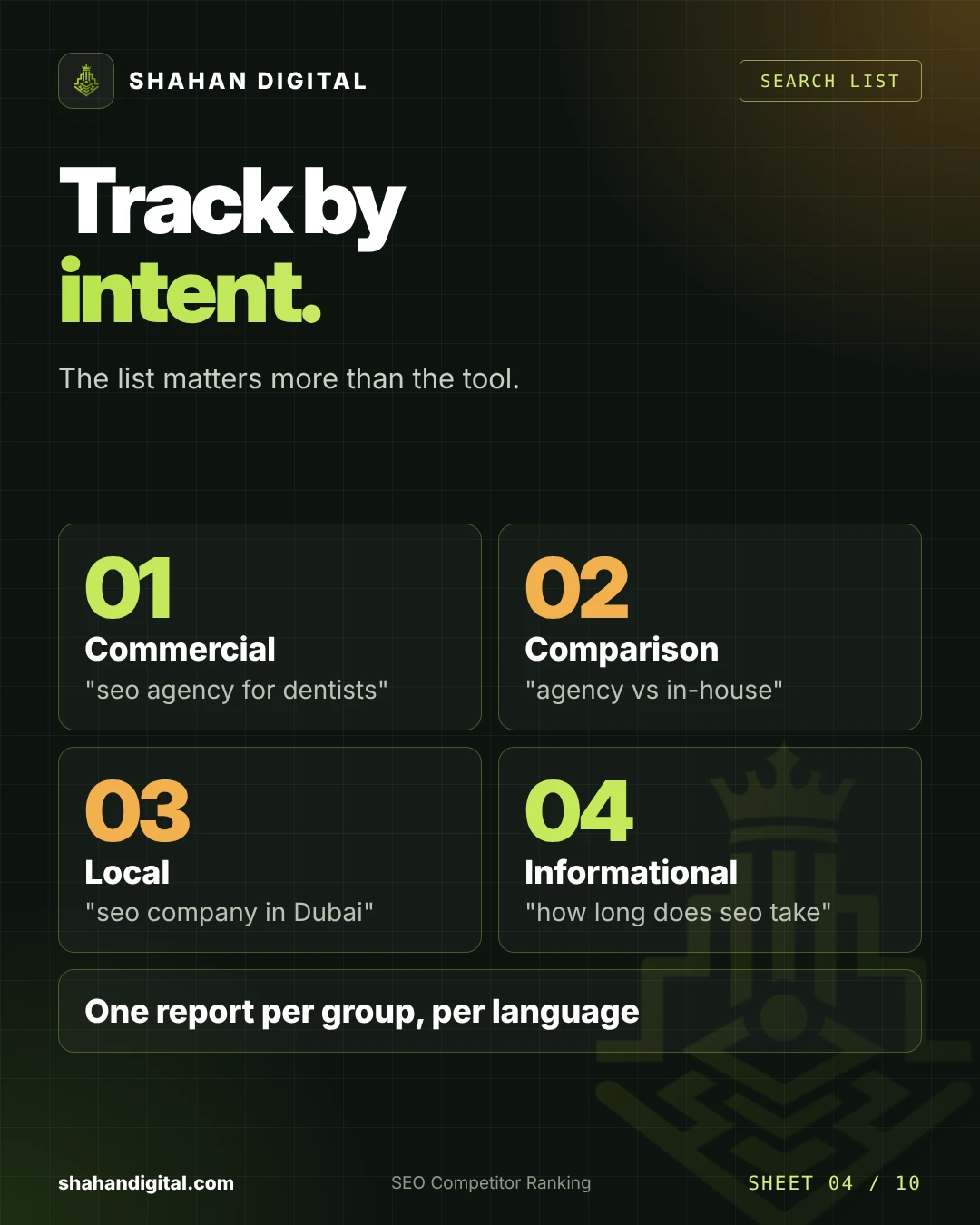
The list matters more than the tool. Build it from four sources:
- Your Search Console queries that already bring clicks or leads.
- Sales calls and enquiries: the words buyers use.
- Competitor pages that win the searches you want.
- Each language and market you sell in, checked separately.
Group the list by intent: commercial (“seo agency for dentists”), comparison (“agency vs in-house seo”), local (“seo company in Dubai”) and informational (“how long does seo take”). Track each group as its own report. A competitor that wins informational searches is not always the one that wins buyers.
For multilingual markets, track each language separately. An Arabic search in Riyadh and an English search in Riyadh can have different winners. Our international SEO and Arabic SEO work sets this up market by market.
Share of voice: a better view than single positions
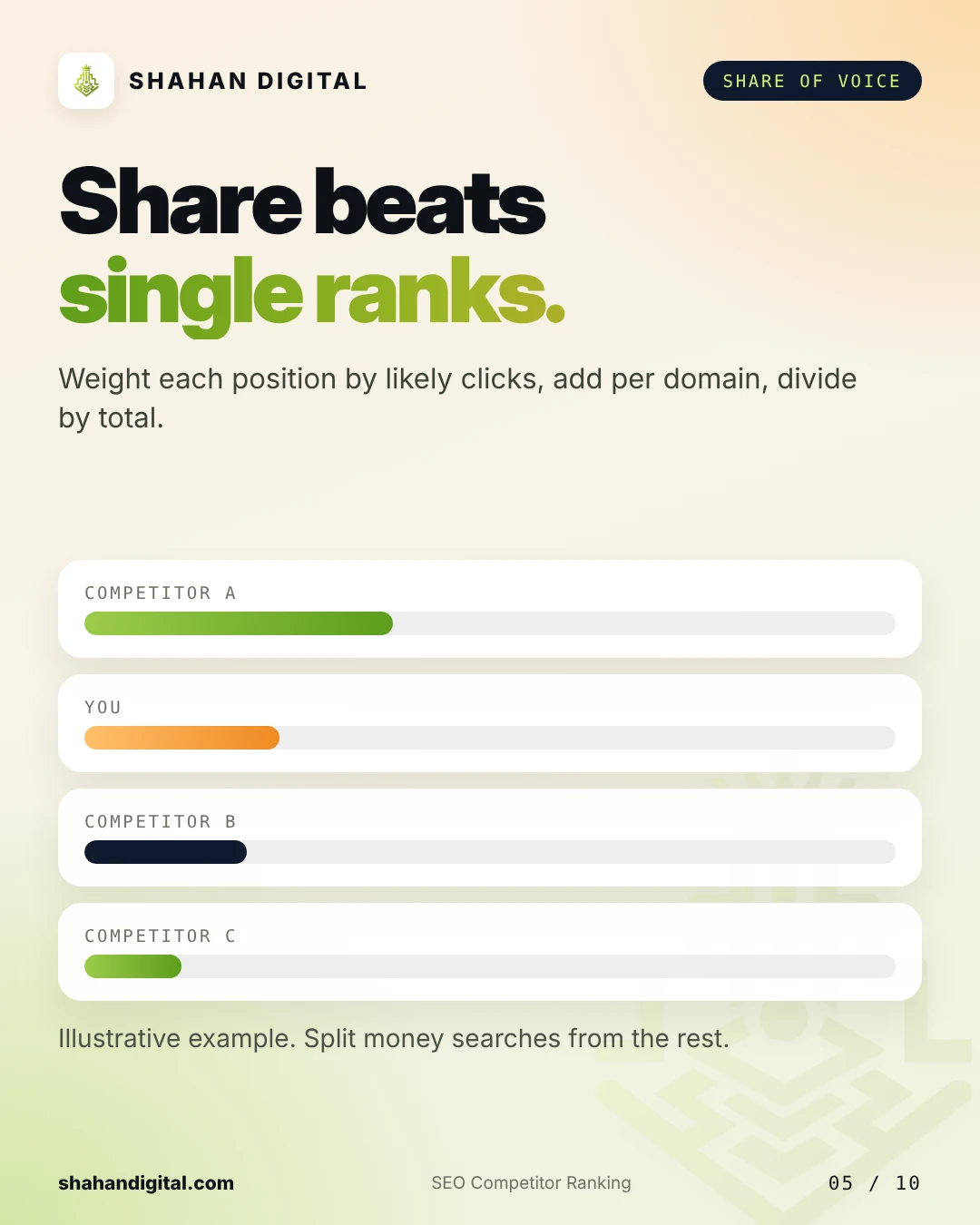
One position tells you little. Share of voice shows how much of the visible space each competitor holds across your whole list. A simple version: give each position a weight based on its likely clicks, add up the weights for each domain, and divide by the total.
You do not need exact click-through rates. Use the same weights every month and compare the trend. If a competitor’s share rises from 12% to 20% in three months, look at what they published or changed.
Most rank trackers calculate this for you. Check how they weight positions and whether they count map pack and AI features.
“We split share of voice into two numbers: money searches and everything else. A competitor can grow its total share with blog posts while losing the commercial searches. We also log the URL that ranks, not only the domain. When a competitor’s ranking URL changes from a blog post to a service page, that usually means they rebuilt the page for buyers, and it is the first thing we review.”
Shahan Behkamrad, Founder of Shahan Digital
Local and AI competitor rankings
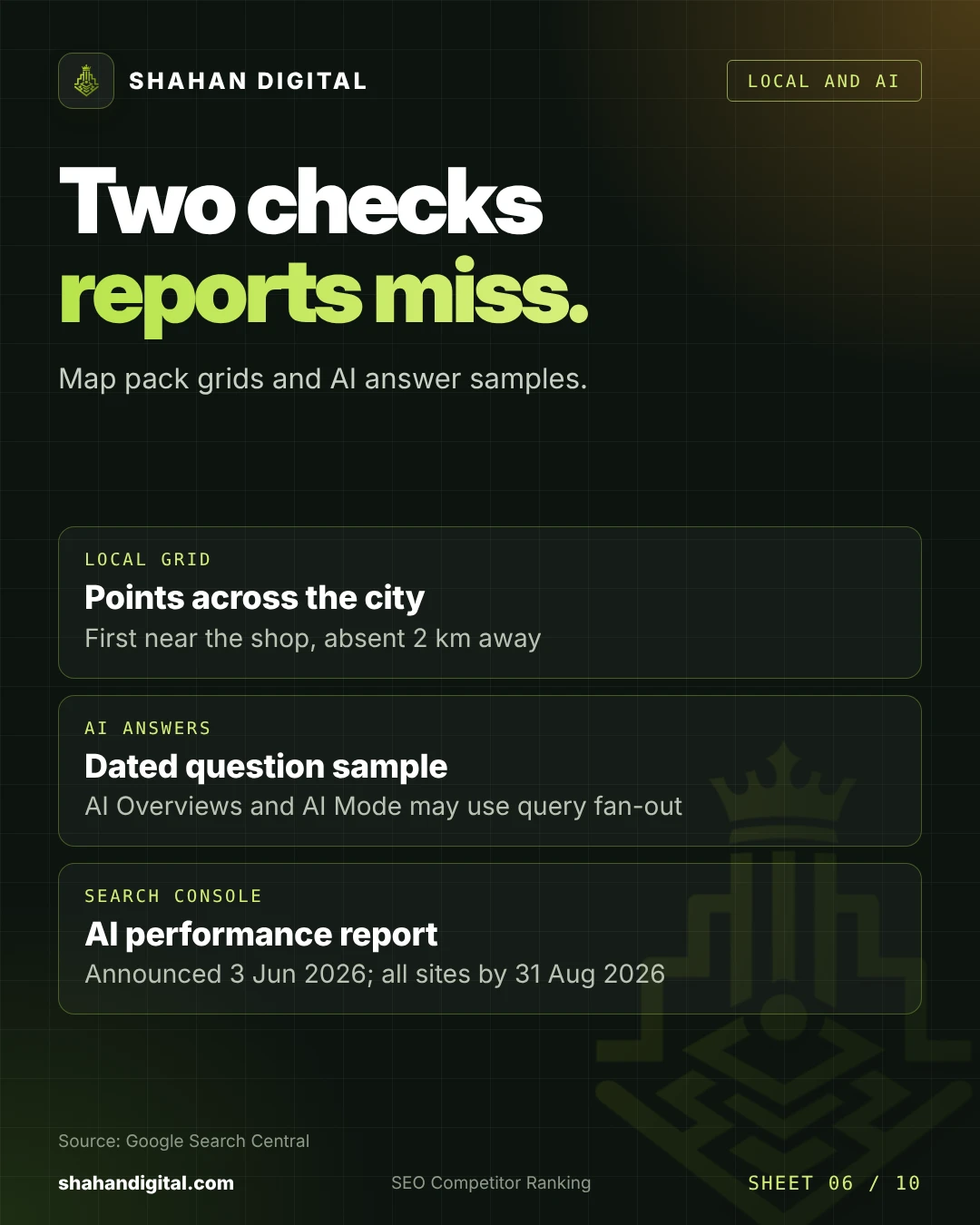
For local businesses, the map pack is often the most valuable spot. Track it with a grid, not a single point. A dentist may rank first near the clinic and not appear two kilometres away. Our guide to local pack SEO explains what moves map rankings, and our local SEO service runs the tracking.
AI answers need their own check. On 3 June 2026 Google announced generative AI performance reports in Search Console, with impressions in AI Overviews and AI Mode. Google says they rolled out to all websites worldwide by 31 August 2026. That shows your own visibility. For competitors, keep a dated sample of questions and record which brands are cited.
Google’s AI features guide says AI Overviews and AI Mode may use “query fan-out”, running several related searches to build an answer. So a competitor can be cited for a question it does not rank for in the usual way. Our AI search optimization guide covers how to test this.
Decision aid: which competitor ranking method fits you?
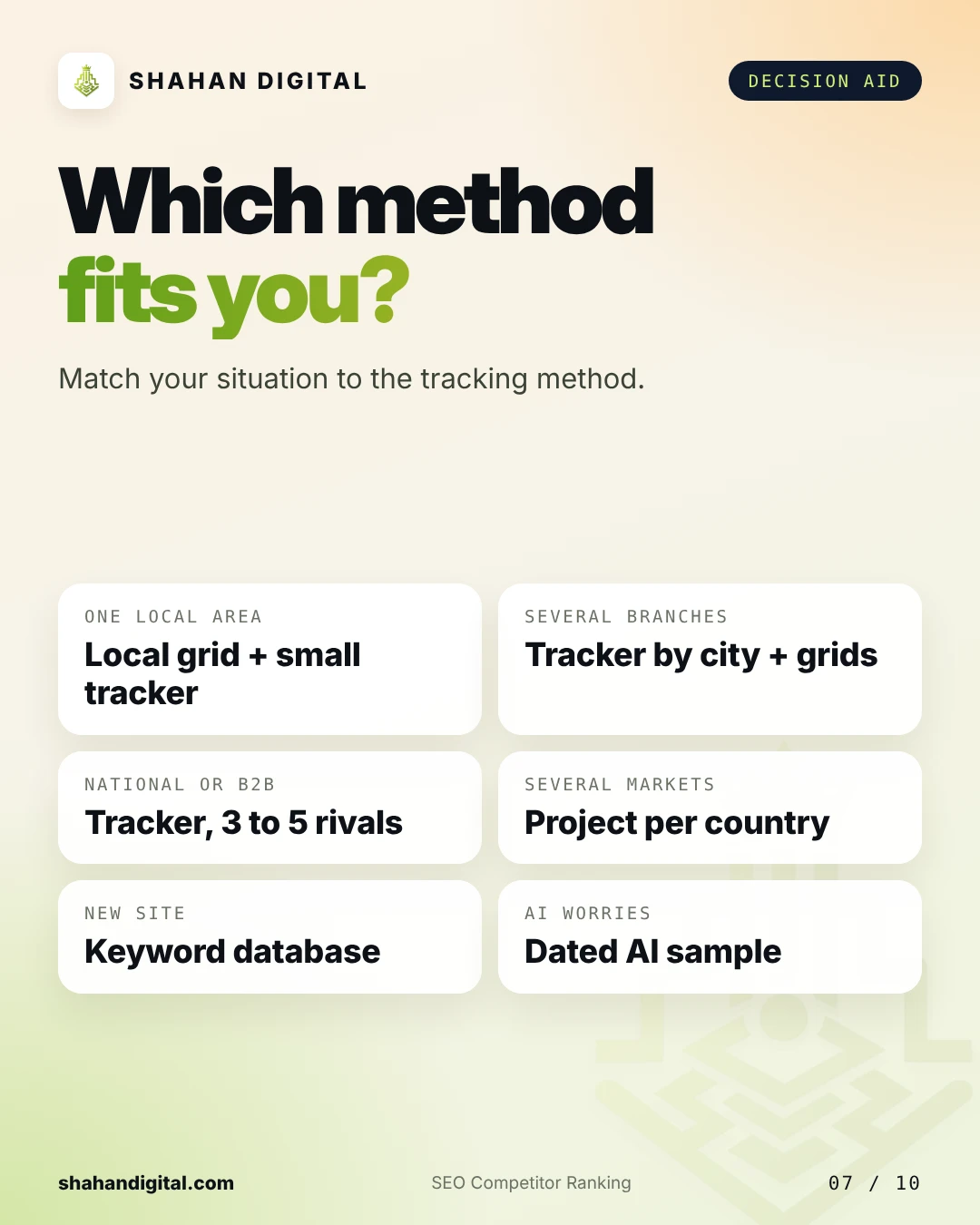
Use this table to pick a method that fits your business. It is built from what we see in client set-ups, not from a tool’s feature list.
| Your situation | Main question | Best method | Watch out for |
|---|---|---|---|
| Local business, one area | Who wins the map pack near me? | Local grid plus a small rank tracker list | Single-point checks that miss nearby areas |
| Several branches or cities | Which branch is losing, and to whom? | Rank tracker by city, plus grids per branch | One national report that hides city gaps |
| National service or B2B | Who owns our money searches? | Rank tracker with 3 to 5 competitor domains | Tracking too many low-value searches |
| Several countries or languages | Who wins in each market? | Separate projects per country and language | Mixing languages in one report |
| New site, no rankings yet | What do competitors rank for? | Third-party keyword database for discovery | Treating estimates as facts |
| Brand worried about AI answers | Who is cited instead of us? | Dated AI answer sample plus Search Console AI report | One-off checks; answers change often |
Want us to set it up?
Send us your website, your main competitors and the markets you sell in. We’ll build the search list, check who really wins it, and show you the first gap worth closing.
What competitor ranking tools cost in 2026
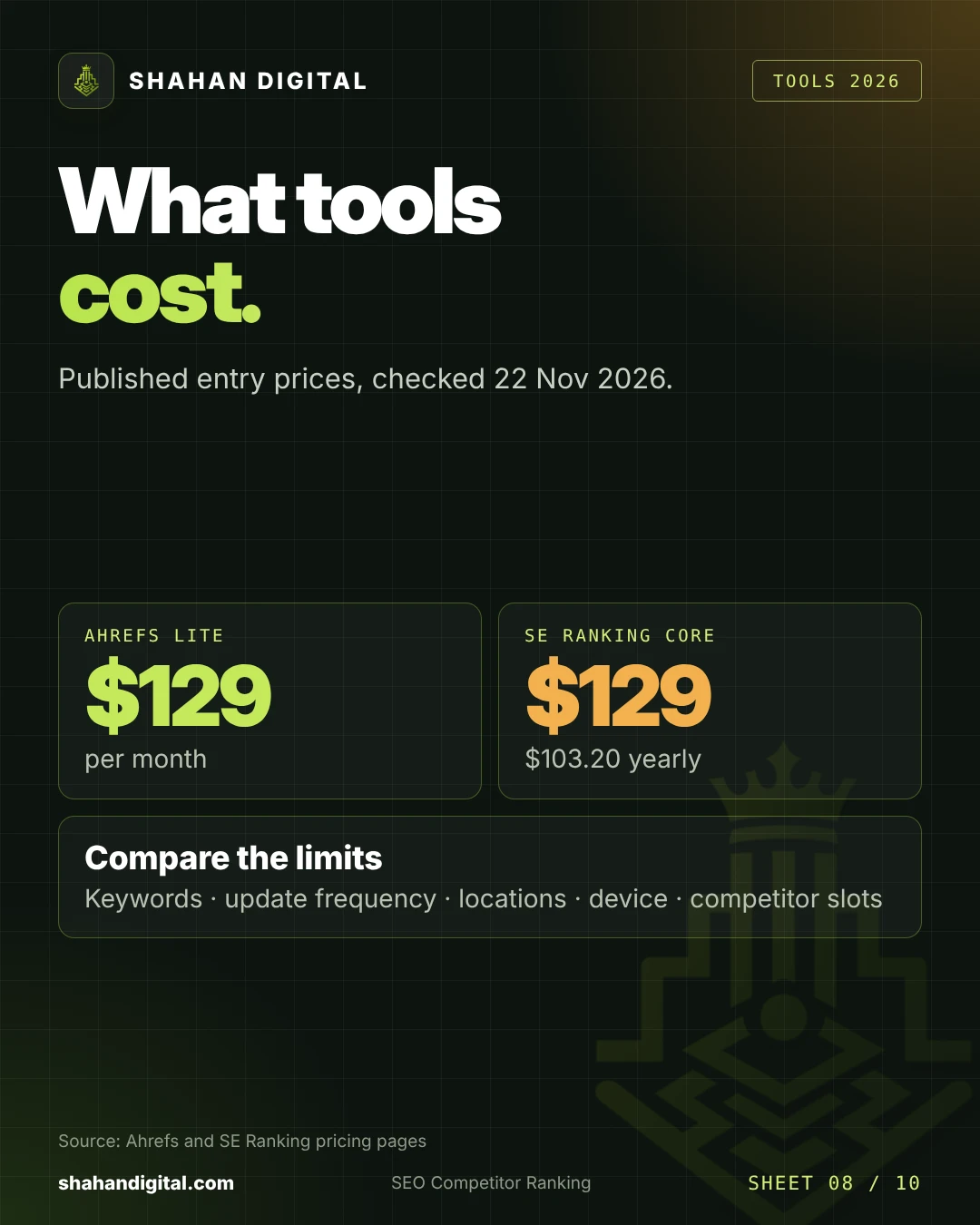
Prices change often and depend on how many searches you track. These were the published entry prices when we checked.
| Tool or service | Published price | Source and date |
|---|---|---|
| Ahrefs Lite | $129 per month | Ahrefs pricing, checked 22 November 2026 |
| Ahrefs Standard / Advanced | $249 / $449 per month | Ahrefs pricing, 22 November 2026 |
| SE Ranking Core | $129 per month, or $103.20 per month billed yearly | SE Ranking pricing, checked 22 November 2026 |
| Google Search Console | Free, own site only | |
| Agency SEO retainer that includes tracking | $1,500 to $5,000 per month | SEO.com, updated 20 November 2026 |
| Shahan Digital | Scoped quote after a review | Markets, languages and search list set the scope |
Check the limits, not just the price: tracked keywords, update frequency, locations, mobile vs desktop and competitor slots. A cheap plan that updates weekly may be enough for a small business. A multi-country brand needs daily data by market.
We reviewed the top results for SEO competitor ranking
We reviewed the top English-language results for “seo competitor ranking” and “how to check competitor rankings” on 22 November 2026. Several are strong, and we credit what they do well.
| Page | What it does well | What’s missing |
|---|---|---|
| HubSpot | Full step-by-step guide with templates | Broad analysis; little on how ranking data varies by place and device |
| SE Ranking | Practical monitoring tasks, including share of voice and AI search | Written around its own tool |
| Mangools | Simple explanation of competitor tracking | Short feature page; no method |
| Ahrefs Academy | Clear walk-through of a competitor report | Product help, not a buyer guide |
| Conductor | Good on identifying real search competitors | Little on local grids or Google’s rank-checking rules |
The gap: guides explain tools, but rarely say why rankings differ between reports, what Google allows, or which method fits which business. The decision aid above is our answer.
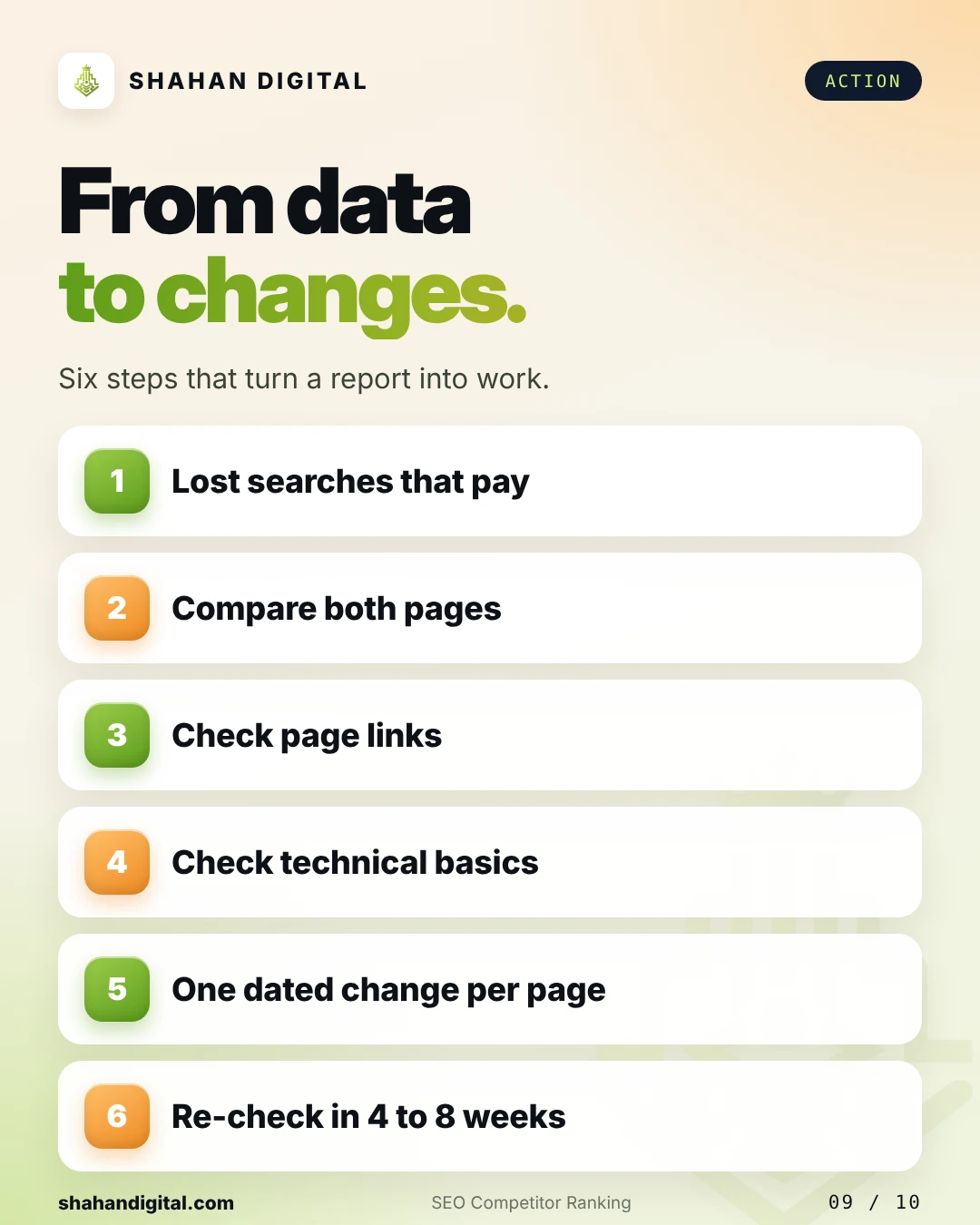
From competitor rankings to action
- Find the searches you lose that pay. Filter to commercial searches where a competitor ranks above you.
- Open both pages side by side. Compare intent, depth, proof, freshness and how easy it is to act.
- Check links and authority for the competing page, not the whole domain.
- Check technical basics on your page: indexed, fast, the right canonical.
- Pick one change per page and note the date, so you can see what worked.
- Re-check after four to eight weeks on the same settings.
Our competitor SEO analysis guide covers the five gaps in depth. Our guide to on-page vs off-page SEO helps you decide whether content or links are the gap. If it is links, read about editorial link building. If it is technical, our technical SEO team can help.
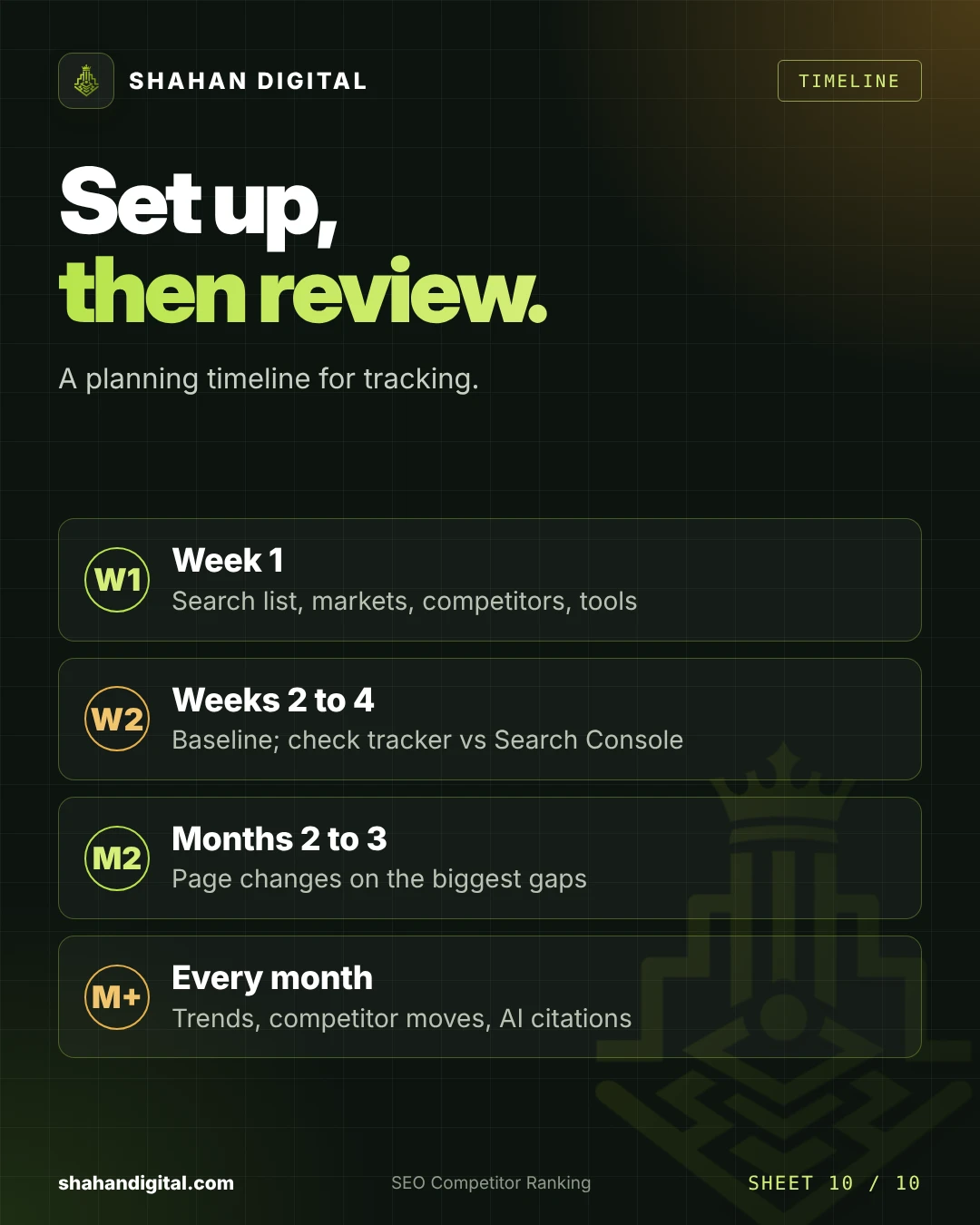
A realistic timeline
| Period | Main work | What you get |
|---|---|---|
| Week 1 | Search list, markets, competitors, tool set-up | A clean tracking project |
| Weeks 2 to 4 | Baseline data; check tracker against Search Console | Trusted starting positions and share of voice |
| Months 2 to 3 | Page changes on the biggest gaps | First movements on target searches |
| Every month after | Review trends, competitor changes and AI citations | A short list of next actions |
Rankings move for many reasons, including Google updates. Google’s November 2026 core update began on 10 November 2026, so compare against a baseline taken outside that window where you can. Our guide on how long SEO takes explains why changes take time to show.
How to measure the work
- Share of voice on money searches, by market and language.
- Positions on the searches you lost to a named competitor.
- Clicks and impressions in Search Console for those searches.
- Leads from the pages you changed. Rankings that do not bring leads are not the goal.
- AI citations in a dated sample, and AI impressions in Search Console.
Our article on measuring SEO success has the full set. When budget is tight, compare the cost of closing a ranking gap with paid search; our guide to SEO vs paid ads helps.
How we work on competitor rankings
We build the search list from your Search Console data and sales conversations. Then we set up tracking by market, language and device, and check it against Search Console before we trust it. Each month we report share of voice, the gaps that cost leads, and the next changes. This sits inside our SEO services and SEO consulting work, and starts with an SEO audit when the site needs one.
We work in English, Arabic, Persian and Turkish, with native writers for each target country, so each market is tracked in its own language. For AI answers, see our AI search optimization service. B2B teams can read our B2B SEO guide. If you are hiring, our guide to hiring an SEO consultant helps, or start from the Shahan Digital home page.
Frequently asked questions
How can I see where my competitors rank on Google?
For a quick look, search in a private window with the right country set. For reliable data, use a rank tracker with your competitors’ domains, set to your markets, languages and devices. Keyword databases from Ahrefs, Semrush or SE Ranking estimate everything a competitor ranks for.
Why do different tools show different competitor rankings?
Google results change with location, language, device and time. Tools check from different places, on different days, and some estimate rather than check. Compare tools only on the same settings, and test them against your own Search Console data.
Can Search Console show my competitors’ rankings?
No. Search Console shows data only for sites you have verified. It is the best source for your own positions, clicks and AI feature impressions. Competitor data always comes from third-party tools or manual checks.
Is it allowed to scrape Google to check rankings?
Google’s spam policies list scraping results for rank-checking purposes, without express permission, as machine-generated traffic that breaks its policies and Terms of Service. Check by hand, or use a commercial rank tracking service.
What is share of voice in SEO?
It is the share of visible search space each site holds across a set of searches. Each position gets a weight based on likely clicks, and the weights are added up per domain. It shows trends better than single positions.
How often should I check competitor rankings?
Weekly is enough for most businesses. Daily tracking helps in fast markets or during a Google update. Review the trend monthly, and act on the gaps that cost leads.
See who really wins your money searches
Send us your website, your main competitors and the markets you sell in. We’ll scope the first review around one question: which competitor wins the searches that bring buyers, and what would it take to pass them?
Editorial note: Google guidance was checked on Google Search Central on 22 November 2026 (How Search works, spam policies, AI features, and the 3 June 2026 Search Console announcement). Tool prices were checked on the Ahrefs and SE Ranking pricing pages on 22 November 2026 and may change. Agency prices come from SEO.com (updated 20 November 2026). Prices are third-party figures, not Shahan Digital quotes. Query figures come from Shahan Digital’s own Search Console data, 21 August to 19 November 2026. No ranking, traffic or lead result is guaranteed. Written by Shahan Behkamrad.
Written by

Shahan Behkamrad
Author · Founder of Shahan Digital · SEO & GEO Strategist
Shahan Behkamrad is an SEO and GEO strategist and the founder of Shahan Digital. Since 2017 he has built search strategies for businesses in Persian, Arabic, English and Turkish markets, usually working alongside a client’s in-house team to decide what to fix first, what to build next and how to measure it.
- Strategy before tactics: every engagement starts with a diagnosis of where growth is being lost, then a ranked plan tied to enquiries and revenue, not to rankings alone.
- Current with how search works now: his work covers Google Search, Google Maps, AI Overviews and AI assistants such as ChatGPT, and he checks Google’s documented updates before changing a client’s plan.
- Specialist depth: technical, international and multilingual SEO, local SEO and AI search visibility (GEO).
- Has trained more than 650 students in SEO and digital marketing, including as an official instructor at Iran’s Technical and Vocational Training Organization.
- Host of the Shahan Behkamrad Podcast on business growth, branding, SEO and AI.
- Master’s student in Strategic Marketing and Brand Management at Nişantaşı University, Istanbul; holds 25+ international digital marketing certifications.